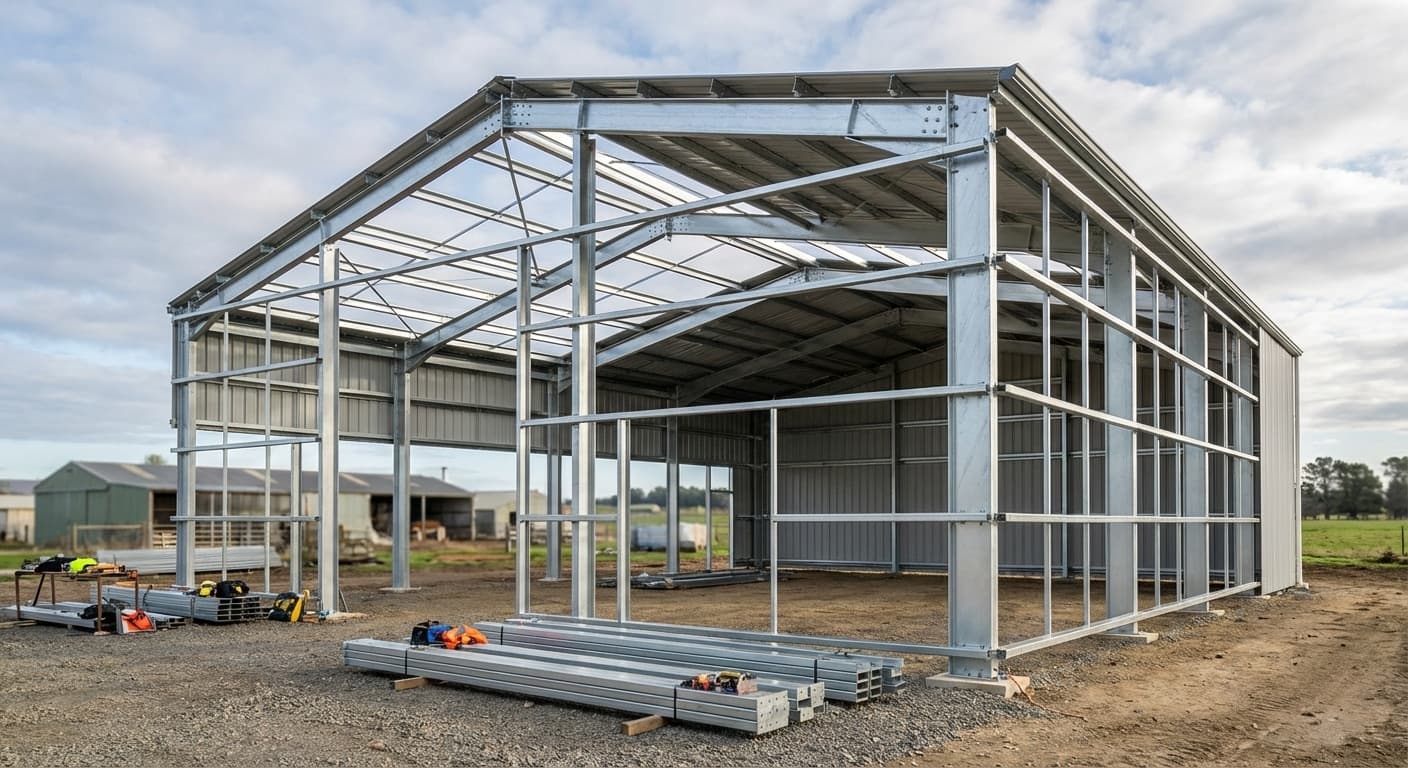

A 30×40 galvanized-steel barn delivers 1,200 sq ft of virtually maintenance-free space for an all-in cost of $24-$43 per square foot, and the article shows how choosing standard dimensions, clear-span framing, and lengthwise expansion slashes both upfront and lifetime expenses while boosting durability. Readers learn that the 15% premium for hot-dipped galvanized (or longer-lived Galvalume) steel is repaid through 30% lower insurance, 75% reduced maintenance, and 40- to 70-year longevity, saving hundreds of thousands over wood or painted-steel alternatives. Smart design moves–sticking to 30×40 or similar modular sizes, adding length not width, opting for multi-span interiors when possible, and integrating light roofing, insulation, and LED lighting–cut material waste, speed erection by up to 33%, and trim annual energy costs 10-20%. The piece walks through every line item, from $12-$14 steel and $15-$20 concrete to $7-$12 installation, explains how site loads and eave height alter totals, and details quality-control, single-source procurement, and permitting tactics that keep projects on schedule and within budget. Ultimately it equips owners, farmers, and small-business operators with the data and design strategies to lock in low lifetime cost per square foot, expand easily when growth demands, and enjoy decades of near-zero upkeep.
Understanding the 30×40 Steel Barn Cost per Sq Ft
A 30×40 steel barn gives you 1,200 sq ft of zero-maintenance workshop or garage space for $24-$43 installed, and choosing galvanized or Galvalume framing cuts lifetime upkeep to near zero while slashing insurance up to 30%.
Why Size Matters for Cost Efficiency
Your 30×40 steel barn delivers maximum value at 1,200 square feet of clear-span space [1][2]. Yes, larger structures (60×100) spread fixed costs like permits across more area [1], but this size gives you everything you need without overbuilding.
You're looking at $28,000 to $55,200 total investment [1][2]. That breaks down to about $12-$14 per square foot for steel, $15-$20 for your concrete foundation, and $7-$12 for professional installation [2].
Perfect for workshops, three-car garages with extra storage, or compact commercial spaces–you get exactly what you need [1].
Impact of Galvanized Framing on Pricing
Galvanized steel framing costs about 15% more upfront–but saves you money every year after [5]. Your maintenance costs drop to almost nothing. Your insurance premiums shrink by up to 30% compared to non-galvanized buildings [5]. A basic 30×40 barn kit runs about $24,000–but that's just the beginning of your savings [5].
Galvanized steel shrugs off rust, fire, and pests. No termite treatments. No rot repairs. No repainting every few years like wood demands [5].
However, some manufacturers prefer Galvalume substrate coating (zinc, silicon, and aluminum combination) over traditional galvanized finishes, as it extends steel life by 2-4 times longer [4]. Your true cost? Between $24-$43 per square foot installed, including everything–steel, concrete, delivery, and construction [5]. With warranties stretching to 40 years, you're spreading that investment across decades of zero-maintenance service [5].
Baseline Cost Metrics for a 30×40 Structure
Your 30×40 steel barn investment breaks down simply. The kit itself runs $15,000-$25,000 [6][7]. Turnkey installation brings your total to $28,000-$46,000+ [6][7]. What you get in that kit: primary I-beam frames and columns, secondary framing (purlins and girts), wall and roof sheeting, plus all hardware and trim [7].
Quality matters–North American commercial-grade I-beams cost more than imported tubular frames, but they deliver decades of reliable service [6]. Height changes everything. Take your eave height from 10 feet to 18 feet, and you'll need more steel–even though your floor space stays at 1,200 square feet [8]. Your location matters too.
Coastal wind loads or northern snow loads mean extra reinforcement–up to 20% more steel than the same building in milder areas [8]. We handle these calculations for you, ensuring your building meets local codes without overbuilding.
Design Choices That Reduce Cost per Sq Ft
Stretch your building lengthwise, keep the width standard, and embrace a few interior columns to slash steel costs by up to 15% while still gaining every usable square foot.
Optimizing Layout for Material Savings
Your layout choices directly impact your bottom line. The smart money stretches length, not width. Adding 20 feet to your building's length? You're just adding another frame line–a simple, cost-effective move [9]. But widen that same building by 20 feet?
Now you're extending every rafter, driving up steel requirements and your invoice [9]. Clear-span versus multi-span is your next decision point. Clear-span designs give you unobstructed floor space–perfect when you need every square foot working. Multi-span layouts use interior columns but deliver the same square footage for less money [9]. If a few strategically placed columns won't cramp your operation, you'll save significantly on materials.
Here's where smart planning pays off: stick to standard dimensions. When you choose common sizes like 30×40, you tap into manufacturing efficiencies that cut costs by up to 15% [9]. Custom dimensions mean custom engineering, custom manufacturing, and custom pricing–none of it in your favor. Standard components streamline everything from fabrication to installation, putting money back in your pocket [9].
Selecting Standardized Components
Your component selection drives cost efficiency from day one. Every [pre-engineered steel building](https://nationalsteelbuildingscorp. com/service/high-quality-preengineered-steel-buildings/) starts with the same core elements: primary framing (I-beams and columns), secondary framing (purlins and girts), wall and roof sheeting, plus trim and hardware [11]. Choose standard components and you unlock three immediate savings: minimal material waste, faster assembly, and reduced labor costs [10]. The numbers speak clearly–standard dimensions like 30×40, 40×60, 50×100, and 60×100 roll off production lines efficiently [9].
These sizes don't need custom engineering or special setups. Manufacturers build inventory, streamline processes, and pass savings directly to you. Go custom? You'll pay for every deviation from the norm. Working with standardized components also means your project moves faster.
Parts arrive sooner. Assembly crews know the drill. Your building goes up on schedule, within budget–exactly what you need when time equals money.
Integrating Energy‑Efficient Features
Energy efficiency pays you back month after month. Start with insulation–your highest-return investment. Fiberglass, rigid board, or spray foam in walls and roof cuts HVAC demands by up to 30% [12]. You'll see the difference on every utility bill. Your roof color matters more than you think.
Light-colored metal roofing stays up to 55 degreesF cooler than dark options, slashing summer cooling costs [14]. For maximum efficiency in a 30×40 structure, consider insulated metal panels (IMPs). They combine structure and insulation in one product–no thermal bridging, no air leaks, just an airtight envelope that performs [13]. You save on materials, labor, and long-term energy costs. Smart details multiply savings.
Position windows for maximum natural light. Install LED fixtures that use 75% less electricity than traditional lighting [14]. Every energy-efficient choice you make today compounds over your building's lifetime. Pair these features with galvanized framing and you've built a structure that costs less to maintain and less to operate–year after year.
Construction Process and Service Excellence
From crystal-clear daily updates and a single accountable project manager to rigorous ASTM-certified galvanizing inspections, every step is engineered to deliver your steel barn on time, on budget, and without a single surprise.
Clear Communication During Build Phases
You'll know exactly where your steel barn project stands–every day, every phase. That's how you avoid the budget-killing surprises that plague construction projects. Your design phase runs 1-3 weeks, but decisive clients who stick to their plans often wrap it up in just one week [15]. You get regular updates during the 3-6 week fabrication window, so you're ready when materials arrive [15]. Your foundation contractor gets exact anchor bolt specs from your steel fabricator–no guesswork, no rework [15].
When erection starts (typically 1-3 weeks), you receive daily progress reports that catch small issues before they become schedule-killers [16]. You work with one project manager who owns every detail. Weekly check-ins keep momentum strong [16]. As one industry veteran puts it: "communication is the key to steel building construction and erection times" [16]. Permit timing varies wildly–some municipalities approve in 1-2 days, others take months [15].
Your project manager handles the paperwork and follows up with building departments, keeping administrative delays from derailing your schedule. The result? Your barn goes up on time, within budget, with zero surprises.
Quality Assurance Practices for Steel Barns
Your galvanized steel barn meets strict ASTM specifications–A123/A123M and A153–that guarantee proper coating thickness, finish quality, and zinc adherence [17]. Every piece gets inspected multiple times. Technicians take at least five thickness readings across each component using magnetic gauges [19]. They run knife tests to confirm the zinc bonds properly without flaking [19].
Visual checks catch any bare spots, rough patches, or coating defects before materials leave the factory [19]. Minor imperfections? They're fixed immediately with zinc-rich paint, zinc solder, or metalizing spray–all within ASTM parameters [19]. You want manufacturers who document every quality check and certify their materials meet both ASTM standards and your project specs [18].
This isn't bureaucracy–it's your guarantee that your barn will perform exactly as promised for decades. With 1,480+ completed projects, quality control isn't just a process–it's how you build structures that last.
Single‑Source Solutions for Streamlined Delivery
You work with one company for everything–design, materials, and erection. That's single-source procurement, and it cuts your project timeline by up to 33% compared to conventional construction [21]. You get firm pricing upfront.
You get solid delivery dates. You get one throat to choke if something goes wrong [20][21]. Every component–from primary frames to sheeting–comes from the same manufacturer, engineered to fit together perfectly [21].
No compatibility headaches. No finger-pointing between vendors. No delays from mismatched parts [22].
Long‑Term Value and ROI of Galvanized Steel Barns
A galvanized steel barn slashes lifetime costs by up to 79%, saving you $320,000-$750,000 over 20 years while outlasting wood by decades with virtually zero maintenance.
Durability Benefits of Galvanized Framing
Your galvanized steel barn will outlast traditional structures by decades. While wood barns deteriorate after 20-40 years, galvanized steel maintains structural integrity for 40-70 years–some even surpass 100 years with basic care [25].
The zinc coating acts as a shield against rust, protecting your investment even if the surface gets scratched [25]. You'll avoid the expensive problems that plague wooden barns [23]: * No termite damage or pest infestations * Complete fire resistance–steel won't ignite or spread flames [24] * Zero warping, splitting, or rotting through seasons * Exceptional strength against hurricane winds and heavy snow loads The protective zinc layer means you won't spend weekends painting or sealing.
Your barn stays strong through temperature swings and severe weather without constant upkeep [24]. In challenging environments–coastal areas, high-snow regions, or tornado zones–properly engineered galvanized frames deliver peace of mind that wooden structures simply can't match [25].
Maintenance Savings Over the Building's Life
You'll spend 75% less on maintenance with a galvanized steel barn. Where traditional structures demand 2-4% of construction costs annually, steel buildings need just 1%–saving you $5,500-$17,500 every year on a typical barn [26]. The numbers speak clearly: * Steel barn maintenance: $1,500-$2,500 annually * Traditional barn maintenance: $7,000-$20,000 annually * 20-year savings: $320,000-$750,000 on a 10,000 sq ft building [26] Your galvanized coating works for decades without touch-ups, paint, or sealers [27].
One commercial project documented 79% savings compared to painted steel over the building's life [27]. You won't lose business days to maintenance closures or emergency repairs. Add 10-20% energy savings–worth $2,000-$5,000 yearly for commercial operations–and your payback accelerates [26].
These aren't theoretical projections.
Future Expansion Options and Cost Implications
Plan for growth now and save thousands later. Your 30×40 steel barn expands easily when business demands it–no tear-downs or major reconstructions needed. Smart expansion strategies: * Lengthen, don't widen: Adding 20 feet lengthwise costs far less than widening by the same amount [9] * Choose load-bearing end walls: They'll support future extensions without compromise * Go clear-span: No interior columns means unlimited reconfiguration options Budget for future growth using today's numbers: * Building package: $18-$22/sq ft * Foundation work: $4-$8/sq ft * Professional installation: $5-$10/sq ft [28] As discussed in our Design Choices section, lengthwise expansion simply adds a frame line–a straightforward, cost-effective modification [9].
Widening requires extending every rafter, multiplying your costs unnecessarily. Think triple your current needs when planning. It sounds excessive, but businesses grow.
Your galvanized frame's 40+ year lifespan means you can expand multiple times on the same solid foundation–protecting your original investment while accommodating success.
- Galvanized 30×40 barn kit costs ~$24k; installed total $28k-$55k ($24-$43/sq ft).
- Galvanizing adds 15% upfront but cuts annual upkeep 75% and insurance up to 30%.
- Standard 30×40 dimensions exploit factory efficiencies, trimming 15% vs custom sizes.
- Lengthening (add a frame) is cheap; widening hikes every rafter and total steel.
- Light metal roof + IMP insulation drop HVAC 30% and peak roof temps 55 degreesF.
- ASTM-galvanized frames last 40-70 yrs, outliving wood by decades with near-zero care.
- Clear-span interior lets future lengthwise expansion reuse foundation, avoiding teardown.
- https://www.probuiltsteel.com/blog/30×40-metal-building-cost/?srsltid=AfmBOopF2RrhdOYaTHZD8Cp5ast40Ad7aMFvlgnXzmD8NnL-VQs4_l-B
- https://www.metalbuildingoutlet.com/how-much-does-a-30×40-steel-building-cost/
- https://www.buildingsguide.com/build/pole-barn-vs-metal-building/?srsltid=AfmBOopfzwNo9o0xS-_nS4Z7FqimJHYznm8DAcXzalrFAHQLv6xOVa3i
- https://info.fbibuildings.com/blog/30-x-40-pole-barn-costs-diy-kits-vs.-construction
- https://www.buildingsguide.com/metal-building-prices/?srsltid=AfmBOopML7y5J270-nKynJolqfGNTmcYuL9S1UQs-6zCMzBRNX0adXND
- https://www.buildingsguide.com/metal-building-prices/?srsltid=AfmBOoqSY2rh-H12W8-ZYyb_ACEE3JNpkkBugMUThhdHgkexCRowx4a4
- https://www.probuiltsteel.com/blog/30×40-metal-building-cost/?srsltid=AfmBOoor352uWXI893mj_tX1gldlvWfmDwOj5o0-azVfUAIR4dnDuPG8
- https://renegadesteelbuildings.com/sample-pricing/steel-building-pricing/
- https://bulldogsteelstructures.com/blog/the-ultimate-guide-to-building-a-30×40-metal-structure-costs-design-and-more/
- https://www.probuiltsteel.com/blog/30×40-metal-building-cost/?srsltid=AfmBOopk64jU57Hnq9hXHng2OVttvXwbL9cq2UjsfzMlxpPL22TRVGSy
- https://norsteelbuildings.com/us/product/30-x-40-x-12-steel-building-kit/
- https://www.etxsteel.com/blog/post/how-to-enhance-energy-efficiency-in-your-metal-building
- https://www.metalbuildingoutfitters.com/3-best-energy-efficient-metal-building-designs/
- https://smartbuildsystems.com/10-strategies-for-creating-an-energy-efficient-metal-building/
- https://metalprobuildings.com/pre-engineered-steel-building-timeline/
- https://www.wasatchsteel.com/steel-building-construction-timeline-factors/
- https://galvanizeit.org/specification-and-inspection/coating-specifications/astm-specs
- https://buildsteel.org/technical/codes-and-standards/quality-assurance/
- https://southatlanticllc.com/blog/galvanized-steel-inspection-process-explained/
- https://ramp.com/blog/single-source-procurement
- http://www.gonzalesconstruction.com/metal-buildings-construction-advantages.html
- https://garrisdirect.com/timely-delivery-of-construction-materials-ensuring-efficiency-and-productivity/
- https://metalprobuildings.com/metal-buildings-vs-pole-barns-which-is-better-for-you/
- https://www.alliedbuildings.com/reliability-and-durability-of-preengineered-metal-buildings/
- https://lionbuildings.com/how-long-do-metal-buildings-last-factors-that-impact-their-lifespan/
- https://www.summitsteelbuildings.com/20-year-cost-comparison
- https://galvanizeit.org/hot-dip-galvanized-steel-for-parking-structures/economic-savings/life-cycle-savings
- https://www.probuiltsteel.com/blog/30×40-metal-building-cost/?srsltid=AfmBOopVta7h7wV6635KFBcbTNQ0UBMhvtvuf-wUQ2Mww5pMkiEZygkP