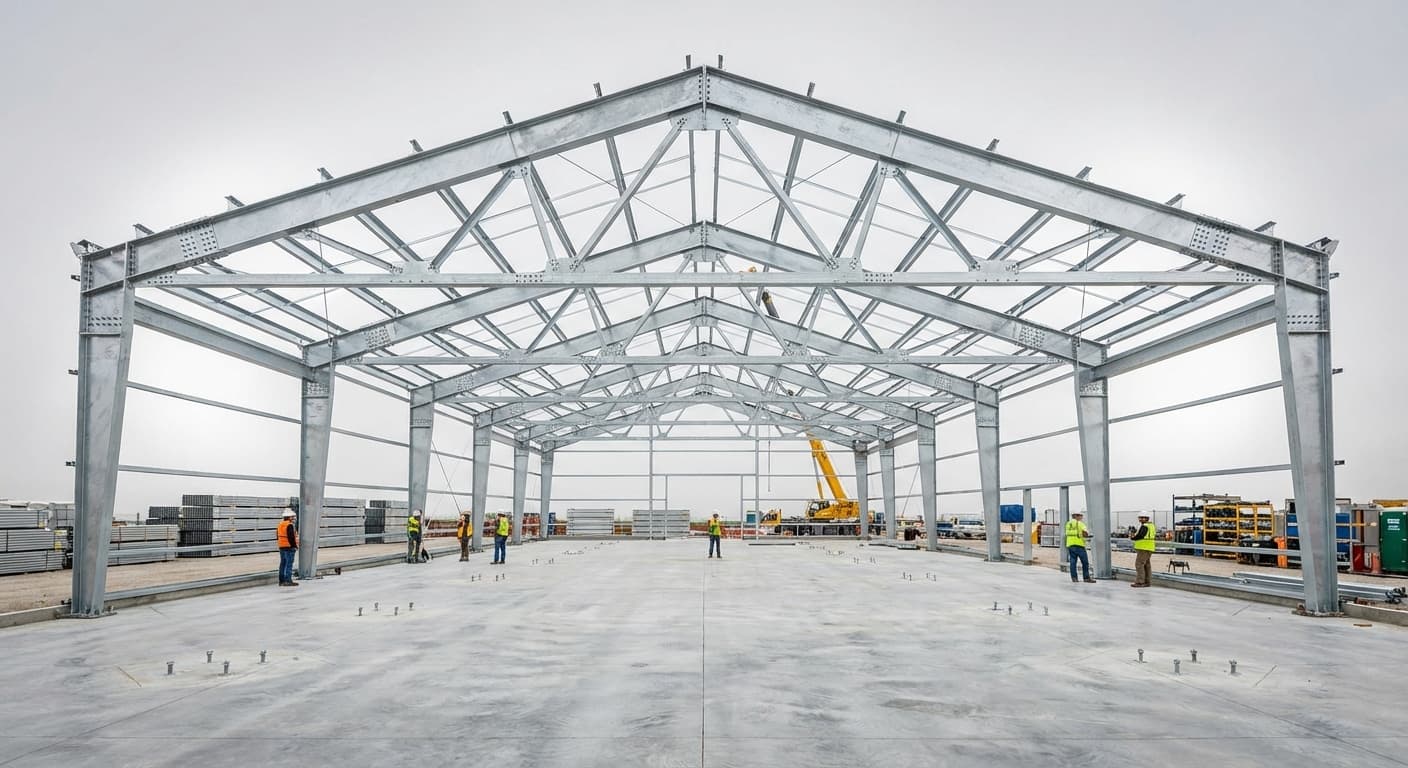

A 40×80 steel-truss building slashes lifetime costs by replacing the endless cycle of post straightening, rot treatments, and repainting that plague wood pole barns with a virtually maintenance-free structure engineered to shrug off fire, insects, and extreme weather for 50-plus years, while insurers reward the switch with 25-30 % lower premiums and energy-smart insulation cuts monthly HVAC bills by up to half. The clear-span design turns every square foot of the 3,200 ft² footprint into usable, obstruction-free space, accommodates any roof style or future layout change, and is stamped to meet local wind, snow, and seismic codes that most pole barns ignore. Although steel costs about 15 % more up-front, the combined savings on insurance, energy, and zero upkeep repay the difference in five to seven years and keep generating cash for decades after the wood building would need rebuilding. Readers will learn how to run accurate ROI calculations, compare insulation options, and tap turnkey services–from engineered drawings and pre-cut components to 35-year warranties–that eliminate contractor finger-pointing and deliver a weather-tight, permit-ready 40×80 asset in less time than it takes to straighten a pole barn's posts again.
Why a 40×80 Pole Barn Alternative with Steel Trusses Delivers Real Value
A 40×80 steel-truss building cuts your lifetime costs and worry in half by swapping pole-barn rot, insects, and annual maintenance for 50+ years of fire-resistant, code-certified, virtually upkeep-free service.
Durability and Lifespan Advantages
Your steel building will outlast a pole barn by decades–it's that simple. You'll get 50+ years of service with minimal upkeep [2], while pole barns need constant attention after just 20-40 years [1]. Why? Wood posts shift, warp, and rot when moisture hits [2].
You'll be straightening posts and checking for decay every few years [3]. Steel shrugs off what destroys wood. Fire, insects, mold–steel resists them all without chemical treatments [2]. Heavy snow loads and high winds that stress wooden structures?
Your steel building handles them without breaking a sweat [2]. Plus, every steel building comes precision-engineered to meet your local codes for wind, snow, and seismic loads [1]–certification most pole barns can't match. What this means for you: fewer midnight worry sessions about structural problems, lower risk over the building's lifetime, and a structure that stays sound while your neighbor's pole barn starts sagging.
Reduced Maintenance Requirements
Here's what you won't be doing with a steel building: crawling under your structure checking for rot, scheduling post straightening every five years, or reapplying chemical treatments that never quite work [4]. Steel needs an occasional inspection–that's it [5]. With a pole barn, you're looking at regular maintenance headaches. Posts shift and need straightening. Wood needs treating against decay.
Exterior surfaces demand repainting to keep weather out [5]. Even posts set in concrete stay vulnerable to ground moisture–they'll warp and rot despite your best efforts [4]. Steel eliminates this maintenance marathon. No rot, no insects, no fire worries–and no chemicals needed [5]. Insurance companies get it too–they'll cut your premiums by up to 30% compared to pole barn coverage [4].
(We'll show you the exact savings calculations in our cost comparison section. ) For your 40×80 building, this maintenance difference hits your wallet hard. Larger structures mean bigger repair bills and more labor when things go wrong. With steel, those bills mostly disappear.
Lower Insurance and Operating Costs
Your insurance company will thank you for choosing steel–with premium cuts of 25-30% compared to pole barn policies [6]. Why? Steel doesn't burn, and it stays standing when extreme weather hits [7].
Yes, you'll invest about 15% more upfront for steel versus wood [6]. But here's where it gets interesting–you'll recover that difference fast through lower operating costs. No more paying for regular painting, decay treatments, or straightening shifted posts [8].
No more shutting down operations for emergency repairs. Add properly insulated steel's energy efficiency advantages (detailed in our energy efficiency section), and your monthly heating and cooling bills drop too [7].
Design and Engineering Essentials for Your 40×80 Pole Barn Alternative
A 40×80 steel clear-span building turns every inch of its 3,200 sq ft into usable, obstacle-free workspace–no posts to dodge, no corners wasted, and no budget-busting beams.
Clear‑Span Design and Space Utilization
Clear-span design gives you 3,200 square feet of completely open floor space–no posts, no obstacles, no dead zones [9]. Traditional pole barns force you to work around interior posts that block equipment paths and waste valuable space. Steel trusses transfer all roof loads to the exterior walls, leaving your interior wide open [10]. This matters when you're maneuvering large equipment, setting up workshop stations, or parking vehicles. You get straight-line access from door to door.
No more three-point turns around posts. No more cramped corners where nothing quite fits. Your 40×80 building sits in the sweet spot for steel construction–wide enough for serious work, economical enough to make sense [9]. Steel's strength-to-weight ratio makes this column-free design affordable. Try getting the same open space with wood, and you'd need massive beams that blow your budget [10].
Beyond 40 feet wide, pole barns need increasingly complex (and expensive) truss systems just to stay standing [10]. Steel handles these spans without breaking a sweat–or your bank account. Every square foot you pay for becomes usable space [11]. That's the difference between a building that works with you and one you constantly work around [9].
Customizable Truss Configurations
Steel trusses adapt to your specific needs. Standard gable trusses handle spans from 20' to 50' with a 4:12 slope–perfect for your 40' width [14]. Need a covered entry? Header trusses span 12' to 30'. Adding a lean-to for extra storage? Those trusses come in the same sizes with a gentle 1:12 slope [14].
Your 40×80 building starts with a standard 2:12 roof pitch, but you can go steeper–up to 6:12 if your area needs extra snow shedding. Just know that steeper means pricier [13]. These triangular frames spread weight evenly across your building. It's simple physics that's worked since the pyramids [14]. Beyond basic gables, you've got options. Single-slope for modern looks.
Gambrel for extra overhead storage. Monitor roofs for natural lighting. Your building, your choice [13]. The steel frame lets you divide that space however you want–separate bays for different equipment, distinct work areas, whatever makes sense for your operation. Even on tight lots where every foot counts [12].
Meeting Code and Wind Load Standards
Your steel building meets every code requirement–guaranteed. While pole barns often skirt regulations, steel structures come engineered for your exact location's wind, snow, and seismic requirements [15]. Wind loads matter more than most people realize. In Florida, buildings face 150+ mph hurricane forces.
In Kansas, it's tornadoes. Mountain areas deal with downdrafts [16]. Your building gets engineered specifically for your site's challenges–not some generic one-size-fits-all design. Every component works together.
Foundation anchors sized for uplift forces. Roof pitch calculated for snow shedding. Wall bracing positioned for lateral loads [16]. It's a system, not just parts bolted together.
Cost Comparison: 40×80 Pole Barn Alternative vs Traditional Options
Spend 15% more upfront for steel and you'll pocket 30-50% lower energy bills, 25-30% cheaper insurance, zero pole-straightening costs, and a 50-year building that pays for itself in 5-7 years.
Initial Investment vs. Lifecycle Costs
You've seen the durability and maintenance advantages discussed earlier–now let's talk dollars. Yes, steel buildings cost about 15% more upfront than pole barns [17]. But here's what that extra investment buys you: a structure that lasts 50+ years instead of the 15-20 years you'll get from a pole barn [18]. Think about it. Every 5-7 years, you'll pay thousands to straighten shifting poles.
You'll treat wood against rot and pests. You'll watch insurance premiums stay high because insurers know wood burns and steel doesn't [18]. Meanwhile, your neighbor with the steel building? They're saving 25-30% on insurance every single year [7]. Run the numbers on your 40×80 project.
That's 3,200 square feet where every maintenance dollar saved goes straight to your bottom line. Most owners recover their initial investment within 5-7 years through these combined savings [17]. After that? Pure profit from lower operating costs.
Energy Efficiency and Insulation Options
Your energy bills don't have to eat your profits. Steel buildings seal tight–no drafts sneaking through nail holes and warped wood like you get with pole barns [19]. That weathertight envelope is just the start. You've got three insulation choices for your 40×80 building: standard fiberglass batts, spray foam for maximum R-value, or reflective systems designed for metal [20].
Pick a white or light-colored roof and watch cooling costs drop up to 25% in summer [20]. We help you choose what works for your climate and budget. Here's what matters: properly insulated steel buildings cut heating and cooling costs by 30-50% compared to typical pole barns [7]. That's real money back in your pocket every month.
Plus, you control where doors and windows go for maximum natural light and minimum heat loss–try doing that when you're working around wooden posts [20]. For shops and maintenance facilities, comfortable working conditions mean productive crews. No more freezing in winter or sweating through summer–just consistent temperatures that keep everyone focused on the job [20].
ROI Calculation Tools and Resources
You want hard numbers before making a 40×80 investment. Smart thinking. Online calculators like BuildingsGuide's Building Value Calculator show the real math–15% higher upfront cost versus 30% annual insurance savings [21]. Factor in these real costs: – Pole barn straightening every 5-7 years (thousands each time) – Steel's minimal maintenance (nearly zero) – Energy savings from proper insulation (30-50% on HVAC) – Light-colored metal roofs cutting cooling by 25% [3] Don't forget the big picture.
Your steel building stays productive 10-20 years after that pole barn needs replacing [3]. No downtime for major repairs. No lost revenue while you rebuild. We provide [custom ROI calculations](https://nationalsteelbuildingscorp.
com/service/agricultural-buildings/) specific to your 40×80 project. Input your local costs, weather loads, and intended use. See exactly when steel pays for itself–usually within 5-7 years [21]. After that, you're banking the difference every single month.
Partnering with National Steel Buildings for a Seamless 40×80 Pole Barn Alternative
Partnering with a single-source steel building provider turns your 40×80 project into a turnkey operation–delivering stamped engineering drawings, pre-cut components, and managed installation that eliminate contractor finger-pointing and compress your timeline.
Single‑Source Solution from Design to Erection
Working with a steel building provider eliminates the complexity of coordinating multiple contractors and ensures engineering continuity throughout your project. Rather than managing separate teams for design, materials, and construction, the entire process flows through a single point of responsibility. The typical steel building process begins with collaborative design, where your specific requirements determine dimensions, layout, and features [22]. Engineers then create stamped drawings that satisfy local code requirements–critical documentation that simplifies permit approval [22].
When materials arrive onsite, they come pre-cut, pre-drilled, and ready to assemble, with each component precision-manufactured to fit together without field modifications [23]. This system delivers three key advantages over traditional pole barn construction: quality control across all project phases, streamlined communication with a single point of contact, and elimination of finger-pointing between separate contractors when issues arise. Many steel building providers include support services that traditional lumber suppliers don't offer–from site preparation guidance to installation management [22]. The most comprehensive services include complete turnkey solutions with free delivery and professional installation rather than simply dropping off material kits [24].
This integrated approach particularly benefits 40×80 projects, where the substantial size requires precise coordination of large structural components and specialized equipment. The steel building's components arrive with everything needed for assembly–primary and secondary framing, sheeting, fasteners, and trim–all engineered specifically for your location's wind and snow loads [23].
Transparent Communication and Project Timeline
Steel building companies provide detailed project timelines that break construction into distinct phases – planning, design, fabrication and installation [26]. The installation phase typically divides into three sub-phases: primary framing (30-40% of installation time), secondary framing (20-30%), and sheeting the building (40-50%) [26]. This transparent breakdown allows accurate scheduling and resource allocation throughout your 40×80 building project.
Before construction begins, factor in pre-construction steps like crew assembly, land grading, foundation pouring, and material delivery [25]. Weather represents the primary cause of construction delays, even with meticulous planning [25]. Regular communication throughout each phase identifies potential issues early, enabling timely solutions that keep projects on schedule [26].
For DIY projects, understanding that smaller, simpler structures (like a 2,400 square foot building with 40' clear span) typically require less than a week for framing helps set realistic expectations [25]. Building buffer time into your schedule accommodates unexpected delays while maintaining project momentum [26].
Expert Support and Problem‑Solving Services
Steel building providers offer specialized technical support that extends far beyond what you'd receive with traditional pole barn construction. Factory-trained staff provide accurate quotes and address structural questions that arise during planning and construction [27]. Many steel building companies back their structures with extensive warranty protection–some offering 35-year hassle-free warranties that significantly exceed the coverage available for wooden pole structures [28].
This long-term protection reflects the manufacturers' confidence in their engineering and materials. The support experience typically includes direct access to building specialists who can troubleshoot site preparation challenges, foundation questions, and assembly procedures [29]. When technical issues emerge during construction, having immediate access to experts familiar with the precise specifications of your 40×80 building prevents costly delays and improvised solutions that might compromise structural integrity [27].
Quality control measures implemented throughout the manufacturing process prevent many common building problems before components ever reach your site [29]. For agricultural applications specifically, technical support often includes consultation on equipment clearance requirements, ventilation needs, and optimal door placement–specialized knowledge that general contractors might lack [29]. This comprehensive support system creates a significant practical advantage over traditional pole barn construction, where problem resolution typically involves coordinating between separate lumber suppliers, framers, and roofing contractors.
- Steel buildings last 50+ years vs 20-40 for pole barns and need almost no upkeep.
- Insurance premiums drop 25-30% when you choose steel over wood.
- Clear-span steel trusses give a full 3,200 sq ft of unobstructed floor space.
- Upfront cost is ~15% higher, but savings recover it in 5-7 years.
- Steel frames are engineered for local wind, snow and seismic loads.
- Pre-cut, pre-drilled steel arrives ready to bolt together, cutting build time.
- Energy-efficient insulation and cool roofs cut HVAC bills 30-50%.
- https://www.buildingsguide.com/build/pole-barn-vs-metal-building/?srsltid=AfmBOoqNG1ygTvGQX06wG-EjoiA-1I2JyF7mBIZsvehxKbd6i9lnpexA
- https://www.omni-builders.com/home-tips/pole-barn-vs-metal-building-cost-maintenance-longevity-compared
- https://www.buildingsguide.com/build/pole-barn-vs-metal-building/?srsltid=AfmBOooZwAHKKLP4OlTgOcPoSHEUjYDUA2VfJg4DVHIxP63kMK2wouXN
- https://www.buildingsguide.com/build/pole-barn-vs-metal-building/?srsltid=AfmBOopfJKAR6IYdcFa3AiZzrBQB30KtW8VINZZ2lk3FPHAKT_UWfxqv
- https://www.buildingsguide.com/build/clear-span-buildings/?srsltid=AfmBOoohRq70vhmwH2tFwsvp0vJ0cJOPlnF3inIY0rPhfeerZ62yz8SZ
- https://www.buildingsguide.com/standard-sizes/40×80-metal-building/?srsltid=AfmBOorkSmQ1qkxQkq-nLsSTy8F7BujZfB_pf5Nk8dcKz06QR20ekf8e
- https://www.buildingsguide.com/build/metal-building-codes-permits/?srsltid=AfmBOood6XGvrYXUwyObTA8NivB5EIjpiz7SjEunTrg8xKhojYIlNun1
- https://www.buildingsguide.com/build/pole-barn-vs-metal-building/?srsltid=AfmBOooFHPuZoPYD4waEAHPduu1oEBqYxAb24XyVElT0CxnUvXzQLXzV
- https://www.buildingsguide.com/build/pole-barn-vs-metal-building/?srsltid=AfmBOorvXYr73c4M6oCujm2eyR6xdbhQj9jYAogSjHTwI3CfeLYG2kwE
- https://www.buildingsguide.com/build/pole-barn-vs-metal-building/?srsltid=AfmBOopW1K8LwW256ieS8dVRWZbfX0NjmADwHNPFWhLtchs7dCtiejuj
- https://usnationalsteel.com/
- https://www.nationalsteelbuildingsinc.com/