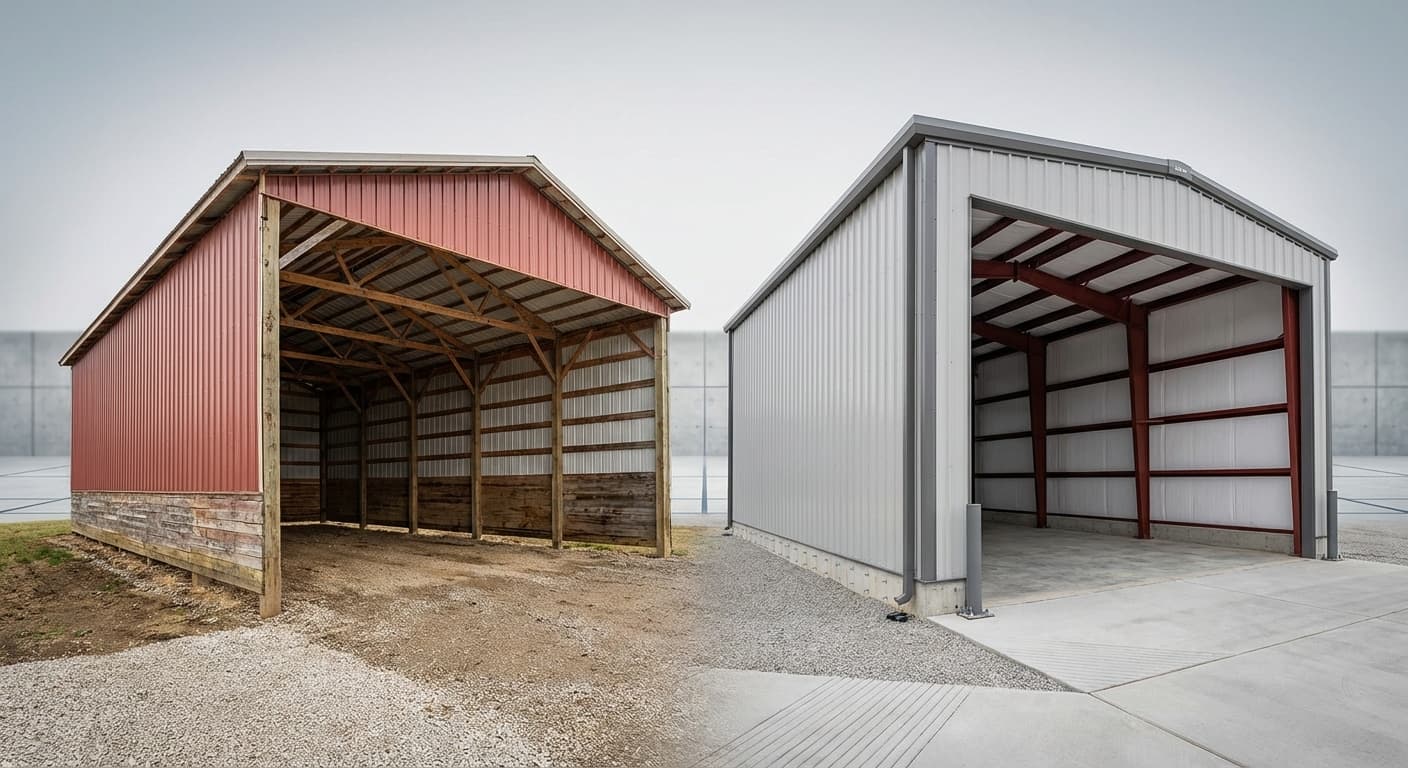

Over a 15-year span a 40×80 steel building quietly outperforms a pole barn even though the wood-framed kit costs roughly 15% less on day one, and this article walks owners through the math that proves it. Readers learn how lower insurance bills, virtually zero maintenance, stronger foundations, and 30-40-year warranties erase that initial savings within seven to ten years, while steel's superior resale value and expansion-ready clear spans protect the investment for decades. The piece also weighs the trade-offs–pole barns offer better thermal performance and cheaper utilities in extreme climates, but their buried posts shift, rot, and drive annual upkeep that can equal half the original price–so buyers can model true lifecycle costs instead of sticker prices. Side-by-side tables for maintenance, insurance, energy, and depreciation, plus a step-by-step decision checklist, give owners the tools to forecast cash flow, code compliance, and future flexibility before they commit. Ultimately, the guide shows that paying a little more up front for engineered steel buys peace of mind, lower lifetime expenses, and a building that grows with a business rather than expiring after 20 years.
Upfront Cost Comparison: 40×80 pole barn vs steel building cost
A 40×80 pole barn may cost 15% less today, but its wood-in-ground design, higher insurance, endless upkeep, and code headaches can turn that "savings" into a money pit the first time the soil shifts or the inspector shows up.
Base kit pricing and what's included
You'll save about 15% upfront choosing a 40×80 pole barn kit over a steel building [1][2].
But that initial savings comes with trade-offs you need to understand.
Pole barn kits give you wooden framing materials–posts, trusses, purlins–plus steel panels for siding and roofing [1].
Foundation and site work cost differences
Foundation work reveals the real cost difference between your options. Pole barns keep it simple–wooden posts go straight into the ground or rest on concrete footings [4]. You'll spend less initially, but you're taking a risk with soil movement. Steel buildings demand more: a complete concrete slab or pier and beam foundation engineered to meet your local codes [4][2]. Yes, you'll pay about 15% more upfront [2].
But you're buying peace of mind. Here's what matters for your site. If you're building on expansive soils, pole barns become risky–ground shifts compromise your entire structure over time [3]. Site prep differs too. Pole barns need minimal grading.
Steel buildings require precisely leveled surfaces for proper concrete work [4]. The bottom line? Steel foundations resist settling and movement that plague pole buildings when soil conditions change [3]. That stability protects your investment for decades.
Hidden expenses and optional upgrades
Your base kit quote tells only part of the story. Both building types exclude essentials–doors, windows, insulation, interior finishes [5]. Budget for these additions now to avoid surprises. Three hidden costs hit pole barn owners especially hard: Insurance premiums run 30% higher than steel buildings due to fire risk [5]. We'll detail these savings in our insurance section below.
Maintenance demands pile up with pole barns. Plan for painting, sealing, and fighting rot and pests [6]. Steel needs just occasional cleaning [6]. Our maintenance section quantifies these differences. Code compliance creates unexpected expenses.
Many pole barns lack prescriptive building codes, forcing costly retrofits during inspections or property transfers [5]. Two factors protect your steel building investment long-term. First, warranties stretch up to 40 years versus shorter pole barn coverage [5]. Second, steel structures command higher resale values–a critical advantage we explore in our depreciation section [6]. The pattern is clear: that 15% upfront savings on a pole barn vanishes when you factor in total ownership costs.
Lifecycle Expenses Over 15 Years
Over 15 years, a steel building slashes your lifetime costs to roughly one-third of a pole barn's by eliminating rot, pests, and constant repairs while cutting insurance bills and keeping its value intact.
Maintenance requirements and costs
You'll spend significantly less maintaining a steel building over 15 years compared to a pole barn. With pole barns, you're looking at ongoing wood treatment, pest inspections, fastener tightening, water damage checks, and repainting every few years [7]. Those buried posts shift over time too–requiring periodic straightening to keep your building square [8]. Your steel building?
It needs occasional cleaning and basic inspections [2]. That's it. No rot, no pests, no moisture damage to worry about. Here's what this means for your budget: pole barn owners typically spend 3-5% of their building's value annually on maintenance, while you'll spend less than 1% with steel [2].
The weathertight design of engineered steel buildings prevents the moisture damage that drives expensive pole barn repairs [8]. Over 15 years, pole barn maintenance often totals 45-75% of initial construction costs. Steel buildings? Just 10-15% [2].
Insurance premiums and risk factors
As covered in the hidden expenses section, you'll save approximately 30% on insurance premiums with a steel building compared to a pole barn [9][10]. This stems from steel's fire-resistant properties and superior engineering that meets all local building codes for wind, snow, and seismic loads [10].
For your 40×80 building, these insurance savings compound to thousands of dollars over 15 years. Steel buildings eliminate the pest damage, wood rot, and structural risks that make pole barns increasingly expensive to insure as they age [2][9].
Your insurance gap actually widens each year–pole barns become more vulnerable while your steel building maintains its protective qualities. This growing differential often eliminates any initial price advantage of pole construction within the first decade.
Resale value and depreciation trends
Your steel building holds its value–pole barns don't. It's that simple. Pole barns function as temporary structures with just 15-20 years before major renovation or replacement [11]. Within your first decade of ownership, that pole barn loses significant value.
Meanwhile, your steel building keeps its appearance and functionality for decades, directly boosting your property's resale value [11]. Appraisers know this difference. They consistently value properties with steel buildings higher because of proven durability and lower future replacement costs [2]. Your warranty protection reinforces this value–steel buildings come with 20-40 year warranties while pole barns offer minimal coverage [12].
For investment properties, the gap widens every year. Wood deteriorates; steel stays sound. Over 15 years, this resale advantage often eliminates the initial 15% price difference, making steel your smarter investment [2]. When you're ready to sell, buyers recognize the value of a building that won't need replacing–and they'll pay for it.
Performance and Operational Impacts
Because wood transfers heat 310 times slower than steel, a pole barn's continuous insulation can cut monthly utility bills enough to offset steel's higher upfront cost within 15 years–while steel's thermal bridging keeps draining your wallet every single month.
Energy efficiency and insulation considerations
Your heating and cooling bills tell the real story of building efficiency. Pole barns deliver better thermal performance because wood conducts heat 310 times slower than steel [13]. This means less heat escapes in winter and less cool air leaks out in summer. Steel buildings face a fundamental challenge–their metal frames act as "power bridges" that transfer heat outside, cutting insulation effectiveness by about 60% [13][14]. The difference starts with spacing.
Pole barns place vertical supports 8 feet apart, letting you install continuous insulation without gaps or compression [13][14]. Steel buildings pack framing members closer together, forcing insulation into compressed waves between panels and frames. Compressed insulation loses most of its R-value–the measure of how well it blocks heat transfer [13]. What does this mean for your wallet? Despite using the same HVAC equipment, pole barns typically use less energy per square foot to maintain comfortable temperatures [14].
For a 40×80 building in regions with hot summers or cold winters, this efficiency gap adds up fast. Over 15 years, lower utility bills can offset much of steel's higher upfront cost–but you'll pay those bills every month while waiting for the payback. The physics won't change: steel conducts energy outside your building 310 times faster than wood [14].
Load capacity and structural durability
When you need serious load capacity and rock-solid stability, steel buildings deliver where pole barns fall short.
Adaptability for future expansion
Your business won't stay the same for 15 years–your building needs to keep up. Steel buildings give you room to grow with 20-30 foot spacing between supports, creating wide-open bays you can reconfigure as needs change [18][15]. Need to bring in larger equipment? Add a bigger door? Expand your operation? No problem.
Pole barns box you in with posts every 6-8 feet that limit where you can put doors and how you use your space [15]. Planning ahead pays off. Steel buildings can include expansion plates in the endwalls, making future additions simple and cost-effective [15]. Try expanding a pole barn and you'll face major structural modifications–if it's even possible. Steel also handles specialized upgrades like taller eave heights or aircraft hangar doors that your growing business might need [15]. This flexibility translates to real money over 15 years.
As discussed in the maintenance section, retrofitting pole structures gets expensive fast. Steel buildings adapt with minimal structural work, protecting your investment as your operation evolves [6]. The wide-open spans mean you're never stuck working around load-bearing posts that limit your options. You get a building that grows with you–not one that holds you back [6].
Total Cost of Ownership Decision Guide
Crunch the 15-year numbers and you'll watch steel's higher upfront price erase itself as maintenance, insurance, and replacement costs flip the savings back to you–then lock it in with one call to National Steel for a turnkey kit that ends finger-pointing forever.
Calculating a 15‑year TCO with clear communication
You need real numbers to make the right decision. Here's how to calculate your true 15-year costs: Start with the basics. Yes, pole barns cost about 15% less upfront [19]. But that's just chapter one of a much longer story.
Add these real-world expenses: – Maintenance: Pole barns need straightening every 5-7 years (thousands each time). Steel buildings? Basic inspections [11] – Insurance: You'll save about 30% annually with steel's fire resistance [19][11] – Energy costs: Check your climate zone–this varies significantly – Building lifespan: Pole barns last 15-20 years. Steel keeps going for decades [11] When you run these numbers, that initial savings vanishes fast.
Most 40×80 building owners see the cost difference flip within 7-10 years [19]. Steel buildings win the long game through lower operating costs and longer life [2]. The math is clear: pay a little more now, save a lot more later.
Choosing a single‑source solution with National Steel Buildings
You want one number to call, one team to trust, one company that owns every detail. That's what National Steel Buildings delivers.
When we take responsibility for your entire steel building project, you skip the vendor juggling act. No finger-pointing between suppliers.
No construction delays from missing parts. Just one complete kit arriving bundled, labeled, and ready to go up [20].
Actionable steps to get a free quote and start planning
Ready to move forward?
- Pole barns cost 15% less upfront but steel wins long-term on total ownership costs
- Steel buildings save 30% on insurance premiums due to fire resistance and code compliance
- Pole barn maintenance over 15 years can reach 45-75% of initial cost vs 10-15% for steel
- Steel buildings retain resale value while pole barns depreciate heavily after 10 years
- Pole barns offer better thermal performance with wood insulating 310x better than steel
- Steel structures allow 20-30 foot spans for flexible future expansion without structural limits
- Total cost advantage flips to steel within 7-10 years despite higher initial investment
- https://www.buildingsguide.com/build/pole-barn-vs-metal-building/?srsltid=AfmBOorPXjNQ8RhWfkqSpvkWMVI1DufaXTQCs_2IxwbrhDX7PjZ_8Qoi
- https://bargainmetalbuildings.com/pole-barn-vs-metal-building/
- https://gensteel.com/building-faqs/building-comparisons/versus-pole-barns/
- https://www.buildingsguide.com/build/pole-barn-vs-metal-building/?srsltid=AfmBOooqiU7FuW0gI7sjtp7DIo9roL1M-Qoho1Qu9ARrgZ-p59HVk5gv
- https://www.buildingsguide.com/build/pole-barn-vs-metal-building/?srsltid=AfmBOooMHclGQ6Dqa1wXR08s-gLFqcswV4hZzngS70X35vtqnZxPFoBX
- https://www.steelcobuildings.com/pole-barn-vs-metal-building/
- https://www.omni-builders.com/home-tips/pole-barn-vs-metal-building-cost-maintenance-longevity-compared
- https://www.buildingsguide.com/build/pole-barn-vs-metal-building/?srsltid=AfmBOop6wOEHhlAUM0A88f7pWfkSJoaX1j5rYLSam1pEtu9BFc9mSL9h
- https://prestigesteelstructures.com/metal-building-vs-pole-barn-a-detailed-comparison/?srsltid=AfmBOorf60AY5tiwBfzVvgyEBWe86e2ceJOKscd1LY_IqLn0Myv2HzK9
- https://www.buildingsguide.com/build/pole-barn-vs-metal-building/?srsltid=AfmBOopFJjyj8Bc0X3-nYjodvGz_PG5JtzZ0AMfQMc9wT44IdSpMGbaz
- https://www.rhinobldg.com/blog/which-costs-less-over-time-a-metal-barn-or-a-pole-barn
- https://prestigesteelstructures.com/metal-building-vs-pole-barn-a-detailed-comparison/?srsltid=AfmBOop6c1ayxUzpq-0i_golNBzzSLD1i0SgRwYIi-cKUCJHWpgY8qJk
- https://info.fbibuildings.com/blog/post-frame-vs-steel-frame-buildings
- https://www.pacemakerbuildings.com/post-frame-building-energy-efficient-solution/
- https://www.acebuildingservice.com/blog/metal-building-vs-pole-barn
- https://www.buildingsguide.com/build/pole-barn-vs-metal-building/?srsltid=AfmBOoq-KVPPQSBIXzBsHYPGq3siHQlYd7xamkAno5w2bhVYggUy17nq
- https://bulldogsteelstructures.com/blog/metal-building-vs-pole-barn-durability-construction-and-design-comparison/
- https://www.buildingsguide.com/build/pole-barn-vs-metal-building/?srsltid=AfmBOorL6kay6-_pCpI_2_72FaI4hqdzBpeosJaLbZnZde_wOj1i16XQ
- https://www.buildingsguide.com/build/pole-barn-vs-metal-building/?srsltid=AfmBOoraWhGhSrc_sugZ1WBxW4PQMNOWeCpEZuAZWdTk3xod9XBIYuUZ
- https://norsteelbuildings.com/advantages-of-steel-series/advantages-single-source-responsibility/
- https://gensteel.com/resources/case-studies/steel-barn-buildings-are-an-economical-option-farmers/
- https://directmetalstructures.com/blog/planning-your-metal-building-project-a-comprehensive-checklist/?srsltid=AfmBOooDqsaAYhrGpMFRnMMAOi-sv-KsPv1tUL8ITnshjaVCZNPqJwUK
- https://americansteelinc.com/blog/site-preparation-before-metal-building/