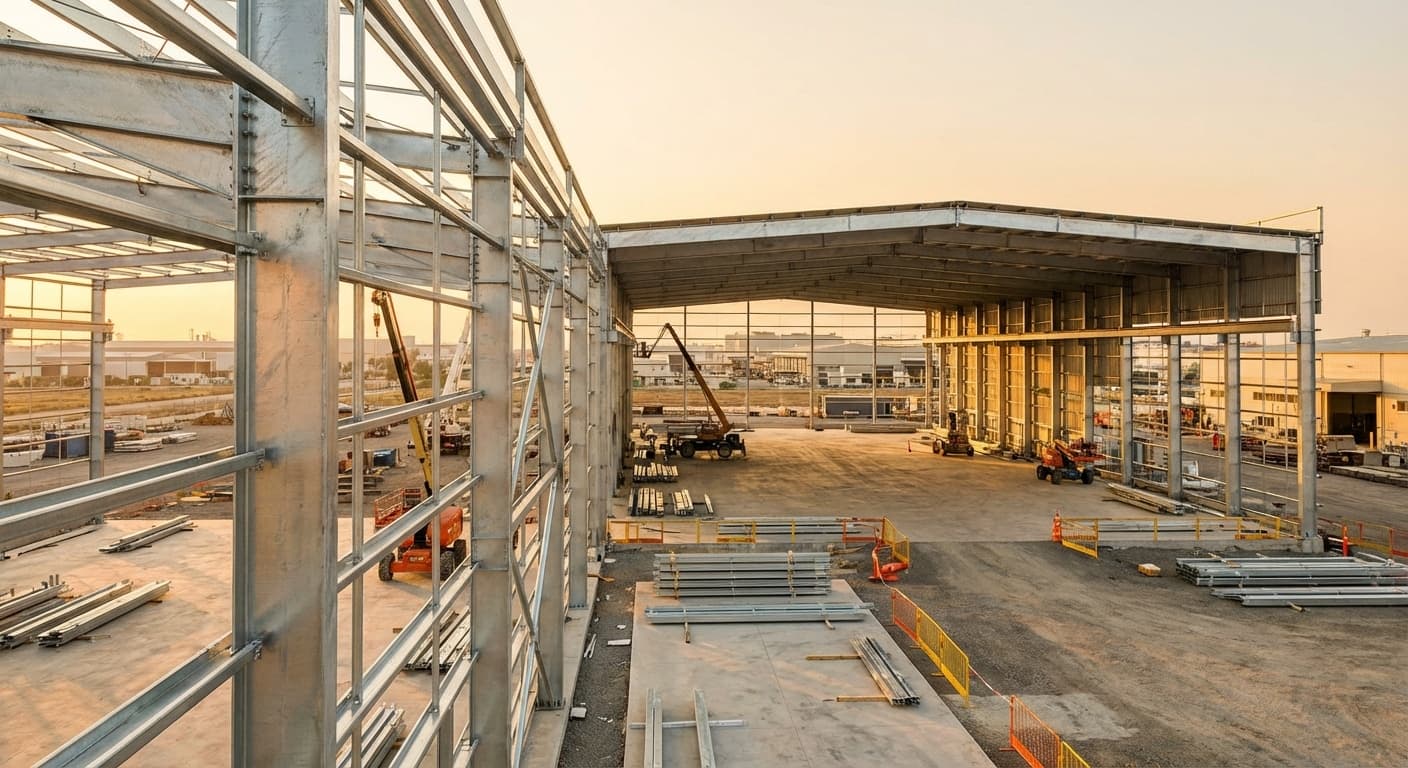

A 40×80 pre-engineered steel building may start at $57-70k for the kit, but the article shows why the real installed price lands between $86-128k once foundations, labor, and the 20-30% in "hidden" site, access, and permit costs are added, then explains how hot-dip galvanized framing flips the long-term economics: by eliminating repainting cycles for 40-70 years it typically pays back its 1.5-2.5x upfront premium in 10-12 years through avoided maintenance and can deliver up to 79% lifetime savings in corrosive or coastal zones. Readers learn to lock in lower total cost of ownership by specifying galvanized steel, timing steel purchases during price dips, using factory-fabricated components to cut high-wage labor 30-50%, and leveraging single-source suppliers who bundle design, permitting, delivery, and pro erection crews to keep schedules tight and change orders–and the finger-pointing–off their plate.
Understanding the True Cost of a 40×80 Pre Engineered Building
Budgeting for a 40×80 pre-engineered building? Expect the real installed cost to land between $86,400-$128,600–about 50-80% more than the kit price once you factor in foundation, labor, and the 20-30% in hidden extras most quotes leave out.
Breaking Down the Kit Price per Square Foot
Your 40×80 pre-engineered building kit runs $18-$22 per square foot–that's $57,600-$70,400 for 3,200 square feet of clear-span space [3]. Height drives the price: 12-foot eaves start at $18/sq ft, while 20-foot buildings hit $22/sq ft, with each 2-foot increment adding $3,000-$7,000 [3]. But here's what matters to your bottom line: the kit price is just the beginning.
You need foundation work ($4-$8/sq ft), construction labor ($5-$10/sq ft), and site preparation. Total installed cost lands between $86,400-$128,600, or about $27-$40 per square foot [1]. Your kit includes the essentials–primary and secondary steel framing, metal roof and wall panels, fasteners, and sealants [1].
Every customization adjusts your rate: doors, windows, insulation, structural upgrades [2]. These extras typically add 20-30% to your budget and rarely show up in initial quotes [3].
Hidden Expenses That Influence the Final Bill
Kit quotes rarely tell the whole story–hidden costs can bump your budget by 20-30% [5]. Site preparation hits first: excavation, grading, soil work, and compaction [5]. Your concrete foundation alone runs $6-10 per square foot–that's $19,200-$32,000 for a 40×80 building [4]. Engineering and permits vary by location, and local codes might force design changes [5].
Delivery creates its own surprises. Limited access means crane rentals at $500-$1,500 per day. Tight properties need special staging areas [5]. Every opening costs more than you think–doors and windows need proper framing, hardware, and trim packages [5].
Utilities demand early planning: trenching, conduit runs, and stub-outs before concrete pours [5]. After construction comes cleanup: waste removal, site restoration, panel sealing [5]. Don't forget property tax adjustments and HOA approvals [5]. Smart builders account for these realities upfront–it's how you avoid budget shock and keep projects on track.
How Galvanized Framing Impacts Long‑Term Value
Galvanized framing changes the math on your 40×80 building. Instead of budgeting for repainting every 5-10 years, you get decades of maintenance-free protection [6]. The numbers tell the story: steel-framed buildings cost 3-5 cents per square foot to maintain over 50 years, while alternatives run 5-8 cents–that's 40% less in your pocket [6]. This isn't about spending more upfront–it's about spending once.
Painted steel needs multiple touch-ups throughout its life. Hot-dip galvanized steel? Your initial investment is typically your only investment [6]. In coastal areas where salt eats standard frames, this protection proves invaluable [7].
The payback accelerates in harsh environments. One documented case showed 79% lifetime savings with galvanized steel versus a three-coat paint system [6]. For your business, that means fewer shutdowns, better resale value, and a building that works as hard as you do–especially if you're near salt water or industrial zones [7]. (For specific ROI timelines in your environment, see our detailed analysis in the next section.
When Galvanized Framing Pays for Itself
Pay once for galvanized framing and you'll break even in 10-12 years while your painted-steel neighbors bankroll two full repaint cycles for the same 40×80 building.
Lifecycle Savings from Corrosion Resistance
Your galvanized frame investment starts paying you back the moment traditional buildings need their first repaint. As detailed in our cost breakdown section, the lifecycle advantage is clear–but the real payoff comes faster than most owners expect. The American Galvanizers Association's data confirms what we see in the field: galvanized systems deliver up to 79% cost savings compared to painted alternatives [6].
For your 40×80 building, this means predictable costs from day one. You won't budget for repainting. You won't schedule maintenance shutdowns.
You won't lose revenue to rust repairs [6]. That's the power of single-source steel construction with proper corrosion protection–especially critical if you're building within coastal zones where salt spray eats standard frames [7]. When you factor in the 28% lifecycle advantage PEB structures already provide over traditional construction [8], galvanized framing becomes the clear choice for protecting your investment.
Maintenance Cost Comparison Over 15 Years
Let's talk real numbers over 15 years. Your painted steel building needs repainting every 5-10 years–that's at least two major maintenance cycles before your galvanized neighbor touches their first maintenance dollar [9]. For your 3,200 square foot building, each repaint means scaffolding, surface prep, materials, labor, and lost operating time. Most owners face this expense just as they're finally seeing positive cash flow from their initial investment [9].
Here's what galvanized framing saves you: zero repainting for 40-70 years in most environments [9]. Yes, you'll pay more upfront–typically 1. 5-2. 5 times the cost of painted steel.
But detailed lifecycle studies prove you break even within 10-12 years through avoided maintenance alone [10]. In coastal or industrial locations? Your payback accelerates because harsh conditions force painted buildings into 3-5 year repaint cycles [9]. The math is simple: pay once for galvanizing or pay repeatedly for paint.
Case Studies Showing ROI in Aggressive Climates
Real buildings in harsh environments prove galvanizing's rapid payback. Take Lyons Salt's Kansas facility–their standard steel frame failed completely after just 10 years of salt dust exposure. Complete replacement forced them to rethink their approach [11]. Their galvanized solution included smart design choices that any owner can apply: * Clear interior liners protecting the frame * Solid galvanized bracing rods (not cables) * Purlin caps blocking corrosive dust * Strategic ventilation systems * Extra epoxy coating on high-exposure areas [11] Coastal buildings tell a similar story with specific payback timelines. Within one mile of ocean spray, unprotected steel shows rust in 5-7 years on windward faces.
Yet sheltered areas on the same building last 15-25 years longer [12]. This variance shows why site-specific planning matters for your ROI calculations. Manufacturing facilities using hot-dip galvanized steel plus epoxy or PU topcoats consistently achieve 20-30 year lifespans with minimal upkeep [13]. The financial lesson? Design smart from the start.
Buildings with 10-15 degrees roof slopes for drainage and 6-12 month inspection schedules dramatically outperform flat-roofed structures with no maintenance plan [13]. For aggressive salt environments, duplex systems (coating over galvanizing) extend life by 1. 5 times either method alone. Some owners supplement with simple freshwater rinses–a small effort that yields major durability gains [12]. Your specific environment determines your exact payback period, but these case studies prove one constant: galvanized framing pays for itself fastest where corrosion threats are highest.
Optimizing Your Budget with Single‑Source Solutions
By hiring ProTrades as your single-source erection team, you can finish a 40×80 pre-engineered building up to 50% faster, cut labor and steel costs through early design optimization, and lock in volatile steel prices before they spike again.
Leveraging ProTrades for Streamlined Erection Hiring specialized erection crews significantly accelerates your 40×80 pre-engineered building timeline and reduces overall costs. Professional trades teams familiar with pre-engineered systems complete projects 30-50% faster than traditional construction methods by leveraging factory-fabricated components that arrive pre-cut, pre-drilled, and ready for assembly [14]. This specialized knowledge eliminates common field errors, minimizes rework, and optimizes crew deployment.
According to the American Institute of Steel Construction, approximately 70% of a steel package's cost comes from fabrication and erection rather than raw materials [14]. Engaging fabricators early in your planning process allows for design optimization that avoids unnecessarily complex connections and reduces steel usage [14]. Single-source procurement streamlines communication by providing one point of contact for all components, minimizing coordination challenges and ensuring proper fit between all building elements [15].
This integration between design, fabrication, and erection teams creates measurable efficiencies–components manufactured with tight tolerances in controlled environments assemble more predictably in the field, reducing labor hours and minimizing material waste [15]. Most critically, professional erection crews bring specialized equipment and safety protocols that prevent costly delays while maintaining compliance with increasingly complex building regulations.
Negotiating Material Prices Through Weekly Market Monitoring
Weekly steel price monitoring transforms your negotiating position from reactive to proactive. Steel prices have shown consistent volatility–dropping 5. 38% in early 2026 after experiencing their first increase in over a year in mid-2025 [16]. This fluctuation pattern offers strategic purchasing opportunities when tracked systematically. Nonresidential input prices have jumped 44.
5% since 2020, though most increases occurred during the pandemic's first two years [17]. Recent trade policies have triggered immediate price reactions, with liberation Day tariffs implemented in April 2025 causing a 5. 4% month-over-month price increase in May and prices remaining 7. 9% above pre-tariff levels by September [18]. Construction professionals can leverage this data by implementing systematic monitoring of trusted sources like RSMeans Data–containing over 92,000 construction cost data points [16].
This approach allows strategic purchasing during price dips, particularly when steel shows "supply side discipline" periods [17]. Capacity utilization for iron and steel products increased approximately six percentage points between April and September 2025 [18], signaling production increases that savvy buyers can track for negotiation leverage. Effective material management has become essential for protecting profit margins from price volatility, with firms maintaining robust supplier relationships able to avoid profit margin compression from sudden material price movements [18].
Reducing Permit and Delivery Surprises
Permit and delivery issues can derail your 40×80 building budget without proper planning. Start by researching local building codes before finalizing your design, as geographic location significantly impacts permit requirements and costs [19]. Request multiple permit quotes early, as fees vary widely between jurisdictions and can represent a substantial portion of your budget [20].
Reduce delivery complications by ensuring adequate site access–narrow driveways or limited turning radius can necessitate smaller delivery vehicles or crane rentals, adding $500-$1,500 per day to your costs [19]. Consider seasonal timing for delivery; building departments process fewer permits during winter months, potentially accelerating approval times [19]. For electrical and plumbing approvals, schedule inspections before enclosing walls to avoid costly rework [21].
The most effective strategy combines these approaches with single-source procurement–purchasing all components from one supplier streamlines communication and ensures proper fit between building elements, significantly reducing coordination challenges during the construction phase [21]. When selecting your supplier, verify they handle permit acquisition assistance and offer delivery coordination services; some providers include permit guidance that can prevent expensive redesigns while ensuring compliance with local regulations [20].
Practical Steps to Calculate Your Project's 40×80 Pre Engineered Building Cost
Feed your estimator every spec–dimensions, site quirks, labor rates, even door types–because the building kit is only half the cost and the right details today stop budget shocks tomorrow.
Using Our Cost Estimator Input Guide
You'll get the most accurate budget by feeding your cost estimator the right details from the start. Your building specs drive the numbers–dimensions, eave height, roof pitch, and load requirements all impact your final price [22]. Location matters too. Local labor rates, shipping distances (3-7% of costs), and specific code requirements can bump up or down your total [22]. Don't skip site conditions when calculating. As covered in our hidden expenses section, site prep typically runs 10-20% of your budget [23].
Include everything: terrain challenges, soil quality, drainage needs, existing utilities. The more detail you provide upfront, the fewer surprises you'll face later. Be specific about your wish list. Every door type, window placement, insulation choice, and interior finish adjusts your square footage rate [24]. Need it fast? Rush schedules mean expedited shipping and overtime labor–both hit your bottom line.
Here's what most calculators miss: your building kit represents just 40-50% of total cost [24]. You're also paying for site prep, freight, labor, permits, and utility hookups. That's why connecting with an experienced steel building supplier beats generic online tools. We factor in current steel prices, regional variables, and local code quirks that generic calculators can't touch [22].
Aligning Design Choices with Local Labor Rates
Labor runs 30-35% of your total project cost–enough to make or break your budget. Your local market drives the math. High-wage areas ($30-35/hour)? Go simple. Every angle, elevation change, or custom feature adds labor hours [22] [25].
Smart design cuts labor costs: * Stick with straight walls and rectangular layouts * Use standard 20-25 foot bay spacing * Choose pre-framed door and window packages * Keep heights under 20 feet when possible [24] Here's where factory-fabricated components pay off. When labor tops $30/hour, pre-fab saves money despite higher material costs. Below $25/hour? Field fabrication might work better [24]. Galvanized framing tips the scales in high-labor markets.
Simpler assembly. Less need for skilled welders. Faster installation [22].
Communicating Clear Expectations to Your Builder
Good communication with your builder stops budget surprises before they start. Put everything in writing–drawings, specs, timelines. This shared reference keeps everyone aligned on your goals [22]. Walk the site together. Your builder needs to see the soil conditions, access points, and utility locations firsthand. These details drive construction decisions and costs [22]. Get itemized proposals that break out: * Materials * Labor * Indirect costs Now you can spot where to save without sacrificing quality [22]. Set your update schedule upfront. Small design tweaks can shift costs fast.
Regular check-ins catch these changes early [22]. When discussing options like galvanized framing, share your performance needs, not just your budget number. Tell your builder if you prioritize speed, quality, or cost control. This helps them recommend the right materials and methods [26]. Be clear about communication expectations. How fast do you need responses on change orders? Who makes decisions when surprises pop up? Sort this out before construction starts [27]. Talk contingencies early.
Agree on how you'll handle unexpected conditions. Document the process. This takes pressure off when decisions need to happen fast [27]. The single-source advantage? One point of contact for all these conversations. No finger-pointing between suppliers and contractors. Just straight answers and clear accountability from design through completion.
- Kit price is only 40-50% of total cost; installed 40×80 runs $86k-$129k.
- Galvanized frames save 79% vs paint over life, break even in 10-12 years.
- Each 2 ft height jump adds $3k-$7k; keep eaves ≤20 ft to control budget.
- Site prep, foundation, doors, insulation add 20-30% beyond initial quote.
- Steel price volatility hit +7.9% post-tariff; monitor weekly to time buys.
- Pro erection crews cut labor 30-50%; factory pre-cut parts slash field hours.
- Coastal salt spray ruins painted steel in 5-7 yr; galvanized lasts 40-70 yr.
- https://www.buildingsguide.com/standard-sizes/40×80-metal-building/?srsltid=AfmBOop2FwmLLWTuAfxP_herCZSMJ0J6rFGRz7kBkZn9_DqCW4SZbDVX
- https://titansteelstructures.com/facts/how-much-will-i-spend-on-a-40×80-metal-building/
- https://chinasteelbuildsales.com/40×80-metal-building-cost/
- https://qebuildings.com/2025/10/how-much-does-a-40×80-metal-building-cost/?srsltid=AfmBOoopVTLcUby7tmaJH72MQAleYmJOHf8Tr4WW8uly–YGBQWHkVoP
- https://www.americanmetalbuildings.com/blog/hidden-costs-that-blow-up-metal-building-budgets-and-how-to-catch-them-early/?srsltid=AfmBOoqBMIXXQCSmSerPPAwuECKwF5_JgmSDxLVpYJYKO5PibqN_GWUa
- https://galvanizeit.org/hot-dip-galvanized-steel-for-parking-structures/economic-savings/life-cycle-savings
- https://www.tylerbuilding.com/post/2026-metal-building-cost-variables
- https://www.metaltree.in/peb-vs-traditional-construction-complete-cost-analysis-roi-breakdown-2025/
- https://parcoengineers.com/blog/galvanized-steel-vs-painted-steel-life-cycle-cost-analysis/
- https://galvanizeit.org/education-and-resources/publications/hot-dip-galvanized-steel-vs-paint
- https://blog.legacybuildingsolutions.com/advanced-methods-of-preventing-corrosion-in-steel-framed-buildings-a-case-study
- https://galvanizeit.org/knowledgebase/article/hdg-in-coastal-climates
- https://qsbsteel.com/en/are-pre-engineered-steel-buildings-in-coastal-areas-durable-solutions-for-corrosion-and-storm-resistance/
- https://www.steelcobuildings.com/pros-and-cons-of-pre-engineered-metal-buildings/
- https://www.buildingsguide.com/build/advantages-of-pre-engineered-steel-buildings/?srsltid=AfmBOor322Ry45DC7ng_y9oCvWwMzp4wf3SBEO4n2SxYiiT4K3xME2Ii
- https://www.gordian.com/resources/steel-price-updates/
- https://www.constructiondive.com/news/construction-materials-costs-increase-gordian/810419/
- https://news.constructconnect.com/the-economics-of-steel-in-construction-materials-management-to-keep-from-getting-bent-out-of-shape
- https://americansteelinc.com/blog/steel-building-costs-prices-guide/
- https://www.buildingsguide.com/build/pre-engineered-metal-building/?srsltid=AfmBOoqjuw1P2UE5qJHkaZpIkOZLaj_xPj2v9KgiDrV0AIe6hhM8iqBJ
- https://www.clarisdesignbuild.com/pros-and-cons-of-a-pre-engineered-metal-buildings/
- https://www.starbuildings.com/blog/case-studies/2025-steel-building-cost-estimator-a-contractors-guide-to-pemb-pricing/
- https://www.metallic.com/news-item/2025-steel-building-cost-estimator-a-contractors-guide-to-pemb-pricing/
- https://www.cecobuildings.com/blog/steel-building-cost-estimator-a-contractors-guide-to-pemb-pricing/
- https://www.buildingsguide.com/metal-building-prices/?srsltid=AfmBOop9psZrvz2hbiSwjIjy8D1lqmm_QzibrGlzg1cBwFF1kYP6sp9X
- https://www.steelcobuildings.com/metal-building-cost-a-comprehensive-guide-to-budgeting-and-planning/
- https://bcentinc.com/tips-for-accurate-construction-budget-estimation/