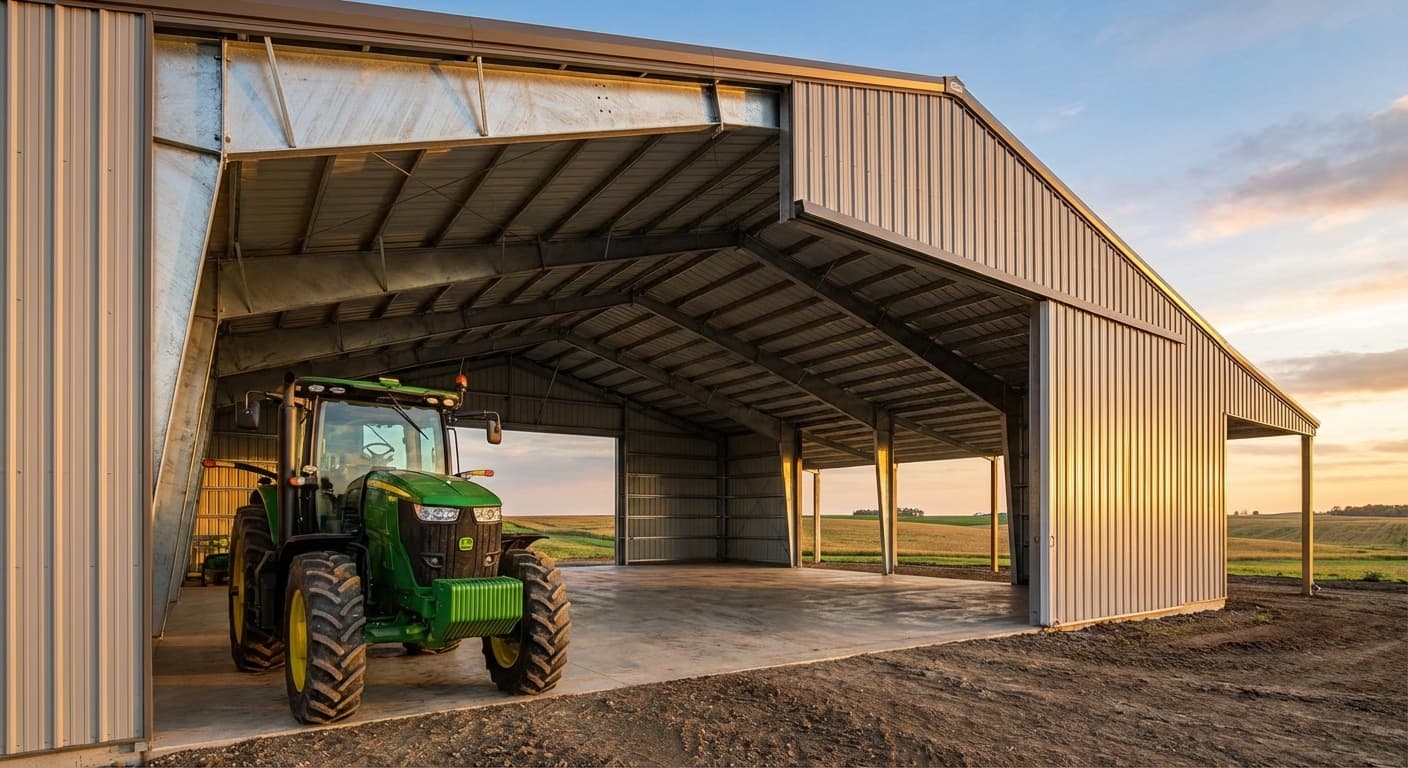

Pre-engineered steel barn kits let farmers move straight from delivery day to daily chores because every I-beam, girt, and panel arrives pre-cut, pre-punched, and labeled for bolt-together assembly that slashes build time by weeks while creating clear-span interiors up to 300 ft wide–no posts, no trusses, no bird roosts–so combines, loaders, and tomorrow's taller tractors glide through unobstructed. The article walks readers through measuring highest cab or loader heights, adding a 2-ft safety buffer, translating those numbers into correct eave and clear-height specs, and choosing roof styles, door sizes, and bay layouts that match workflow and future expansion. It explains how single-source suppliers bundle engineering stamped for 160 mph winds and 110 psf snow loads, fire-resistant steel that termites can't touch, and lifetime support that solves site surprises in one call, turning up-front prices of $22,500 for a 30×40 kit into long-term savings that beat wood-frame barns on maintenance, energy, and insurance. Readers learn cost drivers (height, span, accessories), see livestock sizing charts from 50 to 300 head, and get insider tips on door placement, center-aisle layouts, and leaving walls ready for easy grow-with-you additions, ensuring the barn they bolt together this season still fits the bigger equipment they'll buy next decade.
Understanding Pre‑Engineered Barn Kits and Tractor Clearance
Measure your tallest tractor, add two feet of breathing room, and let a pre-engineered steel barn kit give you up to 300 feet of column-free space that's ready weeks faster and built to outlast termites, rot, and 100-mph winds.
What makes pre engineered barn kits ideal for modern farms
You need a barn that works as hard as you do. Pre-engineered barn kits deliver exactly that–clear spans up to 300 feet without interior columns getting in your way [1]. Your tractors and combines move freely.
No posts to dodge. No beams to duck under. The open design eliminates bird nesting spots while giving you every square foot of usable space [1].
Components arrive pre-cut and ready to bolt together–you're operational weeks faster than with stick-built construction [2][3].
How tractor clearance height impacts barn layout
Your tractor sets the rules for your barn design. That 7-foot tall tractor? You need 8-10 foot walls minimum [5]. Got a loader that extends higher? Plan accordingly.
Smart clearance planning starts with measuring your tallest equipment–then adding breathing room. As covered in our design section, that means at least 2 feet overhead for safe daily operation [4]. Your building width affects total clearance too. A 24-foot wide structure gives you about 3 extra feet at center peak, minus 10 inches for bracing [5]. Door placement makes or breaks your workflow.
Position them where your equipment naturally moves–no awkward maneuvering, no wasted time [4]. Too many farmers squeeze by with tight clearances, then kick themselves when they upgrade equipment. Plan for tomorrow's tractor, not just today's: – Design around your tallest future machine [4] – Create zones for different equipment heights – Choose wall heights and roof styles that give you options [5] Pre-engineered steel buildings adapt to your exact clearance needs. We customize wall heights, roof configurations, and door placements to match your operation perfectly.
Key terminology clarified for clear communication
Speak our language, get your barn built right. These terms matter when you're planning equipment clearance: Clear height–The actual usable space between floor and truss bottom. This is your real working height, not what it looks like from outside [6]. Eave height–Where sidewall meets roof, measured from ground level. Important, but clear height determines if your tractor fits [6].
Ridge height–Floor to roof peak. Local codes often limit this measurement [7]. Bay–Distance between posts along your building's length [8]. Clear span–No interior columns. Your equipment moves freely anywhere inside [8].
Know your roof options: – Monitor style: Raised center section adds height and natural light [7] – Gable style: Traditional peak roof with loft potential [7] When ordering, specify sidewalls (parallel to ridge) versus endwalls (triangular ends). This ensures doors go exactly where you need them [6]. These terms prevent expensive miscommunication. Use them when discussing your project–we'll know exactly what you need.
Designing for Exact Clearance Height: Tools and Tips
Measure every machine yourself–then give it 2 extra feet of clearance–because a tape measure today beats a costly roof-raising tomorrow.
Accurate measurement methods for clearance requirements
You need precise measurements when planning your pre-engineered barn. Start with your tallest equipment–measure from ground to the highest point, whether that's an extended loader, cab roof, or exhaust stack. Add at least 2 feet of overhead clearance for safe operation [4]. Don't trust manufacturer specs alone. Aftermarket modifications often change equipment height, so grab a laser measuring tool or tape measure with a helper and capture exact heights in multiple positions.
Your tractors with front-end loaders need extra thought. Measure both resting height and maximum operational height with the loader fully raised. If you're storing multiple equipment types, design around your tallest machine while creating zones with appropriate clearances for different functions [4]. Door openings require special attention. Account for the full turning radius of longer implements, not just their height [4].
Think ahead–equipment upgrades happen, and farmers who skip this planning step often face expensive modifications later [4]. Document everything. Take photos showing the measuring tool in position, especially for complex equipment profiles.
Configuring kit dimensions to match tractor specs
Now turn those measurements into building specifications. Your sidewall height should exceed your tallest equipment by at least 2 feet–standard agricultural heights start at 12 feet [10]. Door sizing matters. Match door openings to your widest equipment plus a minimum 12-inch buffer on each side [11]. Standard barn doors run from 8'x10' to 12'x12', but custom sizes like 12'x14' handle larger machinery [10][11].
Your roof choice affects clearance too. Vertical roof designs give you maximum headroom compared to regular or boxed-eave styles [10]. Steel I-beam construction means no interior roof trusses–just unobstructed vertical space throughout your building [11]. Smart layout tip: Configure your barn with a center unit flanked by lean-tos. This creates dedicated zones for different-sized machinery while maximizing space efficiency [10].
When you talk to manufacturers, share both equipment dimensions and operational requirements. Modern design software lets you visualize exact clearances before committing to purchase [10]. You'll see precisely how your equipment fits–no surprises on delivery day.
Integrating safety and service excellence into the design
Safety starts with engineering that exceeds local building codes–your structure withstands up to 160 MPH winds and 110 PSF snow loads [13]. This strength translates to daily operational safety through smart design choices. Door sizing prevents accidents. Make doors at least 12 inches wider and taller than your largest equipment [13]. That extra clearance eliminates hazardous squeeze points and expensive equipment damage.
The bolt-together design delivers precision. Components fit correctly the first time, eliminating structural weaknesses that could fail during extreme weather [13]. Steel I-beam construction removes interior roof trusses entirely–no dangerous obstructions waiting to catch tall equipment [13]. Fire resistance matters when you're storing hay and other combustibles. Steel won't burn like wood structures [13].
You also avoid pest damage and rot that weaken wooden barns over time [13]. Simple maintenance preserves safety. Regular fastener inspections keep your structure sound for decades. Planning software shows exact clearances before you build [12]–preventing dangerous modifications after the fact. You see potential problems on screen, not after steel arrives.
Quality Construction and Single‑Source Solutions
Pre-engineered, code-ready steel barn kits–every I-beam, clip, and panel cut, punched, and labeled to bolt together flawlessly the first time, backed by a single supplier who answers one call to solve any issue and keeps your build on schedule and on budget.
Material standards that ensure lasting quality
You already know steel beats wood for barn construction–we covered those clear span advantages and weather resistance earlier. What matters now is getting components that fit together perfectly the first time. Quality pre-engineered barn kits deliver exactly that. Your I-beam primary framing arrives cut, punched, and ready for bolt-together assembly [14].
Secondary components attach with clips or self-drilling screws that create watertight seals [14]. No guesswork. No field modifications. Just precision-manufactured parts that meet or exceed your local building codes [14].
The pre-cut specifications mean every connection point fits as designed [15]. For dairy operations and livestock facilities, steel's non-porous surfaces simplify sanitization–they handle high-pressure washing without deteriorating [2]. When you factor in steel's recyclability and decades of maintenance-free performance, the long-term value becomes clear [2][15]. Bottom line: You get a barn that goes up faster, lasts longer, and costs less to maintain than any wood-frame alternative.
Streamlined procurement: one source, many benefits
Single-source procurement changes everything about your barn project. You deal with one supplier. You make one phone call when questions arise. You get one accountability partner from design through delivery.
Here's what that means for your build: * Complete kits arrive labeled and organized – Your inventory checklist matches what's on the truck [17] * Questions get answered fast – One number connects you to people who know your exact components [17] * Problems get solved immediately – Missing bolt? Damaged panel? One call fixes it [17] * Parts fit as designed – No mismatched components from different vendors [16] * Future expansions stay simple – Same supplier, same specs, same quality [17] This isn't just convenience–it's cost control. Fewer delays mean lower labor costs.
Precise fit means no expensive field modifications [16]. For busy farming operations, that single point of contact saves hours of administrative headaches.
Problem‑solving during installation with expert support
Your barn kit arrives with detailed plans, but real job sites throw curveballs. That 60-foot truss weighing 1200 pounds? You'll need guidance on safe handling [18]. Unexpected weather during assembly? You'll want proven bracing techniques [20].
Expert support makes the difference between a smooth build and costly delays. When you call with questions, you reach specialists who know your exact components and assembly sequence [19]. They've solved your problem before–probably dozens of times. Smart support teams do more than answer phones: * Review your progress photos to confirm proper connections [20] * Translate engineering specs when inspectors have questions [20] * Provide real-time solutions for site-specific challenges [20] * Guide equipment handling for those heavy structural pieces [18] * Prevent small issues from becoming expensive problems [20] Weather throws you a curve? They'll walk you through temporary bracing for high winds or proper drainage during wet conditions [20].
Local inspector needs clarification? They'll provide the documentation and explanations to keep your project moving. Quality manufacturers know their support directly impacts your barn's 50-year performance. They're invested in getting it right because proper installation today means satisfied customers tomorrow [20].
Cost, Sizing, and Choosing the Right Kit for Your Farm
Size your barn to your workflow–starting at $22,500 for a 30×40 ft kit–and watch every extra square foot drop the price per animal or tractor while you bolt together pre-cut steel that already saved you 20% over stick-built.
Pricing models for 30×40 barns to mega dairies
You get straightforward pricing based on what you actually need. Small utility barns (30×40 feet/1,200 square feet) start around $22,500 to $26,500 for basic metal configurations [21]. Perfect for equipment storage with proper tractor clearance. Step up to a 42×26 stepdown barn for $27,000 to $32,800–you get varying roof heights to match different equipment needs [21]. Here's where it gets interesting: bigger barns deliver more bang for your buck.
Commercial-grade structures starting at $33,000 give you significantly more usable space per dollar [21]. Livestock operations see predictable scaling. A 6,000 square foot barn handles 50 head of cattle. Need more? A 14,000 square foot monoslope design accommodates 120 head [22].
Dairy farmers, your 20,000 square foot freestall barn houses 170 head, while 36,000 square foot structures support 300 cows with integrated management systems [22]. Every size delivers the same construction advantages discussed in our single-source approach–pre-cut, pre-drilled components ready to bolt together [21]. You save 15-20% over conventional building methods right off the bat. Plus, steel's natural resistance to weather, pests, and fire means you're not writing maintenance checks year after year [21].
Matching size and price to your operational needs
Start with what you do every day. List your immediate needs–equipment storage, livestock housing, or both [23]. Map out how you move through your workday. For equipment-focused operations, measure your largest machinery and add clearance. Then look at standard sizes that balance cost and function: 30×40, 40×60, or 50×100 [24]. Your layout choice matters–open designs flex with your changing needs, while segmented layouts work for specialized operations [24]. Door placement makes or breaks your workflow. Put doors where equipment naturally flows through your space.
Smart placement now saves renovation headaches later [24]. Here's what drives your costs: height and span affect pricing as much as square footage [24]. Taller walls accommodate bigger equipment but cost more. Wider spans need stronger engineering. Each customization–doors, windows, insulation–adds to your bottom line [24]. The traditional center aisle design still works. Wide corridor down the middle for tractors and equipment, with stalls or storage on either side [23]. Simple.
Effective. Think ahead. Leave at least one wall clear for future expansion. Run utilities where they can extend easily. Your operation will grow–plan for it now [23]. Commercial operations face stricter codes that affect materials and design, so factor those requirements into your planning [24].
Decision guide: selecting the best pre engineered barn kit
Wood-framed pole barns look cheaper upfront at $10-$15 per square foot. Metal barns run $15-$30 per square foot. But here's what those numbers don't tell you: steel pays for itself through decades of zero-maintenance performance. For high tractor clearance, metal buildings deliver clear spans up to 200 feet without interior columns [25]. No posts to dodge. No beams to duck under.
Just open space for your biggest equipment. Steel frames solve the problems that plague wood structures–no rot, no termites, no fire worries. You get warranties that actually mean something because the building will outlast them. Before you buy, ask the right questions: – What's their industry experience? – Are they properly certified? – What warranty do they offer?
– Can they show you blueprints and material specs? Focus on what matters: material gauges, primary frame thickness, secondary framing components. These determine whether your building stands strong or needs constant repairs. Measure your current equipment, then think bigger. What will you buy in five years? Ten?
- Pre-engineered steel barns offer clear spans up to 300 ft with no interior columns, maximizing usable space.
- Measure tallest equipment, then add 2 ft clearance; design for future upgrades, not just current machines.
- Specify clear height (floor to truss bottom) as the real working height, not eave or ridge height.
- Door openings need 12 in extra width and height on each side to prevent squeeze points and equipment damage.
- Steel I-beam construction removes interior trusses, eliminating obstructions for tall equipment.
- Single-source kits arrive pre-cut, pre-punched, and labeled, cutting construction time by weeks.
- Upfront steel cost ($15-30/sq ft) beats wood long-term via zero rot, termite, or fire maintenance.
- https://www.rhinobldg.com/blog/13-reasons-farmers-and-ranchers-choose-steel-systems
- https://imagebuildingsystems.com/pre-engineered-agricultural-buildings/
- https://www.raecobuilders.com/blog/2024/2/23/built-for-the-land-why-pre-engineered-metal-buildings-are-a-farmers-best-friend
- https://info.fbibuildings.com/blog/pole-barn-height
- https://eversafebuildings.com/design-your-building/?srsltid=AfmBOoruzsk7g-oDk2fOWW9odlTJywKQCmblHAij4PFEWoFg43XFwAT5
- https://beehivebuildings.com/eave-height-vs-clear-height/
- https://barnpros.com/resource-center/anatomy-of-a-barn-common-terms-styles/
- https://www.barntoolbox.com/barn-glossary.htm
- https://iconsteelbuildings.com/prefabricated-metal-building-kits/
- https://www.vikingsteelstructures.com/buy-from-photos/44x40x12-metal-barn-building?srsltid=AfmBOoodQEWHOVAgEnhZnyfetxw3g6OOBgA8bQbKC-D7yRCY1HquEMem
- https://www.buildingsguide.com/metal-building-kits/horse-barns/?srsltid=AfmBOoq0S8tyg5h-t-HJgmrY2YLFySmia9L-ktC4puprBeXjsHXRKHJ5
- https://eversafebuildings.com/design-your-building/?srsltid=AfmBOoo2HteC-b_n27iF00Jb0BDkTYZolk72G5n7_PY6T_7cryAMoEfV
- https://www.buildingsguide.com/metal-building-kits/horse-barns/?srsltid=AfmBOoolGViK-Xp62rUr09KniADbSKuYMeN4MJREj_MV9CNDi5LPOKd-
- https://www.universalsteel.com/steel-barn-kits/
- https://mavericksteelbuildings.com/the-steel-barn-kit-buying-guide-quality-meets-convenience/
- https://www.buildingsguide.com/build/advantages-of-pre-engineered-steel-buildings/?srsltid=AfmBOoodY7br0J5sgA8ah4Pz7Rml8MNdc8CAFGQnMpEvKA-l89J0jGnR
- https://norsteelbuildings.com/advantages-of-steel-series/advantages-single-source-responsibility/
- https://matadorstructures.com/blog/addressing-concerns-common-problems-with-simple-pole-barns/
- https://barnsandbarndos.com/diy-barn-kits-guide/
- https://www.diypolebarns.com/our-process.php
- https://titansteelstructures.com/prefab-building-types/how-much-does-a-metal-barn-kit-cost/
- https://www.buildingsguide.com/metal-building-kits/metal-barns/?srsltid=AfmBOooIGqRz-0T5Vo5cG37En4_TzaqmbqhWA4vgoTvPjRyYsKy3xTE5
- https://qualitystructures.com/choosing-the-right-barn-layout-for-your-farm/
- https://pbsdirect.com/blogs/ask-pbs/pole-barn-prices-sizes-and-uses?srsltid=AfmBOop4xjzf9NJXKB1ooOhdRfrlAFV0fY3uoqWdHOIYg3hOeOY6IVHD
- https://www.rhinobldg.com/blog/metal-barns-and-buildings-for-rural-life
- https://alansfactoryoutlet.com/blog/pole-barn-vs-metal-barn-kits/?srsltid=AfmBOornXqxcXl9TuIHOq7NXpYbrEnGdW_EqJB5JwnuywGs_OJv5VKxy