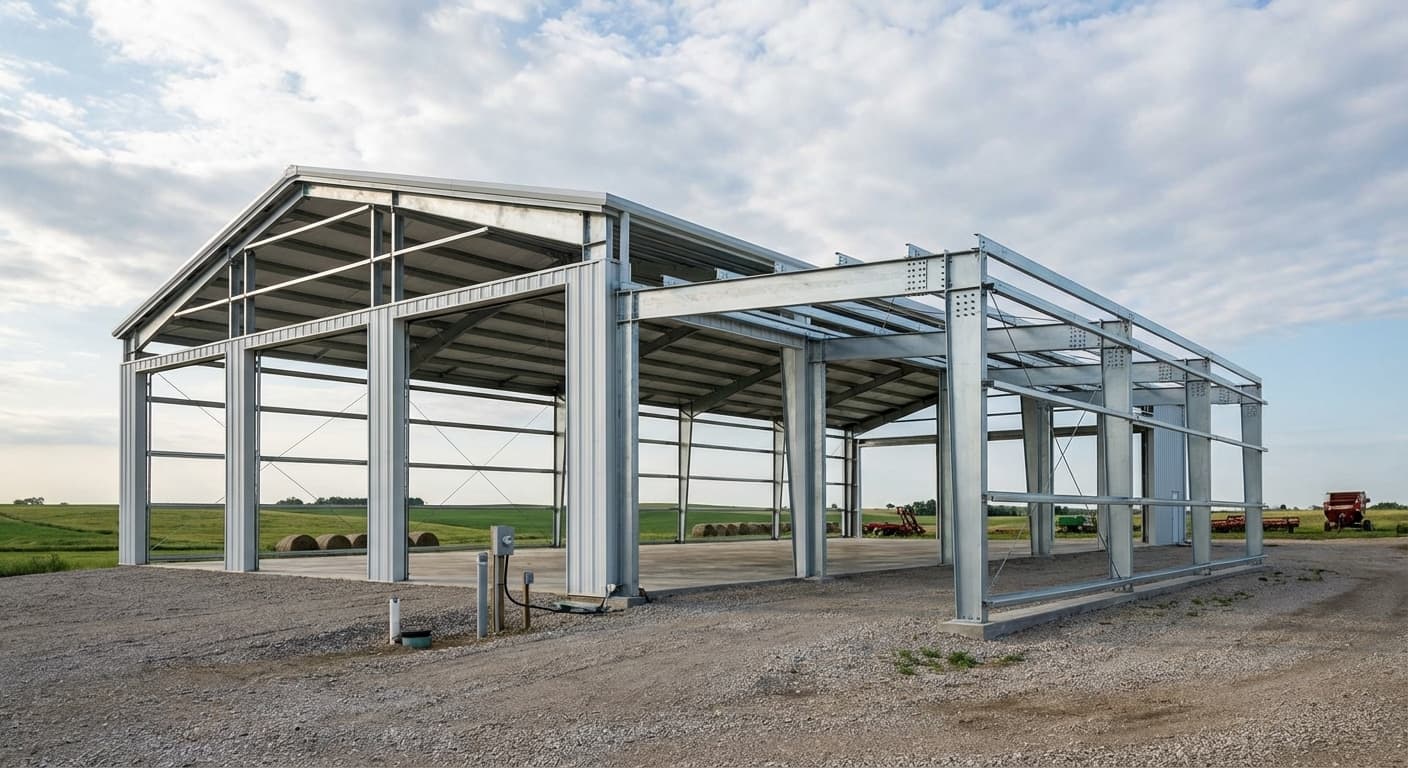

Modular steel-frame farm buildings let you start small–say a 30 x 40 ft. clear-span barn–and expand bay-by-bay without shutting down daily work or paying for costly tear-downs, because every connection point, load path and utility line is engineered from day one to accept future modules that bolt on seamlessly. The article walks you through mapping tomorrow's workflow, heavier equipment and cash-flow cycles, then choosing expandable endwalls, over-sized foundations, 2-in. water lines, empty conduit and hidden-clip roof systems that keep the old and new sections looking identical and performing to the same warranty. You'll learn how to phase construction so revenue-generating spaces pay for the next add-on, how to avoid the 40 % of expansion failures caused by poor soil prep, and how to run fiber and solar-ready roofs before prices rise. By using precision-cut steel that won't rot or harbor pests, you gain an open, column-free interior, lower maintenance and energy bills, and a single-source supplier who guarantees the whole system–from first frame to final bay–fits perfectly for decades.
Why Steel Frame Farm Building Systems Are the Future‑Ready Choice
Expand your steel-frame farm building without shutting down–bolt on precision-made modules for clear-span, column-free space that outlasts wood and cuts energy bills while your operation keeps running.
Understanding modular design for scalability
Your farm won't stay the same size forever. That's why modular steel buildings let you expand without tearing down what you've already built. You get standardized components made with computer-controlled precision–every piece fits perfectly when it's time to grow [2]. Here's what makes expansion practical: You add new sections while your operations keep running [1].
No shutdowns. No starting over. The clear-span design gives you wide-open space with zero interior columns, so your equipment layout stays flexible as your needs change [1]. Built-in connection points take the guesswork out of future additions [2].
Every module maintains the same quality standards, whether you built it yesterday or plan to add it five years from now [2]. You avoid the expensive cycle of build-demolish-rebuild that traps farms using traditional construction [1].
Benefits of steel framing for durability and flexibility
Steel beats wood every time. No rot. No termites. No water damage. Your building stands up to whatever weather throws at it, year after year [4].
Lower maintenance costs mean more money stays in your pocket, backed by warranties that actually mean something [4]. You get completely open floor space–no posts blocking your combine's path or limiting your storage layout. Set up processing lines, sorting stations, and storage zones exactly where they make sense for your workflow [4]. When you need more space, expansion stays simple. Unbolt the endwall, add your new frames, often reuse the same endwall components at the new end [4].
Smart designs include expandable endwalls from day one, making future growth even faster [4]. Your operation keeps running while construction happens, and the finished building looks like you planned it that way all along [4]. Steel buildings also cut your energy bills. Superior insulation keeps temperatures steady for crops, equipment, and livestock without breaking your budget [4]. You get durability and flexibility working together–exactly what growing farms need.
How single‑source solutions simplify future expansions
One provider. One phone number. No finger-pointing when something needs fixing.
That's the advantage of single-source steel building solutions. Your building stays consistent from first frame to final expansion. Same engineering standards.
Same components that fit together perfectly, whether installed today or five years from now [5]. Connection points and load calculations get engineered right from the start–no expensive surprises or jerry-rigged fixes down the road [6].
Planning Your Farm Building for Seamless Add‑Ons
Design your barn today with bolted, anti-seized expandable endwalls on a cash-flow-mapped site so tomorrow's bigger combines, extra storage, or new processing lines slide into place without moving utilities or rebuilding frames.
Assessing current and projected farm operations
Your expansion plan starts with a simple question: where will your operation be in 5 years? Map your current workflow–track how equipment moves, where bottlenecks happen, and which areas see the most traffic [8]. Then project forward. Will you need space for larger combines? More grain storage?
Additional processing lines [9]? Focus on three key growth factors: * Production volume: Calculate realistic increases based on market trends and contracts * Equipment evolution: Plan for heavier machinery and automated systems that need more clearance * Workflow changes: Consider how new technology might reshape your daily operations [9] Smart farmers phase their expansions. You don't need everything at once. Identify which areas generate revenue first–maybe it's cold storage that pays for itself in two seasons, or a processing area that opens new markets [9]. Match your building phases to your cash flow cycles.
Walk your site with expansion in mind. Where do trucks naturally flow? Which direction keeps you clear of wetlands or setbacks? Mark where utilities run now–moving them later costs a fortune [9]. Sometimes the smartest move is starting fresh on a better site rather than forcing an expansion where it doesn't belong [10].
Designing load paths and connection points for steel frame farm building systems
Your building's strength comes from smart load path design–how weight travels from roof to foundation. In farm settings, this matters even more. Your loads change with the seasons: empty in spring, packed at harvest, snow-loaded in winter [11]. Skip the standard endwalls. Expandable endwall frames cost a bit more upfront but save thousands when you expand. They carry a full bay's load–just like your interior frames–so they stay put when you add on [11].
No retrofitting. No engineering workarounds. Just unbolt the panels and keep building. Connection points make or break your expansion. Get these details right now: * Bolt connections: Use anti-seize compounds on every connection. Farm chemicals and moisture will lock up untreated bolts [12] * Panel systems: Choose cladding that stays available.
Nothing worse than mismatched panels five years later [12] * Roof transitions: Hidden clip systems create seamless connections between old and new sections [12] Here's what kills expansions: bad foundations. Poor soil prep causes 40% of extension failures [12]. Test your soil. Compact properly. Build your foundation to handle future loads, not just today's needs.
Integrating utility and ventilation infrastructure early
Run your utilities for tomorrow's operation, not today's. It costs pennies more to install 2-inch water lines instead of 1-inch now–but thousands to dig them up and replace them later [13]. Electrical Planning That Pays Off: * Size your main panel for double your current needs * Run empty conduit to future expansion areas * Use cable trays instead of rigid conduit–easier to modify [13] Ventilation That Scales: Start with passive ventilation. Position windows and skylights to create natural airflow that works year-round [13]. Your workers stay comfortable. Your energy bills stay low [14].
For mechanical systems, think modular. Standard duct sizes let you add sections without custom fabrication. Plan for increased heat and moisture loads–especially if you're adding livestock. Poor ventilation costs you in sick animals and lost productivity [14]. Don't Forget Digital Infrastructure: Your next tractor might drive itself. Your grain bins will text you moisture readings.
Run fiber conduit now, even if you don't pull cable for years [13]. Same goes for solar–design your roof pitch and structure to handle panels when electricity prices make them worthwhile [13]. Smart utility planning turns a good building into a great investment. You expand when you're ready, not when you're forced to by inadequate infrastructure.
Step‑by‑Step Build Process from 30×40 Barns to Mega Dairies
Start with a 30×40 expandable-endwall barn, lay a foundation 10-15 ft longer than today, and every hidden clip, oversized panel, and empty conduit you install now lets you double capacity later without shutting the cows or the cash flow down.
Starting small: The 30×40 barn foundation
Your expansion journey starts with getting the basics right. A 30×40 barn serves as the perfect proof-of-concept for farms testing steel construction. You'll see firsthand how clear-span design eliminates interior posts, creating 1,200 square feet of unobstructed space for equipment, feed storage, or livestock [4].
Begin with an expandable endwall frame instead of standard post-and-beam construction. This decision costs slightly more upfront but saves thousands when expansion time arrives [11]. Your foundation should extend 10-15 feet beyond current needs–this forward thinking prevents costly concrete work later.
Choose connection systems that support future growth. Hidden clip roof systems and modular wall panels make expansions seamless [12]. Install electrical panels sized for double your current needs and run empty conduit to future expansion zones [13].
Scaling to mid-size operations: 60×80 to 100×120 structures
When your operation outgrows that starter barn, the modular design pays off.
Remove endwall panels (often reusable at the new terminus), add prefabricated frames, and extend roofing–all while keeping existing operations running [4].
Mid-size expansions introduce specialized zones within your structure.
- Modular steel frames let you expand without shutting down operations
- Expandable endwalls carry full bay loads, eliminating retrofit costs
- Build foundations 10-15 ft longer and size utilities for double capacity
- Use anti-seize on bolts and specify enduring panel/cladding systems
- Map 5-year workflow, equipment weight, and cash flow before phasing
- Hidden clip roofs and standardized ducts create seamless old-to-new joins
- Test soil and compact properly; 40% of expansions fail from poor foundations
- https://titansteelstructures.com/metal-building-types/prefabricated-agricultural-buildings/
- http://prefabex.com/posts/importance-steel-frame-modular-construction
- https://norsteelbuildings.com/advantages-of-steel-series/advantages-flexibility-of-expansion/
- https://armstrongsteel.com/blog/the-future-of-farming-steel-buildings-and-modern-agriculture
- https://www.universalsteel.com/why-agricultural-steel-frame-buildings-are-the-best-choice-for-modern-farms/
- https://internationalsteelframing.com/the-benefits-of-steel-framing-for-agricultural-buildings/
- https://smartbuildsystems.com/benefits-of-steel-agricultural-buildings/
- https://www.baldpates.org/blog/designing-a-metal-building-for-future-expansion-build-once-grow-forever/
- https://xtdsteel.com/blogs/steel-factory-expansion-planning/
- https://gensteel.com/resources/case-studies/should-you-build-from-scratch-or-expand-existing/
- https://www.cecobuildings.com/blog/metal-building-flexibility-for-future-expansion/
- https://peb.steelprogroup.com/steel-structure/construction/expand-metal-building/
- https://mbmisteelbuildings.com/blog/multi-purpose-agricultural-steel-building/
- https://www.cfisherconstruction.com/6-things-to-consider-before-constructing-agricultural-steel-buildings/
- https://midweststeelerector.com/blog/f/how-long-do-metal-buildings-last-lifespan-and-maintenance-guide
- https://premierbuildings.com/seasonal-maintenance-guide-for-metal-buildings/
- https://roimetalbuildings.com/lifecycle-of-a-metal-building/