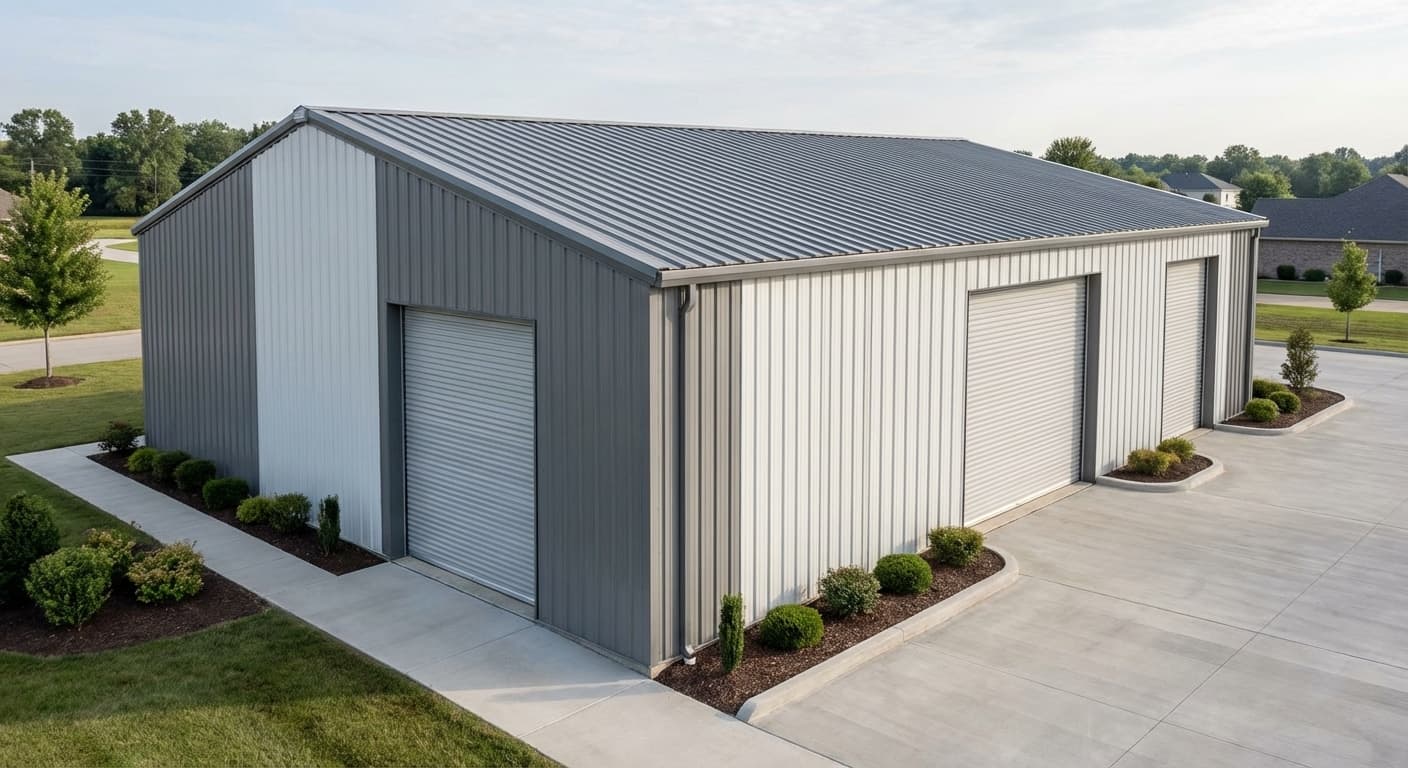

A 20×40 metal building packs 800 square feet of column-free, code-engineered space that works as a garage, workshop, gym, barndominium, or income-producing ADU while costing only $0.40-$0.80 per square foot each year to maintain–far less than wood-frame rivals–and going up in weeks, not months. Readers learn how to match foundation type to soil, pick roof styles for local weather, position doors and windows for maximum access and daylight, and layer insulation, vapor barriers, and smart controls to cut energy use up to 50 percent. The article walks through real-world layouts, from four-bay vehicle storage to partitioned live-work suites, and spells out hard numbers: kit prices $15-$20/sq ft, turnkey totals $19k-$34k, 40- to 60-year lifespan, faster payback via lower insurance, tax credits, and potential rental income. With delivery, certified installation, and lifetime support bundled, the 20×40 steel building becomes the sweet-spot investment that adapts as needs change, outlasts traditional construction, and keeps cash in the owner's pocket every year.
Understanding the 20×40 Metal Building Advantage
An 800 sq ft 20×40 metal building gives you column-free, code-engineered space that parks two cars, hosts a workshop, or runs a business while trimming both upfront costs and long-term energy bills.
Why the 20×40 metal building size is a top choice in 2024‑2025
Your 20×40 metal building delivers 800 square feet that works as hard as you do. It's the size that makes sense–big enough for serious work, small enough to fit your property and budget [1]. Park two vehicles side-by-side, set up a full workshop, or run your business operations without paying for space you don't need [1]. Today's metal buildings do more than shelter equipment.
You get contemporary finishes, larger openings, and the curb appeal that protects property values [3]. Your 20×40 building adapts to how you work–partition it into zones, leave it wide open, or reconfigure it as your needs change. No structural compromises, no support columns eating up floor space [1]. In this economy, the 20×40 footprint hits the sweet spot for value.
You avoid the higher per-square-foot costs of smaller buildings and the unnecessary expense of oversized structures [2]. Plus, modern insulation options turn your metal building into an energy-efficient asset that cuts operating costs year after year [3].
Core specifications: dimensions, clear‑span capacity, load ratings and energy‑efficient options
Your 20×40 building starts with commercial-grade I-beam framing engineered for your exact location [4]. Every inch of the 800 square feet stays usable–no columns blocking your equipment or workflow [5].
We design to your local codes, whether that means heavy snow loads up north or high wind ratings on the coast [5]. Choose from three insulation approaches based on your budget and needs: economical fiberglass batts, high-performance insulated metal panels, or interior liner systems that boost both efficiency and appearance [4][5].
Your building frame handles whatever configuration you need–multiple doors, custom windows, interior offices–while maintaining full structural integrity [5]. Every component works together: primary framing carries the main loads, secondary framing supports panels and transfers forces, and the entire system exceeds the demands of your environment.
Key benefits over traditional construction: speed, cost, durability and sustainability
Your metal building goes up faster, costs less to maintain, and outlasts traditional construction–period. Components arrive ready to assemble, cutting your construction timeline from months to weeks [6]. No weather delays, no surprise costs, just predictable progress from foundation to finished building. The numbers tell the story. You'll spend just $0. 40 to $0.
80 per square foot annually on maintenance versus $1. 50 to $3. 50 for traditional buildings [6]. Lower insurance premiums often follow, thanks to steel's fire resistance and structural strength [8]. While you might pay slightly more upfront for materials, you save on labor and time–and those maintenance savings add up fast [7]. Your building stands up to whatever nature throws at it.
Engineered for high winds, heavy snow, even earthquakes, steel doesn't warp, crack, or feed termites [6][8]. Plan on 40-60 years of service life, often more with basic care [6]. Steel makes environmental sense too. It's one of the most recycled materials available, and your building's energy efficiency–through smart insulation and reflective roofing–cuts operating costs while reducing environmental impact [7][8]. You get a building that works better, lasts longer, and costs less to own. That's the steel advantage in action.
Customizing Your 20×40 Metal Building
Anchor-bolt precision, soil-specific footings, and wind-rated foundation choices decide whether your 20×40 metal building stands for decades or costs you a fortune in fixes.
Foundation and site‑preparation best practices for diverse soils and climates
Your foundation determines how long your 20×40 metal building lasts. Metal buildings handle loads differently than traditional structures–they're lightweight but need solid foundations to resist wind uplift and lateral forces [9]. Start with soil testing. Sandy soil needs deeper footings. Clay soil expands and contracts, requiring extra reinforcement [10]. Know your frost line–foundations must go deeper to prevent shifting during freeze-thaw cycles, especially if you're adding plumbing [9]. Getting this right the first time saves you from expensive fixes later. Your 20×40 building needs the right foundation for your site.
Concrete slabs work for most applications–they're cost-effective, durable, and minimize movement [10]. Got uneven ground or moisture issues? Pier and beam foundations lift your building above problem areas using concrete piers [10]. Need maximum stability? Perimeter wall foundations run continuous concrete walls along your building's outline–perfect for challenging soil [9]. In high-wind zones, moment-resisting foundations act like retaining walls with wide bases that won't tip or slide [11]. Your local codes and site conditions determine the best choice. Anchor bolt placement can make or break your project.
Miss by an inch, and your columns won't fit–that's how precise pre-engineered buildings are [11]. You need at least four anchor bolts per column now, not the old standard of two. Your engineering specs dictate exact bolt types, diameters, and lengths [11]. Site prep means clearing everything–vegetation, debris, unsuitable soil–to create a level base [9]. In extreme weather areas, add drainage systems and waterproofing to prevent moisture damage [9]. Your foundation must handle both your local conditions and steel's unique characteristics: light weight but vulnerable to uplift forces [9]. Professional installation teams know these details matter.
Roof styles, door & window configurations, and interior layout flexibility for a 20×40 metal building
Your roof style affects how your building performs and lasts. Vertical roofs run panels from peak to eave–rain, snow, and debris slide right off, preventing rust and damage in tough climates [12]. Gable roofs give you traditional looks with good drainage. Single-slope roofs excel in heavy rain areas [13]. Standard buildings come with 9-foot legs, but you can go taller for equipment clearance or extra storage [12]. Choose based on your climate and needs. Your door setup determines how you use your space.
The 20×40 footprint fits two vehicles side-by-side standard. Need more access? Install four 8×8 garage doors along the side for a 4-bay setup–perfect for frequent vehicle movement [12]. Roll-up doors save space and last longer, with custom frame-outs for special sizes [12][14]. Place walk-in doors where you need them. Windows go wherever you want–you can even specify locations after ordering [12]. It's your building, your way.
Clear-span design gives you 800 square feet with zero obstructions–as covered earlier, no support columns means total flexibility [14]. Park vehicles, set up workshop equipment, or partition spaces however you need [14]. Add a mezzanine to double your usable area. Build offices in one corner, storage in another. Run a workshop up front and park in back [13]. Each zone gets its own insulation and climate control [14]. Your layout changes as your needs change–that's the advantage of open design.
Insulation, panel options and smart‑home integrations to maximize energy savings
The right insulation cuts your energy costs dramatically. You've got four proven options: Fiberglass batt – Most popular and affordable. R-values from R-10 to R-30. Easy to install but thermal bridging at purlins reduces efficiency [15][17]. Spray foam – Creates an airtight seal with superior thermal resistance. Costs more and needs professional installation, but performs best [15][17]. Rigid foam board – High R-values with stable dimensions. Great for flat roofs but won't dampen sound like fiberglass [17]. Insulated metal panels (IMPs) – Structure and insulation in one. Higher upfront cost but saves on labor and delivers excellent performance [15][17].
Vapor barriers prevent expensive problems. Standard vinyl barriers (1. 0 perm rating) barely protect you. Quality barriers rate 0. 02 or lower–that's what stops condensation, rust, and mold [17]. Your facing material matters too. White or reflective facings cut lighting costs. Reinforced facings with fiberglass or nylon mesh resist punctures and last longer [17]. Premium systems use vapor barriers 300% stronger than standard vinyl, brightening interiors while eliminating condensation and those failure-prone stapled seams [16]. Smart panel choices boost your energy savings.
Vertical panels shed water efficiently, protecting your insulation from moisture damage. In hot climates, reflective insulation systems bounce heat away–combine them with other insulation for maximum effect [15]. Today's metal buildings work with smart-home tech. Automated systems adjust heating, cooling, and lighting based on when you're there. Pair smart controls with quality insulation and you'll cut energy use by up to 50% versus traditional buildings [16]. Bottom line: The right insulation, panels, and controls pay for themselves through lower utility bills. You stay comfortable year-round while saving money every month. That's smart building.
Smart Applications and ROI of a 20×40 Metal Building
A 20×40 metal building turns $15-$20 per square foot into a column-free, multi-purpose asset–park four cars, run a rental ADU, or host a fully-equipped gym–while outlasting stick-built options and often paying for itself through rental income alone.
Residential and hobby uses: garages, home gyms, barndominiums and accessory homes
Smart Applications and ROI of a 20×40 Metal Building### Residential and hobby uses: garages, home gyms, barndominiums and accessory homesYour 20×40 metal building delivers immediate value for residential use. Park four vehicles side-by-side, store your boat and RV, or create the ultimate hobby space–all in one structure [4][18]. As discussed in the customization section, the column-free interior lets you divide space however you need. Want a two-car garage plus workshop? Done. Need seasonal storage plus year-round workspace? Easy.
Add insulation and climate control to specific zones, and you're working comfortably year-round while keeping utility costs in check [19]. Turn your building into a home gym that actually gets used. The steel frame handles ceiling-mounted equipment–heavy bags, suspension systems, pull-up rigs–without breaking a sweat [19]. High ceilings give you room for basketball hoops or climbing walls. Strategic window placement cuts your daytime lighting costs to near zero. Add proper insulation (see Section 2 for options), and you've got a comfortable workout space that beats any monthly gym membership [19]. Barndominiums and ADUs make smart financial sense.
Your 20×40 building converts into profitable living space–whether that's rental income, in-law quarters, or your own efficient home-workshop combo [19]. No load-bearing walls means you design the layout you want. Add plumbing, electrical, and proper insulation, and you've got a legitimate dwelling that boosts property value. Many owners recoup their investment through rental income alone, while solving housing needs for family or tenants. The steel structure outlasts traditional ADU construction by decades, keeping your investment sound [19].
Commercial and agricultural uses: workshops, small warehouses, livestock shelters and RV storage
Financial outlook: current cost per square foot, financing options, tax incentives and long‑term ROI compared to alternativesYour 20×40 metal building investment breaks down simply: $15-$20 per square foot for kits, $24-$43 installed and ready to use [21]. Yes, commercial-grade I-beam frames cost more than tubular steel–they also last twice as long and handle whatever nature throws at them [21]. Total cost? Plan on $19,200-$34,400 for a complete 800 square foot building, foundation to finish. Here's what makes the numbers work: You'll spend $0. 40-$0. 80 per square foot annually on maintenance.
Traditional buildings? Try $1. 50-$3. 50 [23]. Over 50 years, that's serious money saved. Insurance companies love metal buildings–lower premiums start day one. Add 12-gauge framing with its 20-year rust warranty, and you're looking at minimal upkeep for decades [22].
Break-even happens faster than you think. Most owners recover the 5-15% premium over wood construction within 15-20 years through maintenance savings alone [23]. Factor in energy efficiency (covered in Section 2), lower insurance, and potential rental income, and payback accelerates. Financing? Beyond standard construction loans, specialized metal building packages offer competitive terms. Commercial users capture depreciation benefits, while everyone can tap energy efficiency tax credits. Smart money goes steel–it's math, not magic [23].
Installation, Compliance, and Ongoing Support
Get a zero-maintenance steel building delivered and installed for free, protected by full-coverage warranties, with one company handling design through decades of live support.
Step‑by‑step installation timeline with DIY vs professional considerations
Maintenance plan, warranty coverage and National Steel Buildings Corp. 's single‑source service from design to post‑sale supportYour steel building needs minimal maintenance–just annual checks on fasteners, sealants, and door operations. That's it.
We back this durability with comprehensive warranties covering workmanship and finishes, including no-dollar-limit weathertightness coverage when installed by certified professionals [30][31]. Here's what sets us apart: single-source accountability from design through decades of use. Free delivery and professional installation come standard–no juggling contractors or surprise charges [30].
We handle everything: initial design, heavy-duty steel framing, weather-resistant panels, secure anchoring for your specific location, and ongoing support when you need it [30]. One call, one company, one point of contact throughout your building's life.
- 20×40 metal building gives 800 ft² column-free space for vehicles, workshop, or business use.
- Annual maintenance costs $0.40-$0.80/ft² vs. $1.50-$3.50 for traditional buildings.
- Vertical roof panels and quality vapor barriers prevent rust, mold, and energy loss.
- Foundation must be engineered to local soil, frost line, and wind-uplift requirements.
- Insulated metal panels and smart controls can cut energy use up to 50%.
- Complete installed cost ranges $19k-$34k with break-even in 15-20 years via savings.
- Steel frame lasts 40-60+ years, is recyclable, and qualifies for lower insurance and tax credits.
- https://www.carportcentral.com/blog/everything-you-need-to-know-before-buying-a-20-x-40-metal-building?srsltid=AfmBOopEI5i4w10FoCxDQsNqoqIW5OJKAuPPHibO7LR3avlQKodroiYw
- https://directmetalstructures.com/blog/comparisons-between-our-most-popular-building-sizes-20×40-30×40-and-40×60-metal-buildings/?srsltid=AfmBOopOhAimjlyE7jSt_S9gm_cMSSOCN39uy27Oc1TxajMX1WmjBg_1
- https://armstrongsteel.com/blog/top-metal-building-design-trends-to-watch-in-2025
- https://gensteel.com/steel-building-kits/base-building-packages/20×40/
- https://www.clearspan.com/metal-buildings/
- https://metalcon.com/blog/what-makes-metal-buildings-more-resilient-than-traditional-construction/
- https://trusteelbuildings.com/cost-benefit-analysis-of-steel-vs-traditional-construction/
- https://www.hswilliams.com/blog/what-are-the-advantages-of-metal-buildings-over-traditional-construction
- https://www.worldwidesteelbuildings.com/blog/guide-foundations-for-metal-buildings/
- https://thelunacrew.com/foundation-plans-for-metal-buildings-the-ultimate-guide/
- https://www.buildingsguide.com/build/metal-building-foundations/?srsltid=AfmBOorgOys0IRfQDtM8wKounmnHmPiFIDYxHWU0zHkjWDGJgzyIlGbb
- https://alansfactoryoutlet.com/product/20×40-vertical-roof-metal-garage/?srsltid=AfmBOopp_R0LLnoibkAd49bdEKuMBa_QuA3WSrhJyn7__S-koTGpkQY4
- https://www.uspatriotsteel.com/sizing/20×40-metal-building/
- https://www.carportcentral.com/blog/everything-you-need-to-know-before-buying-a-20-x-40-metal-building?srsltid=AfmBOoqA1B07T010uJPRxUCcsNrU431sYAr3C_RSa2x9Y5MTkyvR39W-
- https://www.rmax.com/blog/metal-building-insulation
- https://www.rhinobldg.com/metal-building-insulation
- https://www.buildingsguide.com/build/metal-building-insulation/?srsltid=AfmBOornh6pRmnDYAiL7JpQbPQWOAkPOpjD6NXVhFG01NqpbZLh7zPU-
- https://www.bossbuildings.com/20×40-metal-buildings/?srsltid=AfmBOopi6MaejX61mBQHBybFcQ6Jk0ub7_y6CuklzQAF_pkNtVo2QkyG
- https://www.carportcentral.com/blog/everything-you-need-to-know-before-buying-a-20-x-40-metal-building?srsltid=AfmBOopMHYChwb4kaYEnWoq5z4XW43rgJvEISWlwSMRt8mkjaHsx5EZ0
- https://www.uspatriotsteel.com/blog/how-much-does-a-20×40-metal-building-cost/
- https://www.buildingsguide.com/metal-building-prices/?srsltid=AfmBOoqjZwB5iPCHRjSh5Loz96Eng66pGlXVCFJZXm2YahbgaPXthkkJ
- https://alansfactoryoutlet.com/product/20×40-vertical-roof-metal-garage/?srsltid=AfmBOoqhuycd99G2CvI4pNIacnyu_b-3LsLrhLTAyvqiCt-O6IcFZ7pC
- https://americansteelinc.com/blog/steel-building-costs-prices-guide/
- https://trinitysteelstructures.com/blog/metal-building-kits-diy-vs-professional-installation?srsltid=AfmBOophnLPr9NGQ7_35JTFJmRWnc7DSQyfnleRaBjdRqaNMyMrf2SGS
- https://www.carportcentral.com/blog/metal-building-installation-self-or-professional?srsltid=AfmBOopMO1HgpZUOHf5O9GfvaF6EZtP22Sc68seplPn6OomipoxN5vFu
- https://premierbuildingswesternoklahoma.com/blog/diy-vs-professional-installation-pros-and-cons-for-metal-buildings
- https://www.flsenate.gov/Laws/Statutes/2025/Chapter553/All
- https://garagebuildings.com/navigating-building-codes-permits-for-steel-structures-state-by-state-guide
- https://www.buyabp.com/understanding-metal-building-permits-in-florida
- https://www.nationalsteelbuildingsinc.com/
- https://www.nucorbuildingsystems.com/resources/warranty/