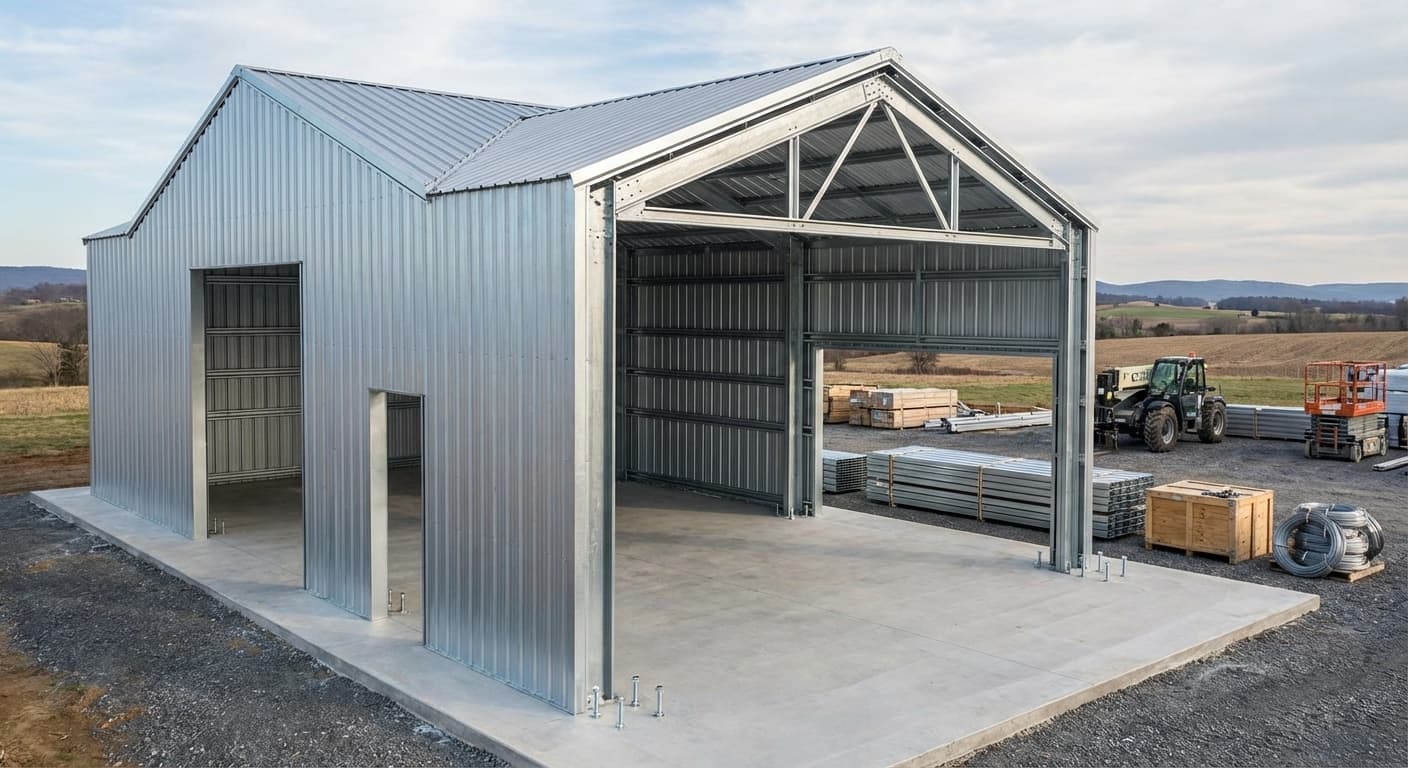

A 20×40 steel barn delivers 800 square feet of rot-proof, maintenance-free workspace that, when specified and erected correctly, will outlast wood structures by decades while needing only two quick inspections a year. The article walks you through every cost and decision–choosing 12- or 14-gauge framing for your snow/wind zone, laying out drive-in, workbench and storage zones, budgeting $19-34k turnkey, and locking in quotes before steel prices climb–so you can balance performance and price without mid-project surprises. It shows how to avoid the classic pitfalls: anchor-bolt misalignment, condensation, water infiltration and delivery chaos, while explaining why single-source suppliers, 3D renderings and weekly one-page updates keep construction on schedule. By following the proven foundation-to-finish sequence–cure concrete five days, erect steel in one to three weeks, seal gaps and apply anti-condensation coatings–you'll own a galvanized, wood-free building that laughs off humidity, pests and weather extremes and still looks new after fifty years of hard farm or shop use.
Designing a Durable 20×40 Steel Barn
Engineer your 800 sq ft 20×40 steel barn for a 50-year life by choosing 12-gauge framing, locking diagonal braces into every bay, and mapping drive-in, workbench, and storage zones before the first panel goes up.
Choosing the Right Frame and Gauge for Longevity
Your 20×40 steel barn starts with the right frame–the difference between 20 years and 50 years of service. Most residential projects thrive with 14-gauge framing, balancing strength with your budget [1]. But if you're facing heavy snow or high winds, 12-gauge steel makes more sense. You'll spend slightly more upfront for dramatically better storm resistance [3].
Your frame works as a system. Base rails lock to your foundation. Vertical legs carry the load. Roof bows span overhead.
The real strength comes from diagonal leg braces and peak braces–these prevent the twisting that causes other buildings to fail during severe weather [3]. Here's what matters when comparing quotes: Check the gauge on every structural member, not just the panels. Premium regional engineering beats generic designs every time [2]. Your 800 square feet needs proper weight distribution throughout–cut corners here, and you'll see sagging in year five instead of standing strong in year fifty [1].
Optimizing Layout for Multi‑Purpose Use
Your 20×40 barn gives you 800 square feet to work with–enough for real flexibility. The single-bay design means you control the layout, not the other way around. Think zones. Map your needs first: Where does the tractor go? Workshop area? Feed storage? Then plan your traffic flow before anything permanent goes in.
Smart owners position big equipment near the main door, keeping the center clear for work space [4]. The 40-foot length naturally splits into thirds. Front third for drive-in access. Middle for your workbench and projects. Back third for secure storage or specialized areas [6]. Keep those walkways 3 feet minimum–you'll thank yourself when maneuvering equipment [6]. Door strategy makes or breaks usability.
An 8-10 foot roll-up door handles equipment. Add a standard walk-through door on the side or rear for quick access without cranking open the big door every time [5]. Position windows where you'll actually work–natural light cuts energy costs while improving ventilation [6]. Skip permanent interior walls. Movable partitions let you switch from wide-open workspace to divided storage as seasons change [4]. Don't forget vertical space–with 8-20 foot ceilings, overhead storage or a loft doubles your usable area without expanding the footprint [4].
Integrating Clear Communication into the Design Process
Clear communication keeps your steel barn project on track and under budget. You need updates that matter, not paperwork that wastes time. Weekly one-pagers work best. Current tasks, next week's work, anything unusual–that's all you need. Add labeled photos of key stages for your records. If problems pop up later, you'll have proof of what happened when [7]. Before breaking ground, get potential issues on the table. Steel deliveries running late?
Weather window closing? Address it now, not when it derails your timeline [7]. The right builder brings solutions, not just problems. They'll also build contingency funds into your initial budget–typically 5-10% for steel projects. No mid-project surprises [7]. Use modern tools to your advantage. Project management platforms beat phone tag every time. Design changes, material specs, timeline shifts–everything stays in one place where you and your builder can track it [8].
Complex details? Ask for visuals. A quick 3D rendering clarifies more than pages of specifications [8]. This systematic approach matters because steel building success relies on precision. Foundation anchors, frame alignment, panel installation–each phase builds on the last. Clear communication ensures everyone stays aligned on your vision while meeting the technical requirements that make steel buildings last decades.
Cost‑Effective Planning and Pricing
Lock in an itemized, single-source quote now–because every month you wait can add thousands to your 20×40 steel barn's real-world, turnkey cost of $19-34k.
Breaking Down the 20×40 Steel Barn Budget
Your 20×40 steel barn starts at $7,000-$12,000 for the basic kit–frame, roof panels, and walls included [9]. But you're planning smarter than that. You need the complete picture: foundation ($3,200-$6,400), professional installation ($3,000-$10,000), permits ($300-$2,500), and site prep ($1,000-$5,000) [10].
All in, you're looking at $24-$43 per square foot for a turnkey project–that's $19,200-$34,400 total [11]. Here's what drives your final number: steel gauge selection (as discussed in the framing section above), roof style, and your local building codes [9][10]. In high-wind or heavy-snow areas, certified structures aren't optional–they're required, and they cost more [10].
Smart buyers know that installation runs 30-40% of total project cost, so comparing kit prices alone tells you nothing [10]. Get itemized quotes that break out every component–materials, labor, foundation, permits. That's how you spot savings without cutting corners on quality [9].
Leveraging Single‑Source Solutions to Reduce Expenses
Single-source solutions cut your costs by 20-30%–no middleman markup, no coordination headaches [12].
Understanding Market‑Driven Steel Pricing Trends
Steel prices move with the market, and right now hot-rolled coil runs $950-$1,050 per ton–about double the 2018 rates [15]. For perspective, a 30×40 building with 12-gauge framing costs $26,000-$32,000 installed today, up from $17,000-$20,000 in 2023 [15]. That's reality, not speculation. What pushes prices in your area? Global supply chains, regional demand, energy costs–plus location-specific requirements [16]. Florida, Gulf Coast, and heavy-snow regions?
Add $3-$6 per square foot for required certifications [15]. Waiting for prices to drop usually costs you more. One Arizona buyer delayed three months hoping for better pricing. Result: $3,800 increase from freight hikes and contractor scheduling [15]. Tariffs and trade policies shift availability overnight [16]. Here's your strategy: Lock in quotes when you're ready to build.
Steel costs have found their post-pandemic level–higher than 2018, stable compared to 2021-2022 chaos [15]. Our national buying power helps cushion these market swings, but the smartest move? Build when you need the building. Time saved often outweighs any potential price drop.
Construction and Erection Best Practices
Lock your anchor-bolt template in place before the concrete truck arrives–because a half-inch misalignment on day one can blow your budget and your 20×40 barn's entire schedule.
Coordinating Foundation Work and Steel Erection
Your 20×40 steel barn rises fastest when foundation and steel work flow together seamlessly. Foundation work takes 1-4 weeks from site prep through concrete pour [19]. The make-or-break moment? Setting anchor bolts. Half an inch off means columns won't seat–and you're looking at expensive fixes [18]. That's why you need plywood templates matching your manufacturer's bolt pattern.
Lock those anchors in position before concrete arrives [18]. Give concrete 5-7 days to cure properly [17]. Then steel erection moves fast: columns first, then girts and purlins. A four-person crew installs about 400 feet of purlins daily [17]. Book foundation inspections two weeks ahead–inspectors stay busy [17]. Weather dictates your schedule.
Rain stops concrete work. High winds halt steel lifting. Plan accordingly [17]. Create a truck unloading sequence that matches your erection plan. Your crew stays productive instead of hunting through bundles [17]. Get this coordination right, and your 20×40 steel frame stands complete within 1-3 weeks after foundation cures [19].
Ensuring Quality with Professional 20×40 Steel Building Contractors
Quality contractors turn your 20×40 steel building into a lasting asset through systematic control at every phase. Before breaking ground, they verify soil conditions match engineering specs. They use anchor bolt templates for precise column alignment–because half-inch errors mean expensive fixes [20]. During steel erection, professionals inspect every component and connection.
They verify welding quality, bolt torque, and structural alignment [20]. This isn't bureaucracy–it's protection for your investment. The best contractors run three critical inspections: – Pre-construction foundation verification – Steel erection quality checks – Final weathertight envelope inspection [21] They document everything with photos and formal sign-offs. You get proof that hidden components meet specifications [20].
They hold pre-fabrication meetings to align quality standards before steel arrives [20]. This systematic approach prevents the problems that haunt poorly erected buildings: misaligned doors, leaking roofs, compromised connections [21]. Top contractors prove their standards early–they'll create mock-ups of foundation templates and coatings before full-scale work begins [21]. That's how you spot a pro.
Problem‑Solving Common On‑Site Challenges
Steel barn construction faces predictable challenges. Here's how you solve them before they cost you time and money: Condensation Control: Steel sweats when temperatures change. Left untreated, moisture causes corrosion. Solution: Apply CondenStop anti-condensation coating. Add proper ventilation. You'll prevent damage and reduce noise simultaneously [22].
Gap Management: Light and insects enter at panel seams and corners. These gaps hurt energy efficiency and security. Solution: Install foam enclosures that match your panel ridges exactly [22]. Water Infiltration: Water seeps under base rails when concrete slabs extend too far (add only 1" for 30' wide buildings, 2" for larger). Solution: Apply polyurethane sealant and foam gaskets between concrete and base rail [22]. Foundation Precision: As covered in our design section, anchor bolt placement demands accuracy.
Use manufacturer templates during concrete pour to position anchors perfectly [24]. Delivery Coordination: Components arriving out of sequence derail schedules and inflate costs. Solution: Create an unloading plan matching your erection sequence. Your crew stays productive, not searching bundles [23]. Address these challenges upfront. Your 20×40 barn goes up faster, stays within budget, and performs better for decades.
Maintenance‑Free Operation for Decades
Galvanized steel barns eliminate rot, termites, and warping–saving you thousands in repairs with just two 30-minute inspections each year.
Why Galvanized Steel Eliminates Rot Concerns
Your galvanized steel barn simply won't rot–period. While wood structures fail from water damage, your steel building shrugs off moisture with its zinc-coated armor that blocks rust before it starts [25]. No rot means no expensive repairs. No termites eating your investment.
No sagging beams requiring emergency fixes [26][27]. Here's what that saves you: zero hours replacing rotted posts, zero dollars on pest control contracts, zero weekends patching weather damage [25]. Your steel stays straight and strong year after year–no warping, no twisting, no splitting that lets moisture creep in [26]. For agricultural use, this matters even more.
Animals and equipment create humidity swings that destroy wood barns through moisture cycling. Your galvanized steel doesn't care–it performs the same whether bone dry or soaking wet [26]. That's decades of reliable service without the maintenance headaches that keep other barn owners up at night.
Routine Inspections that Preserve Service Life
Two inspections per year keep your steel barn running like new. Mark your calendar for spring (after the last freeze) and fall (before winter hits) [29]. These 30-minute walkarounds catch small issues before they cost real money. Your inspection checklist takes five steps: – Roof systems: Tighten loose fasteners, clear gutters, check sealants – Foundation: Look for water pooling or concrete cracks – Wall panels: Spot scratches or dings needing touch-up – Penetrations: Re-seal around vents and utility entries – Doors: Test operation and adjust as needed [28] Keep a simple logbook–date, what you found, what you fixed.
This documentation backs warranty claims and shows patterns before they become problems [28]. Our [metal roofing systems](https://nationalsteelbuildingscorp. com/service/metal-roofing/) include detailed maintenance guides specific to your installation. Once yearly, pressure wash the exterior to remove dirt and chemicals that can eat through protective coatings [30].
Consider professional inspection annually–trained eyes catch issues you might miss, especially where multiple systems connect [30]. This basic routine prevents those cascading failures that turn minor fixes into major rebuilds [28].
- 14-gauge steel suits most homes; 12-gauge resists heavy snow and wind.
- All-in cost: $19-34k for turnkey 20×40 barn, $24-43 per sq ft.
- Anchor bolts must be exact; ½-inch misalignment ruins column fit.
- Galvanized steel eliminates rot, termites, warping–zero wood repairs.
- Twice-yearly 30-min roof-to-foundation inspections prevent costly failures.
- Single-source design-build cuts total price 20-30% versus split vendors.
- Lock steel quotes when ready; delays added $3.8k in one Arizona case.
- https://www.carportcentral.com/blog/everything-you-need-to-know-before-buying-a-20-x-40-metal-building?srsltid=AfmBOorM4qvx_pBYkxeYVgCMmbYkHy2t79p0EmUNFYIgeKE-kWEWk9vC
- https://directmetalstructures.com/blog/comparisons-between-our-most-popular-building-sizes-20×40-30×40-and-40×60-metal-buildings/?srsltid=AfmBOopMNMUCv-_S5qC1oWtx8QGLJrU7-zq5slLCIjZMIQOjmLnYbBD_
- https://www.bossbuildings.com/infographics/metal-building-and-carport-framing-an-ultimate-guide/?srsltid=AfmBOoq-pqRS4BHxiQRJXYzYTYFcPEvx0bqGNEbDnamrSkOmbe1KmJcH
- https://www.vikingsteelstructures.com/40×20-metal-building?srsltid=AfmBOorreBQvss01PtTyUdKaqSm9eMqGhbVw9PKFIGplXSsdtk0idg2R
- https://gensteel.com/steel-building-kits/stables/20×40-stable/
- https://www.uspatriotsteel.com/product/20×40-heavy-duty-equipment-workshop/
- https://constructionexec.com/article/mastering-the-art-of-construction-client-communication?utm_campaign=PostBeyond&utm_source=LinkedIn&utm_medium=353405&utm_term=Mastering+the+Art+of+Construction+Client+Communication
- https://struxhub.com/blog/the-ultimate-guide-to-effective-communication-in-construction-top-useful-strategies-and-tools/
- https://www.uspatriotsteel.com/blog/how-much-does-a-20×40-metal-building-cost/
- https://www.vikingsteelstructures.com/metal-shop-building-prices?srsltid=AfmBOoqvlxpu24bd7XXF_-9p_xQSGNMIKeoELHIPRnlcWsfON9jzUrVQ
- https://www.buildingsguide.com/metal-building-prices/?srsltid=AfmBOor-ZhpBJEKUKvrgf4mturWAf5nBv6lPqwzYi31A-YOfnp25jaDY
- https://www.tylerbuilding.com/post/why-buy-direct-from-a-metal-building-manufacturer
- https://fairview-na.com/single-source-supply/
- https://www.metalconstructionnews.com/articles/features/metal-building-systems-pre-engineered-metal-buildings/
- https://www.aametalbuildings.com/blog/2025-metal-building-price-trends-are-steel-building-costs-going-up-or-down-this-year?srsltid=AfmBOooMWvWrtxcHxowld51As3g_1WO3OHli6EvJmd9nUu0tNMRvysuW
- https://americansteelinc.com/blog/steel-building-costs-prices-guide/
- https://www.alpha-labor-co.com/blog/pemb-erection-timeline
- https://iconsteelbuildings.com/steel-building-foundation-requirements/
- https://gravitycontractors.com/how-long-does-it-take-to-erect-a-steel-building/
- https://iconsteelbuildings.com/construction-quality-control-checklist/
- https://buildnp.com/blogs/construction-quality-control-checklists/
- https://mwsteelbuildings.com/common-steel-building-problems-solutions/
- https://wiebessteelstructures.com/common-challenges-in-steel-building-construction/
- https://www.coast-to-coastcarports.com/dont-make-these-concrete-foundation-mistakes-with-your-steel-building-project?srsltid=AfmBOoqps5lj-4rORk1HWqKOH5weQEeB0Pz4aG1WRpMkAerhy3O5h7Au
- https://www.newmartbuildersinc.com/blog/benefits-of-steel-farm-buildings/
- https://www.summitsteelbuildings.com/free-up-time-steel-farming-buildings-require-less-maintenance
- https://waldropmetalbuildings.com/the-benefits-of-metal-buildings-over-traditional-construction/
- https://seufertconstruction.com/company/blog/metal-building-maintenance-checklist
- https://premierbuildings.com/seasonal-maintenance-guide-for-metal-buildings/
- https://www.mscsteel.com/blog/maintenance-tips-for-your-steel-building-with-checklist.html
- https://www.nationalsteelbuildingsinc.com/
- https://www.nationalsteelbuildingsinc.com/faq
- https://garagebuildings.com/steel-building-warranties-explained-whats-really-covered-in-2025-2026