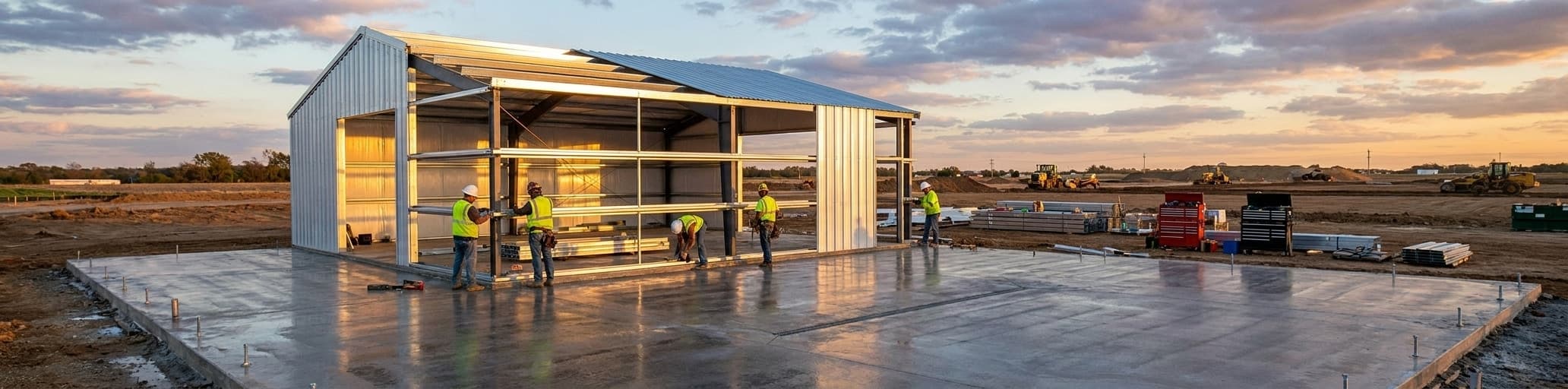

We help you understand 24×32 metal building costs by breaking down kit pricing, foundation requirements, and customization options so you can budget accurately. A turnkey approach protects you from hidden expenses and scheduling delays that typically inflate project costs beyond initial estimates.
How Much Does a 24×32 Metal Building Cost in 2026?
A 24×32 metal building shell ranges from $7,700 to $34,560 depending on whether you choose kit-only materials or fully engineered turnkey construction.
Average pricing for a 24×32 steel building shell (with real cost ranges)
A 24×32 steel building covers 768 square feet. Using current market data, kit-only shells for structures in this size range start around $10-$15 per square foot before installation, while fully engineered, turnkey construction runs $15-$45 per square foot depending on materials, local labor rates, and customizations.[1] That puts a 24×32 metal building shell in the following realistic ranges:
| Build type | Estimated cost range | Notes |
|---|---|---|
| Kit shell only (no installation) | $7,700-$11,500 | Materials only; erection costs are separate[1] |
| Turnkey custom construction | $11,500-$34,560 | Includes design, labor, and basic features[1] |
| Comparable pole barn kit (24x36x8) | ~$8,825 starting | Nearest available reference size[2] |
For context, basic shells on small buildings in this footprint class start around $12,000, with mid-range structures climbing to $24,000 and above once site conditions, permit fees, and add-ons are factored in.[1] Pole barn kits of similar dimensions — a 24×36 at 8-foot eave, for example — are listed starting at $8,825 as a materials-only kit, which underscores how much erection labor and engineering can shift your final number.[2] The spread between low and high estimates is wide precisely because local labor rates, regional code requirements, and selected finishes each carry real dollar weight. Settling on a budget without accounting for all three typically produces a shortfall mid-project.
Cost per square foot: what you'll actually pay versus industry estimates
The gap between what industry guides quote and what you actually pay for a 24×32 metal building often comes down to which cost tier is being reported. At 768 square feet, applying current per-square-foot benchmarks produces a wide range — and knowing why that range exists protects your budget from mid-project surprises. Kit-only shells for comparable structures advertise $10-$15 per square foot, but those figures exclude installation.[1] Fully custom, turnkey construction with design and labor included starts closer to $15-$20 per square foot and can climb to $45 per square foot depending on materials and regional complexity.[1] For a conventional detached garage in the same footprint class, national averages for 2026 run $45-$75 per square foot fully built, putting a completed 24×32 structure between $34,560 and $57,600 when construction labor, finishes, and utilities are part of the equation.[4] HomeAdvisor's surveyed data puts the typical detached garage project at $26,400, with a realistic range from $9,600 to $75,600 — confirming that no single number applies universally.[3]
| Cost tier | Per sq ft range | Applied to 768 sq ft |
|---|---|---|
| Kit shell only (materials, no install) | $10-$15 | $7,680-$11,520[1] |
| Custom turnkey (design + labor included) | $15-$45 | $11,520-$34,560[1] |
| Fully built detached garage (national avg, 2026) | $45-$75 | $34,560-$57,600[4] |
| National survey average (all detached garages) | Varies | ~$26,400[3] |
Labor is the largest hidden multiplier: professional crews add roughly 60% on top of material costs, and electricians alone can contribute another $1,000-$3,800 to the total.[3] Regional labor rates and permitting further shift the number by 15%-30% depending on location.[4] The practical takeaway is straightforward — industry estimates quoting $10-$15 per square foot describe a materials-only kit sitting on a flatbed, not a finished, code-compliant structure ready to use. Budget using the turnkey range, then treat the kit price as a floor rather than a target.
Why National Steel Buildings' turnkey pricing beats kit-only quotes
The kit sticker price for a 24×32 metal building looks attractive until you realize it covers only 40-60% of your actual project budget.[5] What's missing: foundation work, erection labor, engineering fees, permit costs, and equipment rental — none of which appear on a standard kit invoice.[6] A certified crew alone charges $5-$12 per square foot just to assemble the base structure, and if you hire a general contractor to coordinate multiple trades, expect an additional 10-20% added to your total.[7] Managing those relationships — surveyor, concrete contractor, steel erector, electrician — introduces scheduling risk, accountability gaps, and the kind of mid-project cost creep that rarely shows up in a kit-only quote.[6] A turnkey approach bundles design, fabrication, foundation coordination, and erection under one contract, so the number you agree to at the start is the number you build to.
There's no separate invoice arriving after the slab pours or after the erection crew finishes.
For buyers evaluating single-source accountability versus the DIY coordination model, the barndominium contractors turnkey vs. shell pricing breakdown illustrates exactly how coordination failures between trades translate into real budget overruns — and why one point of contact changes that math entirely.[6] Locking in a turnkey quote also protects against material price swings: with hot-rolled coil steel hovering around $1,002 per ton and Section 232 tariffs adding 25-30% pressure across North American supply chains, a fixed contract price insulates your 24×32 project from mid-build escalation.[7]
Concrete Slab Requirements for 24×32 Metal Buildings
Pour your 24×32 slab at least 4 inches thick and extend it one extra inch on all sides to reinforce the concrete anchor zones and prevent cracking.
Standard slab specifications: thickness, reinforcement, and frost depth
For a 24×32 metal building, the concrete slab should be poured at a minimum of 4 inches thick, and the slab itself should be sized slightly larger than the building footprint — one extra inch on all sides.[8] That means a 24×32 structure calls for a slab closer to 24'2" x 32'2".
The added perimeter concrete isn't incidental: it reinforces the zone where concrete anchors expand into the footing, preventing cracking or chipping caused by load transfer as the steel structure settles and shifts.[8] Footing requirements hinge on building width.
Buildings 32 feet wide and up require a minimum 24-inch wide by 24-inch deep footing to handle the combined weight of the steel framing and engineered trussing, compared to the standard 12-inch by 12-inch footings used on narrower structures.[8] Because a 24×32 measures 24 feet wide, it falls into the standard footing category — but confirming local code requirements with your township or county is non-negotiable, since frost depth, soil bearing capacity, and municipal ordinances all influence what your inspector will accept regardless of what any manufacturer recommends.[8] If the building will include overhead or roll-up doors, the slab design also needs a drainage slope: a minimum 3/4-inch drop over at least 4 inches beyond the outside of the building, directing water away from the door opening rather than pooling beneath it.[8]
Site preparation costs that most quotes forget to mention
Most 24×32 metal building quotes hand you a number that stops at the steel.
Grading, excavation, and concrete work represent 10% to 20% of total project cost on average — but because manufacturers price only the kit, those line items land on your plate without warning.[9] For a 24×32 footprint, land grading alone runs $1 to $2 per square foot, adding $768 to $1,536 before a single anchor bolt touches the ground.[10] Utility hookups — water, sewer, and electrical connections — easily contribute several thousand dollars more, and building permits range from $500 to over $5,000 depending on your municipality and project complexity.[10] Site-specific variables that no standard quote anticipates include soil bearing capacity, demolition of existing structures, proximity to wetlands, and access road conditions — each carrying costs that shift with your specific parcel rather than your building dimensions.[9] The coordination burden compounds the problem: sourcing, scheduling, and managing a surveyor, concrete contractor, and utility provider across a single build is effectively a part-time job, and most property owners don't feel that weight until the project is already moving.[9] If your 24×32 budget is anchored to a kit sticker price, you may be working with 50% to 60% of your actual project cost and treating it as a complete number.[10]
How National Steel Buildings coordinates slab work with erection for faster timelines
The scheduling insight most 24×32 buyers miss is that your steel package spends 6-12 weeks in fabrication — and that window is exactly when your slab should be getting poured, cured, and inspected.[11] Projects that treat concrete work as a separate phase to tackle after the kit arrives add six or more weeks of dead time to the schedule for no reason. Smart coordination sequences the pour so the 28-day cure period runs concurrently with manufacturing, meaning your slab hits full design strength right around the time the delivery truck calls with a 24-hour notice.[11] This isn't just a scheduling convenience — it's a cost-protection mechanism.
When an erection crew arrives and finds a foundation that's off-dimension, still curing, or out of level, they leave. Return trip fees for that scenario run $500 to $2,000 depending on crew distance and project size.[11] The sequencing risk is compounded by a common misconception: that slab work can be planned independently from steel installation.
Pour timing depends on site access, interface accuracy, and handover criteria — all of which must be locked in before either trade begins work.[12] National Steel Buildings manages this as one coordinated package: engineered drawings define anchor bolt placement and slab dimensions before the concrete contractor ever shows up, the pour is scheduled against the manufacturing lead time, and the slab is verified to meet interface-ready conditions before erection is scheduled.[13] What you get from that process is a structure that goes up on a dry, properly cured, code-compliant slab — with no return trip fees, no mid-project re-sequencing, and no separate invoices arriving after the fact.
24×32 Metal Building Specifications: Roof, Walls & Customization
A 4/12 roof pitch with 48-inch truss spacing gives you full clear-span usability without interior support columns while meeting moderate snow-load requirements.
Standard roof pitches, eave heights, and load ratings for this size
A 24×32 metal building in the 10-foot eave class is the most practical starting configuration for this footprint. Reference kits at this dimension specify a 4/12 roof pitch — meaning the roof rises 4 inches for every 12 inches of horizontal run — with pre-fabricated trusses spaced 48 inches on center.[14] That truss spacing balances material efficiency with structural integrity across the 24-foot span without requiring interior support columns, preserving full clear-span usability.
The 35-5-5 load rating assigned to these trusses specifies 35 psf of live/snow load, 5 psf of dead load, and 5 psf of additional load — a combination calibrated for moderate snow regions.[14] Buyers in higher snow-load zones should verify whether local ground snow requirements exceed that baseline before committing to a standard kit specification. Roof overhangs on both eaves and gables are set at 12 inches in this configuration, providing meaningful weather protection for wall panels and door openings while keeping the footprint compact.[14] The eave height of 10 feet clears standard 9-foot overhead doors with room to spare, which matters if you plan to install a roll-up garage door as part of the package.[14]
Wall panel options: galvanized, painted, and insulated configurations
For a 24×32 metal building, wall panel choice drives both upfront cost and long-term maintenance load more than almost any other finish decision. The most affordable starting point is an exposed-fastener panel — corrugated or R-panel profiles — where materials run $1.50-$3.50 per square foot, and R-panel comes in roughly 15-20% cheaper than corrugated for the same square footage.[15] These panels are typically offered with either a bare Galvalume substrate or a pre-painted finish.
Galvalume — a zinc-aluminum alloy coating applied over the steel — is the standard for unpainted panels and extends service life to 40-60 years by forming a barrier against rust.[16] Painted configurations add a topcoat over the Galvalume base in either SMP (silicone modified polyester) or PVDF (polyvinylidene fluoride); PVDF costs more at the outset but resists UV fading and holds color longer, making it the practical choice in high-sun or coastal environments where SMP finishes degrade faster.[16] Insulated metal panels represent the third configuration: a rigid foam core bonded between two metal skins. Adding insulation increases material costs by $5-$12 per square foot, but a 3-inch insulated core delivers an R-value around R-19 — which shrinks HVAC sizing requirements and lowers operating costs enough to offset the upfront premium over time.[16] Whichever panel type you select, budget an additional $0.30-$0.40 for every dollar spent on panels to cover trim and flashings at corners, eave edges, and door openings — those components aren't included in base panel pricing but are required for weather-tight performance.[16]
Common customizations (overhead doors, windows, ventilation) and their impact on total cost
Every feature you add beyond the base steel shell carries both a material cost and a labor cost, and those line items accumulate faster than most buyers expect.
Overhead doors, windows, and ventilation are the three customizations most commonly underpriced at the planning stage — not because they're optional luxuries, but because they're priced separately from the kit and rarely appear on the initial quote.[18] A standard kit for a 24×32 building ships as an enclosed shell; any opening you cut into it for a roll-up door or a window requires framing reinforcement, trim, and a separate installation sequence on top of the base assembly cost.[17] Ventilation is a specific case worth isolating: buildings used as workshops, agricultural spaces, or any occupancy generating heat or moisture will need mechanical or passive ventilation designed into the structure — and that need increases material costs meaningfully compared to a simple storage enclosure.[18] The roof design compounds these decisions.
A steeper pitch adds structural steel and engineering complexity, which increases cost independently of whatever door or window package you select.[17] Insulation, often bundled with the ventilation conversation, is another add-on priced separately: while it raises upfront cost, it reduces HVAC sizing requirements and long-term operating expenses, making it a net-positive investment for any building where temperature control matters.[17] The practical approach is to specify all three — doors, windows, ventilation — before finalizing a quote, not after; retrofitting any of them post-erection costs significantly more than designing them into the original package. 24×32 Metal Building Cost Comparison: DIY Kits vs. Turnkey Solutions
What's included in a kit versus a fully engineered, erected building
A standard 24×32 metal building kit covers exactly what it sounds like: the steel frames, wall panels, roof panels, and the fasteners to connect them, delivered to your job site on a flatbed.[6] That's the bones of a structure — not a building ready to use. What's missing from that shipment is the engineering documentation required for permits, the concrete foundation, the labor to erect the frame, equipment rental for installation, and any utility rough-ins you need inside the finished space.[6] The kit sticker price represents roughly 40-60% of your actual total project budget once all those missing components are factored in.[5] A turnkey, fully engineered building flips the model: it bundles structural design, fabrication, foundation coordination, erection labor, and permitting support under a single contract, so the number you agree to at the outset reflects the complete investment — not just the materials sitting on a truck.[6] The difference shows up most sharply when you start adding line items.
Shipping the kit to your site costs extra. A separate erection crew charges $5-$15 per square foot on top of the kit price, and that crew's quote may not account for site-specific terrain or access conditions.[5] Engineering fees, permit costs, and equipment rental each arrive as separate invoices that no standard kit quote anticipates.[6] A fully engineered, erected package rolls all of those variables into one number and one point of accountability — which is why buyers who start with a kit quote and then tally the rest consistently find their initial budget was built on an incomplete foundation.[5]
Hidden costs of self-assembly: labor, permitting delays, and rework
Self-assembly looks like a savings play until the rework bills arrive.
The most common mistake self-builders make is underestimating foundation work — and the consequences aren't abstract.[19] Even a slight incline in a poured slab puts uneven stress on the steel frame, producing warping, leaks, and doors and windows that won't close properly over time.[19] Correcting those problems after erection costs far more than preventing them during the pour.
Permitting compounds the risk: a 24×32 structure on a permanent concrete slab will require a permit in most jurisdictions, and self-managed projects that skip early permit coordination routinely stall mid-build when inspectors flag incomplete documentation or non-compliant details.[19] The financial gap between a kit and a finished building makes the exposure concrete — kits for comparable structures run $9,000-$15,000, while fully installed buildings land between $18,000-$30,000, meaning the kit covers roughly half the actual project cost and leaves the rest for the buyer to source, schedule, and coordinate independently.[19] That coordination burden — managing a surveyor, concrete contractor, erection crew, and permit office simultaneously — is where self-assembly projects absorb the most unplanned cost, because each scheduling failure cascades into the next trade's timeline and delays the entire build.[19]
Why single-source design-build from National Steel Buildings saves time and money
The coordination problem is where project budgets bleed out — and the single-source model closes those gaps before they open.
Buyers who price materials separately from multiple vendors routinely pay nearly 20% more than those who go through a single packaged supplier, because volume purchasing power doesn't transfer to piecemeal sourcing.[22] That premium compounds once you add the scheduling risk: DIY attempts where foundation placement didn't match kit dimensions have cost more to correct after the fact than doing it right the first time would have.[22] Pre-engineered components designed to work together cut installation time and reduce the labor hours your crew bills against the project — fewer hands, fewer days, same structure.[22] Once the slab is ready, steel building shells reach a dried-in, weather-tight state within days, which shortens weather-exposure risk and moves the occupancy date forward without adding cost.[21] The math anchoring all of this is the kit-price misconception: the steel package itself represents roughly 30% of total project cost, with the other 70% absorbed by labor, foundation, finishing, and trade coordination.[20] A single-source contract bundles every one of those line items under one number agreed to before the first anchor bolt is set — which is the only way to know what your 24×32 metal building will actually cost before you're already committed to finding out.
- A 24×32 metal building kit shell costs $7,700-$11,500, but fully engineered turnkey construction ranges $11,500-$34,560 depending on labor and customizations.
- Kit prices represent only 40-60% of actual project costs; missing expenses include foundation work, erection labor, engineering fees, permits, and equipment rental.
- Professional erection crews add roughly 60% on top of material costs, with electricians contributing an additional $1,000-$3,800 to the total budget.
- Concrete slab must be 4 inches thick and sized 1 inch larger on all sides; footing requirements vary by location, requiring verification with local code officials.
- Scheduling the concrete pour concurrently with steel fabrication prevents 6+ weeks of delays and eliminates costly return trip fees for erection crews.
- Wall panel choice significantly impacts costs and maintenance: exposed-fastener panels cost $1.50-$3.50/sq ft, while insulated panels add $5-$12/sq ft but reduce HVAC needs.
- Single-source turnkey contracts protect against material price swaps and eliminate mid-project cost creep by bundling design, labor, and permits under one fixed price.
- https://rockymtncontractors.com/blog/what-are-average-expenses-for-custom-pole-buildings/
- https://www.hansenpolebuildings.com/pole-barn-prices/?srsltid=AfmBOoqPS2gHAONdD65llixETlbPMIVM3G8OmvXW_MPOCoxvHthYMUCl
- https://www.homeadvisor.com/cost/garages/build-detached-garage/
- https://trusscore.com/blog/how-much-does-it-cost-to-build-a-garage.html
- https://iconsteelbuildings.com/how-much-are-metal-buildings/
- https://www.summitsteelbuildings.com/the-hidden-costs-of-metal-building-kits
- https://ameribuilds.com/steel-building-costs-what-to-expect-2026/
- https://mwsteelbuildings.com/foundation-requirements-for-steel-buildings-32-wide/
- https://builtmammoth.com/how-much-does-a-steel-building-cost/
- https://iconsteelbuildings.com/commercial-metal-building-cost/
- https://metal-america.com/commercial-metal-building-construction-steps/
- https://globalsteelconstruction.com/concrete-slab-for-steel-building/
- https://metal-america.com/the-hard-truth-about-slab-concrete-specs/
- https://www.newhollandsupply.com/shop/pole-barn-kits/garage/24×32-garage
- https://www.westernstatesmetalroofing.com/blog/types-of-metal-wall-panels-which-is-right-for-you
- https://sqpanel.com/blog/metal-panel-cost-guide-factors/
- https://harrisconstructorsinc.com/how-much-does-a-metal-building-cost/
- https://summertownmetals.com/pole-barn/pole-barn-cost-guide/
- https://iconsteelbuildings.com/30-x-30-metal-building/
- https://masonsteelcorp.com/how-to-build-your-dream-home-using-steel-building-kits-a-beginners-guide/
- https://www.vcstar.com/press-release/story/11641/americans-turning-to-metal-buildings-for-affordable-living/
- https://thelunacrew.com/building-in-a-box-kits-the-affordable-way-to-build-faster/