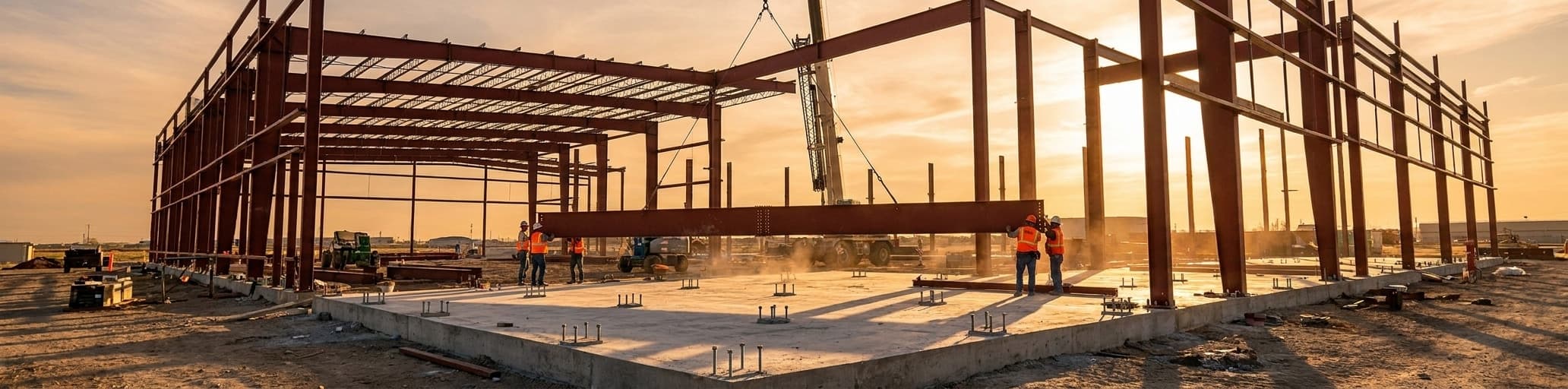

A 30×100 metal building costs between $60,000 and $150,000 installed, with pricing driven by steel materials, labor, foundation type, and regional factors like wind and snow loads. We help you control each cost layer independently through itemized quotes so you understand where your budget goes and identify real savings opportunities.
What Does a 30×100 Metal Building Cost in 2026?
A complete 30×100 metal building costs $60,000 to $150,000 installed, with eave height and regional labor rates as your primary cost drivers.
Base price range for a standard 30×100 metal building frame
A standard 30×100 metal building frame covers 3,000 square feet of footprint.
Prefabricated metal building kits run $10-$25 per square foot for the steel package alone, which puts the material cost for a 30×100 frame between $30,000 and $75,000 before any foundation or labor is added.[1] Fully installed — kit, delivery, and concrete slab combined — the price range shifts to $20-$50 per square foot, placing a complete turnkey 30×100 metal building cost between $60,000 and $150,000 depending on your site and specs.[1] That broad spread exists because steel prices fluctuate with market conditions, local labor rates vary by region, and factors like wind exposure category, snow load engineering, and eave height all push the structural package toward the higher end of the range.[1]
How eave height (8' to 20') impacts total project cost
Eave height is essentially a hidden multiplier on your 30×100 metal building cost. Every foot you add between the ground and the roofline increases the linear footage of wall panel required across all four sides — and on a 100-foot-long structure, that adds up fast. Comparable post-frame structures show this pattern clearly: a 24×30 building at 12' eave runs roughly $6,937 installed, while a 24×40 at 16' eave reaches $8,664, with taller wall heights contributing directly to higher material and labor totals.[2] The principle holds for pre-engineered steel as well — larger structures require more materials and labor, and the price scales accordingly.[2]
Beyond raw wall area, taller eave heights demand more from the structural package itself. Columns must be engineered to handle greater moment forces at the base, which can push frame specifications from lighter-gauge members to heavier profiles. Labor costs compound this effect: erecting taller walls takes more time, more equipment reach, and in some cases additional crew staging — and labor already accounts for 40-60% of a total installed project cost.[2] An 8' eave on a 30×100 keeps the structural demands modest and the erection straightforward. Moving to a 14' or 16' eave for equipment clearance, overhead door height, or mezzanine space is a legitimate operational decision — just budget for the cost ripple it creates across materials, labor, and potentially local permitting fees.
A useful rule of thumb: treat each additional foot of eave height above a standard 10' as a line-item upgrade, not a free variable. For a 30×100 footprint, the wall panel alone covers 260 linear feet of perimeter. Adding 4 feet of eave height adds roughly 1,040 square feet of wall surface before you account for any gable ends. At material rates that range from $15 to $45 per square foot for comparable post-frame and pre-engineered steel structures, that additional wall area represents real budget impact.[2] Matching your eave height to your actual clearance requirement — not a round number that sounds generous — is one of the fastest ways to keep a 30×100 project within budget.
Cost breakdown: materials, labor, and permitting for a complete installation
Understanding where money goes inside a 30×100 metal building project prevents the budget shock that hits buyers who price only the steel kit. The kit — primary rigid frame, secondary purlins and girts, roof and wall panels, trim, and fasteners — represents the material layer and runs $10-$25 per square foot for the steel package alone.[1] Labor is the second layer, and it is consistently the heaviest: installation crews account for 40-60% of the total installed cost regardless of building size.[2] The third layer is permitting, which is priced separately from nearly every contractor quote and varies by jurisdiction — local regulations may require specific materials, engineered stamped drawings, or a particular foundation type, all of which add to the final permit fee.[1] Site preparation — clearing, grading, and utility setup — sits outside all three layers and adds cost before a single steel member is delivered.[1] For a 3,000-square-foot 30×100 footprint, the table below shows how those layers stack at both ends of the installed price range.
| Cost layer | Low estimate | High estimate | Notes |
|---|---|---|---|
| Steel kit (materials) | $30,000 | $75,000 | $10-$25/sq ft; excludes delivery |
| Labor (erection) | $24,000 | $90,000 | 40-60% of total installed cost |
| Concrete slab | included in range | included in range | Captured in $20-$50/sq ft turnkey figure |
| Permitting | $500 | $5,000+ | Varies by county and engineering requirements |
| Site preparation | $2,000 | $15,000+ | Clearing, grading, utility access |
| **Total installed** | **~$60,000** | **~$150,000+** | Kit + delivery + slab + labor |
Custom features — insulation, windows, overhead doors, and energy-efficient upgrades — sit on top of this base and push the per-square-foot rate higher.[1] The fastest way to control each layer independently is to request an itemized quote that separates materials, labor, delivery, and permitting rather than accepting a single lump-sum number, which makes it impossible to identify where cost reductions are available.[1]
Concrete Slab Requirements and Pricing for 30×100 Buildings
Frost depth requirements range from near zero on the Gulf Coast to over 60 inches in northern states, so your foundation design must match your site's specific soil and climate conditions.
Why a proper foundation matters: frost depth, soil conditions, and load capacity
The foundation under a 30×100 metal building does more than anchor 3,000 square feet of steel frame — it has to perform against the specific conditions beneath your site, and those conditions vary dramatically by geography.
The choice of foundation design depends on soil type, load-bearing capacity, climate, and the building's structural requirements.[5] Frost heave is among the most damaging forces a slab faces in northern climates: when freezing temperatures, soil moisture, and frost-susceptible soils converge, water migrates toward the freeze front, forms stacked layers of ice called ice lenses, and can lift a slab enough to crack the concrete or shift anchor bolts out of tolerance.[5] Building codes address this directly — IBC Section 1809.5 requires footings to be protected from freezing by extending below the local frost depth, a figure that ranges from near zero along the Gulf Coast to more than 60 inches in northern states.[4] Slab-on-grade foundations work well in stable, mild-climate soils, but regions with severe frost require either T-shaped perimeter footings below the frost line or frost-protected shallow foundations (FPSFs) under IRC R403.3, which use rigid perimeter insulation to prevent soil freezing without deep excavation.[5] Understanding concrete thickness requirements for steel buildings connects directly to load capacity: IBC Section 1806.2 assigns presumptive bearing values by soil class — competent gravel and bedrock support far more weight per square foot than soft clay or organic fill — and when a site contains questionable material, expansive soils, or a high water table, IBC Section 1803.5 triggers a formal geotechnical investigation before any foundation is designed.[4] A 30×100 steel frame transfers significant point loads to anchor bolt clusters at each column, and a foundation that settles unevenly shifts those loads in ways the frame was never engineered to handle — making that soil report one of the most cost-effective documents in the entire project budget.[5]
30×100 slab cost estimator: calculating square footage and regional concrete rates
A 30×100 footprint covers 3,000 square feet of slab area. Concrete slab pricing runs $4-$8 per square foot nationally, so a 30×100 foundation lands between $12,000 and $24,000 installed — with the $6 per square foot median producing an $18,000 baseline.[6] Three variables move that number before you pour a single yard: region, slab thickness, and reinforcement spec. On region alone, labor and materials cost meaningfully more in the northeastern United States and on the West Coast than in southern and Midwestern states, so the same 3,000-square-foot slab can carry a different price tag depending entirely on where the project sits.[6] Slab thickness is the second lever: a standard 6-inch pour is the baseline, but a 4-inch slab costs roughly $0.74 less per square foot — saving approximately $2,220 on a 30×100 footprint — though thinner concrete typically requires supplemental reinforcement, which offsets part of that savings.[6] Optional reinforcements such as rebar, wire mesh, and a vapor barrier add about $1.90 per square foot collectively; across 3,000 square feet, all three upgrades together add roughly $5,700 to the material cost.[6] The table below summarizes how these layers stack for a 30×100 slab at both ends of the installed price range.
| Slab scenario | Rate | 30×100 total |
|---|---|---|
| Low end (4-inch, minimal reinforcement) | $4.00/sq ft | $12,000 |
| National median (6-inch, standard prep) | $6.00/sq ft | $18,000 |
| High end (6-inch + full reinforcement, high-cost region) | $8.00/sq ft | $24,000 |
| Add rebar, wire mesh & vapor barrier | +$1.90/sq ft | +$5,700 |
Labor accounts for roughly $2.60 of the $6 median, meaning a self-managed pour drops to approximately $3.60 per square foot — about $10,800 for 3,000 square feet.[6] At commercial scale, however, anchor bolt placement must hit tolerances the steel frame manufacturer specifies, and even small deviations in bolt layout require expensive corrections once erection begins. Professional forming and finishing on a slab of this size is one cost that rarely makes sense to cut.
Slab alternatives: gravel pads, post footings, and when each makes sense
Not every 30×100 project requires a full poured concrete slab. Three alternatives — gravel pads, pier or post foundations, and hybrid bases — each solve a specific problem, and choosing correctly saves money without trading away structural performance. A gravel pad, typically 4 to 6 inches of compacted crushed stone over excavated topsoil and a weed barrier, costs far less than concrete and drains water away from the structure rather than letting it pool, making it a practical choice for light-duty storage where a permanent finished floor isn't operationally necessary.[8] Post or pier foundations address a different challenge: when a site slopes more than a few inches or sits where standing water is common after rain, concrete piers lift the structure above grade, keep the base level, and allow airflow beneath the frame — a standard approach on rural or secondary-use properties where a polished appearance matters less than drainage and accessibility.[7] A hybrid base — typically a gravel pad combined with poured concrete runners or isolated pads at each column location — reduces the cost of a full slab while still delivering the localized bearing capacity that steel frame anchor bolt clusters require at each load transfer point, and it preserves flexibility for phased expansion without locking in a complete foundation footprint upfront.[7] The practical decision comes down to use intensity, site geometry, and local code requirements.
| Foundation type | Best fit for | Key advantage | Main limitation |
|---|---|---|---|
| Full concrete slab | Commercial use, heavy equipment, code-required permanent structures | Maximum load capacity and floor durability | Highest cost; requires anchor bolt precision |
| Gravel pad | Light storage, semi-permanent structures, wet sites | Low cost, excellent drainage, DIY-feasible | Not suitable for heavy equipment or permanent commercial use |
| Pier or post footings | Sloped lots, rural secondary structures, flood-prone sites | Levels uneven ground, elevates frame above standing water | Less floor utility; may not meet code for commercial occupancy |
| Hybrid (gravel + concrete pads) | Phased projects, budget-constrained builds, future expansion planned | Balances cost and bearing capacity at column points | Requires precise placement at anchor bolt locations |
One practical note on gravel pads for a 30×100 footprint: the site slope matters more at this length than it does on a compact 30×30 or 30×40 structure.[8] A 100-foot run amplifies even a modest grade, and when slope exceeds roughly 6 inches across the footprint, a gravel pad alone requires a tall retaining wall to hold the stone in place — at which point the cost advantage over concrete narrows quickly and pier footings become the more cost-effective solution.[8]
30×100 Metal Building Specifications: Frame, Roof, and Customization Options
On a 30×100 building, 24-gauge steel carries the engineering certifications required by code review and resists oil canning better than 26-gauge across your large surface area.
Standard frame configurations: column spacing, roof pitch, and wind/snow load ratings
Wall and roof panel choices: 26-gauge vs. 24-gauge steel and insulation R-values On a 30×100 building, panel gauge controls structural performance, engineering eligibility, and material cost across a large surface area — so the choice deserves more than a quick price comparison. The core difference is thickness: 24-gauge steel has a minimum of approximately 0.023 inches, while 26-gauge measures approximately 0.018 inches, making 24-gauge about 27.8% thicker.[10] That gap matters most in two places. First, 24-gauge is the minimum thickness at which panel manufacturers apply formal engineering and testing certifications on standing seam systems — 26-gauge standing seam panels typically do not carry the same engineering, meaning they cannot be specified where code review requires documented engineering on a roof or wall assembly.[10] For a 30×100 commercial, industrial, or agricultural structure subject to permit review, that certification requirement frequently resolves the gauge question before any other factor enters the conversation. Second, on a 100-foot-long building, cumulative wind pressure and thermal movement stress panels across a large surface, and 24-gauge material's greater rigidity makes it significantly less prone to oil canning — the visible waviness that develops in flat panels under rollforming stress and thermal cycling — than the thinner 26-gauge alternative.[10] In high-wind, high-precipitation, or hail-prone environments, 24-gauge is the appropriate specification; 26-gauge is a practical option for residential structures, light-duty storage in mild climates, or budget-constrained projects where formal panel engineering is not a permitting requirement.[10] On material cost, 24-gauge Galvalume coil runs approximately $1.20-$2.15 per square foot before fabrication and finishing, while 26-gauge material costs 8-15% less — a real spread across the panel area of a 3,000-square-foot footprint, though modest relative to the labor costs it sits alongside in a full installation budget.[10]
| Characteristic | 24-gauge | 26-gauge |
|---|---|---|
| Minimum thickness | ~0.023" | ~0.018" |
| Relative thickness | ~27.8% thicker | Baseline |
| Engineering/testing eligibility | Yes — minimum standard for standing seam | Typically not available for standing seam |
| Oil canning resistance | Higher | Lower |
| Extreme weather suitability | Recommended | Limited |
| Typical application | Commercial, industrial, standing seam | Residential, exposed fastener, light storage |
| Material cost (coil, pre-install) | $1.20-$2.15/sq ft | ~8-15% less than 24-gauge |
| Paint system standard | PVDF (Kynar 500(R) / Hylar 5000(R)) | PVDF or SMP depending on supplier |
One spec detail worth flagging: some 26-gauge products are finished in silicone-modified polyester (SMP) paint rather than the PVDF coatings standard on 24-gauge systems.[10] SMP coatings are generally more prone to chalking and fading over time than PVDF, so on a structure like a 30×100 that will carry panels for decades, the paint system is worth verifying explicitly in any quote — not just the gauge number.[10] Insulation R-values are a separate specification layer that gets added on top of the panel assembly; the panel gauge sets the structural and weather envelope, while the insulation spec addresses thermal performance and energy code compliance independently.
Common add-ons that affect final cost: doors, windows, skylights, and HVAC rough-ins
The steel frame and slab set your floor, but the add-ons determine whether the building actually works for your operation — and on a 30×100 footprint, those line items accumulate fast. Window installation runs $150-$1,000 per opening, exterior door installation costs $300-$1,900 per unit, and skylight installation lands between $1,600 and $4,200 each.[12] HVAC is the heaviest single add-on: a complete system with ductwork runs $7,000-$16,000, while rough-in plumbing for new construction costs $2,280-$5,120 and electrical wiring for a new build runs $6,000-$22,500.[12] Spray foam or fiberglass insulation — which also reduces noise from rain and HVAC equipment against bare metal panels — adds $1.00-$4.50 per square foot of surface area, a meaningful spread across 3,000 square feet of floor and several thousand more square feet of wall and roof surface on a building this size.[11][12] The table below summarizes each add-on with its typical cost range so you can evaluate each against your actual operational requirements rather than defaulting to a fully loaded spec.
| Add-on | Typical cost range | Notes |
|---|---|---|
| Window installation | $150-$1,000 per window | Per opening; quantity drives total cost quickly |
| Exterior door (walk-in) | $300-$1,900 per door | Overhead doors priced separately by size |
| Skylight installation | $1,600-$4,200 per unit | Higher end for larger or curb-mounted units |
| HVAC (full system + ductwork) | $7,000-$16,000 | Rough-in only reduces cost; full system required for occupancy |
| Rough-in plumbing | $2,280-$5,120 | New construction; does not include fixtures |
| Electrical wiring | $6,000-$22,500 | New construction; wide range reflects panel size and circuit count |
| Spray foam insulation | $1.00-$4.50/sq ft | Applied to wall and roof surface area, not floor |
One cost-control principle worth applying here: substituting a sliding door for an overhead door, reducing window count, and delaying non-essential interior finishes are among the fastest ways to trim the add-on total without compromising structural integrity.[12] On a 30×100 project where the base installed cost already spans $60,000-$150,000, the add-on stack can easily add $30,000-$60,000 more depending on use case — so prioritizing which openings and mechanical rough-ins are operationally necessary at initial build, versus which can be phased in later, keeps the first-year budget where it needs to be.[12]
How to Get an Accurate 30×100 Metal Building Quote from National Steel Buildings
Accurate 30×100 quotes require three critical inputs: your site's postal code, intended building use, and local code requirements that engineers must verify before fabrication begins.
Key information you'll need: site location, intended use, and local building codes
Three inputs determine whether a 30×100 quote is accurate or a placeholder: site location, intended use, and local code requirements.
Engineers use the job site postal code to pull applicable building codes and load values for that specific municipality — wind speed, wind exposure category (B, C, or D based on surrounding terrain and obstructions), ground snow load, and seismic design category.[13] A 30×100 framed for coastal conditions and one engineered for a high-snow-load region like upstate New York are fundamentally different structures; snow load requirements can reach 50 PSF or higher in parts of the Northeast, and incorrect load assumptions tied to the wrong geographic zone produce structural failures, costly redesigns, or permit rejections after fabrication begins.[13][14] Intended use determines collateral load — the combined weight of permanent suspended systems such as sprinklers (3-4 PSF), mechanical and electrical equipment, and suspended ceilings (4 PSF additional) that must be engineered into the primary frame from day one.[13] Reducing collateral load values to cut upfront cost is a false saving: reinforcing a structure post-fabrication routinely costs more than the original reduction, and the design relies entirely on accurate information about the building's purpose and contents.[13] Pre-engineered steel buildings are custom structures; a package engineered for a different address carries the wrong load calculations for your site, and submitting mismatched documentation at local permit review guarantees rejection before a single anchor bolt is set.[13] Understanding what vetted prefab contractors ask about your site before quoting is a reliable way to confirm whether a contractor has done the engineering homework your project actually requires.
Why single-source turnkey pricing saves time and money versus kit-only estimates
Next steps: from design consultation to final erection with ProTrades in-house crews The complete 30×100 project timeline from first design conversation to move-in typically runs 6 to 8 months — but the steel erection phase that most buyers picture takes only 2 to 3 weeks with a 5-to-6-member crew.[18] The calendar is consumed almost entirely by pre-construction work: engineering the building system and foundation, filing for permits (which cannot be submitted until all engineering is stamped and complete), grading and compacting the building pad (1-5 days), forming and pouring the foundation (1-15 days), and then observing a mandatory 28-day concrete cure before any structural steel load can be placed on the slab.[19] Weather, client decision response times, land survey delivery, and zoning approvals all sit outside a contractor's direct control and represent the primary source of schedule slippage on projects that start on time but finish late.[18] The seven phases below reflect the sequence a turnkey crew works through from concept to certificate of occupancy.
| Phase | Description | Primary driver of duration |
|---|---|---|
| 1. Pre-construction planning | Zoning verification, survey plat, retainer and contract execution | Client documentation turnaround |
| 2. Site access and road/driveway | Access prep for equipment and material delivery | Site conditions and clearing complexity |
| 3. Civil work and site preparation | Land clearing, grading, leveling, compaction | Terrain, soil type, drainage requirements |
| 4. Fabrication and delivery | Manufacturer engineers and produces the steel package | Building complexity, special-order components, supply chain |
| 5. Foundation construction | Forming, municipal inspection, pour, 28-day cure | Weather, inspector scheduling, concrete cure time |
| 6. Structural erection | Frame, panels, trim, doors, and windows installed by crew | Building size, crew size, weather |
| 7. Finishing and close-out | Interior buildout (if applicable), final inspection, certificate of occupancy | Scope of interior work, municipal inspector availability |
Pre-construction planning alone — the window covering design, engineering, and permit issuance — typically runs 4 to 8 weeks, and that range widens when a jurisdiction requires additional engineering documentation or when the client's survey plat is delayed.[20] Adding an interior buildout phase extends the erection timeline by 6 to 8 months on top of structural completion, so buyers who plan office space, restrooms, or climate-controlled interiors inside a 30×100 footprint should treat the structural erection date as the midpoint of the project, not the finish line.[18] The single most effective way to keep every phase on schedule is front-loading the decisions — site location, intended use, eave height, door and window placement, and mechanical rough-in requirements — before engineering begins, so the manufacturer produces a package that matches your permit drawings exactly and the crew arrives at a site that is ready to receive steel.[19]
- A 30×100 metal building costs $60,000-$150,000 installed, with labor accounting for 40-60% of total project cost.
- Eave height is a hidden cost multiplier; each additional foot above 10 feet adds roughly 1,040 square feet of wall surface requiring more materials and labor.
- Concrete slab costs $12,000-$24,000 for a 30×100 footprint at $4-$8 per square foot, with regional labor rates and frost depth requirements significantly affecting final price.
- 24-gauge steel panels are required for commercial structures needing engineering certification, while 26-gauge suits residential or light-duty storage in mild climates.
- Complete project timeline spans 6-8 months, with actual steel erection taking only 2-3 weeks; the majority of time is consumed by pre-construction engineering, permitting, and foundation curing.
- Add-ons like HVAC ($7,000-$16,000), electrical wiring ($6,000-$22,500), and insulation ($1-$4.50/sq ft) can easily add $30,000-$60,000 beyond the base structural cost.
- Site-specific factors including wind speed, snow load, soil type, and local codes must be confirmed before engineering begins to avoid costly permit rejections or redesigns.
- https://homeguide.com/costs/metal-building-cost
- https://summertownmetals.com/pole-barn/pole-barn-cost-guide/
- https://www.summitsteelbuildings.com/understanding-concrete-foundations
- https://up.codes/viewer/tennessee/ibc-2021/chapter/18/soils-and-foundations
- https://www.nachi.org/frost-protected-shallow-foundation-fpsf.htm
- https://www.barndominiumlife.com/how-much-does-a-50×80-concrete-slab-cost/
- https://ravenelbuildings.com/foundations-for-metal-garages-what-options-work-why/
- https://wildoaktrail.com/blogs/adventure-essentials/gravel-pad-vs-concrete-slab-choosing-the-right-foundation-for-your-best-barns-shed
- https://www.americanpolebarns.com/trusses
- https://sheffieldmetals.com/learning-center/24-vs-26-gauge-metal-roofing/
- https://trusteelbuildings.com/steel-buildings/custom/
- https://homeguide.com/costs/pole-barn-prices
- https://norsteelbuildings.com/us/building-codes-permits/steel-building-codes-loads/
- https://carport1.com/states-service-area/new-york-ny/
- https://www.gtasteel.ca/steel-building-kit-vs-turnkey-real-cost-breakdown
- https://www.summitsteelbuildings.com/turnkey-construction-eliminates-hassles-of-building-kits
- https://ameribuilds.com/steel-building-costs-what-to-expect-2026/
- https://incosteelbuildings.com/timeline-metal-building-construction/
- https://incosteelbuildings.com/process/
- https://allensconstructllc.com/how-long-does-it-take-to-build-a-metal-building/