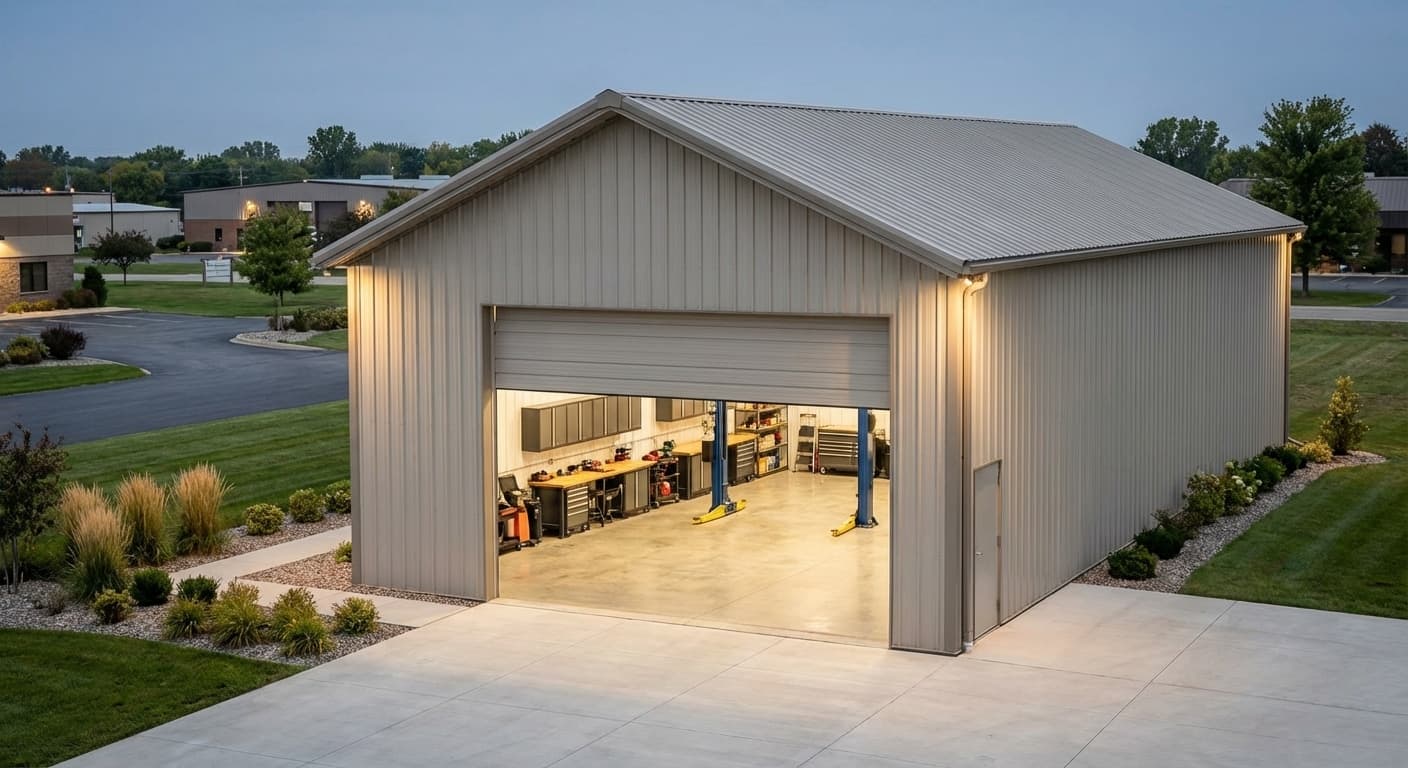

A 30×30 metal building delivers 900 square feet of clear-span, column-free space that functions like a full workshop–big enough for three vehicles, workbenches, and future expansion yet small enough to heat cheaply and maintain easily–while outlasting wood structures with 180-mph wind ratings, 50- to 60-year lifespans, and fire-resistant steel that slashes insurance premiums. Readers learn how to leverage 3D design tools to pick optimal heights, roof pitches, door placements, and code-compliant wind/snow loads before a single beam is cut; how high-recycled-content steel and factory prefabrication shrink environmental impact and site waste; and how to control real-world costs–from a $10-15 k kit to a $22-39 k turn-key build–while capturing tax breaks via Section 179 or bonus depreciation, financing energy upgrades through PACE, and securing single-source warranties that stretch 40-50 years. The guide demystifies insulation choices that cut monthly energy bills up to 50%, foundation options that adapt to frost depths or direct ground anchors, and quality checkpoints like 16-gauge frames and multi-layer coatings that prevent rust, ensuring the building stays maintenance-free for decades. Whether you need a workshop, farm shed, or small business space, the article arms you with the planning, financing, and sustainability insights to turn a 30×30 steel shell into a long-term asset that earns its keep through lower operating costs, higher property value, and tax-advantaged returns.
Understanding the 30×30 Metal Building Advantage
A clear-span 30×30 steel building delivers 900 obstacle-free square feet that work harder than structures twice its size, shrugging off fire, pests, and 180 mph winds while cutting insurance bills and maintenance headaches for decades.
Defining the 30×30 metal building size and clear‑span benefits
A 30×30 metal building gives you 900 square feet of working space–enough room to actually work without playing Tetris with your equipment. The square footprint keeps construction costs down while maximizing usable space [1]. You get the sweet spot: big enough to fit three vehicles with room left for workbenches, small enough to heat efficiently and maintain without breaking the bank [2]. Here's what makes the difference: no posts in your way.
The clear-span design gives you 30 feet of open space from wall to wall–park equipment anywhere, rearrange your shop next week, add a mezzanine next year [3]. You're not working around obstacles like you would with pole barns or stick-built structures. That flexibility turns 900 square feet into space that works harder than buildings twice the size [2]. Bottom line: a 30×30 building is the smallest size that still functions like a real workspace.
You get room for storage along the walls, workbenches where you need them, and–here's the key–space left in the middle to actually move around and work [2]. It's why mechanics, farmers, and small business owners choose this size. Every square foot earns its keep without the overhead of heating and maintaining unused space [1][2].
Key performance advantages: durability, energy efficiency, and low maintenance
Your 30×30 metal building works as hard as you do. Built to handle 180 mph winds and 80 PSF snow loads, it stays standing when Mother Nature throws tantrums [4]. Steel doesn't rot, warp, or feed termites–problems that eat away at wood structures year after year. The non-porous surface sheds water instead of absorbing it, so you're not dealing with decay or mold issues down the road [4]. Insurance companies love steel buildings–they don't burn. That fire resistance often translates to lower premiums, putting money back in your pocket every month [5]. Add it up: weather resistance, pest immunity, fire safety, and a 50-60 year lifespan with basic maintenance. Yes, steel costs more upfront than a pole barn.
But when you're still using the same building decades later while your neighbor's rebuilding, the math becomes clear [4]. Here's a number that matters: proper insulation cuts your energy bills by 25-50% [4]. Whether you choose bubble insulation or go with R-17 woven systems, you're looking at real savings every month. The open floor plan helps too–no posts blocking airflow means your heating and cooling work more efficiently [5]. For detailed insulation options and energy code compliance, see our Planning section below. Maintenance? An annual walkthrough and occasional washdown–that's it. Steel is 25 times stronger than wood and doesn't care about seasonal temperature swings [4].
No warping, no cracks, no emergency repairs because a beam twisted. For business owners, that means fewer surprises and more predictable costs. Your building looks professional and works reliably for decades, not just years [5][6]. The 30×30's versatility shows up in how people use them. Workshop owners love the uncluttered space–set up your benches today, rearrange them next month, no posts dictating your layout [7]. Small furniture shops, repair businesses, and craftsmen find the size hits that sweet spot between cramped and cavernous [8].
Planning and Designing Your 30×30 Metal Building
Before you order a single steel panel, lock in your 30×30's height, roof pitch, and door placement–then use 3D design tools and a quick call to your local building department to confirm wind, snow, and setback requirements so your building adapts flawlessly for decades.
Selecting height, roof style, and door/window configurations for flexibility
Your 30×30 building starts taking shape with three key decisions: height, roof style, and openings. Wall heights typically run 12 to 16 feet–the standard 12-foot height handles most needs, while taller walls give you room for lifts, stacked storage, or future loft additions [7]. You'll likely want a gable roof with a 4:12 pitch–it sheds water efficiently and handles snow loads without overbuilding [7]. Door placement makes or breaks your workflow.
Position your overhead door (typically 10'x10') to leave room for workbenches along the walls and easy access to your walk-through door (standard 3'x7') [7]. The beauty of a square building? You can place doors on any side without compromising the structure. Some owners mount windows higher for security while still getting natural light throughout the day [7].
Here's where modern planning pays off: 3D design tools let you see exactly how your building functions before you order steel. You'll spot workflow bottlenecks, visualize equipment placement, and test different door configurations–all from your computer [9]. For heavy rain or snow areas, vertical roof panels channel water straight down instead of letting it pool [9]. Get these choices right upfront, and your building adapts as your needs change over the decades.
Site assessment: zoning, setbacks, wind, snow loads, and foundation options
Your building permit starts with a simple phone call to your local building department. Ask which IBC code version they follow and get their setback requirements–the minimum distances from property lines [10]. Skip this step, and you'll face permit rejection and expensive redesigns. Wind and snow loads determine your building's strength and price.
Coastal sites might need 150 mph wind resistance, while inland locations vary widely [10]. Snow loads swing from 10 PSF in the South to 70+ PSF up North [10]. Your exposure category matters too–protected suburban sites (Category B) need less bracing than open fields (Category C) or coastal areas (Category D) [11]. Get these numbers wrong, and you'll either overbuild (wasting money) or underbuild (risking failure).
Foundation planning addresses your specific soil and climate. In cold regions, footings must extend below frost depth to prevent seasonal heaving [11].
Using modern 3‑D design tools and ensuring code compliance
Forget squinting at flat blueprints. Today's 3D design tools let you walk through your building before ordering steel. You'll see exactly how equipment fits, where shadows fall, and whether that door placement actually makes sense [12]. Start with a template–workshop, garage, whatever matches your needs–then adjust every detail in real-time [13]. The real payoff comes when you're planning workflow. Rotate the view, check clearances, test different layouts.
You'll catch problems that 2D drawings miss every time [13]. Need to squeeze a workbench between the overhead door and your equipment? The 3D view shows if it fits–or if you need to shift that door six inches [12]. Here's the smart part: enter your ZIP code, and the system applies your local wind and snow requirements automatically [12]. No guessing about load ratings or code compliance–the software handles the engineering while you focus on functionality. Your final design translates directly into manufacturing specs and permit drawings [14].
What you design is what gets built. Your saved specifications go straight to the steel fabricators who cut and label every piece [14]. The installation crew gets the same 3D model you created, eliminating those costly "interpretation" errors that plague traditional construction. From screen to steel, everything stays connected–keeping your project on track and within budget [14].
Quality, Materials, and Sustainable Choices
Build a 30×30 steel building that lasts 50-60 years with 16-gauge galvanized frames, 27-gauge coated sheets, factory-welded connections, and insulation systems that already beat 2026 energy codes–while using 90% recycled steel that earns LEED points.
Premium steel grades, protective coatings, and corrosion‑resistance standards
Your 30×30 building starts with the right steel. Quality structures use 16-gauge frames and 27-gauge cover sheets–thick enough to handle decades of use without overbuilding and inflating costs [15]. This combination gives you the strength you need at a price that makes sense. Here's what keeps your building looking new: multi-layer protection systems.
Each steel component gets galvanized coating, primer, and weather-resistant finish before it leaves the factory [16]. Skip this protection, and you're looking at rust, repairs, and headaches within years instead of decades [16]. Smart construction details make the difference. Factory-welded connections mean fewer field cuts that damage protective coatings [8].
The right roof pitch sheds water fast. Quality fasteners seal tight between panels [15]. Together, these choices add up to a building that performs like we discussed earlier–50-60 years of reliable service with minimal upkeep.
Insulation, roofing systems, and energy‑saving options for 2025‑2026 standards
Energy codes keep getting stricter. By 2026, you'll need higher insulation values to pass inspection in every climate zone [17].
Here's what works for metal buildings: Two proven insulation systems meet new standards: – Liner systems: Double fiberglass layers with vapor barrier for roofs and walls [17] – Filled cavity systems: Layered insulation specifically for metal roofs [17] Real-world performance beats paper specs–that R-30 system typically tests at R-27 once installed [17]. Your roof choice matters too.
Recycled steel, LEED considerations, and NSB's quality‑assurance guarantees
Structural steel offers exceptional sustainability credentials with most North American-produced steel containing at least 90% recycled content–far exceeding the 25% minimum threshold required for LEED certification [20]. This high recycled content directly translates to reduced environmental impact, as steel production using recycled materials requires significantly less energy than manufacturing virgin steel. The steel's inherent recyclability creates a true closed-loop material system, with a 98% recovery rate that keeps valuable resources in circulation rather than in landfills [21]. Metal buildings particularly benefit from steel's sustainability profile, as prefabrication reduces on-site construction waste to less than 2%, compared to approximately 20% waste produced by traditional wood framing [22]. For projects seeking LEED certification, steel's documented environmental performance contributes to multiple credit categories.
The Materials and Resources credits are particularly accessible, with recycled steel contributing to both Credit 4. 1 (10% recycled content) and Credit 4. 2 (20% recycled content) [20]. Beyond recycled content, steel offers additional sustainability advantages that align with LEED objectives–its dimensional stability creates tighter building envelopes for enhanced energy efficiency, and its non-porous nature eliminates VOC emissions that compromise indoor air quality [20][22]. For maximum sustainability value, implement Designing for Deconstruction (DfD) principles by specifying bolted rather than welded connections, allowing future disassembly and direct reuse of structural members without reprocessing [20].
This approach can reduce carbon emissions by approximately 1. 5 tons of CO2 for each ton of steel reused rather than newly manufactured [20]. Recycled steel's combination of high performance, circularity, and transparent supply chain makes it one of the most effective materials for achieving modern sustainability standards while maintaining structural integrity [21].
Cost, Financing, and Partnering with NSB
Compare the true, all-in cost of your 30×30 metal building–$21,600 to $38,700 when you count kit, foundation, delivery, and pro assembly–and then slash that outlay instantly with Section 179's $1.16 million deduction or skip the slab altogether for farm storage to pocket thousands more.
Transparent cost breakdown: kit, foundation, labor, permits, and optional accessories
Your 30×30 metal building investment breaks down into predictable categories. The building kit runs $10,000 to $15,000–that's $16 to $20 per square foot for the steel structure itself [25]. But the kit's just the start. Foundation costs hit your budget next. Pour it yourself? Budget $2,700 minimum. Hire a contractor?
That jumps to $7,200+ for your 900-square-foot slab [23]. Professional installation makes sense if you value time over sweat equity–concrete work done wrong costs more to fix than to do right the first time. For a complete, ready-to-use building, plan on $24 to $43 per square foot. That's $21,600 to $38,700 all-in, covering kit, foundation, delivery, and professional assembly [24]. Price variables that move the needle: – Overhead doors (each adds hundreds to thousands) – Window packages – Insulation systems – Interior finishing – Permit and engineering fees Smart quote comparison goes beyond the headline number. Does it include foundation drawings? Delivery?
Installation? Some providers bundle everything; others nickel-and-dime you into budget overruns [23]. Look for warranties that matter–at least 1 year on workmanship, 20+ years on the steel frame itself [23]. Pro tip for agricultural use: Skip the concrete. Direct ground anchoring or gravel pads work fine for equipment storage, saving thousands without sacrificing stability [23].
Financing programs, tax incentives, and ROI analysis for residential and commercial owners
Your metal building delivers tax advantages that transform good investments into great ones. Here's what moves your bottom line: Commercial Owners–Three Ways to Win: 1. Standard Depreciation: Write off your building over 39 years through MACRS. That's steady tax reduction, year after year [26]. 2. Section 179 Fast Track: Deduct up to $1,160,000 in 2024–potentially your entire building cost in year one. Instant tax relief [26].
3. Bonus Depreciation: Still available but phasing down (80% in 2023, 60% in 2024). Act fast if you want maximum first-year benefits [26]. Residential Owners–Build Value, Cut Taxes: Your permanent steel structure becomes a capital improvement, boosting property value while potentially reducing capital gains when you sell [27]. Add energy-efficient features? The Residential Energy Efficient Property Credit hands you 30% back on solar panels, wind turbines, and similar upgrades [27]. Financing That Works: PACE programs let you finance energy improvements through property tax assessments–spread payments over 20 years with potentially tax-deductible interest [27].
No huge upfront costs, just manageable payments that often cost less than the energy you save. Insurance Savings–The Hidden ROI: Your fire-resistant, storm-tough steel building earns insurance discounts other structures can't touch [28]. Lower premiums every year add up to thousands saved over your building's lifetime. The math is simple: accelerated depreciation creates immediate tax savings, energy credits reduce upgrade costs, and insurance discounts keep paying you back year after year. Traditional construction can't compete with these cumulative advantages [28].
Choosing the right provider: NSB's single‑source solution, warranty, and after‑sale support
Single-source providers save you from the contractor circus. One company, one number to call, one throat to choke when something needs fixing. No finger-pointing between the designer, manufacturer, and installer–just straight answers and clear accountability [29]. Warranty Reality Check: Quality warranties stack up like this: – Structural frame: 40-50 years – Panels and roofing: 20-40 years – Paint and finish: 20-30 years [29] But here's what matters: Is the company still around to honor it? That 50-year warranty becomes worthless paper if they fold in 18 months [29].
Stick with providers who've survived at least 20 years–they've weathered recessions and still answer the phone. Watch for prorated warranties that shrink over time. And remember–even solid warranties rarely cover labor. You'll pay for the work, just not the materials [29]. Support That Actually Supports: Before you sign, test their support system.
Call the warranty department. Ask about claim processing times. Request actual warranty documents, not glossy marketing sheets [29].
- 900 sq ft clear-span 30×30 steel building fits 3 cars plus workbenches without interior posts.
- All-in cost runs $21.6k-$38.7k; DIY slab saves ~$4.5k vs contractor.
- Pre-painted 16-gauge frame & 27-gauge skin with galv. coating yields 50-60 yr life.
- Fire-resistant steel often cuts insurance premiums and qualifies for Section 179 or bonus depreciation.
- Vertical-roof 4:12 pitch, 12-16 ft walls, and ZIP-code loads auto-applied in 3D design software.
- Steel contains ≥90% recycled content, generates <2% site waste, and is 98% recoverable.
- Bolted DfD assemblies let future reuse, saving ~1.5 t CO₂ per ton vs new steel.
- https://www.buildingsguide.com/standard-sizes/?srsltid=AfmBOorRoZZhRHL8OYNMNIN1GInV8Hti-IPH-RSiTd3ydodLVgGPbVsf
- https://www.aametalbuildings.com/blog/why-a-30×30-custom-metal-building-is-the-perfect-choice-for-a-metal-workshop-or-small-business?srsltid=AfmBOoroeHNHfylMJuL70LxeMkoAroOD0o8iSWBxKFa7gPU6kUluSSzp
- https://www.alliedbuildings.com/open-span-steel-buildings/
- https://www.vikingsteelstructures.com/blog/why-a-30×30-metal-building-is-the-perfect-choice-for-your-small-business-or-workshop?srsltid=AfmBOooNgBAhgu8XW8esamUgZ2XKBTRrOR7iwJCzx7MXAY1tBKFiAucB
- https://iconsteelbuildings.com/30-x-30-metal-building/
- https://alansfactoryoutlet.com/30-x-30-metal-building/?srsltid=AfmBOorNfIUe8Cm12tGG4_XP4Qxizc_ERhm9DNNQ-lq-KMC6GPL1Jnh1
- https://metalbuildingsnorthamerica.com/30×30-metal-building/
- https://renegadesteelbuildings.com/30×30-metal-building/
- https://www.bossbuildings.com/30×30-metal-buildings/?srsltid=AfmBOorLfInBm2LCV-9gMMe_OVTzMCa2KgOJZ0lZEf5TifTu74qEMksH
- https://www.aametalbuildings.com/blog/snow-load-wind-speed-requirements-for-metal-buildings-with-codes-pricing-impact?srsltid=AfmBOop03GwZpFk_MYrcGfv2U7-ksjH8Bs5xQ6iBWrpk_OfuuUSd6CuO
- https://metalbuildingsguide.com/loads-codes
- https://www.vikingsteelstructures.com/metal-building-3d-estimator?srsltid=AfmBOooEgGD5C_Xy3ShHiWjxFoixYK1_76krq2xeOjP37poVXdIb1Mrv
- https://www.buildingsguide.com/design/3d-metal-building-designer/?srsltid=AfmBOopZ4vtdUXtPKVLvJj3oBRUrRrIitqE4qQlPStyJco-0elISUnjQ
- https://www.muellerinc.com/3d-tool
- https://www.tmgindustrial.com/products/30ftx30ft-metal-garage-shed-steel-building?srsltid=AfmBOorGa6HAbSI5Pn2BpSUjUkLXfsNLCrQgKys38cd8X4Ej107wlv7k
- https://protectiveeu.sherwin-williams.com/en/corrosion-protection-coatings/areas-of-application/steel-structures
- https://www.metalconstructionnews.com/articles/features/insulation-systems-metal-building-code-compliance/
- https://info.greenspanprofiles.com/blog/building-codes-imps-what-specifiers-need-to-know-for-2026
- https://www.polyiso.org/page/energy-code-by-state
- https://www.okonrecycling.com/industrial-scrap-metal-recycling/steel-and-aluminum/steel-recycling-compliance-requirements/
- https://www.aisc.org/news/new-guide-simplifies-leed-v5-certification-for-designers-using-structural-steel/
- https://roimetalbuildings.com/metal-buildings-and-leed/
- https://alansfactoryoutlet.com/30-x-30-metal-building/?srsltid=AfmBOopgTjsOhQSl6piG-In-n2PMbMpbvtIDenccqUjigExKX5eQgb6x
- https://www.buildingsguide.com/metal-building-prices/?srsltid=AfmBOooRIIDd035x-HpMmM1n7HHyJNFPySHmpP9ndVjuwQqpoDAaipGb
- https://mavericksteelbuildings.com/how-much-does-it-cost-to-build-a-30×30-garage/
- https://www.paramountmetalsystems.com/tax-advantages-of-metal-building-systems-save-money-while-adding-value
- https://armstrongsteel.com/blog/what-are-the-tax-benefits-of-steel-buildings
- https://www.usametalstructures.com/post/financial-benefits-of-metal-buildings-an-in-depth-analysis
- https://www.factorysteeloverstock.com/steel-building-warranty-coverage/
- https://www.vikingsteelstructures.com/blog/what-is-included-in-a-metal-building-warranty-know-the-in-out?srsltid=AfmBOorJtHLbmGbhbyDM1KMH3xYCSfAruXUC4y1pM4lONf3uRdRFTISz
- https://bulldogsteelstructures.com/blog/7-things-to-know-before-choosing-your-metal-building-provider/