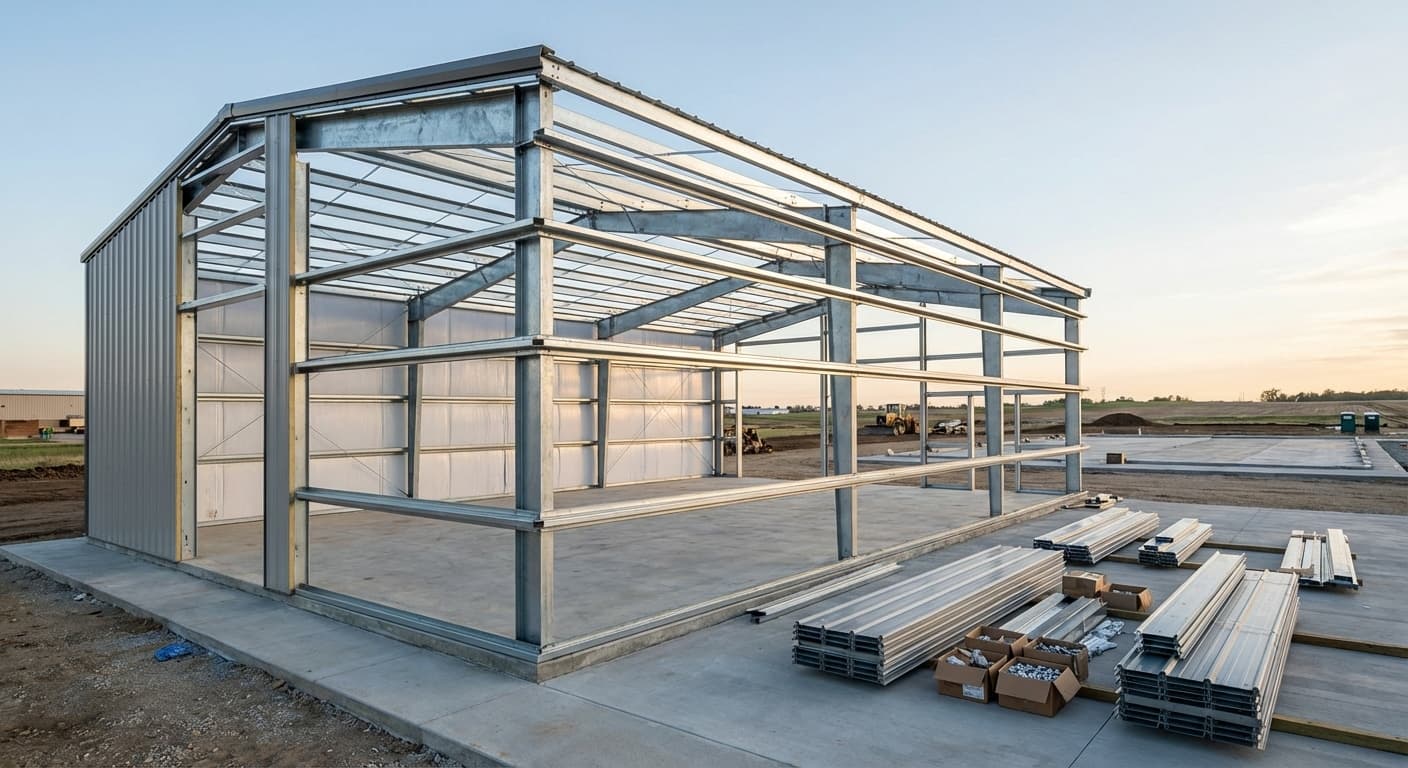

A 30×40 metal building isn't a one-price-fits-all purchase–expect anywhere from a $15-25k materials-only kit to a $28-46k+ turnkey build–but this guide shows exactly how every choice you make up-front ripples through your wallet for decades. Readers learn to decode the real cost drivers: steel gauge (12-gauge costs more but outlasts 14-gauge), site prep that can swing $1-4 per square foot, local codes that add hurricane or snow-load steel, and "small" extras like doors, insulation, and delivery access that quietly tack on thousands. Regional snapshots prove why the same building runs $18/sq ft in the rural Southeast yet $30/sq ft on the West Coast, while 2025 steel-tariff and futures data reveal why locking quotes before year-end can save thousands more than waiting for a "dip." The article arms buyers with battle-tested savings tactics–winter timing, standard dimensions, itemized bids, 100% first-year depreciation, and zero-down manufacturer financing–so they can shrink the real cash outlay while still getting a structure engineered for their climate and ready for future expansion.
Understanding the True Cost of a 30×40 Metal Building
Before you lock in a 30×40 metal-building budget, size up every hidden price driver–steel gauge, site prep, local codes, custom add-ons, regional labor, and market swings–because a $15k kit can balloon past $46k turnkey if you ignore the details.
Key Factors That Drive 30×40 Metal Building Cost
Your 30×40 metal building cost depends on several key factors you'll want to nail down before setting your budget. Steel gauge drives both price and performance. Lower gauge numbers mean stronger steel–12-gauge costs more than 14-gauge but pays you back in durability and decades of worry-free use [1]. Choose your steel wisely now, save on repairs later. Your site conditions directly impact your bottom line. Level ground keeps prep costs minimal. Need serious grading or fill dirt? That's where costs climb [1]. Foundation requirements vary by use–standard 4-inch slabs work for workshops while heavy equipment demands 5-6 inch reinforced concrete (detailed foundation pricing covered in Section 3) [3].
Your local codes shape your building specs. Florida demands hurricane-ready designs. Colorado requires snow-load engineering [1]. These aren't suggestions–they're requirements that affect material quantities and engineering complexity [3]. Every certified building includes stamped engineering calculations, keeping you code-compliant and inspection-ready [3]. Customization turns your steel shell into your working space. Every door, window, insulation upgrade, and electrical run affects your final number [1][2]. Quality matters–budget for the components you actually need, not what looks cheapest on paper [2]. Location changes everything.
Labor rates, permits, and shipping vary dramatically by region [2]. That same building costs more in coastal California than the Midwest–blame seismic requirements and labor costs [1]. Hard-to-reach sites? Budget extra for delivery logistics (see Section 4 for detailed regional breakdowns) [2]. Steel prices move with the market–what you quote today might change tomorrow [2]. Smart budgeting looks at two numbers: your base kit ($15,000-$25,000) and your complete turnkey project with foundation, labor, and finishes ($28,000-$46,000+) [1]. Know both. Plan for both.
2025 Price Ranges per Square Foot and Full Project Estimate
A 30×40 metal building kit runs $15,000 to $25,000 in 2025–that's $15 to $20 per square foot for materials alone [4][5]. This gets you the bones: steel I-beams, secondary framing (your purlins and girts), wall and roof panels, plus the hardware to bolt it together [6]. We're talking commercial-grade steel I-beam frames here–not the tubular stuff that cuts corners on durability [4]. Quality steel drives the base price, but it's what keeps your building standing strong decades later. Your complete turnkey investment lands between $28,000 and $46,000+–or $24 to $43 per square foot [4][5][6]. That's your real number, the check you write for a building ready to work.
Here's how it breaks down: site clearing ($1-$4/sq ft), grading ($0. 40-$2/sq ft), concrete foundation ($4-$8/sq ft for standard 4-inch slabs), and professional erection ($5-$10/sq ft) [6]. Every site's different. Every budget's different. But now you know the range. Regional differences hit your wallet hard.
Midwest builds cost less than coastal California–thank lower labor rates and simpler code requirements [5]. Smart timing saves money too. Schedule for early spring or late autumn when contractors want your business [6]. Steel markets move fast–when you get a good quote, lock it in. Tomorrow's price might not be today's [5][6].
Kit‑Only vs Turnkey Packages: What's Included and How Prices Vary
You've got two paths to your finished building, each with its own price tag. Kit-only packages run $18,000-$25,000 for your 30×40 structure. You get the steel shell–framing, panels, hardware–and nothing else [7][6]. Site prep, foundation, assembly? That's on you. Turnkey packages deliver everything for $30,000-$40,000+. One contract, one point of contact, one building ready to use [7].
Your package includes the steel kit, concrete foundation ($8,000-$12,000), professional erection ($5,000-$10,000), basic insulation ($2,000-$4,000), and electrical rough-in ($2,000-$5,000) [7]. No coordination headaches. No surprise bills. Real builds show real numbers. One owner spent $30,000 total–$21,000 for building and slab, the rest for site prep and electrical [7]. Another went $35,000 for a climate-controlled shop with multiple doors and windows [7]. Your needs drive your costs.
Choose based on your skills and schedule. Experienced builders save 20-30% going kit-only [6]. Busy owners choose turnkey–pay once, build once, done. Watch the fine print though. Some suppliers skip essentials like roof seals and rat blocks in their "complete" kits [7]. Budget reality check: most owners spend 15-20% above kit price for the extras that make buildings work [6].
Detailed Cost Breakdown of Major Components
Steel frames, coatings, and concrete specs decide half your total budget–get the thicker I-beams, demand full coatings, and pour 6-inch slabs now or pay for rust, cracks, and do-overs later.
Steel Frame, Panels, and Protective Coatings
Your building's bones matter. The steel frame makes up 40-50% of your kit cost, and choosing right saves money long-term. Primary frames use rigid I-beams for the main structure. Secondary framing–purlins and girts–supports your walls and roof [9]. Commercial I-beam frames beat tubular steel every time.
Yes, they cost more upfront. But they last longer and handle stress better [8]. Steel gauge drives your price. Lower numbers mean thicker steel. A 12-gauge frame costs more than 14-gauge but resists weather and wear better [9].
Think of it like buying work boots–spend more now, replace less later. Your panels and roof style affect both cost and performance: * Galvanized steel panels come standard * Vertical roofs cost more but shed snow and rain better [10] * Quality coatings prevent rust and UV damage Watch what's actually included. Some suppliers skip critical items like protective coatings to show lower prices [9]. Ask for complete specifications–a well-coated building lasts 40+ years with minimal upkeep [9].
Foundation Choices and Site‑Preparation Expenses
Your foundation and site prep eat up 30-40% of total project cost–more than any other single expense. Site Preparation Breakdown: * Clearing: $1-$4 per square foot (trees, brush, debris) [11] * Grading: $0. 40-$2 per square foot (leveling) [11] * One owner spent $6,500 just on dirt work and dozing [7] Foundation Options and Real Costs: Most buildings use concrete slabs.
For a 30×40 building, expect $8,000-$12,000 total [7]: * Standard workshop: 4-inch slab at $6-$10 per square foot [11] * Heavy equipment: 5-6 inch reinforced slab [12] * Cold climates: Frost footings can push costs to $27,000 [7] Smart builders go stronger than minimum. One owner poured 6-8 inches thick "designed for lifts" [7]. Proper compaction prevents settling–critical if you're parking vehicles or equipment [11].
Common Foundation Mistakes: * Pouring too thin * Ignoring drainage * Pouring concrete before finalizing building specs [11] * Forgetting local wind and snow loads transfer through the frame to your foundation [12] Get it right the first time. Foundation fixes cost triple.
Doors, Windows, Insulation, and Optional Finishes
These components turn your shell into a working building. Budget 20-30% of total cost for doors, windows, and finishes.
Door and Window Pricing: * Basic package: one walk door, one or two roll-ups * Quality sectional doors: add $2,000-$5,000 [7] * Windows: $200-$500 each (low-E glass saves energy long-term) [7] Insulation Makes or Breaks Comfort: * Basic fiberglass: $2,000-$4,000 * Closed-cell spray foam: $4,000-$7,000 (most quotes around $5,300) [7] Real Projects Show the Range: One builder spent $35,000 total on a climate-controlled 30×50 with three windows, one walk door, and three 10×10 insulated doors [7]. Another paid $30,000 for two 12×12 roll-ups, one man door, and five low-E windows [7].
Don't Forget These Extras: * Gutters: $500 standard installation * Climate control: $1,000+ for mini-splits [7] * Roof seals and rat blocks (some suppliers skip these) Quality varies wildly between suppliers. Get detailed quotes–missing components mean surprise bills later [7].
Regional, Market, and Regulatory Influences
Lock in your steel price before year-end–tariffs, rebounding futures, and regional labor swings of up to $12/sq ft mean waiting could cost thousands and stretch urban permits for months.
Current Steel Market Trends and Material Costs in 2025
Steel prices stabilized in the low-mid $800s per short ton by summer 2025, following months of volatility [14]. Structural steel hit $2,653. 03 per ton in July–a 2. 06% bump and the first increase in over a year [13]. Here's what matters for your project: Prices rebounded 3. 15% from Q1 to Q2, but they're still down 10.
5% year-over-year [13]. The 50% steel tariff that kicked in June 4, 2025 (up from 25%) pushes prices higher on imported materials [14]. Some components cost more than others. Open web joists jumped 12% nationally while overall steel rose just 1. 85% [13]. If your building needs these joists, budget accordingly.
Looking ahead? Steel futures point upward through spring 2026 [14]. Most buyers place Q4 orders for spring construction, creating the usual pattern: * Limited supply * Longer lead times * Higher prices Smart move: Lock in your price before year-end. With pent-up demand after years of slow construction, waiting could cost you thousands [14].
Labor Rates, Permit Fees, and Zoning Differences by Region
Your location drives major cost differences for metal building projects in 2025. Here's the breakdown: Labor Rates by Region [15]: * West Coast: $25-$30/sq ft (highest) * Northeast: $22-$28/sq ft * Midwest: $19-$23/sq ft (best value) * Southeast: $18-$22/sq ft (except Florida) Permit and Engineering Costs: Rural counties charge $500-$1,500 for permits. Metro areas?
Often $3,000+ for the same building [16]. Your local building department enforces specific codes that affect everything: * Coastal areas: Wind and debris ratings matter most * Mountain regions: Snow loads drive the design * Site-specific engineering: Add $1,500-$3,000 for stamped plans [16] Hidden Regional Costs: * Zoning variances when you don't meet standard requirements [17] * Conditional use permits for certain business types * Impact fees in growing areas * Remote locations: Add $1-$3/sq ft just for delivery [15] Timeline Reality Check: Rural permits might clear in days. Urban centers can take months [16].
Plan accordingly. Working nationwide means we know these regional quirks. We handle the permits, meet the codes, and keep your project moving–whether you're building in rural Iowa or coastal California.
Shipping, Delivery, and Site Logistics Impact on Cost
Shipping your 30×40 metal building can add 5-15% to total cost–more for remote sites [18]. Steel is heavy and bulky. Distance matters. So does access. Site Access Challenges = Higher Costs: * Narrow roads or tight turns * Steep terrain * Limited crane access * Need for smaller trucks or manual handling These issues can add $1,000-$5,000 to your delivery bill [19]. Distance-Based Pricing: Most suppliers charge by zones–100, 250, and 500 miles from their facility [18].
Midwest locations typically pay less than coastal sites [19]. That "free delivery" advertised? It's baked into the price [18]. Real Example: An Arizona buyer delayed 90 days hoping for lower prices. Freight costs jumped $3,800 during the wait [19]. Lesson learned.
Smart Delivery Strategies: * Schedule off-season delivery for better rates * Combine shipments with nearby projects * Ensure clear site access before delivery day * Have adequate storage if phased delivery is needed [18] Limited storage space? Phased deliveries work but require careful coordination. Get the sequence wrong and you'll pay redelivery fees [18]. Bottom line: Factor delivery into your budget early. Tell us about your site access during planning–we'll work out the most cost-effective delivery strategy for your location.
Saving Strategies and Securing Accurate Quotes
Use online estimators to nail down a steel-building budget in minutes, lock in zero-down financing around $7.60/sq ft, and cash in on 100% first-year depreciation before the 2026 deadline.
Using Our Online Estimator and Providing Precise Project Data
You need accurate numbers fast. That's why online estimators have become essential tools–they convert your building specs into realistic budgets in minutes. Start with the basics: dimensions, roof style, door and window counts, plus your location for wind and snow load calculations [20]. The more details you provide, the sharper your estimate gets. Site conditions matter.
Will you store heavy equipment? Need a crane system? Building a workshop or warehouse? Each answer refines your price [22]. Quality estimators factor in span requirements, load capacities, and material specs automatically–no engineering degree required [22].
But here's what separates rough estimates from real quotes: engineer verification. Online calculators give you ballpark figures based on typical projects [22]. Your actual building needs site-specific calculations stamped by licensed engineers. Foundation type, local codes, access roads–these variables shift your final price [22].
Financing Options, Tax Incentives, and Bulk‑Purchase Discounts
Tax law just handed you a gift. The "Big Beautiful Bill" restored 100% first-year depreciation on qualifying buildings through 2033 [23]. Instead of spreading deductions over 39 years, you write off the entire cost when you place it in service. That transforms a $40,000 building into immediate tax savings [23]. Without this change, depreciation would have dropped to 40% in 2025 and 20% in 2026 before disappearing entirely [23].
Now? You keep that cash working in your business instead of waiting decades for tax benefits. Financing makes steel buildings even more accessible. Zero-down options let you start building immediately–some manufacturers finance everything from the kit to the concrete foundation at around $7. 60 per square foot [24].
Monthly payments often cost less than renting equivalent space. Here's why 2026 shapes up as the ideal building year: full depreciation benefits remain, steel prices have stabilized, and manufacturers still have capacity [23]. Energy-efficient improvements qualify for additional incentives, stacking savings on top of the base depreciation [23]. Your accountant will love this: combine immediate write-offs with our national buying power, and your effective building cost drops dramatically. That's real money back in your pocket, not someday–this tax year.
Practical Tips to Lower 30×40 Metal Building Cost While Maintaining Quality
You want maximum building for minimum budget. Here's how experienced buyers cut costs without cutting corners: Time Your Purchase Right Late fall through winter sees slower demand and better pricing [25]. Contractors have openings. Steel yards want to move inventory. You save without sacrificing quality. Stick to Standard Dimensions Custom sizes sound appealing, but standard dimensions like 30×40 cut production costs by up to 15% [26]. Manufacturers optimize material usage on common sizes. You get the same steel, same strength, lower price. Compare Complete Quotes Get three quotes minimum. Look beyond the bottom line–check what's included. Itemized costs reveal hidden fees.
Local compliance certifications matter. Delivery charges add up [25]. One missing detail can blow your budget. Skip Unnecessary Extras Every door, window, and trim package adds cost. Ask yourself: Do I need it now, or can it wait? [25]. Premium colors look nice but don't strengthen your building. Focus on function first. Plan for Future Growth Choose load-bearing end walls now. When business expands, you'll extend length easily without major structural work [26]. Small upfront investment, huge future savings.
Pick the Right Roof Vertical roofs cost more initially but handle snow and rain better. In heavy-weather regions, they pay for themselves through reduced maintenance [25]. Prepare Your Site Early Level ground saves thousands. Clear access roads prevent delivery delays. Fix drainage before crews arrive [25]. Every hour saved on-site translates to money in your pocket. Budget Smart Set aside 5-10% for surprises. Weather delays happen. Material prices fluctuate [27]. Better to have it and not need it than scramble for cash mid-project.
- 30×40 kit costs $15-25k; turnkey runs $28-46k+.
- Foundation & prep eat 30-40% of total budget.
- Steel gauge: 12-gauge costs more but outlasts 14-gauge.
- Lock steel price early; tariffs & Q4 demand spike costs.
- 100% first-year depreciation restored through 2033.
- Standard 30×40 dimensions cut production costs ~15%.
- Winter builds save money via lower demand & pricing.
- https://www.probuiltsteel.com/blog/30×40-metal-building-cost/?srsltid=AfmBOoqKzeKf6AHtfYWY4qUIazMeWtL4RDFGJ2pfR6UsFmTjw02yoiu2
- https://pricebuildings.com/steel-buildings/cost/30×40-metal-building-cost/
- https://www.engineeredmetalbuildings.com/blog/30×40-metal-building-prices/?srsltid=AfmBOoqroJe41X5yq7q3zlSf20WyHQoaiFc3D3K0vO5-DkNKs3Wlf9qA
- https://www.buildingsguide.com/metal-building-prices/?srsltid=AfmBOopoVBRcDXOpihhXw2hRAoFk8J4L37DhrLcCpPxuQZ_7zuejBqfs
- https://www.probuiltsteel.com/blog/30×40-metal-building-cost/?srsltid=AfmBOoqkm9197V4uXNeB1WgAZIQkvzTYsaDE0aXS3N_F1xsfa0wqlGDs
- https://www.cascadingfallsinc.com/what-do-prefab-metal-building-cost-to-construct
- https://www.reddit.com/r/metalbuildings/comments/1mer6n7/real_cost_breakdown_of_a_30x40_metal_garage_with/
- https://www.buildingsguide.com/metal-building-prices/?srsltid=AfmBOor52e01ZdgCDBDDGaijqkOuSRzIoplHShKTQldUdiWWlr7TYgV6
- https://www.probuiltsteel.com/blog/30×40-metal-building-cost/?srsltid=AfmBOooSPSZXh6Mux3fgZQG9HUfF9yXGvJw3YKwCJ0kI8FO_dOat5ZDb
- https://www.engineeredmetalbuildings.com/blog/30×40-metal-building-prices/?srsltid=AfmBOoo6JmHefZG5LIEdScol3oMfgICMzgUqL44VqYuri9HR5ftkxxph
- https://www.engineeredmetalbuildings.com/blog/30×40-metal-building-prices/?srsltid=AfmBOopq5ii8uSErVKSVqDNBM4jNfycBbVzxYDdCV7btnvdimWBfknnN
- https://www.probuiltsteel.com/blog/30×40-metal-building-cost/?srsltid=AfmBOopTE1UsSMoL3Fs8Z1s4eC7euWvPKZmyUefmf6VIRutCFF0jEgq9
- https://www.gordian.com/resources/steel-price-updates/
- https://gensteel.com/building-faqs/steel-building-prices/forecast/
- https://www.aametalbuildings.com/blog/2025-metal-building-price-trends-are-steel-building-costs-going-up-or-down-this-year?srsltid=AfmBOorEcEas3ZhFtBQWazZ4-NGSU-lPyQXc_CXgomZvPqHVR1-rvVjg
- https://www.engineeredmetalbuildings.com/blog/30×40-metal-building-prices/?srsltid=AfmBOor7a3dkevvtWqZ3c6lmRgFwIBozAEHPn3HrYjLPJEtvm_Gjy8Eo
- https://www.architecturecourses.org/build/prefab-metal-building-prices
- https://xtdsteel.com/steel-structure-building/how-much-does-a-steel-structure-building-cost-in-2025/
- https://www.aametalbuildings.com/blog/2025-metal-building-price-trends-are-steel-building-costs-going-up-or-down-this-year?srsltid=AfmBOoqT1-rf7xaJOtjW6qiucYEITfkvWmrEbeITUAeGtxp5iXFL0jyo
- https://steelestimatingsolutions.com/metal-building-cost-estimator-tool/
- https://www.buildingsguide.com/metal-building-prices/?srsltid=AfmBOopaiDfgkqnif2wQRvYY3M8ssHNHnhXbJNU26CFKg9SMyCwyGmAA
- https://havitsteelstructure.com/steel-building-calculation-online/
- https://gensteel.com/resources/infographics/steel-building-tax-advantages-2026/
- https://keensbuildings.com/metal-garages/30x40x12-metal-garage/?srsltid=AfmBOooovR5kChbhlcRluUp_nfW3fCGjjsrsFARr_wzjpWguq2geFmfR
- https://goldtierstructures.com/blogs/news/how-to-save-on-metal-building-prices-without-sacrificing-quality?srsltid=AfmBOoq0oTBwo9GElPn-mwDeIpsifePc8nimP2-BtuwzNAW4UX1pvxrB
- https://bulldogsteelstructures.com/blog/the-ultimate-guide-to-building-a-30×40-metal-structure-costs-design-and-more/
- https://www.metalbuildingoutfitters.com/5-best-tips-for-estimating-metal-building-costs/