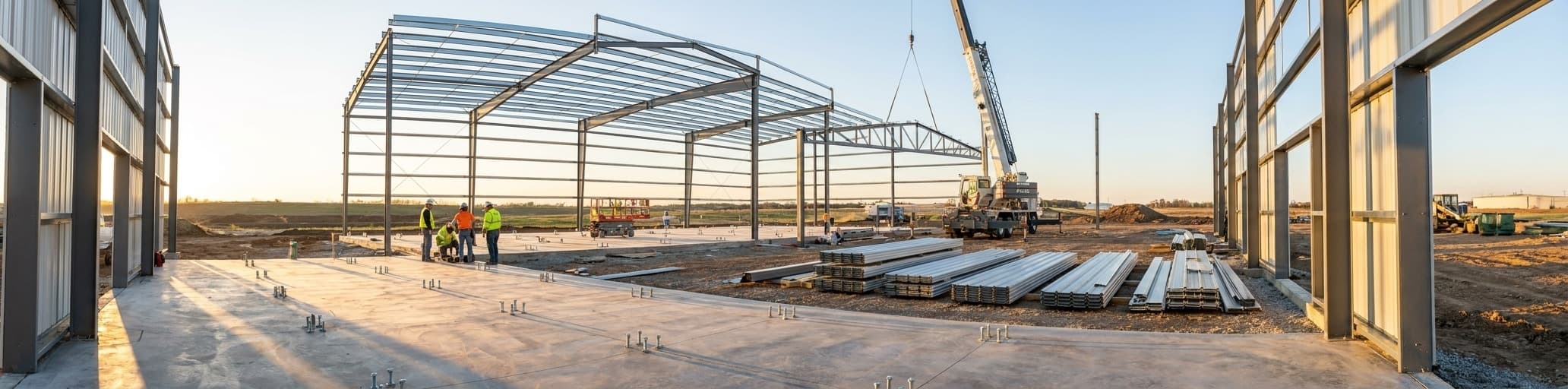

We help you understand that a 40×60 metal building ranges from $24,000 for a kit to $348,000 fully finished, with foundation and site prep representing the biggest cost variables. Working with a single-source supplier prevents markup stacking and scope gaps that commonly expand budgets mid-project.
How Much Does a 40×60 Metal Building Actually Cost in 2026?
A 40×60 metal building kit runs $24,000 to $60,000, but site prep and interior finishing typically consume 70% of your total project budget.
Direct Cost Range: What You'll Pay for Kit vs. Turnkey InstallationA 40×60 metal building covers 2,400 square feet — and the price gap between a bare kit and a finished turnkey install is substantial. Metal building kit prices run $10 to $25 per square foot for plans and materials alone, which puts a 40×60 kit between $24,000 and $60,000.[1] Erecting the shell on-site adds another $5 to $10 per square foot in assembly labor.[1] Once you move to a fully installed, finished structure, costs climb to $50 to $145 per square foot — meaning a complete 40×60 metal building project lands between $120,000 and $348,000 depending on finishes, region, and intended use.[1] One ratio worth anchoring your budget to: the kit and shell assembly typically account for only 30% of total project cost, while site prep, interior work, and exterior finishing absorb the remaining 70%.[1]
| Cost tier | Price per sq ft | 40×60 total (2,400 sq ft) |
|---|---|---|
| Kit only (materials + plans) | $10 – $25 | $24,000 – $60,000 |
| Kit + shell assembly | $15 – $35 | $36,000 – $84,000 |
| Turnkey finished installation | $50 – $145 | $120,000 – $348,000 |
The widest cost variable isn't the steel itself — it's the finish scope. A straightforward commercial shell with no interior finishing sits near the low end. A barndominium-style 40×60 with full living quarters, HVAC, plumbing, and kitchen finishes pushes toward the ceiling.[1] Knowing where your project falls on that spectrum before you request quotes is the fastest way to keep your 40×60 metal building cost from expanding mid-project.
Cost Breakdown: Materials, Labor, and Hidden Expenses Explained
The listed kit price for a 40×60 metal building covers more than raw steel — but less than most buyers assume. A standard kit package includes the primary steel frame (12 or 14 gauge depending on span requirements), 26-gauge roof and wall sheeting in your selected color, trim, fasteners, J-bolt anchor hardware, stamped engineered drawings calibrated to your local wind and snow loads, and a standard installation crew working on a prepared, level pad.[2] What it does not include is where budgets quietly expand. Concrete foundation and site grading, permit fees, any engineering revisions required by local code review, electrical and plumbing rough-ins, interior finish-out, insulation upgrades, and additional roll-up doors or walk doors beyond the base package are all separate line items.[2] For a 40×60 project specifically, those additions can easily double or triple the base kit figure depending on your finish scope.
Five cost drivers account for the majority of line-item surprises on 40×60 builds:
- Frame gauge and height — upgrading from 14-gauge to 12-gauge framing, or adding wall height for equipment clearance, increases both material weight and structural complexity.[2]
- Door count and opening size — large roll-up doors and multiple openings are among the highest per-unit cost drivers in the entire project.[2]
- Insulation specification — vinyl-backed, reflective, and spray foam options each carry different price points; choosing the wrong spec for your climate adds operating costs that outpace the upfront savings.[2]
- Foundation scope — concrete slab design and soil prep vary significantly by region and soil type; this line item should be priced in parallel with the kit, not after.[2]
- Permit and engineering timeline — local code review can require engineering revisions that add both cost and schedule risk if not anticipated early.[2]
Why National Steel Buildings' Single-Source Model Saves You Money
Splitting a 40×60 metal building project across multiple vendors compounds cost in ways that don't show up until invoices arrive. General contractors typically add 15-25% on top of direct costs to cover their own overhead and profit.[4] When you hire a kit supplier, a separate erection crew, and an independent foundation contractor, each party applies that markup independently — meaning you pay markup on top of markup before a single bolt is tightened.[5] On a 2,400-square-foot project, those stacked percentages translate to real dollars. A single-source supplier compresses that chain: one fee covers design, stamped engineering, fabrication, and installation, so you're not funding three separate overhead structures on the same build.
The financial risk of multi-vendor coordination goes beyond markups. Cost-plus arrangements between separate trades can expand sharply when scope evolves — one documented case saw a project grow from a $4M estimate to $10M at completion as finish decisions shifted between vendors.[5] A design-build relationship with a single point of accountability prevents that drift. When a permit revision or foundation adjustment is needed, there's no negotiation over whose scope covers the change and no schedule gap while two contractors exchange emails.[5] The contractor who managed sourcing, engineering, and erection from day one already knows every dimension of your project — so changes get resolved fast, within budget, and without the finger-pointing that derails multi-vendor jobs. That's the practical difference between a quote that holds and one that expands every time a decision gets made.
Foundation and Concrete Slab Requirements for 40×60 Buildings
Upgrading from a 4-inch to 6-inch slab costs roughly $2,760 on a 40×60 building–a modest investment that prevents structural failure under vehicle and equipment loads.
Slab Sizing and Depth: What 2,400 Square Feet Demands
A 40×60 concrete slab costs between $22,000 and $25,000 in most U.S. markets, and the thickness specification you choose has real consequences for what the floor can handle.[6] A 4-inch slab with 3,500 PSI concrete and welded wire mesh is the minimum viable spec for light storage use — but any building that will see vehicle traffic, heavy equipment, or workshop loads requires a 6-inch slab with 3,500 PSI concrete and rebar on an 18-inch grid in both directions.[6] The price difference between those two tiers is roughly $1.15 per square foot, which amounts to about $2,760 on a 2,400-square-foot pour — a small cost relative to the structural risk of under-building the floor.[6] At 40 feet wide, your building also falls into the category where engineers recommend a deeper perimeter beam: standard builds use a 12-inch perimeter footer, but a 40-foot-wide structure carries more lateral stress on the foundation, and expansive clay soils demand a 24-inch perimeter beam depth to prevent seasonal soil movement from cracking the slab or shifting anchor bolt alignment.[6] Two details that budgets routinely miss: a 6-mil or 10-mil polyethylene vapor barrier is required beneath the slab regardless of thickness tier, and the slab must match your building's frame dimensions exactly — an oversized slab wastes concrete and leaves exposed edges that collect water and accelerate soil movement around the perimeter.[6] Plan on a minimum 5 to 7 days of cure time before erection can begin, with cold weather extending that window further.[6]
Soil Preparation and Site Work Costs by Region
Site preparation is where regional variation hits hardest, and it's also where metal building budgets most frequently surprise buyers.
Every site is different, and factors like the amount of necessary grading, soil type, site clearing requirements, ecosystem sensitivities, and access to utilities each add their own cost layer to a 40×60 project.[7] Grading, excavation, and concrete work represent a significant share of total project cost — yet most kit-only prices from manufacturers exclude these line items entirely, which means buyers comparing quotes aren't always comparing equivalent scopes.[7] Climate compounds the problem further: frozen ground in northern states delays foundation pours and pushes schedule risk into the spring construction rush, while high rainfall in coastal and Pacific Northwest markets complicates drainage design and can extend cure windows unpredictably.[7] Foundation costs across U.S. markets generally run $5 to $15 per square foot, putting the site prep and foundation line item for a 40×60 building between $12,000 and $36,000 before any interior work begins — a range that reflects the real difference between building on a flat, stable lot with good drainage versus breaking ground on a sloped, clay-heavy site that demands significant excavation and a deeper perimeter beam.[8] Regional labor rates add a separate variable: local labor market conditions, transportation costs for materials, and local building code requirements all differ by geography, and a supplier without national procurement relationships pays retail rates on every one of those inputs.[7] Understanding the price of local labor and the full scope of services required to complete a 40×60 project — not just the steel — is what separates a realistic budget from one that expands after the kit arrives on site.[7]
How to Budget for Concrete When Working with Your Steel Building Supplier
The single most important sequencing rule on a 40×60 project: your concrete contractor cannot pour the slab until your steel building supplier delivers the anchor bolt plan. That drawing specifies the exact location, diameter, and embedment depth of every anchor bolt in the slab — and positioning errors of even an inch prevent proper column alignment during erection, creating stress concentrations that compromise structural performance and void your manufacturer's warranty.[9] Get that drawing in hand before you schedule the pour.
Your foundation also must meet the concrete strength your building's engineering specifies — typically 3,000 to 4,000 PSI — and using a lower-strength mix is not a cost-saving option; it voids warranties and creates liability.[9] Budget the soil test before you finalize any foundation scope with your concrete contractor. The $500-$1,500 investment reveals bearing capacity, expansion potential, and frost depth requirements that directly change what your concrete contractor will need to build — and discovering expansive clay after your kit is three weeks from delivery, as some buyers have learned, adds both significant cost and weeks of schedule delay.[9] Once the slab is poured, plan for a minimum 7-10 days of cure time in normal weather before erection can begin, with cold-weather pours extending that window further — a timing reality your erection crew needs to know upfront so schedule gaps don't cost you mobilization fees.[9] The cleanest way to manage all of this without gaps between vendors is to work with a supplier who coordinates foundation engineering alongside kit delivery, so the anchor bolt plan, concrete spec, and erection schedule are integrated from day one rather than assembled piecemeal after the kit arrives on site.[10]
40×60 Building Specifications: Height, Span, and Customization Options
Customize your 40×60 building's eave height, door placement, and interior span to match your specific operational needs rather than forcing your workflow into a fixed structural envelope.
Standard Eave Heights and Clear-Span Configurations for Common Uses
A 40×60 metal building serves a wide range of applications, and the span configuration you choose follows directly from the use case — not the other way around.
Common applications for the 40×60 footprint include hobby shops, RV garages, home garages, barndominiums, and small business facilities.[11] Each use places different demands on vertical clearance and interior column placement: an RV garage needs considerably more eave height to clear a Class A motorhome than a retail shell or workshop requires, while a barndominium layout prioritizes unobstructed interior width to allow flexible partitioning without load-bearing walls interfering with the floor plan.[11] What makes the 40×60 particularly practical is that its framing system accommodates additional customization beyond the standard base package — meaning eave height, door placement, and interior span options can be adjusted to match the operational requirements of your specific use, rather than forcing your workflow to conform to a fixed structural envelope.[11]
Roof Pitch, Wind Load, and Snow Load Ratings: What Matters in Your Climate
Climate determines your structural specification more than any design preference does.
States like North Carolina follow the International Building Code with climate-specific modifications — coastal counties require a minimum wind rating of 140 mph, while mountainous regions carry a 20 psf ground snow load requirement that directly affects roof framing weight and pitch selection.[12] South Carolina counties layer on wind-load certification and site-specific geotechnical reports as permit prerequisites, meaning your building's structural drawings must reflect local wind exposure before a permit is issued.[12] Virginia takes a parallel approach under its Uniform Statewide Building Code, which integrates IBC standards with seismic zone mapping — so in addition to wind and snow load analysis, your stamped structural calculations must account for ground movement risk by zone.[12] Roof pitch choices interact with all three of these variables: steeper pitches shed snow faster and reduce accumulation loads in high-snowfall regions, while lower-slope configurations can perform better in high-wind coastal zones where a larger roof surface area creates more uplift force.
Engineered drawings stamped by a licensed professional in your state are not optional in any of these markets — they're the document that confirms your 40×60 building's structural spec is calibrated to the actual climate loads your site will experience.[12]
Interior Layout Flexibility: Offices, Mezzanines, and Crane Runway Considerations
40×60 vs. 30×40 and 40×80: Comparing Footprints, Costs, and Practical Use Cases The 30×40, 40×60, and 40×80 footprints each serve a distinct operational tier — and choosing between them comes down to equipment scale and workflow complexity, not arbitrary square footage preference. The 30×40 at 1,200 square feet is the most common shop size built, hitting a practical balance between cost and usable space for farm shops, heated workshops, and small commercial operations.[15] Step up to the 40×60 and you double that capacity to 2,400 square feet — the footprint most farmers and small business owners settle on when they need room for larger equipment, multiple vehicles, or a combination of heated workspace on one end and cold storage on the other.[15] The 40×80 at 3,200 square feet moves into commercial-grade territory: fleet storage, equipment dealerships, oilfield service companies, and multi-tenant shop bays, where engineering complexity increases meaningfully with roof spans, wind loads, and snow load calculations all requiring more involved structural design.[15] One consistent pricing dynamic across all three sizes is that cost per square foot drops as the building gets larger — so if you're deciding between two adjacent sizes, the incremental cost to go bigger is proportionally smaller than it appears at first glance.[15] A 30×40 prefab building cost breakdown can anchor the low end of that comparison if you're weighing whether the extra 1,200 square feet of a 40×60 justifies the budget difference for your specific use.
| Footprint | Square footage | Best fit | Key layout note |
|---|---|---|---|
| 30×40 | 1,200 sq ft | Farm shop, heated workshop, small commercial | Two to three vehicles plus workbench area |
| 40×60 | 2,400 sq ft | Farm equipment storage, service bays, multi-use space | Fits two 14-ft overhead doors on the front wall with clearance between them |
| 40×80 | 3,200 sq ft | Large farm operations, fleet storage, commercial/industrial | Requires more involved structural engineering for spans, wind, and snow loads |
Common Applications: Warehouses, Workshops, Agricultural Storage, and Barndominiums
The 40×60 footprint earns its versatility from one structural fact: 40 feet of clear-span interior width with no load-bearing columns dividing the floor plan.
That single characteristic makes it viable for four operationally distinct use categories, each with its own finish scope.
For mini storage and light warehouse use, the clear-span layout maximizes unit count and layout flexibility — a single-story drive-up storage configuration at this footprint delivers high usable density with minimal aisle waste, and single-story drive-up construction generally runs $35-$55 per square foot for the building package, slab, doors, and basic electrical combined.[16] Workshop and commercial service bay builds use the 40-foot width differently: two full service bays fit side by side with clearance to spare for a parts counter or enclosed office partition, and vehicle movement across the full floor width remains unobstructed.[16] Agricultural storage at this scale bridges light and heavy equipment in one structure — the footprint handles a full-size tractor with implements alongside a covered tool storage area or a grain-handling station partitioned at one end, without any column placement forcing workflow compromises.[16] Barndominium use pushes the structure into residential territory, and steel's design vocabulary has expanded enough that a finished 40×60 residential build can be visually indistinguishable from a conventional home: stone or wood-look wainscot panels, covered entry details, and contrast trim make the metal frame undetectable from the street.[17] The footprint itself stays constant across all four uses — what changes is finish scope and trade coordination complexity, and for barndominium builds specifically, the relationship between structural shell delivery and interior living-space trades is where project timelines most commonly slip if not managed under a single contract.[17]
How to Request a Custom Quote and Avoid Pricing Surprises
Most steel building quotes are valid for only 30 to 60 days, which means timing your quote request matters as much as what you ask for.[18] Steel prices in 2026 are holding in the low-to-mid $800s per short ton with a slight upward trend, and overall project costs are projected to increase 4 to 6 percent through the remainder of the year — so delaying a quote while you deliberate doesn't protect your budget, it erodes it.[18] The single most effective move buyers make: compare at least three fully itemized proposals, a step that has helped buyers save as much as 28 percent on final project costs by exposing line-item gaps between suppliers.[18] "Itemized" is the operative word — a quote that bundles the kit, foundation, labor, and permits into a single lump sum tells you nothing about where the number came from or where it might shift. Ask each supplier to break out materials, erection labor, foundation scope, permit fees, and any tariff-related surcharges separately; tariff line items currently run $15 to $25 per square foot on some quotes and disappear entirely on others, which makes apples-to-apples comparison impossible without the line detail.[18] Permit fees add another variable most buyers underestimate: they average $550 to $2,000 nationally but climb to $7,500 or more in major metro areas, and that figure changes based on local jurisdiction adoption of the 2024 International Building Code, which introduced new tornado and wind provisions that alter structural specs and review timelines in affected counties.[18] Before any quote is finalized, schedule a soil test — the $500 to $1,500 investment reveals bearing capacity and expansion potential that directly change your foundation scope, and discovering expansive clay after your quote is locked can reopen foundation costs at the worst possible moment.[8] Build a 7 to 10 percent contingency into your total budget from day one, keep your design rectangular and sized to standard dimensions like 40×60 to avoid custom engineering fees, and lock in your quote with a down payment once the scope is confirmed — because in a market where supply is constrained and input prices are rising, a signed agreement is the only real price protection available.[18]
The checklist below covers what every quote request for a 40×60 project should include before you sign anything:
- Itemized line for the structural kit (frame, sheeting, trim, fasteners, stamped drawings)
- Separate line for erection labor, quoted per square foot
- Foundation scope and concrete spec referenced explicitly, not bundled
- Permit and engineering fee estimate for your specific county and jurisdiction
- Any tariff surcharges or material escalation clauses disclosed up front
- Quote validity window stated in writing, with lock-in terms for a deposit
- Contingency language: confirm whether the quote is fixed-price or cost-plus
When you work with a single-source supplier who handles design, fabrication, and erection under one contract, the number of line items that can shift between vendors collapses — and so does the risk that a scope gap between your kit supplier and your concrete contractor adds cost after the project is underway.[8]
- A 40×60 metal building kit costs $24,000-$60,000, but fully finished turnkey installation ranges $120,000-$348,000 depending on finishes and regional factors.
- Kit and shell assembly represent only 30% of total project cost, while site prep, interior work, and exterior finishing account for the remaining 70%.
- A 6-inch concrete slab with rebar is required for vehicle traffic and equipment loads, costing roughly $1.15 more per square foot than a 4-inch minimum slab.
- Anchor bolt positioning plans from the steel supplier must be delivered before concrete pouring to prevent structural misalignment and warranty voidance.
- Using multiple vendors adds stacked markups of 15-25% per contractor, while single-source suppliers eliminate this markup duplication and reduce scope creep risk.
- Steel price quotes are valid only 30-60 days; delaying decisions costs money as prices trend 4-6% higher through 2026.
- A soil test costing $500-$1,500 before finalizing foundation scope prevents expensive post-quote surprises from expansive clay or poor bearing capacity.
- https://homeguide.com/costs/metal-building-homes-cost
- https://www.northtexassheds.com/steel-building-cost-guide
- https://truittandwhite.com/contractor-markup-on-materials
- https://projul.com/blog/construction-cost-plus-vs-fixed-price-contracts-guide/
- https://www.designwithfrank.com/blogs/building-guide/builder-contract-types-explained-fixed-price-cost-plus-gmp?srsltid=AfmBOoqdADEBWnMOIjQktqhT-4MaK71fQPmfZFZqqwukwBcvXJnLh7Jf
- https://www.northtexassheds.com/concrete-foundation-steel-building-guide
- https://builtmammoth.com/how-much-does-a-steel-building-cost/
- https://iconsteelbuildings.com/how-much-are-metal-buildings/
- https://mbmisteelbuildings.com/blog/steel-building-foundation/
- https://norsteelbuildings.com/us/steel-building-foundations/an-introduction-to-building-foundations/
- https://www.getcarports.com/30×40-metal-building-vs-40×60-metal-building?srsltid=AfmBOooAE0FhJlDnUKtMNPJLeHcZKXeOUxuB-WEiPZXlVhYvTcZt5qVo
- https://hintonbuildings.com/metal-buildings-40×60/?srsltid=AfmBOoqhwuN_eXorqRKOyXM_GZKUDCYDFVZM4gbIEKIdTzDB9OsiJktl
- https://steelcommandercorp.com/product/40x60x18-metal-building/
- https://trusteelbuildings.com/faqs/
- https://kbconstructionltd.com/guides/shop-size-guide
- https://trusteelbuildings.com/what-is-the-cost-to-build-a-storage-unit-building/
- https://metalbuildingsus.com/metal-buildings-delaware/metal-vs-wood-building-delaware/
- https://ameribuilds.com/steel-building-costs-what-to-expect-2026/