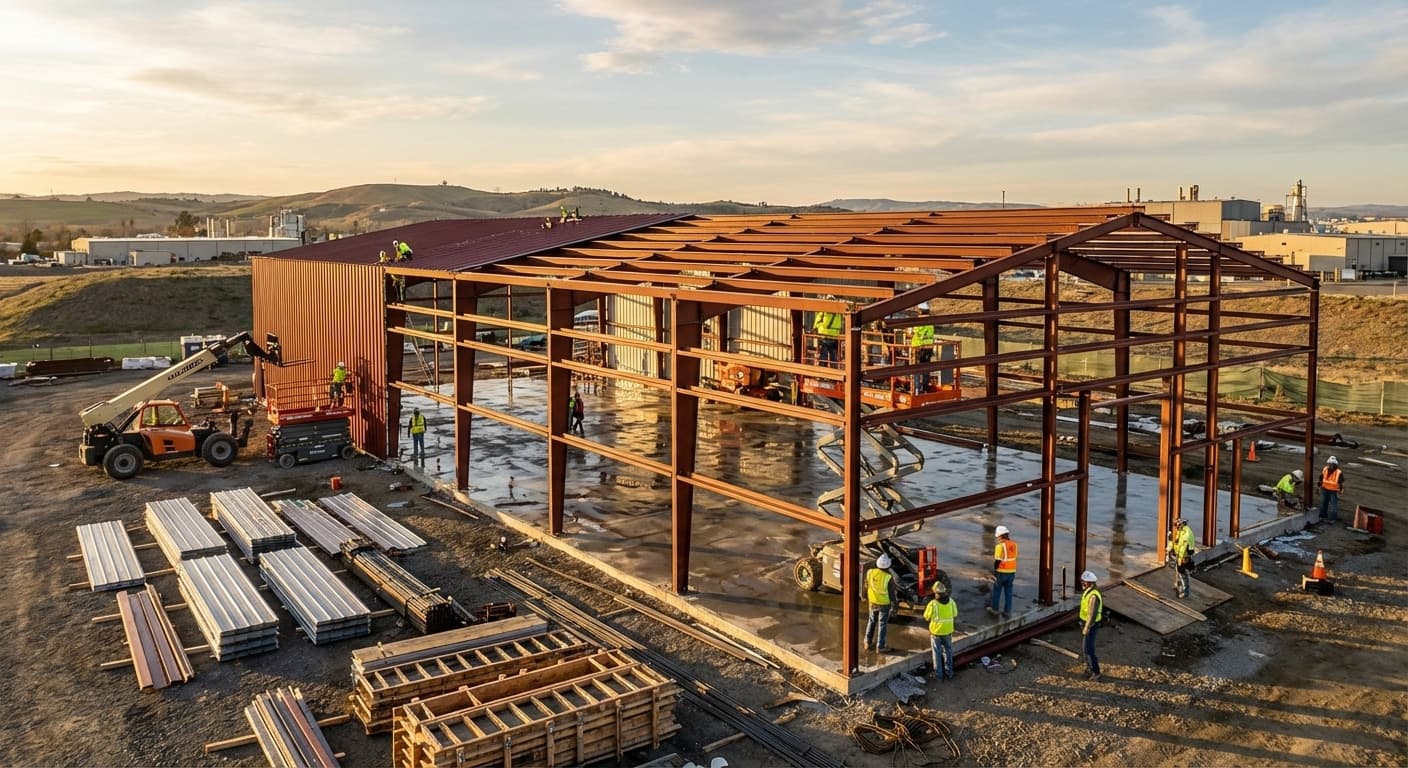

A 40×80 metal building's sticker price of $57-70k is only the down-payment on a project that really costs $86-128k once you add foundation, labor and site work, so this article shows you how to budget the full 50-80% gap, anticipate steel-market swings that can change quotes in weeks, and spot the "hidden" 20-30% extras like soil fixes and insulation that first-time buyers miss. You'll learn square-foot rules of thumb (kit 55%, foundation 20%, labor 25%), why local codes and height choices can add thousands, and which smart add-ons–walk doors, R-17 insulation, color–pay for themselves in energy or resale value. It explains how single-source "supply-and-erect" teams cut 15-20% by eliminating subcontractor layers and delays, and it gives timing tactics for locking steel prices before the next 18-20% spike. With check-points, expansion-ready designs and a 10-15% contingency buffer, readers gain a predictable roadmap that turns a seemingly simple kit into a turnkey, low-maintenance asset without the budget-busting surprises that derail most DIY builds.
Understanding the True Cost Components
Before you sign on the dotted line, brace yourself: the turnkey price of a 40×80 metal building can surge 50-80% above the $57-70k kit quote once foundation, labor, site prep and volatile steel-price swings are tallied.
Base Kit Pricing vs Installed Cost for 40×80 Metal Building Cost
A 40×80 metal building kit typically costs $57,600 to $70,400 ($18-$22 per square foot), but this represents just the starting point of your total investment [1][2]. This base price covers only the structural components: steel frame, roof and wall panels, fasteners, trim, and standard anchors [2].
The fully installed cost ranges from $86,400 to $128,600, factoring in the concrete foundation ($4-$8 per square foot or $12,800-$25,600 total), construction labor ($5-$10 per square foot or $16,000-$32,000), plus any required site preparation [1][2]. This significant gap between kit and turnkey pricing–approximately 50-80% higher for complete installation–often surprises first-time buyers.
When budgeting, remember that quoted prices frequently exclude site preparation and interior finishing, which can add another 20-30% to total project costs [2]. The true cost difference varies based on building height (taller structures cost more), local labor rates, and site conditions that might require additional foundation work [1].
Material Market Fluctuations and Their Impact on 40×80 Metal Building Cost
Steel prices directly impact your 40×80 metal building budget, with market volatility potentially causing significant price swings throughout the year. The steel market fluctuates based on international supply and demand, production costs, and broader economic factors [5]. Recent trends show declining US steel production–dropping to 6,700 thousand tonnes in September 2023 from 7,000 thousand tonnes the previous month [4].
These market shifts explain why 40×80 metal building quotes (typically $18-$22 per square foot or $57,600-$70,400 total) often include time-limited pricing guarantees [5]. When planning your project, consider that quotes may only remain valid for 15-30 days during volatile periods. Trade policies, geopolitical events, and currency exchange rates directly influence steel pricing and can dramatically change your bottom line [4].
To mitigate risk, request quotes from multiple suppliers simultaneously for the most accurate snapshot of current pricing, and ask about price-locking options that could save thousands on a structure this size [5].
Hidden Expenses: Permits, Foundations, and Site Preparation for 40×80 Metal Building Cost
The kit price of a 40×80 metal building overlooks critical expenses that often surprise first-time builders. Most quotes exclude site preparation, foundation work, and interior finishing, which can add 20-30% to your total project cost [6]. Before any steel goes up, your site requires clearing, leveling, and possibly excavation–none typically included in kit pricing [6].
Soil testing may reveal unstable ground conditions requiring compaction or imported fill, further increasing expenses [6]. Foundation work constitutes the largest hidden cost, typically adding $12,800-$25,600 to your total investment [6]. These precisely engineered foundations must be tailored to specific loads, building layout, and soil conditions, yet rarely appear in basic building quotes [6].
To avoid budget overruns, consult local contractors early to determine specific site requirements and associated costs before finalizing your metal building purchase [6].
Planning for Accurate Budgeting
Break your 3,200-square-foot metal-building budget down to the square foot–$27-$40 installed, with local labor and code variations swinging the final price by tens of thousands–so you can lock in accurate, location-specific quotes before you commit.
Calculating Per‑Square‑Foot Estimates for a 40×80 Metal Building Cost
Breaking down costs by square footage helps create realistic budgets for a 3,200 square foot metal building. The standard components have established price ranges: base kit materials run $18-$22 per square foot ($57,600-$70,400 total), concrete foundation adds $4-$8 per square foot ($12,800-$25,600), and construction labor costs $5-$10 per square foot ($16,000-$32,000) [7].
Together, these core elements bring the installed cost to $27-$40 per square foot ($86,400-$128,000 total) before customization [7]. This square-footage approach reveals how each element contributes proportionally to your budget–the kit represents approximately 55% of costs, foundation 20%, and labor 25% in a typical project [8].
Local conditions significantly impact these calculations; areas with strict building codes or remote locations often command premium labor rates that can push total costs toward the upper end of the range [9]. For the most accurate estimate, collect quotes that specifically break down per-square-foot costs for your location rather than relying on national averages.
Regional Labor Rates and Their Effect on 40×80 Metal Building Cost
Labor costs represent 25% of a typical 40×80 metal building project, ranging from $16,000 to $32,000 ($5-$10 per square foot) [10]. These rates fluctuate significantly across regions, creating substantial cost variations even for identical buildings. Rural areas generally command higher installation fees due to contractor travel expenses and limited workforce availability.
Conversely, metropolitan regions with competitive contractor markets might offer better rates but often impose stricter building codes that increase overall costs [10]. These regional code differences trigger cascading expenses–buildings in hurricane-prone coastal zones or high-snow-load northern states require additional engineering and reinforcement that increases both material and labor costs [9]. Labor rate variations affect not only the steel erection process but also site preparation and foundation work, which explains why identical building kits can result in final costs differing by 20-30% depending on location [10].
When planning your budget, obtain multiple local contractor quotes rather than relying on national averages, as labor constitutes a significant variable that can make or break your financial planning.
Choosing Add‑Ons Without Compromising 40×80 Metal Building Cost
Strategic customization of a 40×80 metal building can enhance functionality without breaking your budget. Doors represent one of the most impactful value-adding options, with walk-in doors costing $250-$500 each and garage doors priced based on size (ranging from 6'x6' to 16'x16'). Windows add natural lighting for $150-$300 per unit depending on size and design specifications [2]. Insulation provides long-term energy savings with three primary options: uninsulated (lowest upfront cost), double-bubble ($1.
50/sq ft for basic temperature control), or R-17 ($3. 00/sq ft for maximum efficiency). For a 40×80 structure, complete R-17 insulation adds approximately $9,600 to your project cost but delivers substantial operational savings [2]. Building aesthetics needn't impact your budget, as most manufacturers include color customization at no additional charge, allowing you to match brand identity or personal preference [2].
When planning add-ons, prioritize features that directly support your building's primary function–overhead doors for equipment access in workshops, enhanced ventilation for manufacturing spaces, or skylights for natural lighting in retail applications [11]. Industry experts recommend setting aside an additional 10-15% beyond your base budget to accommodate customization changes during construction without derailing your financial plan [11]. This buffer proves especially valuable when addressing unexpected site conditions or taking advantage of efficiency upgrades that become apparent during the building process.
Leveraging Single‑Source Solutions for Savings
Handing your 40×80 metal building to one integrated team cuts 15-20% from the budget and slashes build time to 2-3 weeks by eliminating subcontractor mark-ups, costly delays, and on-site rework.
How ProTrades Integration Streamlines 40×80 Metal Building Cost Control You save 15-20% on your 40×80 metal building when one experienced team handles everything from start to finish. Single-source integration means your project runs with one crew, one schedule, one point of contact–no markup layers from multiple subcontractors [12]. When the same team that understands your foundation pours also erects your steel frame, you avoid the expensive surprises that hit multi-vendor projects.
Your equipment rentals stay short. Your timeline stays tight. Your budget stays intact.
This approach shines on 40×80 structures where foundation and frame must work together perfectly–one team ensures they do [12]. The same crew that builds your structure also knows how to maximize its efficiency: proper sealing cuts energy costs, smart construction reduces future maintenance [13]. That's the difference between hoping contractors communicate and knowing they do because they're the same people.
Coordinated Delivery and Erection Reduces Unexpected 40×80 Metal Building Cost
When your steel arrives exactly when your erection crew needs it, you dodge the 15-20% cost bump from delays and rescheduling [14]. Supply-and-erect services turn your 40×80 project into a smooth operation: materials show up ready to assemble, no cutting or fitting on site, no waste disposal headaches [15]. Your pre-engineered components fit together like they should because they're built for immediate installation [16].
Here's what coordination means for your bottom line: skilled crews who know the building system complete your 40×80 structure in 2-3 weeks instead of 6-8 weeks [16]. Every component goes up right the first time–aligned, secured, weathertight [15]. You skip the rework.
You skip the warranty claims. You get a building that costs less to maintain because it was erected properly from day one [16]. That's what happens when delivery and erection work as one system instead of two separate hopes.
Clear Communication Milestones to Keep 40×80 Metal Building Cost on Track
Five clear checkpoints keep your 40×80 building costs locked down: pre-construction approval, foundation completion, frame erection, enclosure weathertight, and substantial completion [17]. Each milestone gets formal sign-off before moving forward–no surprises, no runaway expenses. Foundation completion matters most for your budget. This checkpoint confirms your soil meets specs before you invest in steel erection [17].
Smart project managers check costs at every milestone, not just at the end. Catch a problem at foundation stage? Fix it for hundreds. Find it during steel erection?
Pay thousands [19]. These aren't just schedule markers–they're financial guardrails that prevent the 15-20% overruns that sink building projects [18]. Each checkpoint triggers two actions: verify completed work meets specs, confirm upcoming materials and crews are ready [19]. One information source, one tracking system, zero confusion about where your money went [19].
Tools and Strategies to Keep Costs Predictable
Lock in your steel price now–every 2-foot height jump adds up to $7k, and with 18-20% increases forecasted, timing the market beats every other lever for keeping your 40×80 build on budget.
Using a Cost Estimator: Key Inputs That Move the 40×80 Metal Building Cost Needle
You'll get the most accurate budget estimates by focusing on the inputs that actually move the needle on your 40×80 building cost. Height drives pricing more than any other factor–each 2-foot increment adds $3,000-$7,000 to your total. A 12-foot structure runs approximately $57,600 ($18/sq ft) while 20-foot buildings reach $70,400 ($22/sq ft) [20].
Your frame gauge choice matters too. Standard 14-gauge frames handle most applications, but severe weather zones demand 12-gauge strength at higher cost [20]. Roof style affects both price and performance–standard gable roofs save money upfront, while vertical systems deliver superior snow shedding and wind resistance [20].
Foundation requirements represent your largest variable expense beyond the kit itself, ranging from $6-$10 per square foot based on soil conditions and load requirements [20]. Smart estimating means accounting for door and window quantities (detailed pricing covered in our planning section) and building in a 10-15% buffer for site-specific adjustments [20]. With 1,480+ completed projects, we've learned exactly which variables matter most for accurate budgeting.
Locking in Steel Prices: Timing Your Purchase for Maximum 40×80 Metal Building Cost Savings
Timing your steel purchase strategically puts thousands back in your pocket. Steel prices swing wildly–from $200 to $2000 per ton historically–with recent hot-rolled coil jumping from $650 to $900 per ton thanks to tariff policies [21][22]. On your 3,200 square-foot building, a 10% market dip saves you $5,700-$7,000 in materials alone [21].
Watch for predictable patterns: prices typically drop around fiscal year-end and spike during construction booms [21]. Current forecasts show 18-20% increases coming, making now better than later for locking in pricing [22]. The 25% import tariff keeps pushing domestic prices higher [22].
Your best defense? Partner with suppliers who buy steel in volume and monitor markets daily.
Designing for Low‑Maintenance Longevity to Reduce Ongoing 40×80 Metal Building Cost
Your upfront material choices determine whether you'll spend decades writing maintenance checks or enjoying a building that practically takes care of itself. Start with corrosion-resistant coatings and proper galvanization–they add years to your structure's life while proper drainage prevents the moisture that causes rust and weakening [23]. Frame design matters more than you'd think. Optimized layouts cut steel usage without sacrificing strength. Engineered connections eliminate stress points that demand constant inspection [24]. Energy efficiency pays you back monthly.
Reflective roof systems slash cooling costs 15-25%. Quality insulation cuts total HVAC expenses 30-40%. Smart window placement brings in light without heat [23]. Add ventilation that prevents condensation, and you've eliminated most moisture-related repairs before they start. The numbers tell the story: your 40×80 metal building needs 60-80% less maintenance than traditional construction. That's $0.
15-$0. 25 per square foot saved annually–$480-$800 yearly on your building [25]. Most "maintenance" becomes simple visual inspections, not structural repairs. Plan ahead with expansion-ready designs, modular interior systems, and standardized components. When growth happens, you'll modify without compromising the structure you've invested in [24].
- Kit price $57.6-70.4k is only 55% of total; turnkey runs $86.4-128.6k after foundation & labor.
- Steel quotes expire in 15-30 days; lock prices fast or risk $5-7k swings on 3,200 sq ft.
- Foundation alone adds $12.8-25.6k and is rarely in kit quotes–verify soil early.
- Labor varies 20-30% by region; rural sites and code-heavy coasts push costs to upper range.
- Each 2-ft height jump raises total cost $3-7k; 12-ft vs 20-ft frame changes kit $57.6k→70.4k.
- Single-source supply-and-erect cuts 15-20% by slashing schedule to 2-3 weeks and eliminating rework.
- Up-front corrosion coatings, reflective roof, and R-17 insulation cut lifetime HVAC 30-40% and yearly upkeep $480-800.
- https://www.buildingsguide.com/standard-sizes/40×80-metal-building/?srsltid=AfmBOooqSxVgfGu5oZsn1MnwUjCfs6P1GYaTQqoRRss5aiv_YllmRh49
- https://www.buildingsguide.com/metal-building-prices/?srsltid=AfmBOoojJfs5Hz-k2tTxHk0UP2X04vHnK9hECx5N8VBxnoeAbhomS11S
- https://northernstatesteel.com/steel-pricing-forecast-2023-2024/
- https://ecosteel.com/ecosteelprefab/hidden-costs-in-steel-building-projects-how-to-avoid-them/
- https://www.buildingsguide.com/standard-sizes/40×80-metal-building/?srsltid=AfmBOor17JV71u3WWrZZYn1QtGZRypRxyH7BYJcjJBGG7IOxnX259KhB
- https://steelbuildingsguide.org/40×80-metal-building/
- https://www.protradesusa.com/
- https://singlesourcesystems.com/blog/cost-saving-benefits-of-steel-frame-buildings/
- https://www.duttongarfield.com/how-supply-erect-services-simplify-commercial-building-projects/
- https://www.tylerbuilding.com/post/the-essential-guide-for-metal-building-erectors
- https://www.alpha-labor-co.com/blog/cost-of-pre-engineered-metal-buildings
- https://www.procore.com/library/project-management-milestones
- https://www.advancedbuildingcorporation.com/blog/construction-project-timeline/
- https://resources.kahua.com/blog/effective-construction-cost-control-key-strategies-for-owners
- https://www.alliedbuildings.com/pemb-steel-material-costs/
- https://www.tylerbuilding.com/post/steel-market-trends-why-now-is-the-time-to-buy-a-metal-building
- https://www.metalbuildingoutfitters.com/durable-and-cost-effective-metal-structures-for-longevity/
- https://www.nationwidesteelstructures.com/post/custom-steel-building-design-strength-cost-longevity
- https://bulldogsteelstructures.com/blog/exploring-the-cost-efficiency-of-metal-buildings-vs-traditional-construction/