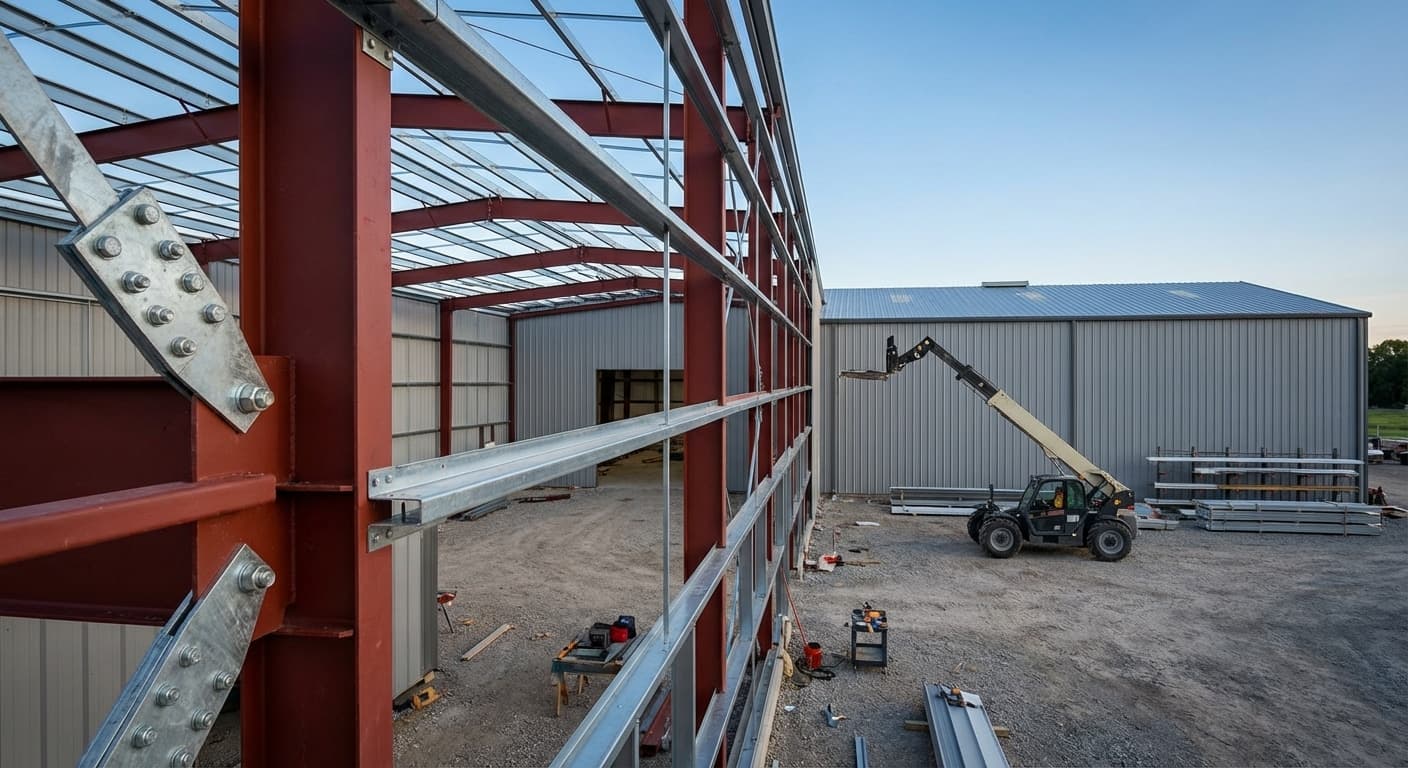

The article demystifies 40×80 metal-building pricing by showing that the base $48-64k kit already delivers a weathertight, code-compliant shell–everything structural, trimmed, and anchored for your zip code's wind, snow, seismic, and soil loads–while making it crystal-clear which "options" (doors, windows, insulation, concrete, erection) will add 20-30% later and why skipping them now can cost tens of thousands in energy, rust, or retrofits down the road. Readers learn to spot pricing games, size door heights early to avoid costly eave raises, justify galvanized framing and proper insulation as 50-year investments that cut insurance and energy bills, and sequence payments so the 8-12-week build finishes on time and on budget with an in-house crew. Ultimately, the piece equips buyers to turn a seemingly low-ball quote into a predictable, lifetime-value purchase that survives both the next storm and the next resale.
Understanding Base Kit Pricing
Your 40×80 metal building's base price delivers a code-compliant, weathertight 3,200-sq-ft steel shell engineered for your exact wind, snow, and seismic zone–no hidden fees, just add doors, insulation, and concrete as you choose.
What's Included in the Base Price
Your 40×80 metal building base price delivers everything you need for a weathertight shell. You get primary and secondary steel framing, metal roof and wall panels, all fasteners, trim, and anchors–engineered specifically for your location [1][2]. That's 3,200 square feet of clear-span space, ready for your customization [1][3]. Here's what you can count on: commercial-grade red iron I-beam framing at $18-$22 per square foot.
Need more height? Each 2-foot increase adds $3,000-$7,000 to your investment–we'll calculate it precisely for you [3]. We include free delivery to keep your budget predictable. What's not in the base price?
Doors, windows, insulation, concrete foundation, and installation [2]. These customizations typically add 20-30% to your total project cost, but you control every choice [3]. No surprises, no hidden fees–just straightforward pricing that lets you build exactly what you need.
How Regional Factors Influence 40×80 metal building kit prices
Your location drives your 40×80 metal building price–and we handle all the complexity for you. Local building codes dictate how much steel your structure needs, and we engineer accordingly [4]. Wind loads vary dramatically. Coastal buildings need hurricane-rated strength. Inland structures require less.
We calculate exactly what you need–no overbuilding, no shortcuts [4][5]. Snow loads create the biggest price swings. A Dallas building (5 lb snow load, 115 MPH wind) costs $26,800. The same building in upstate New York (70 lb snow load, 115 MPH wind) runs $35,650. That's a 33% difference from Mother Nature alone [6].
Your region might also require: * Seismic engineering (New Madrid Zone, West Coast) [5] * Rigid frame construction for tornado alleys [4] * Deep foundations for soft soils (Gulf Coast) [5] Here's what matters: We know these codes inside out. We've engineered buildings in all 50 states. You get exactly what your location requires–fully compliant, properly engineered, competitively priced. No guesswork, no surprises at permit time.
Comparing National Steel Buildings' Quote to Market Averages
Market prices for 40×80 metal building kits range from $15-$20 per square foot–that's $48,000-$64,000 for materials [7]. We price competitively while using only commercial-grade steel I-beam frames manufactured in North America. No shortcuts with cheaper tubular framing [7].
Your total investment breaks down clearly: * Building kit: $15-$20/sq ft * Concrete foundation: $7/sq ft * Professional installation: $5/sq ft That puts your complete 40×80 building at $76,800-$137,600, depending on your location and specifications [8]. Watch for pricing games. Some companies quote the same building at $62,000 to one customer and $123,000 to another [9].
We don't play those games.
Optional Features and Their Impact
Plan your door heights early–every extra two feet adds $3,000-$7,000–and insulate now to pocket $24,000 in energy savings over 20 years.
Evaluating Door and Window Add‑Ons
You'll need doors and windows–they're not included in your base kit. Here's what you're looking at: personnel doors run $250-$500 each, while overhead options include sectional, rollup, sliding, or bifold designs from 6'x6' up to 16'x16' [3]. Critical detail most people miss: you need two feet between your tallest door and the eave. Want a 10-foot door? You'll need 12-foot eaves minimum [10].
Each 2-foot height bump adds $3,000-$7,000 to your project, so plan door heights early. Windows typically cost $150-$300 per unit, and placement matters more than you think [3]. Put them where they'll cut your electric bill–natural light in work areas, cross-ventilation where heat builds up. For hangars and specialty buildings, electric or hydraulic doors give you the clearance you need, though they'll impact your budget substantially [3]. Smart door and window placement pays dividends.
Think workflow first–materials in, products out, people moving efficiently. When reviewing quotes, check if door and window framing is included. Large openings need extra engineering, and that cost might hide elsewhere in the quote.
Insulation and Energy Efficiency Options
Skip insulation and you'll pay for it–in rust, energy bills, and early replacement. Bare steel conducts heat like crazy, creating condensation that eats your building from the inside out [11]. But here's the payoff: save $100 monthly on energy and you're looking at $24,000 over 20 years [12]. Your insulation options break down like this: – Fiberglass blanket: $0. 50-$1. 50 per square foot. Basic R-10 starts at $0. 50, high-performance R-38 double-layer runs about $1.
50 [12]. Good sound reduction, but watch for thermal bridging where it compresses – Spray foam: Superior air sealing but pricier–about $1 per square foot per inch. Need R-25? That's 3. 5 inches at $3. 50 per square foot [12] – Insulated metal panels (IMPs): One-step installation, excellent performance, higher upfront cost but worth it for climate-controlled spaces [11] Retrofitting? Single-layer R-30 fiberglass runs about $1 per square foot for materials, but labor can double that depending on obstacles [12]. Critical detail: vapor barriers matter.
Standard vinyl facing (1. 0 perm rating) won't cut it–you need below 0. 1 perm to prevent condensation damage [11]. Building codes are tightening on insulation requirements too, so what's optional today might be mandatory tomorrow [11]. Bottom line: insulation typically adds 20-30% to your project cost but protects everything else you've invested [12]. Factor it in from the start.
Custom Trim, Colors, and Finishes
Good news on aesthetics–most visual upgrades won't blow your budget. Standard trim packages come free with your kit, handling the basics at eaves, corners, and openings [13].
Need extra weatherproofing in problem areas? Custom trim pieces are available.
Color selection costs nothing extra. You'll typically choose from 10-20 options for roofs, walls, and trim–match existing buildings, meet HOA requirements, or reinforce your brand identity [14].
Essential Upgrades for Long‑Term Value
Galvanizing your steel frame turns a 50-year investment into a lifetime of zero repaints, lower insurance bills, and a structure that will still be standing when your neighbor's unprotected building has rusted into scrap.
Why Galvanized Framing Is a Must
You're making a 50-year investment when you choose galvanized framing–not a 15-year gamble on bare steel. The zinc coating shields your building's bones from moisture, chemicals, and salt air that would otherwise eat through unprotected metal [15]. This isn't just surface protection either. Hot-dip galvanized steel keeps working even when scratched, with the zinc sacrificing itself to protect exposed areas–like having a full-time bodyguard for your building's frame [16].
Your insurance company will notice the difference too. Galvanized steel buildings often qualify for lower premiums because insurers know these structures resist damage better than standard construction [17]. That 10-15% upcharge for galvanized components? You'll recover it through eliminated repainting, avoided rust repairs, and those insurance savings–while your neighbor replaces their entire structure in 20 years.
For coastal projects or humid climates, galvanized framing moves from smart upgrade to absolute necessity. Without it, condensation attacks from inside while weather assaults from outside, turning structural steel into expensive scrap metal [17].
Structural Reinforcements for Wind and Snow Loads
As discussed in the regional factors section, your location drives the engineering requirements that keep your building standing through whatever nature throws at it. Those wind and snow load calculations aren't just numbers on paper–they determine whether your building survives the next blizzard or hurricane. What matters here is understanding these aren't optional upgrades you can skip to save money. Building codes mandate specific reinforcements based on your zip code [20].
Your 40×80 structure needs engineering certified to handle local conditions, whether that's 140 mph coastal winds or 70 pounds of snow per square foot up north. The right structural system makes all the difference. Red iron I-beam frames handle extreme loads that would buckle lighter gauge systems [20]. Every connection point, beam size, and purlin spacing gets calculated to AISC standards for your specific site [20].
Yes, these reinforcements add cost–but they're the difference between a building that stands for decades and one that becomes an insurance claim after the first major storm. We engineer each building to exceed minimum requirements because we know you're not building for minimum conditions. You're building for the worst day, not the average one.
Warranty‑Backed Accessories That Protect Your Investment
Your building accessories need warranties that match your investment timeline–not empty promises that expire before the paint dries. Quality insulation systems come with 10-20 year warranties when professionally installed, protecting both your energy bills and your steel from condensation damage [21]. Door and window systems backed by manufacturer guarantees keep working smoothly through thousands of cycles while maintaining their seal against weather [1]. Here's what smart buyers check: Do those warranties transfer when you sell? Transferable warranties boost property value because buyers know they're protected.
Premium finishes with 40-year fade warranties don't just look good–they qualify your building for insurance discounts thanks to proven weather resistance [21]. Match your accessories to your threats. Humid location? You need vapor barriers that actually work. High-wind zone?
Reinforced door systems aren't optional. Extreme temperatures? Specialized insulation pays for itself through energy savings [22]. These warranty-backed components often outlast the base building coverage, giving you overlapping protection that reduces long-term ownership costs. When you're ready to build, ask about warranty terms upfront–because the cheapest accessory with no warranty costs more than quality components backed by manufacturers who stand behind their products.
Managing Costs from Quote to Completion
From deposit to done in 8-12 weeks, your 40×80 metal building rolls out on a fixed payment schedule with ProTrades' own crews–no hidden fees, no subcontractor chaos, no inspection failures.
Transparent Pricing Timeline and Milestones
You need clarity on when to pay and what to expect–we get it. Your 40×80 metal building project follows a predictable timeline that keeps surprises at zero. As covered in our base pricing section, your initial quote includes the complete structural package [23]. What matters now is understanding the payment milestones and how each phase unfolds.
Your project moves from signed contract to completed building in 4-8 weeks. You'll make a deposit at signing, then progress payments at clear milestones–no hidden surprises, no sudden cash demands [3]. Here's your roadmap: While your building is manufactured, you'll finalize foundation plans and pull permits. When your materials arrive, inspect everything before signing–damaged goods are the manufacturer's problem, not yours.
Foundation curing takes 7-14 days, then our crews move fast: frame assembly (1-2 days), panels (2-3 days), trim and finishing (1 day) [3]. Start to finish, including permits and site prep, you're looking at 8-12 weeks from contract to completed building [23][3].
Financing, Deposits, and Payment Strategies
Service Excellence: Coordination with ProTrades for Seamless Installation Professional installation makes or breaks your building's long-term performance–that's why we handle it ourselves. Our in-house erection division, ProTrades, brings 25+ years of specialized expertise to your project. No costly delays, no workmanship issues, no inspection failures [27]. Our approach is simple: "Do what you say you will do.
" Our crews–lead men, iron workers, roofers, sheet metal workers, and laborers–show up with everything needed to complete your project efficiently, correctly, and safely [27]. Unlike contractors who scramble for local subs, our crews work together project after project. They know our Your 40×80 building requires cranes and specialized equipment–exactly what our experienced crews handle daily [29]. We mobilize once and stay until it's done.
No fragmentation, no quality issues, no excuses [27]. Our workflow moves like clockwork: foundation prep, primary framing, secondary framing, sheeting, finishing. What takes inexperienced teams weeks, we complete in 3-6 days [29]. You get your building faster, your operation starts sooner, and your investment starts paying back immediately.
- Base 40×80 kit ($48-64k) excludes doors, windows, insulation, concrete, installation–add 20-30% to total cost.
- Snow load drives biggest price swings: Dallas $26.8k vs upstate NY $35.65k–33% jump from climate alone.
- Every 2-ft height increase adds $3-7k; tallest door needs 2-ft clearance to eave, so plan openings early.
- Galvanized framing adds 10-15% upfront but prevents rust, cuts insurance, outlasts bare steel by decades.
- Insulation saves ~$24k over 20 years; retrofitting costs double in labor, so install vapor barriers from day one.
- Professional in-house crews finish erection in 3-6 days versus weeks for fragmented subs, slashing total timeline.
- Progress payments tied to clear milestones–foundation cure 7-14 days, full build 8-12 weeks from contract.
- https://gensteel.com/steel-building-kits/base-building-packages/40×80/
- https://www.buildingsguide.com/standard-sizes/40×80-metal-building/?srsltid=AfmBOopqEgbKcc6yzjBrk1M5nfb59vShju3oSQPLAM8kGFY_FkidzZW1
- https://chinasteelbuildsales.com/40×80-metal-building-cost/
- https://steelcommandercorp.com/what-factors-influence-the-price-of-metal-buildings/
- https://www.tylerbuilding.com/post/2026-metal-building-cost-variables
- https://www.rhinobldg.com/blog/comparing-pre-engineered-steel-building-costs
- https://www.buildingsguide.com/metal-building-prices/?srsltid=AfmBOopladHeEo3qxlz3b1d7axRYfe93JlnCp6yi2etbs8IvM-EqeBrU
- https://www.coast-to-coastcarports.com/price-comparison-brick-and-mortar-vs-steel-buildings?srsltid=AfmBOorHWixxpgSpFYxBznDw0cXJXegd-Ei5lIlFClD7_V9qSZrndYLM
- https://www.reddit.com/r/barndominiums/comments/1atavn2/buyer_beware_buying_steel_buildings/
- https://www.buildingsguide.com/standard-sizes/40×80-metal-building/?srsltid=AfmBOop3Iw9FDzUFghybRCYo_DeOSDzGH54-wILvNUisCGkgVde4AOJ6
- https://www.buildingsguide.com/build/metal-building-insulation/?srsltid=AfmBOor-W7B2CAgzPf9tHxc43TazqAJx1OYC_tlRgZNYwsX_w3qHNe-T
- https://steelbuildinginsulation.com/steel-building-insulation-cost/
- https://www.buildingsguide.com/metal-building-prices/?srsltid=AfmBOooqAWV_ZnrLRgN-q8XzHXN5ua_b0bFrtFmSS3WDK3graq_g6IjJ
- https://www.buildingsguide.com/standard-sizes/40×80-metal-building/?srsltid=AfmBOopQMRVK0Enx8yqigRcLahkfqOdb4VA6952IJWNpY_cFmMuu8sJw
- https://directmetalstructures.com/blog/steel-framing-vs-wood-framing-cost-loads-and-lifespan/?srsltid=AfmBOoppJI9ud33D2NVOD7wCIFuUDTFFAzWXIIvAFaorNY4BGRdBQO0L
- https://steelbuiltdirect.com/why-galvanized-steel-is-a-game-changer-for-your-steel-building-and-why-steelbuiltdirect-is-the-right-choice-for-you/
- https://garagebuildings.com/galvanized-steel-in-metal-building-construction
- https://www.buildingsguide.com/standard-sizes/40×80-metal-building/?srsltid=AfmBOoqcjOg6TuU6wftmIdydGcH_rc7MAxQMqKwsS3PtaeLmY7pRFUxE
- https://bullbuildings.com/40×80-metal-building/
- https://metalbuildingshop.com/red-iron-steel-buildings/
- https://www.buildingsguide.com/products/standard-size/40x80x12-metal-building/?srsltid=AfmBOoou549j5d-VJZmzfPFGE72KmdR8SDvkarUkjSRgKmyVhxV2darI
- https://www.metalbuildingoutlet.com/40×80-metal-building-kit/
- https://www.buildingsguide.com/standard-sizes/40×80-metal-building/?srsltid=AfmBOoq8Ho7M8hovnhzi52em1upaEccXuFenH71vSEnrIxgdG6eLOEHe
- https://bulldogsteelstructures.com/about/financing-options/
- https://garagebuildings.com/rent-to-own
- https://alansfactoryoutlet.com/40×80-steel-building/?srsltid=AfmBOophCCyx4Fjy3L3iXsx4ogw-NbNGuYWI3LaVOoC_Ckmoqqw4j9zI
- https://www.protradesusa.com/
- https://www.metalbuildingcontractorsnearme.com/metal-building-construction-contractor/
- https://www.buildingsguide.com/build/metal-building-construction/?srsltid=AfmBOopDJbOJbSgxI7kHtKRywMg3rHz_7r_1DvSfKk5By4NL-_8chDfK