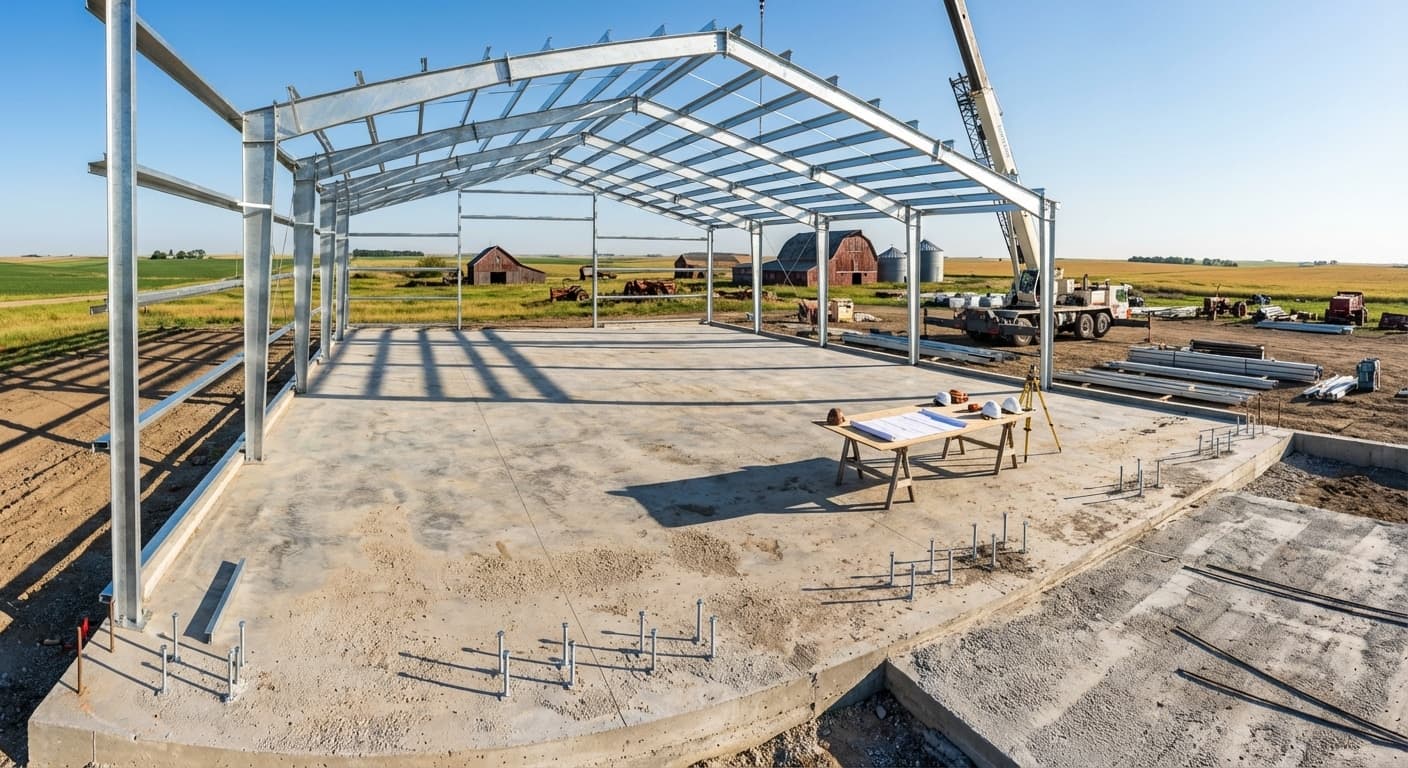

Ag owners planning a 40×80 steel building can avoid expensive regrets by spotting contractor red flags early–from vague proposals that invite change-order shakedowns to missing insurance docs that expose them to million-dollar injury claims–because this article walks through every phase where shortcuts turn into surprises. Readers learn to demand itemized scopes, milestone-linked payments, and verified mill certifications so "industry standard" can't morph into thinner steel or skipped soil prep, and they see why the lowest bid usually hides a 20 % recovery plan billed later as "extras." It flags pre-construction warning signs like evasive communication, lapsed coverage, and unlicensed crews, then tracks erection hazards–improper steel handling, botched site prep, and brokered labor–that lead to warped frames, OSHA fines, or voided warranties. Post-completion pitfalls are covered too: missing as-builts that block future financing, one-year warranty tricks that erase longer defect rights, and punch-list disappearances once final checks are cashed. By tying payment to documented milestones, requiring full policy endorsements, and holding back retainage until every gasket and anchor bolt is photo-verified, owners keep control of timeline, quality, and liability. Mastering these safeguards turns a project that too often collapses into cost overruns and litigation into a predictable, on-budget build that protects both the farm operation and the pocketbook.
Common Red Flags in Contractor Proposals
Vague Scope of Work from the 40×80 steel building contractor
Vague scope of work from the 40×80 steel building contractorA vague scope of work is the fastest way to lose control of your 40×80 steel building project before the first anchor bolt goes in. Generic contract language like "builder shall complete the project as agreed" or "work completed as needed" gives contractors room to redefine what's included after you've signed. [1] That ambiguity hits you directly when disputes arise over whether foundation prep, steel gauge, insulation, or trim were ever part of the deal.
When those items aren't spelled out, the contractor claims they weren't–and you're stuck with change orders you can't legally refuse. [2] Your protection is a written, itemized scope that names materials by type and quality, lists every project phase, and calls out exclusions by name. Attach engineering drawings and fabrication specs as contract exhibits–this locks the contractor into building exactly what's engineered, not cheaper substitutes that pad their margins.
[2] Without that paper trail, brokers and erection crews swap structural members, skip details, or cut corners on fit and finish. When problems surface, you're fighting a dispute you won't win.
Unrealistic Pricing and Hidden Costs
Unrealistic pricing and hidden costsA bid that undercuts every competitor by 20% or more isn't competitive pricing–it's a recovery plan. These contractors know exactly what they're doing: win on price, then make their money back through change orders once you're locked in, adding 15-20% markups on everything they "forgot" to include. [4] Permits, site cleanup, and steel testing lead the list of profitable omissions–easy to defend as outside scope and easy to charge premium rates once crews are already on your property. [5] Watch for vague material specs buried in the bid.
Terms like "industry standard" or "or equivalent" are your warning that cheaper steel panels, thinner members, and off-brand components are coming–substitutions that won't show problems until years after installation. [5] That impossibly fast timeline? Same game. When one contractor promises half the schedule of everyone else, they're either understaffed or planning to skip steps other bidders know you need.
[5] Fixed-price protection only works when every detail is defined upfront. Smart contractors spot those gaps during bidding and bank on them as future revenue once you've signed and construction starts. [6] That's why [design-build suppliers](https://nationalsteelbuildingscorp. com/service/high-quality-preengineered-steel-buildings/) who handle engineering through erection eliminate those gaps–no handoffs means no finger-pointing when specs change.
Lack of Detailed Timeline and Milestones
Lack of detailed timeline and milestonesA proposal showing just a completion date–no milestones–tells you this contractor doesn't manage schedules. Without baseline tracking, delays pile up and your costs follow, but you won't have the documentation to push back. [8] For ag operations, those delays hit where it hurts: planting windows close, harvest waits, livestock stays exposed.
Early milestone misses are your clearest signal that a contractor overbooked their crews and your project just became their flex time. [7] Build milestone protection into your contract before signing. Name specific completion dates for site prep, foundation, steel delivery, erection, roofing, and trim–then tie payment to performance.
Each phase needs consequences for delays written in. Without those checkpoints, contractors quietly shift your crews to other jobs while invoicing you on schedule. By the time you realize what's happening, you've paid for work that hasn't happened and have no documented leverage to fix it.
Warning Signs During the Pre‑Construction Phase
Missing or Incomplete Insurance Documentation
Missing or incomplete insurance documentationA certificate of insurance alone won't protect you if something goes wrong. Without the actual policy endorsements attached, that piece of paper carries zero legal weight when a worker gets hurt or your equipment gets damaged during steel erection. [9] For ag owners, the risk is personal: if your contractor lacks workers' comp and someone gets injured on your property, that worker can sue you directly–not the contractor. [10] Before any work starts, verify three specific items: you're named as additional insured on the actual policy (not just the certificate), the policy includes waiver of subrogation language in the endorsements themselves, and coverage dates extend past your completion date.
[9] Here's what the numbers tell you: nearly half of all insurance certificates need corrections before they're valid. Missing waiver language shows up in 35% of submissions. Incorrect additional insured language appears in 28%. Each gap exposes you to $8,500 to $12,000+ per incident.
[9] When a contractor stalls on providing proper documentation or offers verbal reassurances instead of paperwork, they're telling you something important. Either the coverage doesn't exist, it lapsed, or it won't hold up when you need it.
Absence of Clear Communication Channels
Absence of clear communication channelsHow a contractor communicates before signing tells you exactly what to expect after your check clears. Contractors who dodge calls, avoid written agreements, or deflect direct questions aren't being careful–they're avoiding accountability.
[11] For ag owners juggling steel delivery, site prep, and erection crews on a 40×80 project, a contractor who disappears between phases creates costly delays. Watch for these specific warning signs: emails and calls go unanswered before contract signing, everything stays verbal instead of written, and promises never make it to paper.
[12] A contractor who won't document agreements now will use that same missing paper trail against you later. When disputes arise about scope, changes, or costs, written communication is the only record that counts.
No Proof of Licensing or Certifications
No proof of licensing or certificationsHere's what surprises most ag owners: no federal license is required to erect metal buildings. A contractor can legally crew your 40×80 steel project without any verifiable credentials. [14] Unqualified contractors count on this regulatory gap–they can dodge your questions without technically lying about their qualifications.
The certifications that actually matter involve materials and fabrication. ASTM standards control steel composition, coating, and treatment. AISC certification proves a fabricator's quality systems meet structural steel standards.
[14] When contractors can't show you these certifications, that missing paperwork becomes missing quality in your building's frame. Certified fabricators provide mill certifications, test reports, and fabrication records that verify steel grade and integrity. You'll need this documentation for warranty claims or structural inspections down the road.
Issues That Emerge During Erection
Skip soil tests, botch drainage and compaction, or manhandle steel with forklifts, and you'll pay for hidden foundation shifts, rusting columns, and bent frames long after the crew is gone.
Inadequate Site Preparation
Inadequate site preparationYou'll spot site prep failures before the first column goes up–if you know what to look for. Most ag owners miss the warning signs until concrete is already poured. Three problems follow inadequate preparation: unstable ground from skipped soil testing, poor drainage that sends water toward your slab, and anchor bolts set on uncompacted fill. [17] When contractors skip soil testing, they're guessing at load capacity. Your 40×80 steel frame pushes concentrated loads through its columns.
Soft or clay-heavy soil can't handle that weight without settling. [18] Proper drainage needs a 2% slope away from your building, with the pad 6 to 12 inches above surrounding grade. Without that elevation, water pools at column bases. That accelerates corrosion and can void your warranty when moisture damage shows up later. [19] Compaction matters just as much.
Loose fill under your slab shifts under load. You get uneven floors, stressed anchor bolts, and frame racking that stays hidden until the crew is long gone. [17] Ask for three documents before concrete pours: soil test results, a grading plan with slope percentages, and a compaction report. A contractor who can't produce them isn't saving you time–they're building risk into your foundation.
Improper Handling of Steel Components
Improper handling of steel componentsYour steel arrives undamaged–then gets compromised before a single column goes up. The handling window between delivery and erection is where damage happens, and inexperienced crews multiply the risk. Watch for these handling mistakes: – Unloading without proper equipment. Rafters and beams lifted by hand bend under their own weight. [17] – Narrow fork spacing on lifts. Panels and beams warp when load concentrates at one point.
– Crane cables angled below 45 degrees. This applies stress the members weren't designed for. [20] Storage problems compound the damage. Components stacked on uneven or wet ground suffer coating breakdown. Uneven support creates permanent deformation in longer members. [21] Smart contractors run pre-installation inventory checks after delivery.
They catch bent flanges, damaged edges, and missing fasteners before erection starts. Without that check, you face two bad options: field modifications that void your engineering specs, or reorders that stall your project. [17] Never let a crew cut or modify primary members on-site. Those members carry specific loads. Any field alteration changes the engineer's load path–without analysis of what happens to your structure.
Unqualified Erection Crew Assigned
Unqualified erection crew assignedYou can't verify an erection crew's qualifications by looking at who shows up. Contractors who broker work to the cheapest labor pool count on that. Here's what stays invisible: whether your crew has supervised experience with metal buildings, or whether they were pulled from a general labor pool with no structural background. The difference shows up in accident statistics.
Falls, struck-by incidents, electrocutions, and caught-in/between accidents cause over 60% of construction deaths. Those same four categories are where unqualified crews take shortcuts. [22] The financial risk lands on you as the property owner: – OSHA fines: $15,625 to $156,259 per violation – Workplace fatality average cost: $1. 34 million – Your liability when an uninsured worker gets hurt on your property [22] Before any crew starts, get specific answers: – Name the lead erector's prior metal building projects – Confirm current OSHA 10/30 certifications for anyone working at height – Verify a competent person is designated on-site (OSHA's term for someone trained to spot and fix hazards) A contractor who dodges these questions runs the exact risk profile behind $11.
5 billion in annual construction injury costs. [22] With 1,480+ buildings completed, we've learned that crew experience isn't optional–it's the difference between a smooth project and a costly disaster.
Post‑Construction Pitfalls to Watch For
Failure to Provide As‑Built Documentation
Failure to provide as-built documentationAs-built drawings show what you actually got–not just what the plans promised. They capture column locations, anchor bolt positions, panel gauges, and any field changes the crew made during erection. [23] Without them, you're flying blind on future projects. Need to add a lean-to?
Replace a damaged panel? Your contractor won't know what's already there. The problem starts when contractors treat as-builts as paperwork instead of protection. They hand the task to whoever's available or farm it out to someone who never saw your site.
[23] You get drawings that don't match your building. Here's what missing as-builts cost you later: – Banks require PE-stamped drawings before financing additions [25] – Insurance companies need them to approve coverage – Building departments demand them for any permit work – You'll pay for a full engineering survey of a building that should already have documentation The legal angle matters too. Courts treat missing as-builts as material non-disclosure–grounds for breach of contract claims when that missing paperwork causes financial harm. [24] But the real pain hits when you need to modify or repair your building and have no accurate baseline to work from.
Delayed or Incomplete Warranty Follow‑Up
Delayed or incomplete warranty follow-upHere's what catches ag owners off guard: that one-year warranty can actually reduce your protection. Construction contracts include two different promises–a callback period (when the contractor returns to fix issues) and a warranty of quality (the standard for their work). Many contracts bundle these together, capping all claims at one year. [26] Without that cap, you'd have 4 to 14 years to pursue claims, depending on your state. [26] For steel buildings, that extra time matters.
Structural problems like bad welds, undersized anchor bolts, or coating failures often stay hidden until year two or three. [27] The real exposure comes from latent defects–problems a reasonable inspection won't catch at closeout. [28] These surface later when your building faces real loads, temperature swings, or moisture at the foundation. By then, your one-year warranty has expired. Red flags to catch before signing: – Contractor won't put warranty terms in writing – Warranty documentation arrives late or incomplete after closeout – Single-page certificate that doesn't separate callback period from quality standards [27] Protect yourself with contract language that keeps these obligations separate.
The callback period stays at one year for repairs. The quality warranty runs as long as your state allows. Don't let fine print shrink your protection window when structural issues take years to show themselves.
Unaddressed Punch‑List Items
Unaddressed punch-list itemsYour punch list captures everything that needs fixing before the job's done–misaligned doors, unsealed penetrations, missing trim, loose fasteners. [29] The expensive problem isn't a long list. It's when contractors agree to fix items, then disappear after you've paid. Without payment tied to completion, they have zero reason to come back. [30] Contractors who rushed the job often delay returns until you've lost leverage.
[29] Those "minor" items become major problems. An unsecured gutter channels water behind panels. A gapped ridge cap lets moisture in. Both void warranties and damage equipment. Warning signs before it's too late: – No written timeline for punch-list completion [31] – No priority ranking (structural vs.
cosmetic items) – No holdback amount linked to specific items – Contractor pushes for full payment before addressing the list Your protection is simple: tie final payment to a signed completion certificate, not a verbal promise. [30] Document every item with photos at closeout. Set clear deadlines for each repair. Hold back enough money to hire someone else if needed. At National Steel Buildings, we handle punch lists differently.
- Vague scopes let contractors add 15-20% via change orders after signing.
- Missing insurance endorsements expose owners to $8.5-12k per incident.
- Unrealistic low bids hide omitted permits and cheaper steel substitutes.
- No milestone schedule lets crews abandon your job while invoicing on time.
- One-year warranty caps can cut defect claims from 14 years to 12 months.
- Inadequate site prep causes settling, corrosion, and voids structural warranty.
- Unqualified crews raise OSHA fines to $156k and injury liability to $1.34M.
- https://wfjlawfirm.com/red-flags-in-contractor-agreements-5-clauses-to-make-you-pause/
- https://www.lawgroup.biz/five-red-flags-in-a-construction-agreement-every-owner-should-watch-out-for
- https://www.partneresi.com/resources/articles/beware-the-low-bid/
- https://www.linkedin.com/posts/aecleadership_hiddencosts-lowbid-activity-7430639652228927489-8eiD
- https://www.schgroup.com/insights/blog/risk/contract-compliance-audit/early-signs-of-contract-risk-in-fixed-price-construction-projects/
- https://wymanlegalsolutions.com/the-truth-about-contractor-delays-and-how-to-handle-them/
- https://www.mbpce.com/insights/8-warning-signs-your-project-is-at-risk/
- https://contractorschoiceagency.com/blog/coi-mistakes-that-cost-contractors-25000-avoid-these-7-deadly-errors
- https://www.cibinsure.com/post/my-contractor-didn-t-have-insurance-who-pays-for-the-damage
- https://www.levelset.com/blog/signs-of-a-bad-contractor/
- https://www.architecturaldigest.com/story/bad-contractors-red-flags-warning-signs
- https://luageneralconstruction.com/signs-of-a-bad-contractor/
- https://jagmetalsllc.com/blog/understanding-the-certifications-and-standards-in-metal-building-materials/
- https://borgasteel.com/top-certifications-to-look-for-in-steel-building-fabricators/
- https://titansteelstructures.com/steel-building-services/how-to-choose-the-best-metal-building-contractor-near-me/
- https://www.alpha-labor-co.com/blog/metal-building-erection-mistakes
- https://marbuildingsolutions.com/avoiding-costly-building-foundation-mistakes/
- https://metalprobuildings.com/drainage-grading-tips-for-steel-building-sites/
- https://www.bromsgrovesteel.com/how-to-avoid-steel-erection-accidents/
- https://tish.law/blog/how-to-avoid-liability-for-construction-site-accidents/
- https://www.dreiym.com/2023/05/17/dealing-with-discrepancies-in-as-built-documentation/
- https://www.ansbacher.net/blog/what-are-the-ramifications-of-failing-to-disclose-in-construction-deals/
- https://www.worldwidesteelbuildings.com/blog/pe-stamped-drawings-for-metal-buildings/
- https://designbuildlaw.com/blog/beware-the-one-year-warranty-contractor-callback-periods-v-warranties-of-quality-work/
- https://adamsleclair.law/blog/issues-with-construction-contractors-warranty-obligations-part-1/
- https://www.munsch.com/Newsroom/Blogs/188104/Post-Construction-Risk-Navigating-Warranties-and-Defects
- https://gravelylaw.com/5-common-issues-detected-during-post-project-construction-audits/
- https://clewislaw.com/the-5-most-common-issues-detected-during-our-post-project-construction-inspections-for-owners/
- https://buildertrend.com/blog/punch-list-pitfalls/