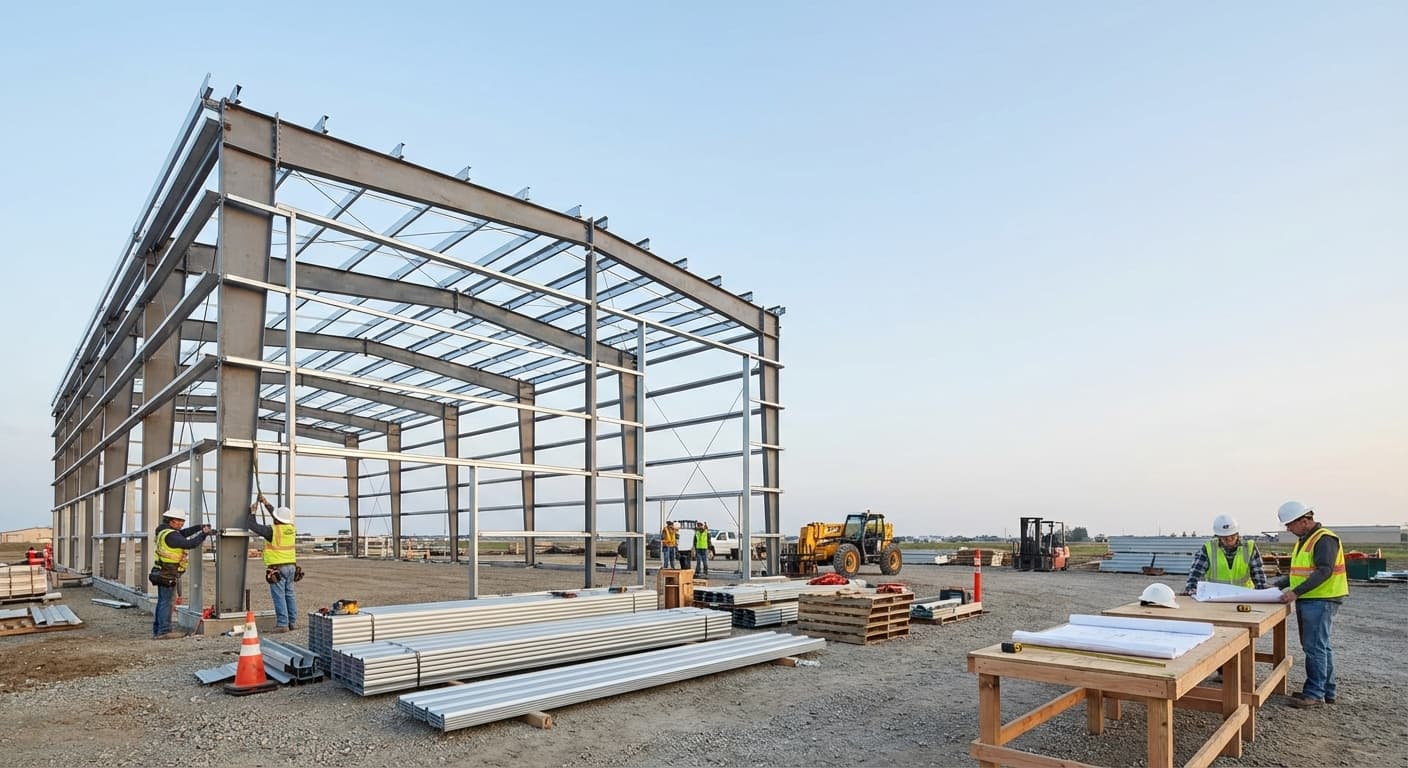

A 40×80 steel building isn't a commodity purchase–it's a strategic investment whose final price swings from $77K for a bare kit to $138K turnkey depending on five controllable levers: commercial-grade I-beam framing, foundation complexity, code-driven engineering, insulation strategy, and who handles erection. The article demystifies those levers, showing that allocating 20 % of the budget to a proper slab, upgrading to spray-foam insulation, and choosing standardized 40×80 dimensions can cut lifetime ownership costs by half versus wood or concrete while delivering 3,200 ft² of clear-span space that can be reconfigured or vertically expanded without structural headaches. Readers learn how to read between the lines of low-ball quotes, why single-source providers prevent hidden engineering or site-prep fees, and how location factors like snow load and local labor rates move the needle more than material list tweaks. Ultimately, it equips owners to balance upfront savings against decades of lower maintenance, energy reductions of 10-20 %, and resale premiums that can recoup the initial spend–turning a simple cost estimator into a roadmap for maximizing both cash flow and operational flexibility over a 50-year building lifecycle.
Understanding the Core Cost Drivers for a 40×80 Steel Building
Every dollar you "save" on a 40×80 steel building can boomerang if you skip commercial-grade I-beams, underestimate the 20% foundation bite, or ignore local snow-load codes that quietly double your concrete and steel costs.
Material Selection and Grade Impact
Your material choices drive both upfront costs and decades of performance. You want commercial-grade steel I-beam frames–they cost more than tubular alternatives but deliver the structural integrity your investment deserves [1].
Your building's skeleton breaks down into primary framing (main I-beams) and secondary framing (purlins and girts), with quality levels that match your budget and requirements [2]. Standard packages include arch-style PBR metal roof and wall panels [1].
For insulation, you choose from vinyl-faced fiberglass (budget-friendly), spray foam (superior performance), or insulated metal panels that combine structure and insulation in one system [1][2].
Foundation and Site Preparation Costs
Foundation work typically consumes 20% of your project budget and rarely appears in base kit quotes [4]. For your 3,200 square foot building, expect $12,800-$25,600 for a concrete slab ($4-$8 per square foot), depending on soil conditions and local labor rates [4][5]. Choose your foundation based on use: concrete slabs handle commercial and industrial loads best, while agricultural buildings might work with gravel bases or ground anchors [4][2].
Don't forget the hidden costs–grading, drainage, utilities, soil testing–that keep your building dry and stable for decades [5]. Your location matters. Snow loads, wind speeds, and seismic zones dictate foundation specs through local codes [2].
Budget for both the concrete you see and the site work you don't. (Section 5 breaks down complete foundation pricing in your comprehensive quote.
Design Complexity and Engineering Fees
Complex designs cost more–it's that simple. Custom specifications push prices above standard configurations [2]. Your local codes matter too. High snow loads or hurricane zones mean extra engineering calculations and stronger frames [2]. Roof pitch affects both look and price.
Standard 2:12 pitch keeps costs down. Need steeper? Options run from 1:12 to 6:12, with each increment adding to your bottom line [1]. Want porches, overhangs, mezzanines, or lean-tos? Each addition requires engineering that drives costs [1].
Commercial buildings demand tighter specs than agricultural structures–your intended use shapes engineering requirements and pricing [2]. Here's the key: base kit pricing ($15-20/sq ft) often excludes engineering fees. Turnkey quotes ($24-43/sq ft) include everything [6]. We handle all engineering in-house, keeping your project moving without coordination delays or surprise fees.
Optimizing Size, Layout, and Usage to Control Expenses
Maximize every dollar by exploiting the 40×80's clear-span 3,200 sq ft–size it 8-20 ft tall, add a mezzanine for double-deck storage, and stick with the proven dimensions for fastest delivery and lowest cost unless custom sizing is the only way to eliminate wasted space.
Space Utilization and Functional Planning
Your 40×80 steel building gives you 3,200 square feet of completely open workspace–no posts, no columns, just pure usable space [7]. That clear-span design means you can park equipment anywhere, stack inventory floor-to-ceiling, or reconfigure your layout next month without working around obstacles. Pick your ceiling height based on what you're doing.
Standard heights run 8 to 20 feet in 2-foot jumps [4]. Higher ceilings cost more upfront but pay you back in vertical storage and operational flexibility. Planning overhead doors?
Add two feet to your door height for proper clearance–that 12-foot bay door needs a 14-foot eave [7]. Here's how smart operators maximize their investment: – Warehouses: Install racking systems and partition storage zones without structural interference – Workshops: Keep the floor open for equipment movement and future layout changes – Commercial spaces: Create customer and work areas that flow naturally – Residential conversions: Get four bedrooms on one level or six with a second story [7] Double your usable space without expanding your footprint–add a mezzanine for offices, storage, or production areas [7]. As covered in our design complexity section, these vertical expansions deliver serious square-footage gains at minimal cost.
Modular vs. Custom Dimensions
Standard 40×80 dimensions save you money and time–it's that simple. These popular sizes leverage efficient manufacturing and reduced material waste [8]. Your building arrives faster and goes up quicker because everything's been engineered thousands of times before [9]. But maybe 40×80 doesn't fit your site or operation.
Custom dimensions cost more and take longer, but you get exactly what you need [8][10]. No compromises on equipment clearances. No wasted space. No "making it work" with a layout that fights your workflow.
The math breaks down like this: – Standard 40×80: Lower cost, faster delivery, proven design efficiency – Custom sizing: Higher initial investment, perfect fit for your specific needs Custom buildings also open doors for specialized features–unique roof lines, precise door placement, or layouts that match your exact operational flow [10]. Yes, you'll wait longer for engineering and fabrication. Yes, you'll pay more upfront. But if standard dimensions force expensive workarounds or limit your operations, custom sizing pays for itself.
Future Expansion and Flexibility Considerations
Plan for tomorrow's growth today. Your 40×80 steel building expands easily because it's designed to grow with you [11]. No support posts means you can repurpose that warehouse into manufacturing space next year–or completely change your operation without tearing down walls [12].
Smart expansion planning starts now: – Choose bolt-together connections over welds–you'll thank yourself when adding that 40×40 addition [1] – Place doors and windows at least 2 feet from corners and eaves for future flexibility [11] – Pre-engineer larger door openings even if you're installing smaller doors today [12] – Add mezzanines instead of expanding outward when land is tight [11][1] The clear-span design does more than create open space–it preserves your options. Manufacturing today, distribution tomorrow, retail next year? Your building adapts without major reconstruction [12].
Frame those future loading docks now, even if you won't cut them open for five years. The minimal extra engineering cost beats retrofitting structural steel later. Same goes for electrical and plumbing rough-ins–stub them where you might need them, cap them until you do.
Strategic Choices That Reduce Installation and Operating Costs
Skip the DIY gamble: a turnkey, single-source package–kit, foundation, and pro install–locks in $24-43 per square foot total, slashes energy bills with correctly installed closed-cell spray foam that pays itself back in two years, and keeps one phone number solving every problem while you run your business.
Erection Methods and Labor Efficiency
Your choice of erection method determines both your budget and your peace of mind. Professional installation runs $5-$10 per square foot [4]–yes, that's $16,000-$32,000 for your 3,200 square foot building. But here's what you're buying: experienced crews who complete standard installations in 2-3 days [4], proper sealing that prevents future headaches, and warranty coverage when things need fixing. DIY installation saves money upfront.
It also risks improper fastening, missed seals, and structural issues that cost far more than professional labor. Weather delays, learning curves, and coordination challenges often stretch DIY timelines from days to months. Your smartest option? Single-source turnkey solutions that bundle everything–kit, foundation, and construction–for $24-$43 per square foot total [13].
No juggling contractors. No finger-pointing when problems arise. One call handles design questions, delivery timing, and installation concerns. You focus on your business while professionals who've done this hundreds of times handle yours.
Insulation, Roofing, and Energy Performance
Your insulation decision affects your wallet every month for decades. Here's your real-world breakdown: Budget Option: Fiberglass batts ($2,400-$7,000) deliver R-values of 2. 2-2. 9 [14]. Decent performance, honest pricing.
Smart Upgrade: Rigid board stops thermal bridging–that energy-sucking heat transfer through steel framing [15]. Your metal building stays efficient year-round. Premium Choice: Closed-cell spray foam (R-values 6-7) costs more upfront but creates an air-tight, moisture-proof envelope [14]. No gaps. No condensation.
No regrets. The payback math is simple: save $125 monthly on energy, recover your insulation investment in two years [14]. But only if it's installed right. Poor installation–gaps at seams, missed penetrations, sloppy vapor barriers–cuts efficiency by 20-30% [15]. Your roof matters too.
Maintenance Planning and Lifecycle Savings
Steel buildings save you money every year you own them. Here's the math that matters: Annual Maintenance: Budget just 1% of construction cost yearly–about $1,500-$2,500 for typical steel buildings [17]. Wood and concrete structures? They'll drain 2-4% annually ($7,000-$20,000) fighting rot, cracks, and pests [17]. Energy Savings: Properly insulated steel cuts energy costs 10-20% yearly [17]. For commercial operations, that's $2,000-$5,000 staying in your pocket annually. Why?
Insulated metal panels create continuous barriers–no seams, no joints, no energy leaks like traditional construction [19]. Lifespan Value: Your steel building lasts 50+ years with basic care [18]. It's also the easiest to expand when business grows. Need more space? Bolt on an addition. Changing operations? Reconfigure without reconstruction.
Resale Reality: Steel buildings appreciate 20-30% over 20 years–beyond normal property gains [17]. Buyers pay premiums for low-maintenance, energy-efficient structures. 20-Year Bottom Line: – Steel facility (10,000 sq ft): ~$350,000 total ownership cost – Traditional construction: $670,000-$1. 1 million [17] That's not a typo. You save hundreds of thousands by choosing steel. Every year of lower maintenance, reduced energy bills, and preserved resale value adds up. Your accountant will thank you.
Leveraging Single-Source Solutions and Transparent Pricing
Demand a single-source 40×80 steel-building quote that itemizes every bolt, door, and permit so you avoid hidden costs, finger-pointing, and future headaches while keeping one accountable team on speed dial from groundbreaking to the day you expand.
Comprehensive Quote Components Explained
Understanding what's in your quote saves you from budget surprises. A proper 40×80 steel building quote breaks into four clear categories. First, the building kit–your steel frame, panels, fasteners, and sealants.
Second, foundation work that varies with your soil and local codes. Third, construction labor that reflects your area's market rates. Fourth, your customizations–doors, windows, insulation, and structural additions that make the building yours [21][2].
Watch for what's missing. Engineering services, permits, site prep, and utility connections often hide as separate line items [20]. The best quotes spell out every component so you know exactly what you're buying and what you'll handle separately.
Value of Integrated Service from National Steel Buildings Corp
Single-source delivery turns potential headaches into smooth operations. When one provider handles your entire building envelope, you skip the contractor coordination circus [22]. You get one phone number for every question, one team that knows your project inside out. This matters most when you're running a business and need your building project to stay on track [22]. Your entire building arrives as one organized kit–components bundled, labeled, and ready for assembly [22].
No missing pieces from different suppliers. No finger-pointing when something doesn't fit. National Steel Buildings' approach leverages nationwide buying power while maintaining that single point of accountability you need. The real payoff comes during construction. Questions get answered fast by people who actually know your building's specs [22].
Problems get solved before they become delays. And years later, when you need an addition or replacement part, you call the same team that built your original structure [22]. They have your plans, know your building's engineering, and deliver compatible solutions that maintain your warranty. Look for providers with proven track records and in-house capabilities. The relationship doesn't end at delivery–it continues through your building's entire lifecycle [22].
Tools and Tips for Accurate Cost Estimation
Smart estimation starts with understanding what drives your costs. Professional estimators use tools like RSMeans Data for location-specific pricing updated quarterly–no guessing at regional labor rates or material costs [23]. These platforms help you validate quotes against market benchmarks and catch potential budget gaps early [23]. Here's your cost breakdown reality check: building components eat 40-50% of your budget, site prep takes 10-20%, and freight runs about 10% of component costs [25].
Break your estimate into manageable chunks–primary framing, secondary framing, panels, foundation, and labor. Calculate each separately for accuracy [25]. Your location matters. Local codes, seasonal construction windows, and regional material availability all move your final number [25].
Online calculators give you a starting point but typically show only base kit pricing–not the complete picture with concrete, delivery, and construction [24]. The smart move? Partner with experienced manufacturers early, especially for complex sites or custom needs. They spot cost-saving opportunities you'd miss and keep your project structurally sound while budget-friendly [25].
- Foundation work adds 20% to budget, rarely in base quotes
- Standard 40×80 saves money; custom sizing costs more
- Turnkey price $24-43/sq ft vs kit-only $15-20/sq ft
- Spray foam insulation pays back in ~2 years via energy savings
- Clear-span 3,200 sq ft interior allows future reconfiguration
- Steel buildings need ~1% annual maintenance vs 2-4% for wood/concrete
- https://steelbuildingsguide.org/40×80-metal-building/
- https://www.uspatriotsteel.com/blog/how-much-does-a-40-x-80-metal-building-cost/
- https://www.buildingsguide.com/metal-building-prices/?srsltid=AfmBOop8I7N2-UitMhttyjb-YYs-4rKbbUpOARlFJisW62blavlLJECq
- https://chinasteelbuildsales.com/40×80-metal-building-cost/
- https://qebuildings.com/2025/10/how-much-does-a-40×80-metal-building-cost/?srsltid=AfmBOoo_VpK9DPfQoJPZl5vPyc8maDhZ0tGbhvTUq3Vw92wgXMkSnejI
- https://www.buildingsguide.com/metal-building-prices/?srsltid=ARcRdnpz3qWX9MobfOx6bVZ-n6R4ViGlcfTb3q3I2QKQxTNpkBy2ylrB
- https://www.buildingsguide.com/standard-sizes/40×80-metal-building/?srsltid=AfmBOooE4n9XuQeq7MP_4g31ajrbT-RHyNyvBDh7ryRmKAdWy8w4wFIG
- https://harrisconstructorsinc.com/prefab-vs-custom-steel-buildings-which-option-is-right-for-you/
- https://americanportablebuildings.com/custom-metal-building/
- https://armstrongsteel.com/blog/custom-steel-buildings-vs-traditional-construction-a-side-by-side-comparison
- https://www.buildingsguide.com/products/standard-size/40x80x20-metal-building/?srsltid=AfmBOooZ5WZ_y0FSErVvofHKtku8SLomMa2vnJXUsw9nyOeQZsoN4m6e
- https://titansteelstructures.com/metal-structure-tutorials/how-to-design-a-40×80-metal-building-using-our-3d-building-design-tool/
- https://www.buildingsguide.com/metal-building-prices/?srsltid=AfmBOopwBYKiay48j0xO0hdMcJbJpxsO6hCraRzq64d8iI6kuZ4Mq0f1
- https://bulldogsteelstructures.com/blog/metal-building-insulation-benefits-types-cost-tips/
- https://www.amddistribution.com/blog/energy-efficient-metal-build-insulation-saves-costs/
- https://www.generalplastics.com/blog/how-to-insulate-a-metal-building-on-a-budget-best-methods-revealed
- https://www.summitsteelbuildings.com/20-year-cost-comparison
- https://xtdsteel.com/steel-structure-building/steel-building-lifecycle-cost/
- https://bulldogsteelstructures.com/blog/exploring-the-cost-efficiency-of-metal-buildings-vs-traditional-construction/
- https://www.buildingsguide.com/metal-building-prices/?srsltid=AfmBOoovA60nljVNhhYb21C_hXxI2OPGxptnkdt3neeHveakvTx_Vdy8
- https://www.buildingsguide.com/standard-sizes/40×80-metal-building/?srsltid=AfmBOoomU-Qh3jwjroiVbrgelsiz_ClV2cEFGIRpAaFJSjxbVMWeMaoX
- https://norsteelbuildings.com/advantages-of-steel-series/advantages-single-source-responsibility/
- https://www.rsmeans.com/?srsltid=AfmBOooZXMRsttmI2BTvnXu-oUGyBjDXowKeNxs_n2Kbr_kD0Fdmhgy8
- https://www.buildingsguide.com/metal-building-prices/?srsltid=AfmBOoprBcrfm9V06vRvrPon-K7NBL8Uuj45kZSPPj7Q5H9IfyeCS4AQ
- https://www.robertsonbuildings.com/blogpost/2025-steel-building-cost-estimator-a-contractors-guide-to-pemb-pricing/