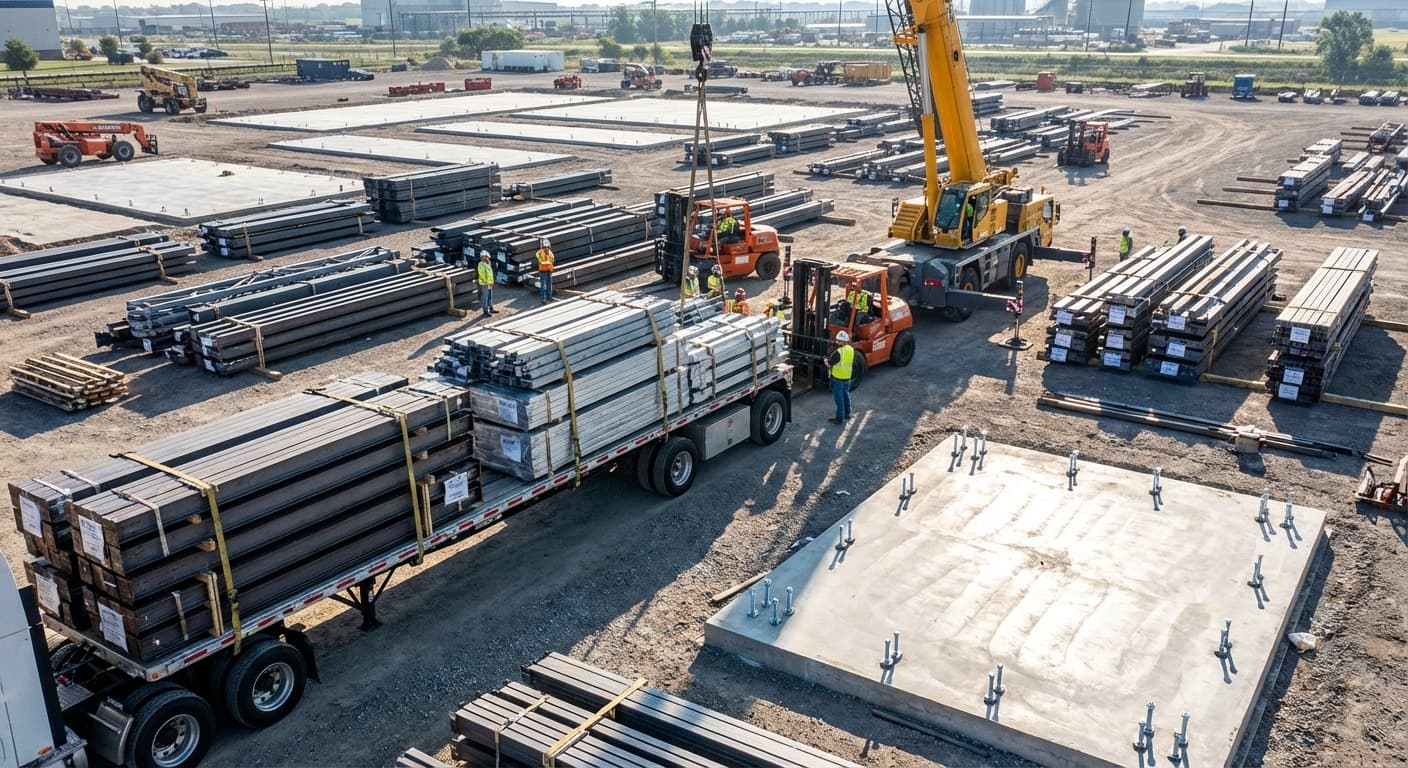

Coordinating a 40×80 steel-building delivery is less about hoping trucks show up on time and more about orchestrating a tightly sequenced dance of site prep, logistics, and crew deployment that can shave 20-30 % off total construction time. The article walks you through the entire playbook: mapping crane paths and staging areas before the first semi arrives, timing foundation cure windows with fabrication lead times, choosing the right trailer–flatbed, step-deck, RGN, or Conestoga–for each load, and locking in 3- to 7-day unloading windows that match your erection sequence. You'll learn how to inspect in two phases (while the truck is still on-site and again within 48 hours), document every dent with photos, and cross-train crews so deliveries can slip early or late without idle labor. By aligning material drops to the exact week columns, purlins, then panels are needed and building 15-20 % buffers into the schedule, owners avoid costly re-handling, keep safety perimeters clear, and turn unpredictable freight arrivals into a seamless, on-budget build.
Coordinating Delivery Timing with Site Preparation
Map your site like a battlefield–stage components within crane reach, time delivery to your cured foundation, and you'll shave weeks off erection while trucks and crews move without a single backup.
Assessing Site Access and Staging Areas
You'll need clear truck access before your 40×80 steel building kit arrives. Map out exactly where cranes, telehandlers, forklifts, and delivery trucks will operate–they need room to enter, work, and exit safely [2]. Walk your property and note every detail: size, shape, slope, rocks, trees, anything that affects truck routing and material placement [1]. For a building this size, you need unobstructed paths wide enough for semi-trucks to turn and equipment operators to position heavy columns and trusses without backing into tight spots.
Your staging area works as hard as your crew. Pick open, level ground that holds all major components without dangerous stacking [2]. Position it smart–close enough to reduce material handling, far enough to keep work areas clear. Drop columns near their anchor bolt locations.
Stage purlins and girts along sidewalls but away from other materials [1]. Set sheet goods on blocks with a slight tilt for rain runoff. Keep hardware packages central where everyone can reach them [1]. Smart staging cuts your erection time and keeps components damage-free while crews work safely [2].
Synchronizing Kit Arrival with Foundation Completion
Time your foundation and delivery like clockwork. Your foundation needs 7-28 days to cure before your 40×80 steel components arrive [5]. Hit this window and you avoid storage headaches and keep construction moving.
Start foundation work while your building fabricates (typically 3-6 weeks)–they run parallel, not sequential [5]. Share exact foundation milestones with your supplier and nail down their delivery dates, since most kits ship 2-4 months after ordering [5]. Triple-check anchor bolt positions against your drawings before locking in delivery–wrong placement stops everything cold [5].
Build weather buffers into your schedule, especially during wet seasons or temperature extremes that mess with concrete curing [4]. When you coordinate fabrication, delivery, and foundation completion this tight, you cut construction time by 20-30% compared to projects with poor timing [4].
Communicating Milestones to the Construction Team
Keep everyone on the same page and your project runs smooth. Build a timeline with your project manager marking every critical checkpoint: anchor bolts, foundation complete, delivery dates, assembly start [6]. Skip the email chains–use a digital project system everyone checks daily.
For your 40×80 building, schedule weekly calls during the 8-22 week lead time to catch problems early [6]. Name one person to handle delivery drivers–someone who knows the project and stays available for unloading coordination [6]. Document everything with photos and dates your whole team can access.
Give field supervisors both digital and hard copies of your bill of materials so they can check deliveries on the spot [6]. Post a big visual timeline where crews see it daily–everyone knows what's coming and what they're doing. Communication breakdowns cause more delays than weather or materials, so nail this part and stay on track [7].
Optimizing Logistics for a Seamless Delivery
Match every 40×80 steel component to the perfect trailer–flatbed, step-deck, RGN or Conestoga–then map the route down to the last bridge, turn radius and off-peak delivery window to keep your 45,000-lb load safe, dry and on-time.
Choosing the Right Transport Method for a 40×80 Steel Building Kit
The right trailer keeps your 40×80 steel building components safe and on schedule. Your transport choice affects your timeline, your budget, and your peace of mind [9]. Most components fit on standard flatbed trailers–48,000 pounds capacity, 48-53 feet long, perfect for parts within legal limits [10]. You'll stay within the 8'6" width and height restrictions while keeping costs down. Need to transport taller frames?
Step deck trailers give you up to 10 feet of clearance on the bottom deck while staying road-legal [10]. Got beams longer than 48 feet? Extendable flatbeds stretch to 80 feet, eliminating dangerous overhang [10]. Heavy components demand specialized solutions. RGN trailers handle 42,000 to 150,000 pounds with 11'6" clearance in the well [10].
Better yet, the detachable gooseneck creates its own loading ramp–no extra equipment needed [10]. Weather-sensitive components? Conestoga trailers combine flatbed flexibility with rolling tarp protection [10]. Your [prefabricated steel building](https://nationalsteelbuildingscorp. com/service/prefabricated-steel-for-commercial-buildings/) materials arrive dry and ready to install.
Route Planning to Avoid Delays and Damage
Smart route planning saves time, money, and headaches. Map every mile from highway to your site–bridges, underpasses, weight limits, road conditions [11]. Your 48-foot trailer carrying 45,000 pounds of steel needs clear passage. Think beyond your property line.
Check access roads for narrow spots, construction zones, seasonal closures [13]. A 53-foot flatbed with 30-foot cab needs room to turn, back up, and position [12]. Create a detailed site map showing: * Best entrance and exit routes * Property features–slopes, trees, rocks * Turning radius requirements * Staging area locations [11] Send this plan to your driver one week before delivery [12]. Include GPS coordinates and visual landmarks for rural sites–street addresses often fail navigation systems [13].
Pro tip: Schedule deliveries during off-peak hours. You'll dodge traffic delays and keep your project moving [12].
Scheduling Unloading Windows with On‑Site Crew
Lock in your unloading window 3-7 days before delivery. Your shipping rep will call to schedule a date and time that fits your timeline [14]. Know your responsibilities upfront: * Unloading is on you–not the supplier [14, 15] * Equipment ready: forklift, crane, or skid steer [14, 15] * Key personnel on-site for component verification [14] Schedule your erection contractor for delivery day.
They'll check components against the packing list while the truck's still there [14]. Quick verification now prevents delays later. Plan 2-4 hours for your 40×80 building delivery [16].
Rushing damages components and causes missed items [15]. Build flexibility into your crew schedule–delivery times can shift [16]. For complete inspection procedures and documentation requirements, see the detailed coverage in "Managing On-Site Unloading and Inspection" below.
Managing On‑Site Unloading and Inspection
Protect your crew and your investment: enforce steel-toed PPE, use spreader bars for long panels, document every dent while the truck waits, and within 48 hours verify every column and bolt against your order before you've officially accepted the kit.
Safety Protocols for Unloading Large Steel Panels
Your crew's safety comes first when unloading a 40×80 steel building kit. Equip everyone with steel-toed boots and thick gloves–those panel edges are sharp and components are heavy [17]. For longer panels, you'll need a spreader bar or two synchronized forklifts to prevent crimping or folding [17]. Set up a clear safety perimeter around crane operations and keep all personnel back from suspended loads [18]. You'll need four workers minimum for wall and roof panels–two at each end to control movement and prevent warping [12].
Position your panels on wooden blocks at least 4 inches off the ground with a slight tilt for drainage. If they'll sit more than 48 hours before installation, cover them [12]. One critical rule: never try to catch falling materials. If something starts to drop, get your people clear immediately [18]. Smart positioning saves time and prevents damage.
Place your lifting equipment where it minimizes material handling–ideally dropping components near their final installation points without creating bottlenecks [12]. Before the truck leaves, photograph any damaged panels and note issues directly on the shipping bill. This documentation protects you later [17].
Quick Inspection Checklist for Delivered Components
You need two inspection phases to protect your investment–and both matter. First comes your unloading inspection while the truck's still there. Check every component against your inventory packing list [19]. Look for bent structural members, dented panels, damaged packaging. Found damage? Open those packages immediately and document everything with photos and notes [19].
Check off each verified item and report problems to the carrier before they leave. Until you complete this inspection, you haven't officially accepted the shipment [19]. Your second inspection happens within 24-48 hours. Grab a fresh inventory list and verify quantities match your order, not just that items arrived [19]. Double-check critical components–columns, trusses, connection hardware. These affect your building's integrity [20].
Take photos of any new issues you discover. You've got 14-30 days to file manufacturer claims for problems missed during initial inspection, so thorough documentation matters [19][20]. Keep all packaging until construction wraps up–you might need it for returns. This two-phase approach catches problems early and keeps your project moving. With 1,480+ [pre-engineered steel buildings](https://nationalsteelbuildingscorp. com/service/high-quality-preengineered-steel-buildings/) under our belt, we've seen how proper inspection prevents costly delays [20].
Documenting Delivery for Clear Communication
Good documentation saves you from disputes and speeds up problem resolution. Build a delivery package that includes dated photos of every component, a signed bill of lading with noted exceptions, and your verified inventory checklist [21]. While the truck's still there, photograph damaged items–get close-ups of damage plus wide shots showing the item's truck position [23]. Keep two separate verification records: your initial unloading inspection while the carrier's present and your detailed inventory check within 24-48 hours [21].
This dual approach gives you solid evidence for any replacement claims. Report damage to the carrier immediately during unloading. For issues found during unpacking, you typically have 14 days to file manufacturer claims [21]. Share your documentation with everyone involved–arrival time, personnel present, equipment used, and any issues affecting your schedule [22].
Track material origins from production through delivery to final installation. This creates accountability at every stage [23]. Clear records mean clear communication, fewer delays, and faster resolution when problems arise.
Integrating Delivery with the Erection Schedule
Synchronize every delivery to the exact week it's needed–columns at week 3, purlins at week 5, panels at weeks 6-7–and your crew will cut erection time by eliminating material hunts and idle labor.
Aligning Delivery Sequence with Erection Phases
Match your delivery sequence to construction phases and watch efficiency soar. Your 40×80 building goes up in a specific order: columns and main frames first, secondary framing next, then roof and wall panels [24]. Schedule deliveries to match this exact sequence. Here's your typical erection timeline: – Week 3-4: Primary columns and framing – Week 5: Secondary framing and alignment – Week 6: Roof installation – Week 7: Wall panels and finishing details [24] Request bundled deliveries by installation phase, not component type. Your crew finds what they need when they need it–no hunting through piles of mixed materials [24].
Position columns near their anchor bolt locations. Stack purlins and girts near sidewalls, as outlined in Section 1's staging recommendations. Steel building erection follows three phases: support structure first (columns and trusses), main frame completion and assessment, then metal sheeting. That final phase eats up nearly half your total construction time [25]. When you organize your staging area to match this workflow, you cut search time to zero.
Primary structural elements sit ready for immediate use. Secondary components wait in installation order [24]. This approach alone can slash your erection time significantly [25].
Adjusting Crew Allocation Based on Arrival Times
Smart crew management flexes with your delivery schedule, not against it. Cross-train your key people on multiple tasks–primary frame erection, secondary components, panel attachments. When trucks arrive early or late, you shift workers seamlessly [26][28]. Set up specialized teams: – Foundation verification team – Primary structure assembly team – Secondary framing team – Sheeting installation team [27] Deploy only the teams you need when materials arrive.
No idle crews burning daylight and budget [27]. Track deliveries in real time. Your centralized system shows exactly where trucks are and automatically adjusts crew assignments [27]. GPS tracking verifies worker locations across your site, keeping everyone productive [27].
When deliveries run late, pivot to prep work. Have crews align bolt holes, stage purlins, or pre-assemble trim pieces. Keep momentum going instead of sending workers home [26]. Build a 15-20% time buffer into your labor schedule for a 40×80 building–it absorbs delivery variations without derailing your timeline [26].
Proactive Problem‑Solving for Unexpected Delays
Plan for problems before they happen. Your 40×80 project faces predictable risks: material shortages, fabrication delays, transportation issues, and weather events [29]. Write specific responses for each scenario. Primary steel late? Shift crews to foundation verification or site prep–keep them productive [6]. Build 15-20% buffer time into your schedule. These cushions absorb delays without toppling your timeline [29][30].
Consider delay insurance to protect your investment [29]. Install real-time tracking that shows fabrication progress and component location. You spot issues the moment they emerge [29]. Communication kills more projects than weather or materials ever will. Stay in constant contact with your fabricator–it's the single best defense against delays [6]. As discussed in Section 1, clear milestone communication prevents most problems before they start. Designate one decision-maker with full authority.
When issues arise, they approve changes, reallocate resources, or expedite replacements instantly. No committee meetings. No approval chains. Just solutions [30]. This system turns potential disasters into minor adjustments. Your project stays on track, your budget stays intact, and your building goes up on schedule.
- Foundation must cure 7-28 days before kit arrives; sync fabrication and pour timelines.
- Unload and inspect twice: on truck for damage, within 48 h for quantity and hidden issues.
- Stage components by erection order–columns near bolts, purlins along walls–to slash search time.
- Build 15-20% schedule buffer and cross-train crews to absorb late deliveries without idle labor.
- Map truck routes, turning radii, weight limits, and site hazards; send plan to driver one week out.
- Bundle deliveries by construction phase, not component type, to keep crews working sequentially.
- Document everything–photos, GPS tags, signed bills–within 14-30 days to secure carrier or manufacturer claims.
- https://www.buildingsguide.com/build/metal-building-delivery/?srsltid=AfmBOoreXEWJD95bMl1TuX-ps195oYOm5vPNhFnhbl31-0fl88RwMabu
- https://metalprobuildings.com/preparing-the-site-what-to-do-before-your-steel-building-erection-begins/
- https://metalprobuildings.com/pre-engineered-steel-building-timeline/
- https://peb.steelprogroup.com/steel-structure/building/metal-building-construction-time/
- https://www.buildingsguide.com/build/?srsltid=AfmBOopJXsGKVVdQZC1Cc8l3Eyd93F7e22DE9Vnhx2X2lfDHzjK2zgE0
- https://www.metalconstructionnews.com/articles/delivering-metal-buildings-on-time/
- https://gra-gcc.com/blog/standard-timelines-for-houston-metal-building-construction/
- https://www.heavyhaulers.com/materials/metal-building-shipping.php
- https://freedomheavyhaul.com/choosing-between-flatbed-and-specialized-trailers-for-equipment-transport/
- https://trinitylogistics.com/blog/flatbed-trailers-which-one-should-you-use-for-your-freight
- https://www.buildingsguide.com/build/metal-building-delivery/?srsltid=AfmBOorOqs3_PtzntcPfbd3bvFKHIIwREMcyYQ2_24pwI08fXuVfxEn1
- https://norsteelbuildings.com/us/steel-building-planning-design/easybuild-kit-delivery-preparation-unloading-guide/
- https://armstrongsteel.com/blog/experts-guide-metal-building-shipping
- https://www.buildingsguide.com/build/metal-building-delivery/?srsltid=AfmBOooLjYXsPoJhbyIySx-C5PFYQu-i_vEnsf2NJSaW79ajjbv2-g7N
- https://unionsteelstructures.com/what-to-expect-during-a-steel-building-delivery-and-setup/
- https://armstrongsteel.com/blog/how-will-my-building-arrive
- https://www.metalbuildingoutlet.com/unloading-metal-buildings/
- https://www.worldwidesteelbuildings.com/blog/unload-and-assemble-your-metal-building-kit/
- https://www.buildingsguide.com/build/metal-building-delivery/?srsltid=AfmBOoqfk07NdqBj4kzaa0zx5HJO22j65yLq_i0PixU_4Cl8_r72yq-B
- https://www.alliedbuildings.com/metal-building-buyers-guide/preparing-for-delivery-and-assembly/
- https://www.buildingsguide.com/build/metal-building-delivery/?srsltid=AfmBOorQAFFUj0AyDFeGfus12DRVF-SOdbsVuIpoHHCad3PVzsE5XfOQ
- https://norsteelbuildings.com/steel-building-planning-design/easybuild-kit-delivery-preparation-unloading-guide/
- https://www.hcsteelstructure.com/step-by-step-delivery-installation-prefabricated-steel-building/
- https://www.alpha-labor-co.com/blog/pemb-erection-timeline
- https://norsteelbuildings.com/us/steel-building-planning-design-us/timeline-of-most-diy-metal-building-kits/
- https://arscontracting.com/how-to-optimize-material-delivery-for-construction-projects/
- https://cmicglobal.com/resources/article/Optimizing-Resource-Allocation-A-Guide-to-Efficient-Construction-Workforce-Management
- https://struxhub.com/blog/construction-materials-deliveries-strategies-for-optimizing-equipment-and-labor-in-construction-projects/
- https://endura-steel.com/steel-fabrication-projects/
- https://www.planradar.com/au/contingency-planning-construction-project-scheduling/