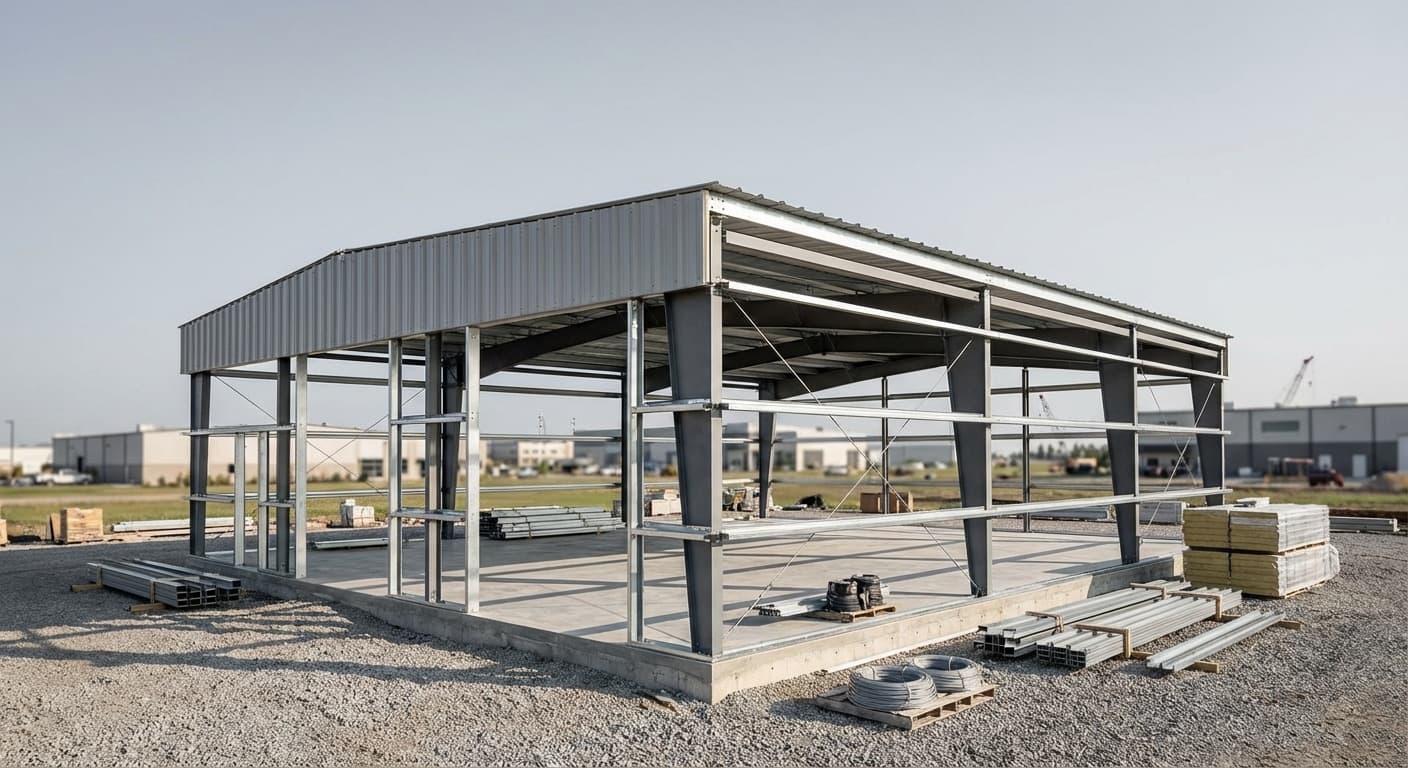

In 2025, a 30×40 metal building delivers 1,200 ft² of unobstructed, fast-to-erect space for vehicles, workshops, or small retail use at a realistic price of $28k-$48k turnkey, and this guide walks you through every dollar–kits ($15k-$25k), foundations ($4-$8/ft²), labor ($5-$10/ft²), plus region-specific premiums for wind, snow, seismic, or coastal codes that can swing totals by 30%. You'll learn how steel gauge, roof pitch, door placement, insulation, and certified engineering shape both upfront cost and decades of performance, why timing purchases for mid-summer off-season can lock in 10-20% savings amid volatile $950-$1,050/ton steel, and which upgrades–insulated doors, skylights, PVDF coatings–pay back through energy cuts, lower maintenance, and higher resale. The article demystifies permits ($550-$2k), site prep, freight, and financing, shows how to compare apples-to-apples quotes that expire in 15-30 days, and urges adding 5-10% contingency so owners can budget accurately, avoid hidden overruns, and start earning revenue weeks faster than with conventional construction.
Understanding the 30×40 Metal Building Market in 2025
A 30×40 metal building gives you 1,200 square feet of unobstructed space for $10,000 to $30,000, operational weeks faster than traditional construction.
Why the 30×40 size remains a top choice for businesses and homeowners
You choose a 30×40 metal building when you need real space without breaking the budget. With 1,200 square feet of clear-span interior, you get room for three vehicles, a full workshop, or compact retail space–all without posts cluttering your floor plan [1][2]. Business owners run everything from equipment storage to service centers in this footprint, while homeowners create dream garages, workshops, and storage solutions [3].
Standard eave heights from 12 to 20 feet mean you can stack inventory high, install vehicle lifts, or park that RV without worry [2]. Your investment stays reasonable too–base prices range from $10,000 to $30,000 depending on your specifications [1]. Need it weatherproofed? Adjust the roof pitch for snow country or add insulation for southern humidity [2]. Best part: you're operational weeks faster than traditional construction, which means revenue starts sooner [3].
What the 30×40 metal building price guide 2025 covers
This guide strips away the mystery of metal building pricing. You'll find exact costs for every phase–from bare kit to finished building. Basic kits (frames, panels, hardware) run $15,000-$25,000, while complete turnkey projects land between $28,000-$48,000 [4][5].
We break everything down per square foot so you can scale calculations: kits at $18-$22, foundations at $4-$8, and construction at $5-$10 [5]. You'll discover which four factors drive your final price: steel gauge selection, foundation type, your local codes, and customization choices [4].
Since a Florida coastal building costs differently than a Colorado mountain structure, we detail regional variations and explain why [6]. You'll learn what's actually included in "standard" packages–primary framing, secondary supports, panels, fasteners–versus add-ons like doors, windows, and insulation [4][5]. Whether you're planning DIY assembly or turnkey installation, you'll know exactly what permits cost and what your local jurisdiction requires [6].
How to use this guide for accurate budgeting and planning
Start smart: nail down your exact requirements first. You need the 30×40 footprint, but what foundation type? How many doors? What gauge steel? With basics defined, budget $15,000-$25,000 for a kit or $28,000-$48,000 for complete turnkey installation [7].
Now catch the hidden costs before they catch you. Permits run $550-$2,000. Site prep adds $1-$2 per square foot. Foundation work costs $4-$8 per square foot. Don't forget utility connections [7]. Build a spreadsheet that separates every expense–materials, labor, site work, extras. No surprises that way [7].
Your zip code matters. Coastal wind ratings, mountain snow loads, and local labor rates all adjust your bottom line [8]. Time your purchase right and save 10-20%–steel prices dip during construction off-seasons [9].
Get itemized quotes from at least four suppliers. Compare apples to apples: what's included versus what's extra? Pay special attention to delivery, site prep, and labor costs [8]. Smart builders add 5-10% contingency for the inevitable changes and market swings [9]. When you work with
Current market trends influencing demand and supply
Here's the steel market reality: prices stabilized in 2025 but they're not dropping. Hot-rolled coil sits at $950-$1,050 per ton–double the 2018 rates [10]. With mills running 75% capacity and new 25% import tariffs, domestic steel stays tight [12]. Your typical 30x40x12 building now costs $26K-$32K installed, up from $17K-$20K in 2023 [10].
The Infrastructure Investment and Jobs Act keeps demand hot, with 18-20% price increases forecast for key steel products [12]. Location hits your wallet too–certified buildings in Florida hurricane zones or Colorado snow country add $3-$6 per square foot [10]. The Southern U.S. boom (695 million square feet of new industrial space) creates perfect conditions for metal building demand [12].
What could shake prices? Several wildcards remain: ongoing Russia-Ukraine tensions, potential mill capacity limits, and anti-dumping investigations spanning ten countries [11]. Suppliers already announced 5-10% increases, with more likely as tariffs work through the system [11].
Bottom line for you: steel costs climbed 4-8% since January 2025 and may rise further if freight spikes this fall [10]. Waiting for dramatic price drops? Don't hold your breath. Lock in pricing when you find a good deal–companies with national buying power can buffer some volatility, but the trend points up, not down.
2025 Cost Benchmarks and Pricing Overview
A fully installed 30×40 metal building costs $28,000-$52,000 in 2025, with foundation work and labor accounting for the bulk of that investment.
National average cost per square foot – kit versus fully installed
Your 30×40 metal building kit will run $15-$20 per square foot–that's $18,000-$24,000 for the basic shell [13]. This gets you the primary steel frame, roof and wall panels, trim, and fasteners. Nothing fancy, just the bones [14].
Want it fully installed and ready to use? You're looking at $24-$43 per square foot, or $28,800-$51,600 total [13]. That price jump isn't markup–it's real work. Your foundation alone adds $6-$10 per square foot [15]. Professional installation, delivery, permits, site prep–it all adds up.
Here's what makes the difference: Commercial-grade I-beam frames cost more than tubular frames, but they'll outlast your mortgage [13]. Building in Florida? Add $3-$6 per square foot for hurricane ratings. Colorado? Same premium for snow loads [15]. Most quality 30×40 installations land between $28,000-$48,000 when you include standard doors and reasonable site work [14].
Remember, these prices don't include electrical, plumbing, or HVAC. That's a separate conversation–and budget line [14].
Typical total price range for a 30×40 metal building in 2025
As covered above, your fully installed 30×40 metal building will cost $28,000-$52,000 in 2025 [18]. Let's break down what drives that number up or down.
Height changes everything. Need 20-foot clearance for your RV instead of standard 10-foot walls? That's thousands more in materials and engineering [18]. Planning ahead saves money–and regret.
Your location's building codes pack a punch too. Hurricane zones and snow country add those same $3-$6 per square foot premiums we mentioned [18]. No shortcuts here–mother nature doesn't negotiate.
Three numbers to remember when budgeting:
- Building kit: $18-$22 per square foot
- Foundation: $4-$8 per square foot
- Labor: $5-$10 per square foot
Add them up, and most buyers land at $32,400-$48,000 for a quality installation [18]. That's real money, but it buys you a building that works hard for decades. At National Steel Buildings, our nationwide buying power helps keep you toward the lower end of that range without sacrificing quality–because we buy steel by the truckload, not the piece.
Regional price variations across the United States
Your zip code affects your metal building price more than you'd think–up to 30% difference between regions. Here's the reality check.
The Midwest wins on price. You'll pay $3-$5 less per square foot than coastal buyers thanks to reasonable weather and competitive labor markets [19]. It's the sweet spot for metal building value.
Building near the ocean? Budget extra. Florida and Gulf Coast projects need hurricane-certified engineering–that's $3-$6 more per square foot for beefier frames and serious anchors [19]. Same story in Colorado's snow country, where 70-pound snow loads demand stronger trusses and steeper roofs [21].
California takes the prize for complexity. Between earthquakes, permits, and labor costs, you're looking at 15-25% above national average [21]. Metro areas everywhere add $2-$4 per square foot just for higher wages [20].
Don't forget shipping. Remote sites pay $1.50-$3.00 extra per square foot in freight [20]. That mountain view costs more than the view.
Smart move? Work with suppliers who know your local codes cold. Generic quotes miss critical regional requirements that blow budgets later [20]. Your building needs to handle your weather, not someone else's.
How steel market fluctuations affect overall pricing
Steel prices drive your building costs, plain and simple. Good news for 2025: structural steel dropped 6.63% from Q3 to Q4, landing around $2,477/ton [22]. That's a 4.7% year-over-year decline–finally some breathing room.
What's that mean for your 30×40 project? Your building needs 4-6 tons of steel, so recent drops save you $500-$700 compared to early 2025 quotes [23]. Not huge, but it helps.
Here's the catch: not everything's dropping. Open web joists jumped 12% while other steel components fell [22]. Tariffs keep stirring the pot too, especially with uncertainty around U.S. Steel's ownership [23].
Timing matters. Suppliers adjust prices 45-60 days after steel market moves, creating windows of opportunity [22]. Late 2025 looks smart–materials costs are down while supply chains still work.
Your main frame feels steel prices most. Trim and fasteners? They barely budge [23]. Focus your negotiating where it counts.
Bottom line: Steel's volatile, but the current dip gives you an edge. Lock in your quote while prices cooperate–they won't wait for your decision.
Key Cost Drivers for a 30×40 Metal Building
Steel gauge, roof panels, and proper foundation prep are the three cost levers that most directly impact your 30×40 metal building's price and long-term performance.
Steel grade, gauge, and panel options that impact cost
You'll find steel gauge makes the biggest difference in both price and performance. Here's what matters: lower gauge numbers mean thicker, stronger steel–and yes, higher costs. Your 12-gauge frame beats 14-gauge every time for durability, but you're looking at a price jump that needs to match your actual needs [24].
Commercial I-beam frames run more than tubular alternatives, but they're worth it when you need real strength. Planning a workshop with heavy equipment? Building where storms hit hard? You want I-beams [24]. For basic storage in calm weather, 14-gauge works fine. But shops, equipment garages, and anything in wind or snow country need 12-gauge minimum [25].
Your roof choice affects your wallet too. Vertical panels cost 5-15% more than standard options, but they shed snow and rain like nothing else–saving you maintenance headaches for years [26]. In coastal areas, you'll add $3-$6 per square foot for hurricane-rated components. Northern builds need certification for 30-70 pounds of snow per square foot [25].
Most suppliers stock 26-gauge panels standard, with 24-gauge available for harsh conditions at about 8-12% more [24]. Every choice ties back to your location's requirements–certified buildings come with engineer-stamped calculations proving your structure handles the specific wind, snow, and pressure your site faces [25]. That certification matters when permits come due.
Foundation choices, site preparation, and associated expenses
Your foundation choice drives costs more than most realize. As covered in our pricing overview, you're looking at $6-$12 per square foot for concrete–but that's just the start [27]. Planning vehicle lifts? You'll need 6-8 inch thickness instead of standard 4-inch, adding 25-40% to concrete costs [28].
Gravel works for basic storage. Asphalt shows up in some commercial projects. But concrete delivers the stability and lifespan you want [27]. Here's what catches people off guard: site prep runs about $6,500 for proper grading and compaction on a 30×40 pad [28]. Skip this step, and you'll pay later when your building settles unevenly.
Northern builds face another reality–frost footings can push foundation costs to $27,000, nearly triple the standard slab [28]. Your intended use matters too. Storage needs different specs than a working shop floor [27].
Three foundation mistakes we see constantly:
- Poor drainage planning that creates water problems
- Skipping soil tests that reveal surprises
- Pouring too thin for your actual loads
Each leads to expensive fixes down the road [27]. Budget smart–calculate foundation costs separately from your building kit and keep 10-15% extra for those site surprises that always pop up [27].
Building height, clear‑span design, roof style, and door configurations
Height beats square footage every time–that's what owners tell us after the build. Standard eaves run 12-16 feet, but think ahead. Planning RV storage? You need door clearance plus room for roof equipment [29]. We've seen too many regrets from going too low, especially when adding lifts or overhead storage becomes impossible later [29].
Clear-span design costs about 15% more but delivers what matters–no posts in your way. The heavier trusses and reinforced walls pay for themselves in usable space [29]. Your roof choice affects both price and performance, with vertical panels adding 5-15% but handling weather like a champ [29].
Door placement changes everything about workflow:
- Single overhead door = more wall space for benches and storage
- Multiple doors = better traffic flow but less storage
Park a truck in your 30×40, and you've got about 22 feet of working width left [29]. Smart layouts keep one long wall clear–your workspace for benches, tools, and equipment [29].
Standard 8-foot doors handle cars fine. But boats, RVs, and equipment need 10-14 feet–plan this during design, not after [29]. At National Steel Buildings, we help you think through these details upfront, customizing height and door configurations to match your actual needs.
Permits, building codes, and site‑specific requirements
Permits catch more budgets off guard than any other cost. You're looking at $550-$2,000 for the certification process–money well spent to avoid rejected applications and construction delays [30].
Here's what certification actually means: your building gets engineered for your exact location, not generic specs. Your local building department wants engineer-stamped plans proving your structure handles the specific conditions where you're building [30].
Every region plays by different rules:
- Coastal areas focus on hurricane-force winds
- Northern states demand 30-70 psf snow load ratings
- Each jurisdiction follows its own code edition with local tweaks
Your permit package needs engineered drawings, site plans, property surveys, and foundation details [30]. Wind engineering goes beyond mph ratings–they factor exposure, height, roof shape, and risk category. Snow calculations consider elevation, roof geometry, and drift patterns. That's why neighboring towns often have completely different requirements [30].
Four permit delays we see repeatedly:
- Generic load ratings instead of site-specific calculations
- Missing site information
- Zoning surprises
- Foundation plans that don't match engineered loads
Start early. Research your local requirements before finalizing your design–regional rules drive your final specs and costs more than you'd expect [30]. This is where working with experienced suppliers pays off–we know the codes, we've done the engineering, and we keep your project moving.
Customization, Upgrades, and Long‑Term Value
Insulated roll-up doors and skylights cut your operating costs substantially while improving daily conditions for anyone working inside your building.
Door configurations – standard, roll‑up, insulated, and security options
Your door choice shapes how you'll use your building every day. Standard roll-up doors work perfectly for basic storage–they're affordable, roll up out of your way, and give you maximum ceiling clearance [31]. With R-values under 2, they won't control temperature much, but that's fine if you're storing equipment or materials [31].
Need climate control? Insulated roll-up doors pay for themselves. Their polyurethane or polystyrene cores deliver R-values of 12 or higher, cutting your heating and cooling bills substantially [31]. You'll also appreciate the noise reduction if you're near a highway or running loud equipment inside. The reinforced construction handles daily abuse better too [31].
Here's what drives your decision: Standard doors save money upfront. Insulated doors save money long-term through lower energy bills–especially important for retail spaces, workshops, or anywhere you need steady temperatures [31]. Factor in your climate, daily traffic patterns, security needs, and whether controlling temperature or noise matters to your operation [31].
Windows, skylights, and natural lighting solutions
Natural light transforms your metal building from a dark box into a productive workspace. Skylights slash your lighting bills by 20-60% while making the space more pleasant to work in [32]. One 2'x4' skylight delivers as much light as eleven 100-watt bulbs–that's serious savings on your electric bill [33].
You have two main skylight options. Glass systems with low-e coatings and double glazing control heat better but cost more. Dome skylights using acrylic or polycarbonate work well for most applications and cost less [32]. Can't install traditional skylights? Sun tunnels pipe natural light through reflective tubes, brightening spaces with just a small roof opening [33].
The benefits go beyond energy savings. Your employees work better with natural light–fewer mistakes, less eye strain, fewer sick days [34]. At $1,500-$3,500 per skylight with a 30-year lifespan, the math works out favorably [33]. For your 30×40 building, placing skylights over 3-5% of the roof area hits the sweet spot–plenty of light without overheating in summer [32].
Insulation R‑value choices, energy‑saving impact, and utility costs
Insulation turns your metal building into a year-round workspace while cutting energy costs. For your 30×40 building, fiberglass insulation runs $0.50-$1.50 per square foot for materials–that's $600-$1,800 total [35]. Add labor at $0.50-$1.25 per square foot, and you're looking at $1,200-$3,300 all-in [35].
Here's why it pays off: Save $100 monthly on heating and cooling, and you'll pocket $24,000 over 20 years. The insulation pays for itself while keeping you comfortable [35]. You'll also stop condensation from damaging your steel, reduce outside noise, and work comfortably year-round [35].
Your insulation options:
- Double bubble: Cheapest option, controls moisture but minimal temperature control
- Woven R17: Better temperature control, good middle-ground choice
- Spray foam: Fills odd spaces, customizable thickness [36]
Match your R-value to your needs. Storage buildings need less insulation than heated workshops or offices [36]. Measure your roof, walls, and ends separately–don't forget extra coverage for gables and joints. Focus on insulating the roof and walls first, then seal around doors and windows to maximize your investment [36]. Our cold-formed steel buildings come ready for any insulation system you choose.
Exterior finishes, colors, and advanced corrosion protection
Your color choice does more than look good–it affects your building's performance and maintenance needs. Earth tones dominate 2025: deep browns, clay, matte black, and textured grays hide dirt and wear better than glossy finishes [37].
Color impacts temperature too. White or light-colored roofs keep buildings cooler in hot climates. Dark roofs help snow slide off faster up north [37]. Textured finishes like Crinkle Black–now more popular than standard black–hide minor dings and break up light reflection that makes imperfections obvious [38].
For corrosion protection, you have three main options:
- Standard SMP coating: Good basic protection at the lowest price
- Textured SMP: Better appearance, moderate protection
- PVDF/Kynar: Premium protection for coastal areas or harsh environments [37]
Location matters. Near the coast? You need PVDF coating and stainless fasteners to fight salt corrosion. Gravel lot? Consider two-tone with dark wainscoting on the bottom 3-4 feet to hide dirt splash [37]. Premium finishes now carry 40-year warranties against peeling and cracking–worth considering for long-term value [38].
Pro tip: Never choose colors from a screen. Get physical metal samples–digital images never match reality. Remember that south-facing walls fade faster, so avoid glossy dark colors there [37]. Your building orientation and local conditions should drive your finish selection as much as your color preference [37].
Smart Purchasing, Financing, and Next Steps
Get at least four quotes broken down by materials, labor, and delivery, then lock in your price during mid-summer's slower demand window before costs climb further.
Getting accurate quotes and comparing multiple reputable suppliers
You'll save time and money by being specific from the start. Share your exact dimensions, door requirements, intended use, and any special needs when requesting quotes. Get at least four quotes to ensure competitive pricing–but don't chase the lowest number without understanding what's included [39].
Here's what separates real quotes from wishful thinking: Quality suppliers break down every cost–materials, labor, delivery, foundation–so you know exactly where your money goes [20]. They use commercial-grade I-beam frames, not lightweight tubular alternatives that won't last [39]. They understand your local codes and engineer specifically for your wind and snow loads, preventing expensive do-overs [40].
Watch for these red flags: quotes missing key components, suppliers who can't provide engineering certifications, or anyone demanding more than 20% upfront [40]. Steel quotes expire in 15-30 days due to market volatility, so compare them promptly [40]. The best suppliers offer 40-year structural warranties–double the industry standard [20]. Factory-direct suppliers typically save you 10-15% by cutting out the middleman [40].
Timing purchases with seasonal steel price trends for savings
Steel prices aren't dropping dramatically anytime soon–they've stabilized around $950-$1,050 per ton, nearly double 2018 levels [41]. But you can still save by timing your purchase right.
Mid-summer typically offers the best pricing window when construction demand softens. Prices have already climbed 4-8% since January 2025 and could rise further if freight costs spike this fall [41]. Even a few weeks makes a difference between peak and off-peak rates [42].
Don't wait too long hoping for a miracle price drop. One Arizona buyer delayed three months and watched his quote jump $3,800 as freight costs rose and crews booked up [41]. Smart buyers lock in quotes during slower periods and negotiate rate-hold guarantees with suppliers [42].
Your best strategy? Build in a 5-10% contingency for market shifts, but pull the trigger when you find a solid quote from a supplier who buys steel in bulk and passes those savings to you [42].
Financing options, tax incentives, and bulk‑order discounts
Why National Steel Buildings Corp. stands out and how to request a personalized quote
Why National Steel Buildings delivers more value for your investment
We handle everything from concept to completion–no juggling contractors, no surprise costs, no delays. Our national buying power means you get wholesale steel prices while our in-house ProTrades erection team gets your building up in days, not weeks.
You work directly with a building specialist who understands your vision and local codes. Need specific door heights for equipment? Custom gauge for heavy snow loads? Partial walls for workflow efficiency? We design it right the first time. Our
- 30×40 metal buildings cost $28k-$52k installed in 2025, up from $17k-$20k in 2023.
- Steel gauge, foundation type, local codes, and customization drive 30-40% price swings.
- Foundation work adds $4-$8/sq ft; frost footings can triple that in cold regions.
- Coastal/snow zones tack $3-$6/sq ft extra for wind- or snow-load certifications.
- Insulated doors and R-17 roof insulation cut energy bills $100/month, paying back in ~3 years.
- Lock quotes within 15-30 days; steel at $950-$1,050/ton could rise 5-10% more this fall.
- Mid-summer purchases and 4+ itemized quotes save 10-20% vs peak-season pricing.
- https://www.probuiltsteel.com/blog/multipurpose-uses-for-a-30×40-metal-building-barns-garages-storage-and-beyond/?srsltid=AfmBOopwWexmuPGL91FhvHqdcHsdv92mfsogPv8O5fxd7f47e493jYfu
- https://metalbuildingsnorthamerica.com/30×40-metal-building-construction-facts/
- https://www.worldwidesteelbuildings.com/blog/metal-buildings-for-commercial-use/
- https://www.probuiltsteel.com/blog/30×40-metal-building-cost/?srsltid=AfmBOorwWkM6agIPKENShL8OHqXHQKVzlUdfYFTOuzTHNPHtLlW5i-8l
- https://www.buildingsguide.com/standard-sizes/30×40-metal-building/?srsltid=AfmBOor2M5B35iwa_bKcnw5XAKnSxKNSWrimCCQ2PETX7ZST0wbxfdYN
- https://www.engineeredmetalbuildings.com/blog/30×40-metal-building-prices/?srsltid=AfmBOorof1kQaCCy0cXVv3B4L1orI6iSaAm2irn-HGYfPN6219XZ5fdN
- https://harrisconstructorsinc.com/how-much-does-a-metal-building-cost/
- https://www.storagebuildingcompany.com/resources/2025/7/31/steel-construction-prices-comprehensive-cost-breakdown-for-2025
- https://xtdsteel.com/blogs/how-much-does-a-steel-structure-building-cost-in-2025/
- https://www.aametalbuildings.com/blog/2025-metal-building-price-trends-are-steel-building-costs-going-up-or-down-this-year?srsltid=AfmBOorW21tlzYTNTIblnIxnry75j3E9J6uHs6Or77bqCI-_YMTQ0rEJ
- https://www.steelcobuildings.com/2025-steel-tariffs-and-rising-metal-building-costs/
- https://www.tylerbuilding.com/post/steel-market-trends-why-now-is-the-time-to-buy-a-metal-building
- https://www.buildingsguide.com/metal-building-prices/?srsltid=AfmBOoqBmUB4R2ZCoKrhakJUIHu-fdiBV2QZdOcVqeKdNm3vK_ZIntBA
- https://www.probuiltsteel.com/blog/30×40-metal-building-cost/?srsltid=AfmBOooFpD2O93p6DfFfvZ_4pz800w1TYmoIEm1y-HsnrS_OuvlAJnKI
- https://www.engineeredmetalbuildings.com/blog/30×40-metal-building-prices/?srsltid=AfmBOoqG1pGOz4Vu7PM2Eb38uEofaHo0-VWdJ4Jzwyv3z-mKGV2xe9VP
- https://www.buildingsguide.com/standard-sizes/30×40-metal-building/?srsltid=AfmBOorkCbOzJlTtfYircas3pZpDsg_YeeZHppG_UP9y3Tc0WSKwWDJB
- https://www.probuiltsteel.com/blog/30×40-metal-building-cost/?srsltid=AfmBOooQylXXYl-o_eDyJcYVn6aaCo5kWv3N7_WyQb–102QH82VcOI-
- https://www.engineeredmetalbuildings.com/blog/30×40-metal-building-prices/?srsltid=AfmBOoq6yr546XoixsfLYIWZVD3AWZ2gAmQYz-SGHQoYSwqpjwXrOgoB
- https://www.aametalbuildings.com/blog/2025-metal-building-price-trends-are-steel-building-costs-going-up-or-down-this-year?srsltid=AfmBOopN67aBdsxSlWUQnZtRNQ-x0dZd5QtbGxgQEWtodlDqS_BzR6dI
- https://americansteelinc.com/blog/steel-building-costs-prices-guide/
- https://www.probuiltsteel.com/blog/30×40-metal-building-cost/?srsltid=AfmBOooejkxI8SjL0c_dRL06Ara52GECBAZrE67lUAqnF4ULH_wasJUD
- https://www.architecturecourses.org/build/prefab-metal-building-prices
- https://www.gordian.com/resources/steel-price-updates/
- https://www.probuiltsteel.com/blog/30×40-metal-building-cost/?srsltid=AfmBOor-WJCFbMM4V4gv8VNP9ANkIQHU3iN3iO5TF9DT7crhapJKJwnE
- https://www.engineeredmetalbuildings.com/blog/30×40-metal-building-prices/?srsltid=AfmBOoqeFZ0yY7i2aHKLBv63AAwj1JPikLs6nvB2COqde6fYJwz-F-XY
- https://www.aametalbuildings.com/blog/30×40-metal-garage-price-guide-what-to-expect-what-drives-cost?srsltid=AfmBOopl4mTKbNvZ0QYyw6ZWYVh8Z7k-VdqSKGZxxVvsdQ-Pg_vKVkpa
- https://www.engineeredmetalbuildings.com/blog/30×40-metal-building-prices/?srsltid=AfmBOoofqP4b3D-PJnpOY0sRuXZZPC8W_A5uhyOaA4uGqyYqeOn-EesH
- https://www.reddit.com/r/metalbuildings/comments/1mer6n7/real_cost_breakdown_of_a_30x40_metal_garage_with/
- https://www.americanmetalbuildings.com/blog/30×40-vs-40×50-metal-building-expert-comparison-and-what-actually-works-in-2025-2026/?srsltid=AfmBOoocQ3vMOZMzyzG43C5c7DGG66HyiFJHZW4YrMX_KxC3vlBCi8fm
- https://www.engineeredmetalbuildings.com/blog/30×40-metal-building-prices/?srsltid=AfmBOoqHJaJ0mKoGWKHtoJHt–Ob_rmEmOZOiYCU8cWMznY-EToPqZ2h
- https://www.topnotchdockanddoor.com/comparing-steel-roll-up-garage-doors/
- https://commercial.velux.com/blog/building-design/how-skylights-influence-energy-efficiency
- https://blog.veluxusa.com/professional/benefits-of-skylights-to-eco-friendly-home-design
- https://www.designcomponents.com/let-the-light-in-6-benefits-of-commercial-building-skylights/
- https://steelbuildinginsulation.com/insulate-30×40-metal-building/
- https://alansfactoryoutlet.com/metal-building-insulation/?srsltid=AfmBOoro2iemTPUKquazfSFTsV-upGS616Eof7WLN3Gq84uobuDU-bkf
- https://www.americanmetalbuildings.com/blog/color-trends-for-metal-building-exteriors-2025/?srsltid=AfmBOooFn89o4ypVQBSJS25EzHXE_jYjBwswJgj9EEcQTfaYYwPJqYuZ
- https://www.wickbuildings.com/blog/most-popular-pole-barn-colors/
- https://www.buildingsguide.com/metal-building-prices/?srsltid=AfmBOopNv7E6rhLAYXOP80k-4HvaFWMU0TUUIhJ5lmx6zoRGslEEVJsm
- https://www.aametalbuildings.com/blog/2025-metal-building-price-trends-are-steel-building-costs-going-up-or-down-this-year?srsltid=AfmBOorCOyOsUNoKUNAb3cdfRF_wx0RXilfMP5VHjdIdR_KPEKD76XeH
- https://www.aametalbuildings.com/blog/2025-metal-building-price-trends-are-steel-building-costs-going-up-or-down-this-year?srsltid=AfmBOooHzNBCj1qQdDnF21eH-Y1nxPjhhz22mrzENsSPq6VI2cWFtk_R
- https://www.alliedbuildings.com/pemb-steel-material-costs/
- https://www.anssteelbuildings.com/find-the-best-steel-building-financing-options-for-your-project
- https://www.paramountmetalsystems.com/tax-advantages-of-metal-building-systems-save-money-while-adding-value
- https://gensteel.com/resources/infographics/steel-building-tax-advantages-2026/
- https://www.nationalsteelbuildingsinc.com/quote-request
- https://www.buildingsguide.com/standard-sizes/30×40-metal-building/?srsltid=AfmBOoouRTZRlmsLEaiWdn7T1IQ-mQo5K8_9-18byO4ORx8CUxqoM7CM