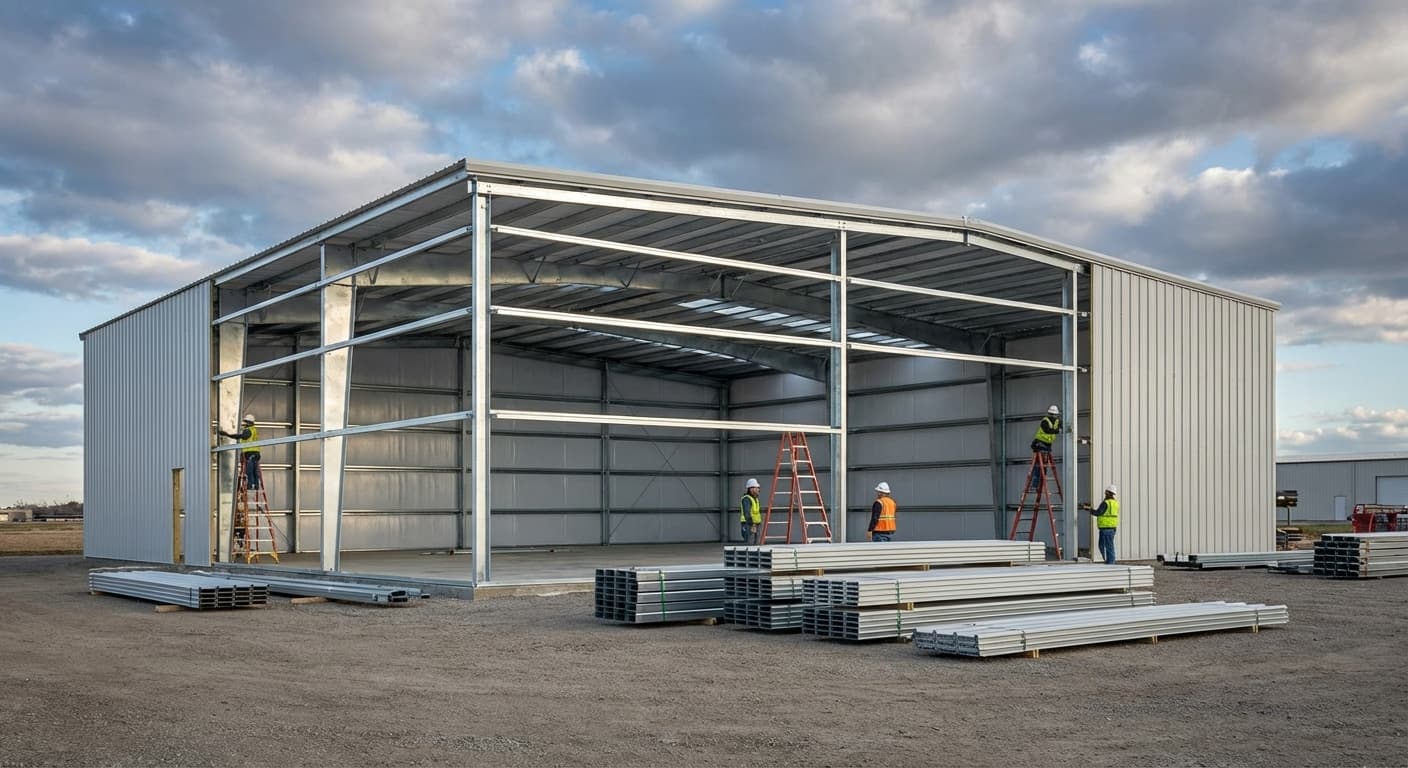

A 40×40 metal building delivers 1,600 square feet of column-free, versatile space for everything from garages and workshops to warehouses, stables, or even insulated homes, while its mid-size footprint keeps both budgets and permits manageable. This guide walks you through every cost variable–base kit prices of $12.5k-$36k, turnkey installed totals of $38k-$61k, plus foundations, site prep, permits, and strategic upgrades–so you can lock in pricing before seasonal steel hikes and tariffs bite. Readers learn how location-driven wind/snow loads, steel gauge choice, roof style, door placement, and energy codes ripple through the budget, and where splurging on thicker framing, premium coatings, or spray-foam insulation pays back through lower maintenance, energy savings, and insurance discounts. By comparing 20-year total ownership against wood or concrete construction–where metal's 1% annual upkeep and 10-20% energy cut can save hundreds of thousands–the article equips buyers to negotiate with suppliers, size contingency buffers, and decide between DIY, hybrid, or single-source builds, ultimately turning a commodity steel box into a high-ROI asset that's faster to erect, easier to expand, and engineered for local climate and code demands.
Understanding Metal Building Cost Fundamentals
A 40×40 metal building gives you 1,600 square feet of unobstructed workspace–enough for equipment, vehicles, and operations without interior columns stealing your floor space.
Defining a 40×40 metal building and its common applications
You get 1,600 square feet of clear, unobstructed workspace with a 40×40 metal building–right in that sweet spot between a residential garage and a full commercial warehouse [1]. Your structure uses two 20-foot bays in a clear-span design. No interior columns eating up floor space or blocking equipment movement [3]. You can configure it with large roll-up doors, walk-in entrances, whatever your operation needs [3].
For residential use, you're looking at a triple-car garage with room left over for workbenches, tool storage, and actual project space [1]. Commercial operators use them as contractor shops, auto repair bays, or small business warehouses–enough room for equipment, inventory, and efficient work flow [1][2]. On the farm, they shelter everything from tractors to hay storage to horse stables [1].
But here's what's interesting: these buildings have grown beyond basic storage. Business owners convert them into offices. Recreation centers use them for sports training facilities and even trampoline parks. With proper insulation and finishes, you can turn one into a comfortable home [2]. The 40×40 hits that perfect size–big enough for serious equipment or multiple vehicles, small enough to keep your budget and permits manageable [1].
Why accurate metal building cost matters for budgeting and ROI
Getting your metal building cost right the first time saves you more than money–it saves your project. Steel prices jumped 91% between late 2020 and 2021, catching unprepared buyers with budget shortfalls mid-project [4]. You can't control the market, but you can control your planning.
Here's what accurate costing does for you:
- Gives you real negotiating power with suppliers
- Shows exactly what financing you need
- Builds realistic ROI timelines based on actual total costs [5]
Break your costs down: materials, labor, permits, site prep. Each category hides potential savings [5]. Sometimes spending more upfront pays off fast–better insulation cuts energy bills, quality coatings extend maintenance cycles, heavier gauge steel reduces lifetime repairs [6].
Build in a 5-10% contingency buffer. Material prices shift. Labor gets tight. Your site throws you a curveball. That buffer keeps your project moving when surprises hit [4].
2025‑2026 market snapshot: steel prices, regional modifiers, and inflation impact
Steel sits at $800-850 per short ton as we head through 2025–stable after the wild swings of recent years [7]. Structural steel dropped 6.63% from Q3 to Q4 2025, landing at $2,477.25 per ton in October [9]. But watch the tariffs: Section 232 jumped to 50% in June 2025, pushing up imported component costs [7].
Here's what affects your specific project cost:
- Location: Your ZIP code determines wind loads, snow loads, and seismic requirements. The 2024 building code's new tornado provisions can add serious steel weight in vulnerable areas [7][8]
- Timing: Q4 typically sees price increases as buyers order for spring. Lock in before the rush [7]
- Transportation: Diesel prices finally eased in 2025, helping offset delivery costs–especially if you're building in remote areas [7]
Steel futures point upward through spring 2026. After slow construction spending, pent-up demand could tighten supply [7]. Smart money says secure your order before Q4 2025 hits. You'll dodge both seasonal price bumps and extended lead times.
National buying power helps here. When you work with a nationwide supplier who purchases steel in volume, you get better pricing stability than going it alone. That's the difference between riding market waves and getting swamped by them.
Itemized Cost Breakdown for a 40×40 Structure
A complete 40×40 metal building shell costs $12,545 to $36,120, with frame gauge and height as your primary price drivers.
Base kit price range and per‑square‑foot analysis
Your 40×40 metal building base kit will run between $12,545 and $36,120 in 2025-2026. That's $16-25 per square foot for 1,600 square feet of clear-span space [10][12]. You're getting the complete shell–primary steel frame, roof panels, wall panels, fasteners, trim, and assembly hardware. Everything you need for the structure itself [11].
The vertical roof style costs more but pays you back in performance. Its panel orientation sheds rain and snow faster than regular styles, keeping your building tight and dry for decades [12].
Frame gauge drives both price and peace of mind. You'll pay less for 14-gauge frames, but they max out at 105 MPH wind resistance and 35 PSF snow loads. Step up to 12-gauge and you jump to 170 MPH wind protection and 65 PSF snow capacity [12]. Your location determines which makes sense.
Height adds cost but delivers flexibility. A 14-foot tall building runs about $2,300 more than 12-foot walls on the same 40×40 footprint [12]. That extra height means more storage, better equipment clearance, and room for future mezzanines. The additional steel and engineering push the price up, but you gain workspace that pays dividends [10].
Lock in your price before Q4 2025. Steel market patterns show consistent seasonal increases as contractors place spring orders. You'll save money and avoid extended lead times by moving now [10].
Turnkey installation costs: labor, foundation, permits, and site preparation
Your complete turnkey 40×40 building runs $38,400-$60,800 when you factor in foundation, professional installation, and basic finishes [13]. Here's how those costs break down:
Foundation: $9,600-$22,400 for your 4-6 inch reinforced concrete slab with vapor barrier, anchor bolts, and drainage [14]. Got problem soil? Add $1,800-$4,100 for expansive clay engineering or $2,700-$6,800 for rock blasting [14]. Your square design distributes weight evenly, often simplifying foundation requirements.
Site prep: $2,500-$10,000 covers everything needed to get your land building-ready [14]:
- Land clearing: $1,800-$5,400
- Soil testing: $400-$1,100
- Excavation: $1,400-$4,300
- Drainage: $1,000-$3,400
- Utilities: $1,600-$5,400
Professional erection: $12,800-$38,400 ($8-$24 per square foot) [14]. Rural projects typically hit the lower range at $12,800-$22,400. Urban markets push $25,600-$38,400 due to higher labor costs. As your single-source solution, we manage every trade to keep your project moving.
Permits: Budget $440-$2,500 total for all required permits [14]:
- Building permit: $240-$1,590
- Electrical: $85-$380
- Plumbing: $70-$300
- Mechanical/HVAC: $45-$230
Processing takes 2-8 weeks with 3-5 inspections throughout construction. We handle the paperwork and coordinate inspections to prevent delays.
DIY considerations: You can save $12,800-$38,400 tackling installation yourself, but you'll need 4-6 skilled helpers, 6-10 weeks, and $2,500-$5,400 in equipment rentals [14]. Most owners find the hybrid approach works best–we handle foundation and frame erection while you install panels, saving $13,600-$29,500 without compromising safety [14].
Optional upgrades and their effect on the overall metal building cost
Strategic upgrades turn your basic shell into a working asset. Here's what each option costs and delivers:
Insulation: Your biggest energy decision. Basic fiberglass runs $1.75-$3.50 per square foot. Premium spray foam costs $5-$8 per square foot [1]. In climate-controlled spaces, proper insulation cuts heating and cooling bills by 20-30% annually. That $8,000 spray foam investment pays back in under five years [1].
Doors and windows: Size matters for both access and cost. Upgrading from 10×10 to 14×16 overhead doors adds $1,200-$3,600 per door [15]. Windows run $250-$750 each based on size and efficiency ratings. More openings mean more light and better workflow–but also more spots where heat escapes [16]. Plan your insulation accordingly.
Structural upgrades: Your gauge choice (detailed in "Material choices" section) determines durability. Moving from 14-gauge to 12-gauge adds 15-22% to frame costs but boosts wind resistance from 105 to 170 MPH [16]. Essential in tornado alley. Optional in calmer climates.
Protection details: Small investments with big payoffs:
- Base flashing: $2.25-$4.50 per linear foot
- Rat guards: $1.85-$3.20 per linear foot
These add just 3-5% to total cost while preventing moisture damage and pest infiltration that could cost thousands later [16].
Roof upgrades: Vertical panels cost 15-20% more than regular style but shed snow faster and carry longer warranties [15]. Smart money in snow country. Unnecessary expense in the desert.
The bottom line: Premium upgrades typically add 30-70% to base costs. But choosing the right ones for your climate and use case optimizes both performance and ROI. Our
Key Drivers Shaping Metal Building Cost Today
Match your steel gauge to actual climate needs rather than overpaying for unnecessary strength, and let protective coatings extend your building's life by 15-25 years.
Material choices: gauge, coating, and sustainability certifications
Your choice of steel gauge drives both upfront costs and long-term performance. As covered in our cost breakdown, thicker 12-gauge framing handles higher loads than 14-gauge–but you'll pay 15-22% more for that extra strength [17]. Here's the key: match your gauge to your actual needs. If you're in a mild climate zone, that premium steel might be overkill. Our nationwide network lets us source the right gauge at competitive prices, keeping your project cost-effective without compromising safety [17].
Protective coatings add $1-$2 per square foot to your investment, but they're worth every penny in the right environment. Galvanized and Galvalume finishes act as your building's shield, taking the hit from corrosion so your structural steel doesn't have to–extending life by 15-25 years [17]. In coastal areas or humid climates, this protection becomes essential, not optional. Premium coatings with UV protection cost more upfront but slash your maintenance schedule, meaning fewer repaints and less downtime [18]. Energy codes keep getting tighter, which means your material choices need to work harder.
Today's codes often require specific thermal breaks and insulation compatibility–details that affect your gauge selection and overall design [18]. If you're pursuing LEED certification, expect to pay 3-7% more for materials that meet recycled content and reflectance standards. But here's the payoff: those certifications can unlock tax benefits and attract environmentally conscious customers. The good news? These premiums keep shrinking as sustainable options become standard practice [18].
Design variables: clear‑span height, bay spacing, doors and windows
Your building's design choices create a ripple effect on costs. Height proves this perfectly–two buildings with identical footprints cost vastly different amounts based on wall height alone. That 30x40x18 structure needs significantly more steel than its 10-foot tall cousin, despite the same 1,200 square feet [19]. For your 40×40 building, expect 10-16 foot walls, with most commercial users needing that full 16 feet to clear equipment or install overhead systems [20]. Bay spacing–how far apart we place your main frames–makes a surprising difference in your final cost.
The sweet spot for 40×40 buildings sits at 20-25 foot intervals, balancing material efficiency with structural integrity [19]. But here's where experience matters: your door placement might require adjusted spacing to ensure everything fits properly. We coordinate these details upfront, preventing costly field modifications [19]. Your door and window placement drives more decisions than you might expect. Most 40×40 buildings include two 12×12 roll-up doors plus a walk-in entrance–but placing them requires working around your building's bracing system [20].
Every opening needs proper support, which means coordinating X-bracing, portal frames, and wind columns to maintain strength without blocking access [19]. Planning interior finishes? Choose flush girts over bypass–they create flat walls perfect for insulation and drywall. These choices interconnect, each affecting the next. That's why our
Location factors: shipping distance, climate considerations, and code compliance
Your project location shapes costs in three major ways. First, shipping distance hits your budget directly–the farther from manufacturing facilities, the more you'll pay for specialized transport of those large steel components [21]. Our national presence helps minimize these distances, but remote sites still face premium delivery charges. Second, your local climate dictates structural requirements that directly impact material costs. Northern snow loads demand beefier roof systems.
Coastal regions require 105-170 MPH wind ratings. Wildfire zones need special fire-resistant sandwich panels [23]. Each adaptation adds steel and complexity–but skipping them isn't an option when safety and code compliance are on the line. Third, local building codes create the wildest cost swings. Some municipalities demand brick facades, specific colors, or architectural features like parapets–requirements that look cosmetic but actually increase structural loads and foundation requirements [23].
These code variations can boost your steel needs by 15-30% compared to basic jurisdictions [22]. Add it all up–shipping, climate adaptations, and code compliance–and location factors typically tack on $3,800-$9,400 to your 40×40 project. High-regulation areas or remote sites push even higher [21]. That's where our experience navigating codes nationwide pays off, helping you meet requirements without overbuilding.
Optimizing Value and Moving Forward with Confidence
A 40×40 metal building costs roughly half what traditional construction runs over 20 years while cutting maintenance expenses by 75 percent annually.
Metal building cost vs. traditional construction: total‑ownership comparisonYour 40×40 metal building delivers value that compounds year after year. While wood framing runs $35 per square foot and concrete hits $50, you're looking at material costs already covered in detail above [24]. The real savings kick in after construction. Your annual maintenance drops to just 1% of initial cost–that's $1,500-$2,500 for a 10,000 square foot building versus $7,000-$20,000 annually for traditional construction [24]. Why the difference? Steel doesn't rot, warp, or feed termites. It just stands there doing its job.
Energy efficiency adds another layer of savings. With proper insulation, your metal building cuts energy bills by 10-20% annually ($2,000-$5,000 in savings), while traditional buildings manage only half that efficiency gain [24]. Insurance companies recognize steel's advantages too–non-combustible materials mean lower premiums, period [26].
Run the 20-year numbers and the picture becomes crystal clear: metal buildings total around $350,000 for a 10,000 square foot facility, while traditional construction lands between $670,000 and $1.1 million [24]. That gap only widens when you factor in expansion flexibility. Adding onto your metal building? Simple bolt-on additions. Traditional structures? Complex structural modifications that drain budgets and timelines [26].
Financing options, tax incentives, depreciation, and insurance savings
Action plan: cost calculator, project brief checklist, and your single‑source solutionStart with a metal building calculator to get your baseline. Input your dimensions, roof style, gauge specs, and intended use. You'll see estimates ranging from $15-$25 per square foot for basic kits to $24-$43 for complete turnkey installations [30]. Remember–steel prices jumped 91% between late 2020 and 2021, so treat these as starting points, not guarantees [30]. Before reaching out for quotes, build your project brief checklist:
- Site conditions (clearing needed? drainage issues?)
- Foundation requirements ($4-$8 per square foot for slabs)
- Permit status by county
- Must-have features (doors, windows, insulation)
- Timeline constraints
- Budget parameters
This prep work matters–site preparation alone runs 10-20% of total project cost, and missing details cause delays [30].
Here's where a single-source provider changes everything. Instead of juggling multiple contractors, you get one itemized quote covering materials, delivery, installation, and warranties. One point of contact from design through completion. One company accountable for your timeline and budget.
Ready to move forward?
- 40×40 metal building kits cost $12,545-$36,120, turnkey $38,400-$60,800.
- Steel prices jumped 91% in 2020-21; lock orders before Q4 2025 to avoid seasonal hikes.
- Switching from 14- to 12-gauge adds 15-22% but raises wind rating to 170 MPH.
- Foundation runs $9,600-$22,400; poor soils can add up to $6,800 more.
- Metal buildings cut lifetime costs: 1% annual upkeep vs. 4% for wood, saving ~$350k over 20 years.
- Insulation upgrades (spray foam $5-$8/ft²) slash energy bills 20-30%, paying back in <5 years.
- Location factors–code loads, shipping, climate–can add $3,800-$9,400 to total cost.
- https://metalprobuildings.com/is-a-40×40-metal-building-right-for-you-uses-layouts-cost-breakdown/
- https://www.probuiltsteel.com/blog/40×40-metal-buildings-everything-you-need-to-know/?srsltid=AfmBOorG8UnOKwI8teAyFi8TVp8_L3fh6RPVBKb9oJaR39wkkeLCev0l
- https://renegadesteelbuildings.com/40×40-metal-building/
- https://www.steelcobuildings.com/metal-building-cost-a-comprehensive-guide-to-budgeting-and-planning/
- https://www.metalbuildingoutfitters.com/5-best-tips-for-estimating-metal-building-costs/
- https://bulldogsteelstructures.com/blog/understanding-the-key-factors-influencing-metal-building-cost/
- https://gensteel.com/building-faqs/steel-building-prices/forecast/
- https://americansteelinc.com/blog/steel-building-costs-prices-guide/
- https://www.gordian.com/resources/steel-price-updates/
- https://www.getcarports.com/40×40-metal-building-guide?srsltid=AfmBOooRpkZjzPgro2xyR4Kh53VFZ5ahgBX851cNk4FhISoSP4oHG1Q6
- https://qebuildings.com/2025/10/how-much-does-a-40×80-metal-building-cost/?srsltid=AfmBOopWdSkaG2Tc1UPFIJzfjQhmqfYKrThXNNpAHar8aAh0Hd-lnGK4
- https://www.vikingsteelstructures.com/40×40-metal-building?srsltid=AfmBOoojGi9oQpb5JQ9mnJW-YlfuO-Ew0C7iaFezun6-U01m1cAe-oxW
- https://www.buildingsguide.com/products/standard-size/40×40-metal-building/?srsltid=AfmBOopYoxJ_1SmmYrwI34fgvF1KP45XvzlD9-fFtKnCuBnWI7TCeVzY
- https://www.metal-buildings.org/40-x-40-metal-building/
- https://www.getcarports.com/40×40-metal-building-guide?srsltid=AfmBOorkTIcTr7A6gSxeIFIB-p3SYDrUnvupiIF9QqgKOhNdsH1AidAn
- https://www.unitedmetalbuildings.us/post/how-to-choose-the-best-40×40-metal-building-kit?srsltid=AfmBOooL4FbIzHVUybfCAXQpqjeXLcOJE6ZEht2o6MkftiRja814DYN6
- https://chinasteelbuildsales.com/metal-buildings-cost/
- https://www.cecobuildings.com/blog/steel-building-cost-estimator-a-contractors-guide-to-pemb-pricing/
- https://renegadesteelbuildings.com/sample-pricing/steel-building-pricing/
- https://www.getcarports.com/40×40-metal-building-guide?srsltid=AfmBOorxR3vAxw_F7ITVahUtfVIiDTSveu1gyEmhHDcSXgLyeIlH3cTu
- https://www.clarisdesignbuild.com/8-factors-that-affect-your-steel-building-cost-estimator-results/
- https://www.metalbuildingoutfitters.com/analyzing-costs-of-custom-metal-buildings-a-guide/
- https://www.metalconstructionnews.com/articles/building-codes-affect-metal-building-cost/
- https://www.summitsteelbuildings.com/20-year-cost-comparison
- https://bulldogsteelstructures.com/blog/exploring-the-cost-efficiency-of-metal-buildings-vs-traditional-construction/
- https://armstrongsteel.com/blog/metal-buildings-vs-traditional-construction-a-comparative-analysis
- https://ddcon.co/alternative-financing-and-tax-incentives-for-metal-building-projects/
- https://idadevelops.com/can-you-finance-metal-building-construction/
- https://www.hswilliams.com/blog/commercial-metal-buildings-cost-vs-value-analysis
- https://vandykeoutdoors.com/metal-building-cost-calculator/