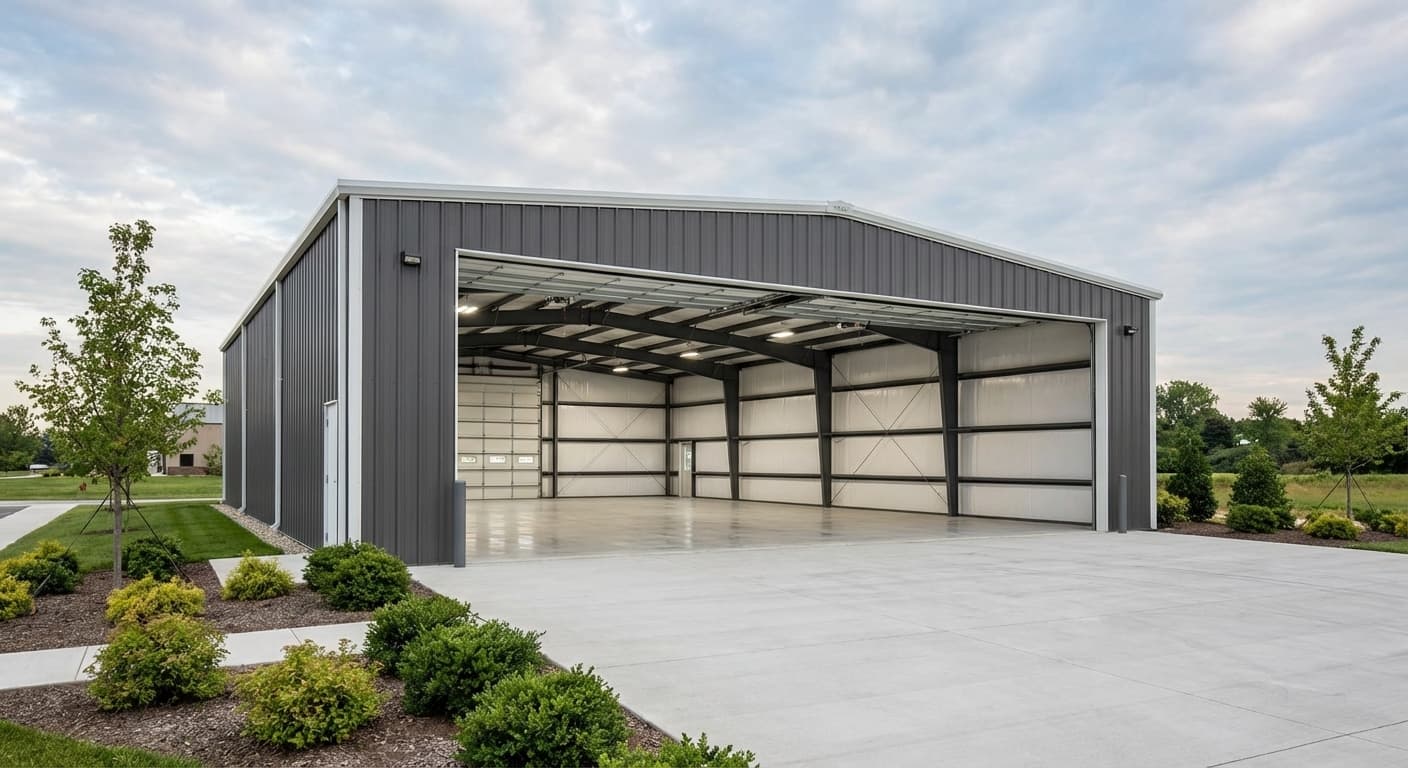

A 40×50 metal building gives you 2,000 square feet of uninterrupted, column-free space that can flex from warehouse or auto shop to barn, retail showroom, or even a live-and-work unit for roughly half the up-front cost of conventional construction. Readers will learn how to size the frame, pick roof styles, and plan doors so the structure fits their workflow today and expands tomorrow, while clear 2024-25 pricing–about $22-40k for the kit plus foundation, delivery, installation and regional code upgrades–keeps budgets realistic. The article explains why commercial-grade steel delivers 50-year durability, cuts energy and annual maintenance bills by up to 20% and 75% respectively, and out-saves wood or concrete by hundreds of thousands over its life. It walks through every stage of a 10-20 week project, from certified drawings and permits to fabrication, site prep, and rapid erection, and shows how to vet suppliers, lock in long structural warranties, and perform simple seasonal upkeep that protects resale value. Ultimately, the piece equips owners to turn a low-maintenance, energy-smart steel shell into a fast-built, future-proof asset that costs less to own and can be re-purposed without rebuilding.
Understanding the 40×50 Metal Building Footprint and Design Options
Your 40×50 metal building gives you 2,000 square feet of completely column-free workspace, with a clear-span design that adapts to your business layout today and tomorrow.
Overall dimensions, clear‑span space and 2,000 sq ft layout for a 40×50 metal building
Your 40×50 metal building delivers 2,000 square feet of wide-open workspace–no posts, no columns, just pure usable space [1][3]. That's what clear-span construction gets you: total flexibility to arrange your floor plan however your business needs it, today and ten years from now [1][3].
Here's what works: two 25-foot bays running the 50-foot length give you room for multiple roll-up doors plus walk-through entries exactly where you need them [3]. The rigid frame design pushes vertical space even higher than the stated eave height–you're not just buying floor space, you're buying volume [1].
Standard eave heights start at 14 feet, perfect for most equipment and storage needs [1][3]. Need to stack higher or add a mezzanine? We build taller. Your foundation matches these exact dimensions with a concrete slab engineered to handle your specific loads [2]. Get the dimensions right from day one, and your building performs for decades.
Height configurations, roof styles and structural framing for a 40×50 metal building
Most customers choose 14-foot eave heights–it's the sweet spot for functionality and cost [4][5]. Remember the door math: a 10-foot roll-up needs 12-foot minimum eave height. That two-foot buffer isn't negotiable [4].
Your building's backbone? Commercial-grade steel I-beams forming a trussless frame that keeps every square foot usable [4][5]. No posts eating up floor space. No beams blocking equipment movement. Just wide-open workspace from wall to wall.
Pick your roof style based on what you need:
- Gabled roof with adjustable pitch–classic, efficient, sheds weather
- Single-slope–simplest water runoff, lowest cost
- Gambrel–extra headroom without extra wall height
- Monitor-style–natural light plus ventilation [4][5]
Your local weather matters. Snow loads, wind ratings, drainage–we factor it all into your
Ideal floor plans for commercial, agricultural and mixed‑use 40×50 metal building projects
Your 40×50 building adapts to whatever business you're running. Small warehouse? Set up two loading bays with office space up front. Retail operation? Split between showroom and back-stock storage [6][7]. The open floor plan works with you, not against you.
Agricultural operations love the unobstructed interior–drive equipment straight through wide bay doors, set up processing lines, create workflow zones that actually flow [6]. No posts to navigate around means faster operations and safer movement.
Shop-with-living-quarters designs are taking off, and here's why they work:
- 1,200-1,400 square feet for your workshop
- 600-800 square feet for living space
- Complete separation or open flow–your choice
- Lower commute: zero minutes [7]
The same flexibility handles auto shops with multiple bays, small churches needing classroom space, or distribution centers with loading docks [7]. Match your foundation to your use–heavier equipment needs beefier concrete, climate-controlled spaces need proper vapor barriers and insulation details [8]. Plan it right, build it once.
Core Benefits of Choosing a 40×50 Metal Building
Save $5,500-$17,500 annually on maintenance while your steel building delivers 50+ years of reliable service without warping or cracking.
Durability, weather resistance and low‑maintenance performance of a 40×50 metal building
Your 40×50 metal building delivers 50+ years of reliable service–that's decades longer than wood structures [9]. The steel framework won't bend, warp, or crack like traditional materials. You get consistently reliable space that performs year after year [9].
Weather? Not a concern. Your
Cost efficiency across materials, labor and lifecycle ownership for a 40×50 metal building
Let's talk real numbers. Your 40×50 metal building kit costs $15-20 per square foot–about $30,000-40,000 for the full 2,000 square feet [13]. Add installation at $10-20 per square foot, and you're looking at $24-43 per square foot total, including foundation, delivery, and construction [13].
Compare that to traditional construction: wood runs $35 per square foot, concrete hits $50 just for materials [12]. You save money from day one.
The savings keep coming. Your annual maintenance costs average just 1% of initial investment versus 2-4% for wood or concrete structures [12]. On a 10,000 square foot building, that's $5,500-17,500 saved every year [12].
Energy costs? You'll cut those by 10-20% thanks to superior insulation and thermal performance [12]. Over 20 years, the numbers become striking: roughly $350,000 total lifecycle cost for steel versus $670,000-$1.1 million for traditional construction of the same size [12].
Pre-engineered components speed up installation too. Everything arrives pre-drilled and ready to assemble. You need fewer workers and fewer hours–more savings in your pocket [12].
Energy‑saving features: insulation, reflective coatings and renewable integration for a 40×50 metal building
You can cut energy costs by 10-40% with the right reflective technology and insulation [14].
Your
Accurate Cost Estimation for a 40×50 Metal Building in 2024‑2025
A 40×50 metal building kit costs $22,000-$40,000, but budget an additional $20,000-$37,000 for foundation, site prep, and permits to avoid surprises.
Base kit pricing per square foot and total cost range for a 40×50 metal building
Your 40×50 metal building base kit runs $11-20 per square foot–that's $22,000 to $40,000 for the shell of your 2,000 square foot structure [19]. Height matters: a 10-foot eave height starts around $30,000, while 20-foot clearance pushes closer to $45,000 [18]. These kits deliver everything structural–the I-beam frame, secondary supports, roof and wall panels, plus framed openings ready for your doors and windows [17][19]. Plans and assembly instructions come standard [17].
Your final cost depends on the features you need. Walk-in doors run about $300, while a 12×12 roll-up door hits $1,400 [18]. Windows add $200 each [18]. Your roof choice–whether traditional gable, single-slope, gambrel, or monitor style–impacts both price and performance [17].
Here's what many quotes leave out: your foundation. As covered in the design section, you'll need a proper concrete slab–figure $8,000-$16,000 for the foundation alone [19]. Add site prep, permits, and any structural upgrades, and your actual investment climbs well beyond that advertised kit price [19]. That's why working with a single-source supplier who handles the complete project makes sense–no surprises, no finger-pointing between vendors.
Site preparation, foundation, permits and regional price modifiers for a 40×50 metal building
Site prep runs $4-$8 per square foot–that's another $8,000-$16,000 depending on your terrain [20]. Your foundation (the concrete slab that supports everything) typically eats up 10-20% of your total budget [20]. Permits? Budget anywhere from $500 in rural areas to $5,000 in major cities [20].
Your location drives costs in ways you might not expect. Coastal areas and snow country need beefier structures–add $3-$6 per square foot for certified wind or snow ratings [21]. That Florida hurricane rating or Colorado snow load can bump your building cost 15-30% compared to mild-weather regions [20]. Even shipping matters: the farther you are from steel manufacturing centers, the more you pay in freight [20].
Labor costs follow local patterns too. Stricter building codes mean more inspection time and higher installation costs [20]. But here's the key: an experienced supplier knows these regional quirks. They've already factored in your local requirements, secured the right certifications, and built relationships with installers who understand your area's codes. No learning curve on your dime.
Planning, Procurement and Long‑Term Value Assurance for a 40×50 Metal Building
Verify that your metal building supplier provides certified blueprints, comprehensive warranties, and direct manufacturing capabilities to ensure quality control and long-term support.
Selecting a reputable supplier, warranties and single‑source solutions for a 40×50 metal building
Selecting a reputable supplier for a 40×50 metal building requires evaluating several crucial factors beyond initial price quotes. Verify that potential manufacturers produce certified building blueprints for permit applications, as local authorities will require third-party certified plans for both the building and foundation [22]. Resistance from suppliers to provide these documents represents a serious red flag indicating potential quality or compliance issues [22].
Warranty offerings vary significantly across the industry–look for manufacturers providing comprehensive coverage such as 20-year limited rust-through warranties on framing components [23] or extended structural warranties that protect web steel trusses for up to 50 years from delivery [24]. These substantial warranty periods signal manufacturer confidence in their materials and fabrication processes. Consider the advantages of working with direct manufacturers rather than middlemen, as companies that both design and fabricate their buildings typically exercise greater quality control while ensuring future support for maintenance or expansion needs [22].
Many reputable companies offer single-source solutions where they manufacture all prefabricated components, providing simplified accountability and consistent quality standards across the entire structure [22]. Request detailed information about certification standards for wind loads (170 MPH in standard packages) and snow loads (35 PSF), confirming these ratings align with local building code requirements [23]. While manufacturers typically don't directly provide foundation or installation services, established suppliers maintain networks of independent contractors familiar with their building systems and can provide referrals–though clear documentation should establish the limits of this referral relationship [22].
Project timeline: design, permitting, delivery, erection and post‑build inspection for a 40×50 metal building
A 40×50 metal building project typically progresses through five key phases, starting with concept and design which takes 1-3 weeks for establishing parameters like building use, layout, and structural requirements [25]. The engineering drawings and permit acquisition phase follows, running 3-6 weeks depending on jurisdiction complexity–rural areas often move faster (2-3 weeks) while commercial zones may require 4-6+ weeks for approval [26]. Component fabrication represents the longest segment at 3-8 weeks, during which all pre-engineered steel components, panels, and fasteners are manufactured to specification [25][26].
This fabrication timeframe depends on manufacturer backlog, material availability, and design complexity, with standard configurations moving faster than highly customized structures [26]. Site preparation should ideally run concurrently with fabrication to avoid schedule gaps–including grading, utility work, and foundation construction which requires curing time before steel components arrive [25][27]. The erection phase progresses rapidly once materials reach the site, with a typical 40×50 structure requiring 1-3 weeks for assembly, weather permitting [25][26].
This includes setting primary frames, installing secondary members, attaching wall and roof panels, and finishing with doors, windows, and trim details [27]. Final inspections and punch list completion mark the project's conclusion, bringing the total timeline from initial concept to occupancy to approximately 10-20 weeks [26]. Projects can move faster with streamlined decision-making, favorable weather, and simultaneous scheduling of site work and fabrication [25].
Service excellence: maintenance plans, upgrades and total cost of ownership for a 40×50 metal building
Regular maintenance directly impacts the total cost of ownership for a 40×50 metal building, with properly maintained structures requiring as little as 1% of initial cost annually compared to 2-4% for traditional materials. Though metal buildings need minimal upkeep, neglecting basic maintenance can void warranties and lead to expensive repairs [28]. Four critical maintenance tasks provide maximum return on investment: fastener inspection to prevent water infiltration, sealant examination around doors and windows, drainage system clearing to prevent foundation damage, and panel coating inspection to extend surface life 10-20 years [29].
Most steel building warranties cover structural components for 20+ years but require documented maintenance–keep detailed records with photos and receipts of all inspections and repairs to protect your coverage [29]. Spring and fall inspections should examine gutters, downspouts, foundation conditions, and panel integrity, with seasonal maintenance focusing on specific weather concerns like snow load preparation or drainage clearing [29]. The maintenance investment delivers substantial returns–each dollar spent on preventive care saves $5-10 in avoided repairs while extending building life [29].
Metal buildings allow cost-effective expansions and upgrades through their modular design, making it possible to add space or repurpose sections without complete reconstruction [28]. This adaptability combined with minimal maintenance requirements creates significant long-term value, with steel frames lasting over a century and metal roofing maintaining integrity for 40-80 years when properly maintained [28].
- 40×50 metal building gives 2,000 ft² clear-span workspace, no posts, 14 ft eave standard.
- Kit $22-40k, total project $48-86k; 50-year steel beats wood lifecycle cost by ~$350k.
- Foundation adds $8-16k, site prep $8-16k; permits $0.5-5k; coastal/snow zones +15-30%.
- Timeline: 10-20 weeks–1-3 wk design, 3-6 wk permits, 3-8 wk fab, 1-3 wk erection.
- Maintenance 1% annual cost: inspect fasteners, sealants, drainage, coatings to protect warranty.
- https://www.buildingsguide.com/standard-sizes/40×50-metal-building/?srsltid=AfmBOooylye7lWPv83-u0PLCUgf8jCROxW6xU3kK8fhdJ2LoYrlPMkzB
- https://www.aametalbuildings.com/40×50-metal-buildings?srsltid=AfmBOoowYH5Hu0K9G_LwP3qLD4hbfWG0mC43QqHIsiRaTIXfIZN1m3Gu
- https://renegadesteelbuildings.com/40×50/
- https://www.buildingsguide.com/standard-sizes/40×50-metal-building/?srsltid=AfmBOordAtBXVPMF63pgAfL6V2Wqe6-6g_riKuJ_QYLNrG6GkOhfvlFY
- https://directmetalstructures.com/shop/40×50-clear-span-metal-building/?srsltid=AfmBOop2hyJV6z4ui_Ss0-g1L3C6cUK1K7YRBtulAQgYfRyPmRc5l7_V
- https://www.buildingsguide.com/standard-sizes/40×50-metal-building/?srsltid=AfmBOoqbgwyMlX8G12004RzK3uIV-BwPIojWwgi-kt2iq6rCW_T47EZQ
- https://steelbuildingsguide.org/floor-plans/
- https://www.aametalbuildings.com/40×50-metal-buildings?srsltid=AfmBOopo9hkb0ApQluGAz9aHO-WKfst6NelpN2wRnu22mZ107PinsPz_
- https://www.metalbuildingoutfitters.com/top-benefits-of-residential-metal-structures/
- https://directmetalstructures.com/shop/40×50-clear-span-metal-building/?srsltid=AfmBOoqdoG7kUrBKg30T6g_ayI1PBzRllpcNBG579nEv9mGMhNqCVVcc
- https://cdmg.com/building-faqs/benefits-of-a-metal-building
- https://www.summitsteelbuildings.com/20-year-cost-comparison
- https://www.buildingsguide.com/metal-building-prices/?srsltid=AfmBOoolW0HZhQ5WM5C6sjnOCsuPD6pmGplDSi1TLv4qsnXgVOAKrjpv
- https://www.metalroofing.com/energy-savings
- https://www.advancedroofing.com/energy-saving-benefits-reflective-commercial-roof-coatings/
- https://industrial.sherwin-williams.com/na/us/en/coil-extrusion/sustainability/cool-roof-wall-coatings.html
- https://www.buildingsguide.com/standard-sizes/40×50-metal-building/?srsltid=AfmBOoop6PCMOA4eE1wJpaqTMQ0K6ZdNFvqqYxmhC3lwSOPEOrKOdnaS
- https://alansfactoryoutlet.com/40×50-metal-building/?srsltid=AfmBOorsZ2tVG1QEq36WrjdHF2WSSxgT4IFoTzVob1kvLXhLqmyHsVCk
- https://www.americanmetalbuildings.com/blog/how-much-does-a-40×50-metal-building-cost/?srsltid=AfmBOopL7CTmeEvTHfrDcj37qnPl0a5QT7abpR7UJZsLIAp6UJH4d4oT
- https://americansteelinc.com/blog/steel-building-costs-prices-guide/
- https://www.aametalbuildings.com/blog/2025-metal-building-price-trends-are-steel-building-costs-going-up-or-down-this-year?srsltid=AfmBOopKyuhjZHT8j0vYOOD1jfpL230OMMX4uCd-oI55QgkX_YOXZLb7
- https://www.muellerinc.com/products/steel-buildings/big-barn-40-x-50-x-14
- https://www.vikingsteelstructures.com/50×40-metal-building?srsltid=AfmBOoriIEXAzU7lwhUUnjnZjRrrBIqzcmfTT_SJLvGUoHiq9fU9FyjS
- https://www.worldwidesteelbuildings.com/about/50-year-structural-warranty/
- https://metalprobuildings.com/pre-engineered-steel-building-timeline/
- https://www.builtbyad.com/learning/how-long-does-it-take-to-build-a-metal-building
- https://www.eaglecarports.com/blog/how-long-does-metal-building-installation-take
- https://www.metalcarports.com/blog/long-term-value-metal-building/
- https://steelcommandercorp.com/warranty-maintenance-upkeep-how-ongoing-care-impacts-lifetime-cost/