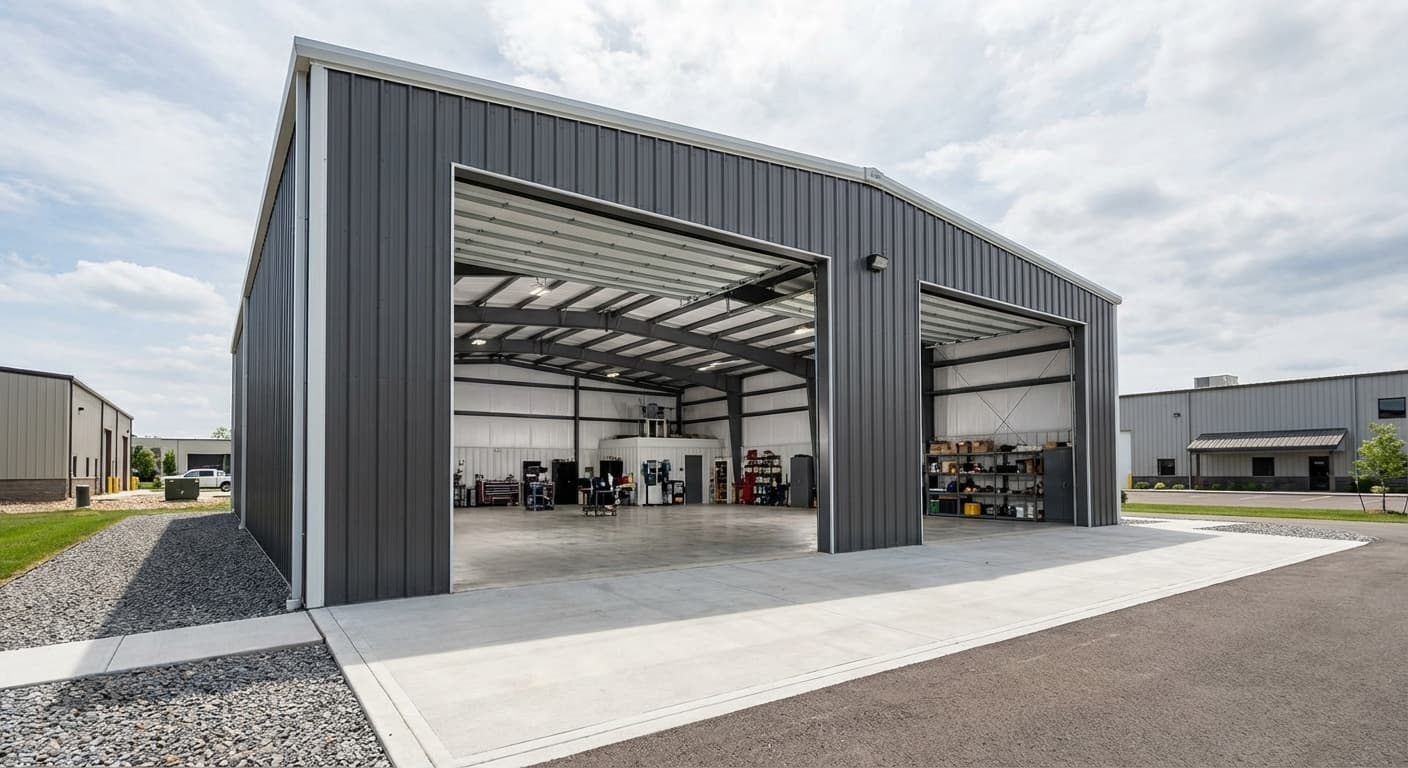

The 40x60x16 metal building kit delivers 2,400 sq ft of clear-span, column-free space that ships complete–every bolt, I-beam, and 26-gauge panel pre-punched and engineered for a four-day bolt-together build–so owners skip the hunt for missing parts and move straight to productive use. Readers learn how the 16-ft eave height unlocks 14-ft doors, mezzanines, and high shelving, why location-specific ASCE 7-22 engineering and modern insulation options satisfy 2026 wind, snow, seismic, and energy codes, and what drives true project cost ($26-91k all-in) so they can budget for foundation, permits, and must-have upgrades without $20k surprises. The article demystifies 100% first-year bonus depreciation, SBA 504 financing, and warranty coverage, while walking through site-prep, DIY vs. pro erection, and low-maintenance routines that protect a 50-year structural guarantee. Whether sheltering farm equipment, RVs, a manufacturing floor, or a growing small business, buyers discover why this footprint remains the 2026 sweet spot–maximum usable volume, minimal wasted cost, and future-proof adaptability–all backed by stamped plans that speed permits and insurance approval.
Understanding the 40x60x16 metal building kit
Every bolt, nut, and fastener arrives pre-measured and pre-punched so your crew can assemble the entire 2,400-square-foot structure with just basic tools–no welding required.
What's included in a 40x60x16 metal building kit
Your 40x60x16 metal building kit arrives with everything you need for the steel structure–no hunting for missing pieces, no surprise trips to the hardware store. You get clear-span rigid steel I-beam frames that leave your entire 2,400 square feet wide open–no posts blocking your equipment or workflow [3]. The kit includes all primary and secondary framing, plus durable 26-gauge steel panels for walls and roof [3]. Every bolt, nut, and fastener comes pre-measured and pre-punched for simple bolt-together assembly–your crew won't need welding equipment [1].
You'll find framed openings ready for doors and windows, plus trim pieces that seal every edge and corner tight [2]. Most importantly, you get engineered building plans stamped by a licensed engineer–the paperwork that keeps your permit process moving [2][3].
What's not in the kit? Foundation materials, the actual doors and windows, insulation, and interior finishes [2][3]. This modular approach keeps your initial costs down and lets you choose exactly what you need. At National Steel Buildings, we coordinate these add-ons as part of our complete design-build service–one call handles everything from foundation to final inspection.
Why the 40x60x16 size remains a top choice in 2026
The 40x60x16 remains the go-to size in 2026 for one simple reason: it works for nearly everything. At 2,400 square feet, you get serious workspace without paying for square footage you'll never use [4].
For agricultural operations, this footprint means your equipment moves freely–no more three-point turns with the combine. You can store machinery, feed, and supplies in organized zones that actually make sense [4]. Residential users love how this size swallows RVs, boats, and multiple vehicles while still leaving room to work around them [4].
That 16-foot eave height changes everything. You can install 14-foot overhead doors, hang hoists, add mezzanines, or stack inventory high. Standard-height buildings simply can't match this flexibility.
Small businesses pick this size because it looks professional without feeling empty. Whether you're running a service center, light manufacturing, or contractor operations, the space adapts as you grow [4]. Workshop owners tell us the 40-foot width finally lets them set up proper work zones–no more shuffling equipment every time they start a new project [4].
The 40x60x16 delivers maximum bang for your buck (detailed pricing in our Cost Planning section), making it the smart choice when you need real space without overbuilding.
Key applications: commercial, agricultural, and residential uses
Your 40x60x16 building works as hard as you do–no matter your industry.
Commercial Operations: Turn this space into a profitable retail showroom, multi-bay service center, or small manufacturing facility. The clear-span interior means zero posts interfering with your workflow or customer traffic [6][8]. As your business evolves, your floor plan evolves with it–no structural limitations holding you back [8].
Agricultural Applications: Protect your expensive equipment from weather damage. House livestock with proper ventilation. Store crops in controlled conditions.
Design, engineering, and code compliance
The clear-span design eliminates interior columns, giving you maximum flexibility to position equipment and configure your workspace across 2,400 square feet.
Structural dimensions, clear‑span calculations, and load capacities
The 40x60x16 dimensions create 2,400 square feet of usable space with specific functional advantages. The 40-foot width provides clear-span construction–meaning no interior support columns–which maximizes equipment positioning flexibility and operational flow [9][10]. The 60-foot depth accommodates multi-zone layouts with distinct work and storage areas [11].
The 16-foot eave height allows installation of tall overhead doors (typically up to 14 feet clearance), overhead equipment, mezzanine levels, and high shelving systems [9][11]. Clear-span design relies on rigid I-beam frames rather than interior support columns, creating unobstructed floor space particularly valuable for maneuvering large equipment or configuring flexible workspaces [10][11]. These buildings typically use 26-gauge corrugated steel panels for exterior walls and roofing, with vertical panel orientation enhancing water and debris shedding [10][11].
Load capacity varies by region, with standard engineering accommodating up to 170 MPH wind resistance and 90 PSF (pounds per square foot) snow loads in applicable regions [10]. Each building receives location-specific engineering to address local environmental conditions, with certified structural drawings calculating precise load requirements based on your site's elevation, exposure category, and regional building codes [11]. This engineering ensures the structure performs reliably under expected weather patterns while maintaining code compliance.
Current 2026 wind, snow, and seismic requirements
Metal building kits in 2026 must meet updated ASCE 7-22 standards that significantly refine wind, snow, and seismic requirements beyond previous codes. These standards now include more specific wind pressure calculations by zone, meaning corners, edges, and localized roof areas require detailed Components & Cladding design even when the overall building footprint remains unchanged [12]. For certain Risk Category III and IV buildings (schools, essential facilities) in tornado-prone regions, ASCE 7-22 introduces additional tornado load provisions requiring enhanced structural reinforcement [12].
Wind requirements vary dramatically by location–inland structures typically need 115-120 mph ratings, while coastal buildings must withstand 140-160+ mph ultimate 3-second gusts and include additional bracing, anchoring systems, and opening protections [12]. Snow loads similarly range from minimal 10 psf in southern regions to over 70 psf in northern states, directly affecting purlin spacing, gauge thickness, and roof pitch [13]. These requirements aren't merely guidelines–they determine permitting approval, insurance coverage, and long-term building performance [13].
Seismic considerations have gained prominence in specific regions, particularly eastern Arkansas (influenced by the New Madrid Seismic Zone) and Oklahoma, where induced seismicity has increased attention on earthquake-resistant design [12]. Regional engineering requirements translate directly to material specifications–higher loads mean heavier framing, stronger connections, and more robust bracing systems that typically add 10-30% to material costs but prevent catastrophic failures [13]. Metal building certification confirms these specific loads have been engineered into your structure, with stamped drawings showing compliance for easier permitting approval [13].
Energy efficiency, insulation options, and sustainability considerations
Metal buildings now require sophisticated insulation systems to meet increasingly stringent energy codes. Since 2012, the International Energy Conservation Code (IECC) and ASHRAE 90.1 standards have significantly raised minimum thermal performance requirements, moving beyond basic R-13 wall and R-19 roof insulation [14]. Two primary high-R insulation approaches dominate current installations: liner systems (LS) for both walls and roofs, and filled cavity systems (FC) specifically for roofs. Liner systems use two fiberglass layers–one between structural members and one perpendicular–with vapor retarders to achieve U-values as low as 0.037 [14].
Standing seam roofs offer more insulation flexibility than screw-down designs, which have limited thermal performance options [14]. Beyond fiberglass, insulated metal panels (IMPs) provide superior thermal performance as continuous insulation that meets IECC and ASHRAE requirements while reducing energy consumption [15]. The sustainability advantages extend beyond thermal performance–steel components contain 30-50% recycled content and are virtually 100% recyclable at end-of-life [15]. Metal buildings further reduce environmental impact through exceptional durability, fire/wind resistance, and low maintenance requirements that extend service life [15][16].
Cool metal roofs that reflect solar heat rather than transferring it into the building create additional energy savings in cooling-dominated climates [15][16]. Metal Building Manufacturers Association (MBMA) provides Environmental Product Declarations (EPDs) for both roof/wall panels and structural components to validate these sustainability claims for LEED and Green Globes certification programs [16].
Cost planning, financing, and value
Your total 40x60x16 metal building investment ranges from $57,600 to $91,200, including the steel kit, concrete foundation, and professional erection.
Base price per square foot and total cost estimate for a 40x60x16 metal building kit
Your 40x60x16 metal building kit starts at $11-$25 per square foot for the base structure–that's $26,400-$60,000 for 2,400 square feet of clear-span space [17]. But here's what matters: your total project investment runs $57,600-$91,200 when you include everything needed to get your building operational [18].
That complete figure breaks down simply: $40,800 for your steel building kit, $14,400 for concrete foundation, and $18,000 for professional erection [18]. You'll find material quotes as low as $6-$14 per square foot, plus $3-$8 for assembly and $4-$10 for concrete work [19].
Location drives pricing. Western projects cost more due to shipping, while eastern builds save on transportation [19]. Your specific costs depend on five factors:
- Building dimensions and layout
- Roof style (vertical panels cost more but shed water better)
- Door and window configurations
- Site conditions
- Insulation requirements [17]
Your zip code determines engineering requirements too. High-wind coastal areas or heavy-snow regions need stronger framing and additional bracing–adding 10-30% to material costs but ensuring your building performs when weather hits [17]. Always clarify whether quotes include just the steel shell or the complete package with foundation. That single question can mean a $20,000 difference in your budget [17].
Additional expenses: foundation, permits, delivery, and optional upgrades
Your steel building kit covers 60-70% of total project costs. Here's what completes your investment:
Foundation: Concrete slabs run $4-$8 per square foot–that's $9,600-$19,200 for your 2,400 square foot building [20]. Soil conditions and local specs drive the final number. (See Installation section for detailed foundation options.)
Permits: Budget $550-$2,000 for most projects. Rural jurisdictions charge as little as $150, while major cities can hit $7,500 [20]. We handle the paperwork–you just sign.
Delivery: Add 4-7% for shipping, depending on distance [20]. Our national network keeps these costs predictable.
Must-have upgrades:
- Insulation: $1-$3/sq ft for fiberglass, $2.50-$7.50 for vinyl-faced, $7-$12 for spray foam [20]
- Personnel doors: $450-$850 each
- Overhead doors: Priced by size
- Windows: $200-$700 each
- Gutters: $3-$15 per linear foot [20]
Labor: Professional installation adds $5-$10 per square foot ($12,000-$24,000 total) [20]. DIY saves 30% but demands experience and time.
Smart budgeting includes 10-15% contingency for interior finishing, electrical, plumbing, and the inevitable project adjustments. We've built 1,480+ buildings–we know what surprises to prevent and which costs to lock down early.
Financing solutions, tax incentives, and long‑term ROI for businesses and homeowners
The 2026 tax landscape makes steel buildings exceptionally smart investments. The Big Beautiful Bill Act restored 100% first-year bonus depreciation–meaning you write off your entire building cost immediately instead of waiting 39 years [21][22]. Without this legislation, depreciation would have dropped to just 20% in 2026.
For businesses: Expense your entire facility upfront. Manufacturers get the biggest wins, but any business benefits from accelerated write-offs on roofing, HVAC, and security systems [22]. That $60,000 building? Deduct it all this year, not over four decades.
For residential developers: The OBBBA eliminated the four-unit cap on construction contracts. Build larger multi-unit projects while deferring income recognition until you actually receive cash [23]. Better cash flow, smarter tax timing.
Long-term value: Your steel building contains 30-50% recycled content and recycles 100% at end-of-life–potentially qualifying for environmental incentives [21]. More importantly, minimal maintenance and 50+ year lifespans mean lower lifetime costs than any conventional building.
Financing options for 2026:
- Equipment financing loans
- SBA 504 loans (below-market fixed rates for owner-occupied buildings)
- Lease-to-own arrangements that preserve capital
We've guided hundreds of customers through financing. Our
Installation, maintenance, and support
Proper soil testing and compaction prevent expensive settling problems, while organized permitting with engineered plans keeps your 40x60x16 project on schedule.
Site preparation, foundation choices, and permitting checklist
Your 40x60x16 building starts with proper groundwork. You'll need soil testing first–it tells you exactly what foundation your site requires and prevents expensive surprises later [24]. Clear the site of vegetation, debris, and old structures, then grade and compact the soil so water flows away from your building [24][25].
For foundation, you've got three choices. Concrete slabs work best for enclosed buildings and cost varies widely based on your site conditions [24]. Gravel bases save money for basic storage structures. Asphalt shows up occasionally in commercial applications [24]. As discussed in the cost planning section, foundation expenses depend heavily on thickness, reinforcement, and local requirements.
Permitting starts with a simple zoning check–make sure your property allows your intended use [25]. You'll need engineered plans stamped by a licensed professional showing compliance with local wind, snow, and seismic codes [26]. Required documents include site surveys with setbacks, structural calculations, and drainage plans [25]. Permit fees vary by location, as covered in the additional expenses section.
Three mistakes cost builders time and money: poor soil compaction that causes settling, bad drainage that leads to erosion, and pouring concrete before finalizing building plans [24]. Smart builders also trench for utilities before foundation work starts [26]. Plan 1-2 months for site prep, though some jurisdictions stretch permit timelines longer [25].
Step‑by‑step assembly timeline and safety best practices
Your 40x60x16 building goes up in 4-6 days once the foundation's ready. Start by checking the engineered plans included with your kit and organizing all components [27][29]. Safety comes first–hard hats, safety glasses, gloves, and steel-toed boots for everyone. Fall protection kicks in at 6 feet [28].
Here's your build sequence:
Frame Construction (1-2 days): Install I-beam columns and rafters from center outward. Level each column. Use temporary bracing until walls go up [29].
Secondary Framing (1-2 days): Add girts, purlins, and eave struts that support your roof and walls [29].
Panel Installation (2-3 days): Start with roof panels for overhead protection, then wall panels from one corner. Check alignment and overlap on every panel [28][29].
Safety stays simple: Position ladders at 75 degrees on solid ground. Keep three contact points when climbing [28]. Seal every seam and joint with quality weatherproofing–it's what prevents leaks down the road [28].
Final step? Inspect all connections and get a professional to verify code compliance [28][29]. While DIY assembly can reduce costs (as outlined in our cost planning section), our ProTrades erection team handles everything safely and efficiently when you want it done right the first time [27]. That's the advantage of our single-source steel building solutions.
Warranty coverage, maintenance program, and how to request a personalized quote from nationalsteelbuildingscorp.com
Your National Steel Buildings warranty protects what matters. We back our primary steel frames with a 50-year structural warranty–because that's your building's backbone [30]. Paint surfaces get 40-year coverage. Roof warranties run 25 years for Galvalume, 20 years for standing seam [30].
Know what's covered and what isn't. Natural disasters? That's insurance territory. Surface rust versus rust-through? Different story [31][32]. Modifications without approval or skipped maintenance can void coverage, so follow the maintenance schedule we provide.
Simple maintenance keeps your warranty valid:
- Check fasteners quarterly
- Clear roof debris seasonally
- Clean surfaces per our specifications [31]
Filing a claim? Document everything–photos from multiple angles, detailed timeline, original paperwork. Having your order number speeds things up [32].
Here's what sets National Steel Buildings apart: We've been here, we'll stay here. Our warranty means something because we're around to honor it. With 1,480+ buildings completed and counting, we're not going anywhere [30].
Ready for your personalized quote?
- 40x60x16 kit = 2,400 sq ft clear-span, 16 ft eave, bolt-together steel, no welding needed
- Complete 2026 turnkey cost $57.6k-$91.2k: kit ~$41k + slab ~$14k + erection ~$18k
- Engineering stamped for local wind (115-170 mph), snow (10-90 psf), seismic & 2022 codes
- 100% bonus depreciation restored: businesses can deduct full cost in year one vs 39 yr
- DIY saves 30% but pro install adds $5-$10/sq ft; 4-6 day build after 1-2 mo prep/permits
- https://www.muellerinc.com/products/steel-buildings/big-barn-xl-40-x-60-x-16
- https://www.uspatriotsteel.com/blog/whats-included-in-a-steel-building-kit/
- https://towersteelbuildings.com/40x60x16-steel-truck-garage-kit/
- https://www.engineeredmetalbuildings.com/blog/40×60-metal-buildings-costs/?srsltid=AfmBOoo7bafzW3i5pa2WIZ1NUbb-kWIj6HXEhi6JdjjJT5aCI0sYkZ6w
- https://titansteelstructures.com/price-guides/the-2026-steel-building-price-guide-what-to-expect-this-year/
- https://masonsteelcorp.com/discover-the-benefits-of-a-40x60x16-metal-building-kit/
- https://renegadesteelbuildings.com/sample-pricing/40x60x16-steel-building/
- https://torosteelbuildings.com/blog/40-x-60-steel-building/
- https://www.buildingsguide.com/products/standard-size/40x60x16-metal-building/?srsltid=AfmBOooJBUJVewPxfh61IUYtVqmOcWs0ZPgMsbEaKq5saC90j0AS8LvE
- https://www.engineeredmetalbuildings.com/shop/40x60x16-all-vertical-commercial-building/?srsltid=AfmBOoqV1lqrYlvSVtbl4D4rJt1mU8S6r5kxeTeBRjIsN23rkJHYV6AB
- https://towersteelbuildings.com/40x60x16-commercial-steel-building-kit/
- https://www.tylerbuilding.com/post/2026-metal-building-cost-variables
- https://www.aametalbuildings.com/blog/snow-load-wind-speed-requirements-for-metal-buildings-with-codes-pricing-impact?srsltid=AfmBOooD3AB6MgrxfuNDB5MgEtY4F2Wjwg8ZxM8vSyjO23HbuMkQLkSV
- https://www.metalconstructionnews.com/articles/features/insulation-systems-metal-building-code-compliance/
- https://www.cecobuildings.com/resources/sustainable-design/
- https://mbma.com/energy-sustainability
- https://www.engineeredmetalbuildings.com/blog/40×60-metal-buildings-costs/?srsltid=AfmBOoqx3s9MHVJ0vnVUSCMTsOSJ2gqqYg-sfjkdIYB7MBe5n52_LE6c
- https://www.buildingsguide.com/standard-sizes/40×60-metal-building/?srsltid=AfmBOopSDGsivUMlwBwfnFtSKvhHAIfGb8yvcN6ykLryNXlDAQUmaQCw
- https://qebuildings.com/40x60x16-metal-building-kit/?srsltid=AfmBOoqJNZTUcdKssfYQWmOB3rlUNTzp4JXoQCbOC0_ZkYreg0TWtciV
- https://steelbuildingsguide.org/metal-building-prices/
- https://www.grantthornton.com/insights/alerts/tax/2025/legislative-updates/2026-business-tax-planning-guide
- https://gensteel.com/resources/infographics/steel-building-tax-advantages-2026/
- https://www.bradymartz.com/residential-construction-contracts-receive-meaningful-tax-relief-heading-into-2026/
- https://www.engineeredmetalbuildings.com/blog/40×60-metal-building-site-prep-concrete-slab-cost/?srsltid=AfmBOop-F1kZhGMNHKCmkxUiEx0QibbBwQHdQ9zr6dRYY7l813Q0BFLK
- https://www.buildingsguide.com/build/metal-building-site-prep/?srsltid=AfmBOoqqUCvDWVfkywhH05VrdSKesj4JI6cmTJaf15dB4ute1hRYJWt2
- https://lionbuildings.com/how-do-i-prepare-my-site-for-a-steel-building-install/5/
- https://www.buildingsguide.com/build/40×60-building-construction/?srsltid=AfmBOopz1qcT8a_5TY7llc3jpr0rSB5F6qNY_wUHYUBvBao4VURDIPs_
- https://qebuildings.com/2025/10/step-by-step-guide-installing-your-metal-building-kit/?srsltid=AfmBOoqq01nBBo4-was6huDnZUb4lIeCDMDuect3H2w7iZVZoRN-drJL
- https://titansteelstructures.com/metal-structure-tutorials/metal-building-installation-step-by-step-process/
- https://garagebuildings.com/steel-building-warranties-explained-whats-really-covered-in-2025-2026
- https://directmetalstructures.com/metal-building-warranty/?srsltid=AfmBOoohubdnNFz115ymC028zFfiieFe5eAGeBIL9MzlM0IQKrerTORb