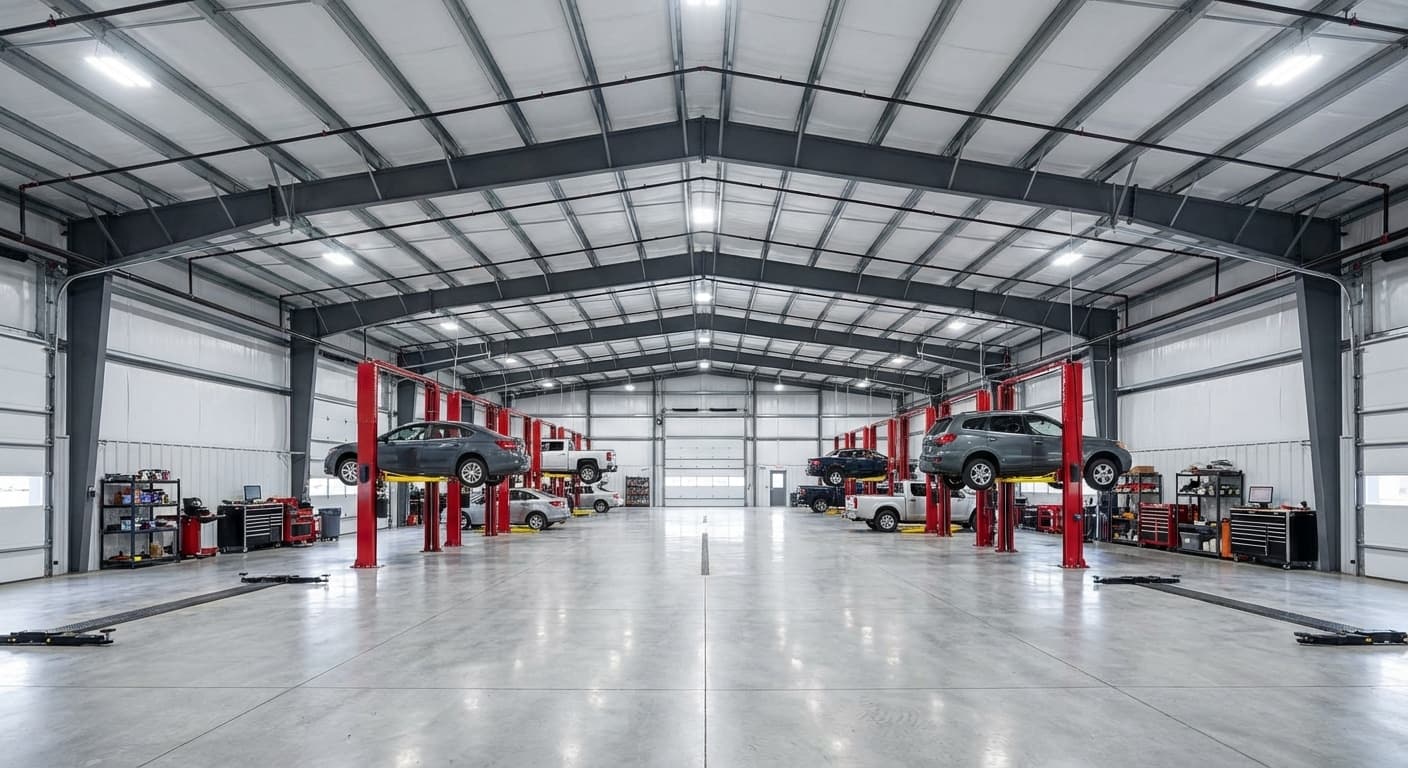

A 40×80 steel auto-shop is only as profitable as its bay layout: this guide shows you how to match modern 2-post and 4-post lift clearances–12 ft ceiling, 24 ft depth, 12 ft width, 2 ft safety buffer–to squeeze up to six revenue-producing bays and 30% more cars through the doors while cutting tech walking time with smart pods, angled or parallel aisles, and parts stored within 20 steps. You'll learn to mix quick-service and heavy-duty zones, pre-plan for EV lifts, and leave one wall removable so future expansion ties in without demolition, all using column-free, pre-engineered steel that assembles in seven weeks, cuts insurance and energy costs, and lasts 50 years with minimal upkeep. Single-source suppliers lock in material and labor pricing early, eliminating hidden site-prep or change-order surprises, and they coordinate OSHA/ALI-compliant inspections, training, and documentation so safety–and the 2-foot emergency clearance–are baked into the design instead of added later. Readers walk away with a turnkey cost range ($86-129k), a week-by-week construction timeline, and a predictive-maintenance playbook that keeps the building profitable for decades, freeing owners to focus on workflow, not rework.
Understanding Bay Requirements for Modern Lifts in a 40×80 Auto Shop Building
Optimize your bay spacing and you'll see up to 30% more vehicles through your doors while keeping techs efficient and safe.
Standard lift dimensions and clearance guidelines
Getting lift spacing right in your 40×80 shop isn't just about measurements–it's about maximizing revenue per square foot. Most 2-post lifts need 11-12 feet of ceiling clearance, though heavy-duty models push that to 14 feet [3]. Here's your quick calculation: lift height + vehicle height + 7-inch buffer = minimum ceiling requirement [2].
Your bay dimensions matter just as much. You need:
- Width: At least 12 feet for door clearance and tech movement
- Depth: 20-24 feet for standard vehicles
- Foundation: 4-inch concrete for 10,000-pound lifts, 6 inches for 15,000-pound capacity [3]
Planning for 4-post lifts? They're bigger–roughly 8 feet high, 8.5 feet wide, and 17 feet long. You'll need 12-14 feet of ceiling and a 24×24-foot footprint minimum [3].
Safety clearance is non-negotiable. Keep 2 feet between lifts and any obstacles for emergency access [2]. Standard 2-post lifts space 10-12 feet between posts, depending on your typical vehicle mix [2].
When you work with
How bay spacing influences workflow efficiency
Bay spacing is money. Get it wrong, and you'll watch techs waste 30 seconds here, a minute there–adding up to hours of lost labor every week [5].
Smart shops pick from three proven layouts:
- Parallel: Most common setup with side-by-side lifts. Needs 24-26 feet of center aisle for smooth traffic flow [4]
- Angled: Easier drive-in access, slightly narrower aisles work fine [4]
- Pod System: Groups 2-3 lifts with dedicated tool storage. Cuts tech walking time dramatically [4]
Every extra step costs you. Put tools and parts within arm's reach of each lift. Create one-way traffic patterns wherever possible–no vehicles backing up or playing chicken in your aisles [5].
The payoff? Shops that optimize their bay spacing see up to 30% more vehicles through their doors [5]. That's real revenue, not theory. (We'll dive deeper into specific layout strategies in Section 4.)
Safety regulations and compliance checkpoints
OSHA doesn't mess around with lift safety, even without specific lift standards. They'll cite you under the General Duty Clause if your workspace has recognized hazards [6]. That's where ALI standards become your compliance roadmap [7].
Your safety checklist:
- Annual inspections by ALI-certified pros who check every cable, hydraulic line, and safety lock [7]
- Daily checks of controls, restraints, and vehicle contact points [8]
- Documentation for everything–inspections, training, maintenance [8]
- Tech training on each lift model with proof they know ALI's "Lifting it Right" guide [8]
Keep that 2-foot safety buffer between lifts and obstacles. It's not just about compliance–it's about protecting your business from one of the 15,000+ serious lift accidents that happen every year [7].
Smart shop owners build safety into their layouts from the start. When your building design accounts for proper spacing and clearances, compliance becomes automatic, not an afterthought.
Designing an Optimized Layout for a 40×80 Auto Shop Building
Strategic lift placement and vertical parts storage within 20 steps of your bays can save thousands of labor hours annually in your 40×80 shop.
Strategic placement of multiple lift types within the bay grid
You'll maximize your 40×80 shop's service capacity by mixing lift types strategically. As covered in the bay requirements section, different lifts have different footprints–use this to your advantage. Narrow above-ground models let you squeeze in one more revenue-generating bay across your shop width [10]. In-ground lifts deliver the same space efficiency while keeping your shop floor clean and professional [10].
Your layout strategy should match your business model. Position quick-service bays with lower-capacity lifts near the entrance–customers appreciate the convenience, and you'll turn these jobs faster [9]. Place heavy-duty bays toward the rear where higher clearances and specialized equipment won't disrupt traffic flow [9].
Smart positioning pays off immediately. Asymmetric lifts push vehicles toward the bay rear for better door clearance, while symmetric models center vehicles between posts–choose based on your typical service mix [2]. And don't forget the future: designate at least one bay for EV-specific lifts. Their heavy batteries and larger frames demand specialized equipment, and you'll be ready when your customer base shifts [9].
Integrating service bays, parts storage, and office zones
Your 40×80 space works best when divided into six connected zones: entrance/parking, reception, service bays, workstations, parts storage, and staff areas [11]. Get the placement right, and you'll save thousands of labor hours annually.
Parts storage placement makes or breaks efficiency. Keep high-turnover items–filters, brake pads, common fluids–within 20 steps of your bays [11]. Every extra minute your techs spend hunting for parts costs you money. Go vertical with storage to maximize floor space, and label everything clearly [11].
Your workflow pattern drives everything else. Linear layouts work great for drive-through operations. Circular patterns speed up parts retrieval. Departmental setups let you separate quick oil changes from complex diagnostics [11]. The beauty of
Scalable design principles for future expansion
Smart shop owners build for tomorrow, not just today. Leave one wall clear of permanent fixtures–that's your expansion zone when business booms [13]. Clear-span framing eliminates interior columns that would complicate future connections. Oversize your foundation edges now for easier tie-ins later [13].
Future-proof your utilities from day one. Install a 400-amp panel when 200 would work today. Run extra conduit beyond current needs. Position plumbing rough-ins where future bays will connect. That $2,000 investment today saves you $20,000+ when you expand [13].
Choose removable wall panels on your expansion side. Pre-frame openings where future doors will go. Select a workflow pattern that scales–linear layouts extend easily for drive-through operations, while departmental designs let you add specialized zones like EV repair without disrupting current operations [11].
Position today's lifts with tomorrow's traffic flow in mind. When you add bays, you want vehicles moving smoothly through expanded space, not creating new bottlenecks [11]. Skip this planning, and you'll face the expensive triple threat: demolition costs, lost revenue during construction, and premium prices for rushed upgrades [13]. Do it right the first time–your future self will thank you.
Selecting Quality Materials and Leveraging Single‑Source Solutions
Pre-engineered steel components arrive pre-cut and pre-drilled to exact specifications, eliminating field cutting, wasted materials, and costly surprises on your job site.
Advantages of pre‑engineered steel structures for 40×80 buildings
Your 40×80 auto shop needs materials that work as hard as you do. Pre-engineered steel delivers exactly that–you get factory-precision components that assemble faster and cost less than traditional construction [14]. The column-free interior gives you complete freedom to position lifts exactly where you need them, without working around structural posts [16].
You'll appreciate how the rigid steel frames handle the constant stress of vehicle lifts and heavy equipment without flex or fatigue [15]. Every component arrives pre-cut and pre-drilled to exact specifications–no field cutting, no wasted materials, no surprises [14]. Your building comes with efficient insulation packages that keep your shop comfortable year-round while controlling energy costs [16].
The expandable design means you can add bays later by simply unbolting end frames–no major demolition required [16]. Each structure meets your local building codes for snow, wind, and seismic loads right from the design phase [16]. With basic maintenance, your steel shop will serve your business for 50 years or more [16].
Enhancing durability, insulation, and energy performance
Your auto shop faces tough conditions daily–oil spills, temperature swings, heavy equipment loads. Commercial-grade 26-gauge steel panels handle it all, providing superior thickness and strength where standard materials would fail [12]. The arch-shaped panel design creates exceptional rigidity to support your lifts and equipment without sagging or deformation [12].
You'll see immediate savings on insurance premiums thanks to steel's natural fire resistance–a significant advantage when you're storing vehicles and flammable materials [17]. Year-round climate control becomes simple with integrated insulation packages that keep your shop comfortable in any weather while protecting sensitive diagnostic equipment [12]. Acoustical panels manage noise levels effectively, creating a better work environment without sacrificing structural strength [12].
Three upgrades pay for themselves quickly: skylights that reduce lighting costs, right-sized HVAC systems that match your bay configuration, and solar panels that turn your 3,200-square-foot roof into a power generator [18]. These improvements cut operating costs immediately while virtually eliminating long-term maintenance headaches [17].
Streamlined procurement: one vendor, coordinated project management
Working with one supplier for your entire 40×80 shop project eliminates the headaches of coordinating multiple contractors. You get one point of contact, one timeline, one accountability chain–everything stays simple [19]. Your buying power increases dramatically when you consolidate purchases, often securing better pricing and payment terms that preserve your working capital [20].
The same team handles everything from steel manufacturing through final construction, ensuring consistent quality and eliminating finger-pointing between vendors [20]. Projects move faster when one experienced team manages the entire process–no delays waiting for different contractors to coordinate schedules [21]. You benefit from specialized expertise in automotive facility requirements, from proper lift spacing to electrical loads for diagnostic equipment [21].
This approach frees you to focus on preparing your business instead of managing construction details [21]. Companies like
Managing Costs, Construction, and Ongoing Support for Your 40×80 Auto Shop Building
Transparent upfront pricing reveals the 20-30% in site prep and foundation costs that typically surprise first-time shop builders halfway through construction.
Transparent budgeting and hidden‑cost mitigation strategies
Your 40×80 auto shop investment breaks down into three main categories: the steel building kit ($18-$22 per square foot), concrete foundation ($4-$8 per square foot), and construction fees ($5-$10 per square foot)–totaling $86,400-$128,600 for complete installation [23]. Here's how you avoid the budget-busters that catch most shop owners off guard. Site preparation surprises sink budgets fast–soil issues, unexpected grading, and foundation complications can add thousands [22].
That's why you need every cost spelled out upfront: permits, inspections, utility connections, earthwork, plumbing, electrical, HVAC, exterior finishes, and parking [24]. When comparing quotes, check if site prep and foundation work are included–they often hide 20-30% of your total costs [23]. Lock in your steel pricing early to dodge market swings, and finalize every design detail before production starts–change orders during construction burn cash and time [22][24].
With our single-source approach and national buying power, you get transparent pricing from day one. We've completed 1,480+ buildings, so we know exactly which costs surprise first-time builders–and we make sure they're in your initial quote, not discovered halfway through construction.
Step‑by‑step erection process with clear communication
Your 40×80 auto shop goes from bare ground to operational in just 7 weeks–here's exactly what happens when. Weeks 1-2: Site prep and foundation work kicks off with excavation, compaction, and anchor bolt placement. We pour concrete and allow 5-7 days cure time while handling inspections [25]. Pro tip: We schedule all inspections two weeks ahead so permits never delay your timeline. Weeks 3-4: Your pre-engineered steel arrives perfectly sequenced. Our ProTrades crew stages components strategically, then erects primary columns, checks plumb, and installs temporary bracing [25]. Week 5: Structural framing takes shape with cross-bracing, alignment verification, and engineer sign-offs.
This mid-point quality check prevents expensive fixes later [25]. Week 6: Roof installation moves fast–crews install 1-2 panels per worker-hour for standard 26-gauge metal, plus all weatherproofing details [25]. Week 7: Wall panels, doors, and final hardware complete your building. We conduct a detailed walkthrough with you to catch any issues before final sign-off [25]. Throughout construction, you'll access our cloud-based schedule showing exactly what's happening each day. Every subcontractor stays synchronized through daily erection plans, and you'll know immediately if anything changes.
As discussed in earlier sections, your bay spacing choices affect construction efficiency–but our crews handle any configuration smoothly [26]. Clear communication keeps your project moving: no surprises, no delays, just steady progress toward your operational deadline.
Maintenance plans and service excellence for long‑term performance
Your 40×80 steel building stays profitable for decades with surprisingly simple maintenance. Here's the payoff: preventative care costs 3-4 times less than fixing failures, and your building runs 30-50+ years with just $1,000-$4,500 in maintenance over a decade [27][28]. That's less than most shops spend on a single major equipment repair. Focus your attention where it matters–door hardware, seals, and fasteners wear first but cost pennies to replace compared to structural repairs [28].
Set up this simple maintenance calendar: roof seams and fasteners every 6-12 months, door tracks and hardware annually, gutters twice yearly. Takes minutes, saves thousands [28]. Three areas protect your investment above all others: foundation integrity (spot cracks early), drainage systems (prevent water damage), and scratch touch-ups (stop corrosion before it starts) [28]. For shops ready to maximize uptime, predictive maintenance technology delivers 8-12% additional savings beyond basic prevention.
Temperature sensors, vibration monitors, and electrical trackers catch problems while they're still cheap fixes–one manufacturer saved $40,000 by detecting transformer issues before failure [29]. Your pre-engineered building and
- 2-post lifts need 11-12 ft ceilings, 12 ft bay width, 20-24 ft depth, and 4-6 in concrete.
- Maintain 2 ft safety clearance around lifts to reduce 15,000+ annual lift accidents.
- Parallel, angled, or pod bay layouts can boost shop throughput by up to 30%.
- Pre-engineered steel kits cost $18-22/sq ft and assemble to operational in 7 weeks.
- Future-proof by leaving expandable walls, oversizing utilities, and planning traffic flow.
- https://www.autolift.org/product/ansiali-alis-standard/
- https://autoleap.com/blog/2-post-car-lift-space-requirements-for-your-30×40-garage/
- https://www.sviinternational.com/2020/08/27/how-much-space-does-an-auto-lift-need/
- https://m.smartparkinglifts.com/optimal-automotive-lift-layout-vehicle-throughput.html
- https://www.kenvo.com/how-to-set-up-an-efficient-automotive-service-bay-workflow/
- http://www.osha.gov/laws-regs/standardinterpretations/2014-11-19
- https://total-tool.com/automotive-lift-safety-a-comprehensive-guide-for-shop-owners-and-technicians/
- https://wanada.org/regular-inspection-of-vehicle-lifts-is-required-by-osha/
- https://www.alliedequip.com/optimizing-auto-repair-shop-layout/
- https://rotarysolutions.com/how-to-fit-more-lifts-in-your-shop/
- https://garage360.io/blog/auto-repair-shop-layout-complete-guide
- https://mortonbuildings.com/projects/automotive
- https://www.baldpates.org/blog/designing-a-metal-building-for-future-expansion-build-once-grow-forever/
- https://steelbuildingsguide.org/pre-engineered-metal-building-construction/
- https://butlermfgparts.com/blog/benefits-of-preengineered-buildings
- https://www.buildingsguide.com/build/advantages-of-pre-engineered-steel-buildings/?srsltid=AfmBOorMrRHHAp8EU2E-CkdaRxYKW4ghshkhJ7Fnd3t_2tI6dgMcZooP
- https://www.vikingmetalgarages.com/blog/metal-garage-building-good-for-auto-shops-and-repair-centers
- https://www.steelcobuildings.com/auto-repair-shop-building/
- https://www.econsteel.com/blog/benefits-of-strategic-sourcing-through-a-steel-service-center
- https://ramp.com/blog/single-source-procurement
- https://claironmetals.com/benefits-having-stop-supplier-metal-components/
- https://ecosteel.com/ecosteelprefab/hidden-costs-in-steel-building-projects-how-to-avoid-them/
- https://chinasteelbuildsales.com/40×80-metal-building-cost/
- https://www.rhinobldg.com/blog/how-to-keep-a-metal-building-project-on-budget
- https://www.alpha-labor-co.com/blog/pemb-erection-timeline
- https://www.buildingsguide.com/build/metal-building-planning/?srsltid=AfmBOorU3aKj_eVbKwpqmzxnMVYKabc3WaxD2VCODuaCtc4q-YyOI1jL
- https://www.selectlee.com/2025/03/24/why-preventative-maintenance-saves-money-in-the-long-run/
- https://www.aametalbuildings.com/blog/maintenance-resale-value-10-year-cost-of-ownership-for-metal-garages?srsltid=AfmBOoqb5La0twPy-RMJrscON2gHsicJThOL8d4Xg4IBxKIFI46s3Le6
- https://www.advancedtech.com/blog/predictive-maintenance-cost-savings/