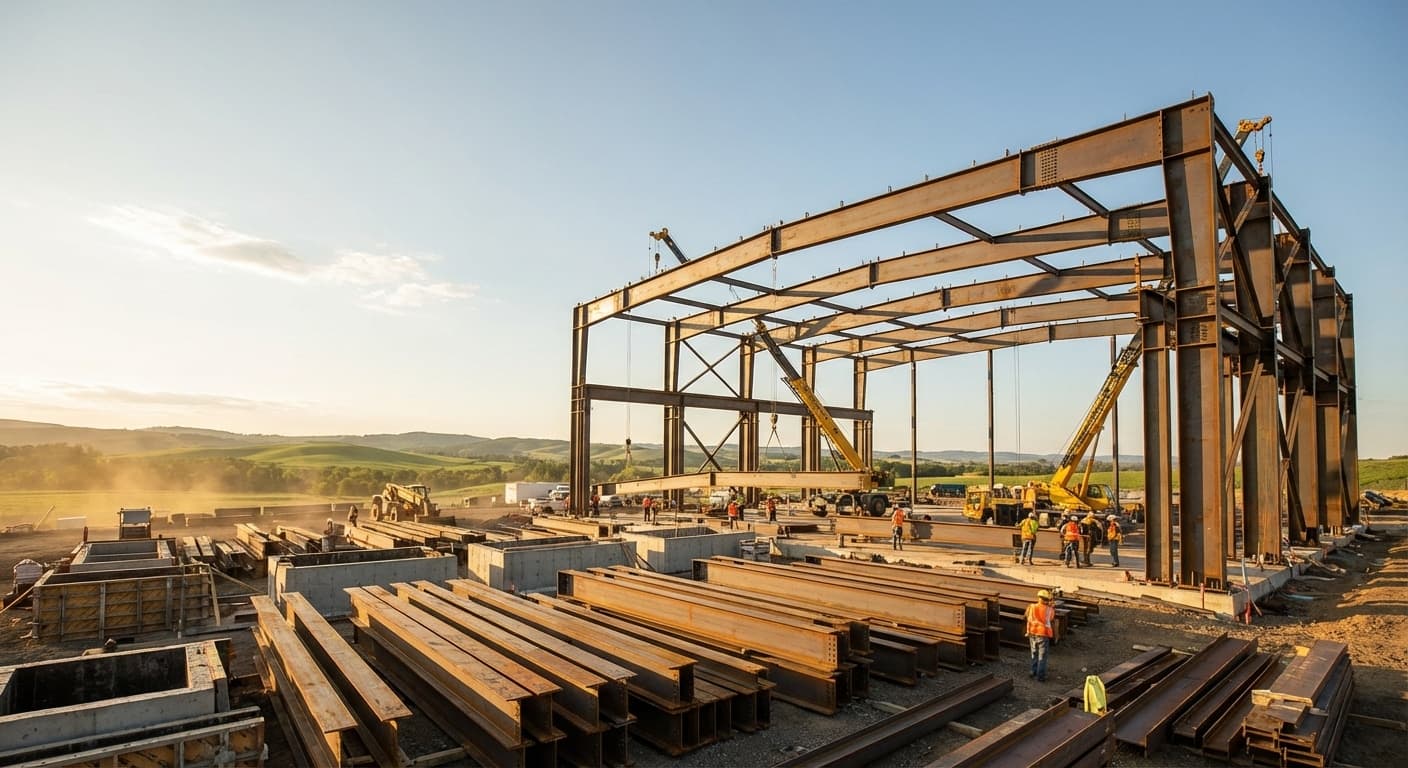

Understanding the true cost of a 40×80 steel building means looking far beyond the $15-$20-per-square-foot kit price and grasping how foundation work, regional labor swings, and single-source project management can shift the final installed price from about $86K in the rural Midwest to well over $128K on the coasts. This article maps those moving parts–showing why East Coast crews can cost 30 % more than Southern ones, how seismic or hurricane zones add hidden steel, why winter scheduling can knock 5-15 % off labor, and why locking in a turnkey partner who bundles materials and erection prevents the change-order creep that sinks budgets. Readers learn to itemize every line–foundation, freight, doors, insulation, regional code upgrades–so quotes stay transparent, timelines predictable, and expensive surprises eliminated.
Understanding the Base Cost per Square Foot
A solid foundation at $4-$8 per square foot prevents costly settlement problems and keeps your steel building level and dry for decades.
Steel Kit Pricing Fundamentals
Your 40×80 steel building kit starts at $15-$20 per square foot [1], or about $20,000-$25,000 for the complete package [3]. That gets you the core components: I-beam frames, secondary framing (purlins and girts), wall and roof panels, trim, and all fasteners [3].
Don't confuse kit-only prices with turnkey costs. A complete installed building runs $24-$43 per square foot–that's your kit plus foundation, delivery, and labor [1]. The difference? Quality steel. Commercial-grade I-beam frames beat tubular alternatives every time for structural integrity [1]. Yes, they cost more upfront. They also last decades longer.
Steel prices fluctuate with global markets [2], and material grade impacts your bottom line [3]. Lock in your quote when you find the right balance of quality and cost. For detailed pricing breakdowns, see our cost analysis in the budgeting section below.
Foundation and Site Preparation Costs
Your foundation runs $4-$8 per square foot for standard concrete slabs [4], or $6-$10 with challenging soil conditions [5]. That's roughly 20% of your total project cost–money well spent to keep your building level and dry for decades [4].
Before any concrete gets poured, you'll need site prep: grading, drainage, utilities. These aren't included in that square foot price [5]. Commercial buildings demand concrete foundations for maximum strength and load capacity. Agricultural structures? You might save with gravel bases or ground anchoring if your soil tests favorable [4].
Skip the soil evaluation at your own risk–settlement problems cost far more than doing it right the first time [4]. A solid foundation prevents moisture damage and structural headaches down the road [5]. Most steel kit quotes exclude foundation work, so budget accordingly [4]. Need exact numbers? Our detailed cost breakdown in the budgeting section covers every expense category.
Labor Rates and Their Impact on 40×80 building cost per square foot
Labor adds $5-$10 per square foot to your project–that's $16,000-$32,000 for skilled crews to erect your 3,200 square foot building [4]. Count on labor eating 20-25% of your budget. It's worth every penny when done right.
Your location drives these costs. Big city? Strict codes? Higher rates [4]. Custom features and complex designs need more skilled hours, pushing costs up [4]. Standard buildings go up in 2-3 days. Add custom work, add time [4].
Here's what catches people: base kit quotes ($18-$22 per square foot) rarely include labor [4]. Always ask. The regional variations section below shows exactly how labor costs shift from coast to coast–critical intel for accurate budgeting. Our
Regional Labor Market Differences
Labor costs vary dramatically by region–East Coast projects run 20-30% higher than the Midwest, while California demands double Alabama's rates, so location planning directly impacts your bottom line.
East Coast vs. Midwest Labor Trends
You'll pay 20-30% more for labor on the East Coast than in the Midwest–a difference that adds $3,200-$9,600 to your 40×80 building project [4]. That $1-3 per square foot premium stems from higher living costs and stricter regulations in coastal markets. Metropolitan areas compound this gap.
While both regions charge more in cities than rural areas, East Coast metros face intense competition for skilled workers that drives rates even higher [2]. Your permit requirements tell the same story–East Coast jurisdictions demand more compliance work and specialized labor, extending timelines and costs [2]. Weather plays its part too.
Midwest projects often enjoy longer construction seasons, while East Coast humidity and coastal requirements can stretch your schedule and budget [2]. Smart builders factor these regional differences into their initial planning, avoiding the budget surprises that sink projects.
Southern and Western Cost Drivers
Your location dramatically impacts labor costs. Southern states like Alabama charge $3-$5 per square foot for labor, while Western coastal markets like California demand $8-$12–more than double for the same 40×80 building. Transportation compounds these differences. Projects in Wyoming, Montana, and the Pacific Northwest pay premium freight rates because steel mills cluster in the Midwest and South.
Climate drives costs even higher. Texas Gulf Coast projects must meet hurricane standards with 140-160+ mph wind ratings, adding bracing, anchors, and protected openings that inland buildings skip [8]. Western states face their own challenges–Oklahoma and eastern Arkansas require seismic bracing due to the New Madrid Seismic Zone [8]. Louisiana's soft soils and high water tables often eliminate standard foundations entirely, forcing deep pile or pier solutions that can become your largest budget item [8]. As discussed in the Foundation and Site Preparation section, these regional soil conditions significantly impact your total investment.
How Seasonal Demand Affects Labor Pricing
Your timing directly impacts your budget. Winter construction saves you 5-15% on labor costs as contractor availability increases and competition for crews decreases [9]. Prices climb steadily from January through summer–expect 4-8% increases, with potential spikes when freight or fuel costs tighten in fall [10].
Waiting rarely pays off. One Arizona builder learned this lesson the hard way–his 90-day delay hoping for price drops cost him $3,800 when his quote jumped from $27,400 to $31,200 as crews booked up [10]. Rural markets offer more price stability ($25,600-$48,000 with 5-7 week timelines), while urban areas swing dramatically with the seasons ($54,400-$80,000 with 7-10 week timelines) [9].
Coastal states show the sharpest seasonal swings. Florida expects 4-6% labor increases in 2025, while Texas anticipates a modest 2.5-3% rise [11]. The message is clear: lock in winter pricing when you can. Delays cost more than savings through permit renewals, reapplication fees, and climbing material costs. Our
Optimizing Labor to Control Costs
One erection partner eliminates coordination headaches, prevents the 5-15% budget overruns from multiple crews, and keeps your labor costs predictable from steel delivery to final bolt.
Choosing a Single-Source Erection Partner
You need one partner who owns your entire 40×80 building project–from steel delivery to final bolt. That's how you keep labor costs predictable and your project on schedule.
When you choose a single-source erection partner, you eliminate the finger-pointing that happens when multiple contractors share a job site [13]. Your materials arrive bundled, labeled, and ready for immediate installation [13]. No missing pieces. No coordination headaches. No crews standing idle while you pay them to wait for delayed deliveries [12].
Here's what matters when selecting your erection partner: steel building experience you can verify, current OSHA compliance, detailed scheduling that accounts for weather windows, and references from projects like yours [12]. Skip the contractors quoting suspiciously low prices–they'll make it up in change orders and delays [12].
Your single-source partner becomes your direct line for questions during construction and your resource for future expansions [13]. One call handles everything, keeping your project moving and your budget intact.
Scheduling Strategies to Reduce Overtime
Leveraging ProTrades Expertise for Predictable PricingWhen you work with an experienced in-house erection team, your labor costs become predictable. No budget surprises. No schedule creep. No finger-pointing between subcontractors.
Our approach eliminates the 5-15% budget overruns you see with cobbled-together crews [16]. We bring integrated teams–lead men, iron workers, roofers, sheet metal specialists–who've worked together for years [16]. They know each other's moves, cutting 3-7 days off typical construction timelines [16].
One mobilization means one setup, one crew, one point of responsibility [16]. You avoid the 8-12% labor premium that comes from multiple mobilizations and crew changes [16]. When materials arrive early or late, our flexible labor allocation keeps workers productive rather than idle [17].
As discussed in earlier sections, your 40×80 building represents a significant investment. Expert labor management protects that investment. Professional erectors spot opportunities to optimize your structure without compromising integrity–especially valuable when steel prices shift unexpectedly. That's the difference between basic assembly and true
Transparent Budgeting and Communication
Your itemized quote should clearly separate building kit costs, concrete foundation work, and professional labor to reveal your true $86,400-$128,000 investment.
Itemized Quote Breakdown for 40×80 projects
You deserve quotes that spell out every cost. No surprises, no hidden fees. As covered in earlier sections, your 40×80 building investment breaks down into three main components that total $86,400-$128,000.
Your itemized quote should clearly separate:
- Building kit package with all structural components [19]
- Concrete foundation work (detailed in Section 1) [19]
- Professional construction labor [19]
Door and window packages appear as separate line items. You'll see costs vary based on type–overhead, rollup, sliding, or bifold–and exact dimensions [19].
Insulation gets its own section too. Basic vinyl-faced fiberglass starts around $1.50 per square foot. Premium spray foam or insulated metal panels run higher but deliver better performance [19].
Watch for delivery fees in your quote. Distance from manufacturing affects this cost [3]. Quality quotes also itemize upgrades like porches, overhangs, carport lean-tos, or mezzanine storage [19].
One final note: Those cheap tubular-framed buildings? They're cheap for a reason. Commercial-grade steel I-beam frames cost more upfront but save you money long-term through durability and lower maintenance [20].
Using the Cost Estimator Tool Effectively
Cost estimator tools work best when you know what to input. Start with building height–it drives your price more than you might think. A 12-foot structure runs about $18 per square foot. Jump to 20 feet? You're looking at $22 per square foot [4].
Don't forget foundation costs in your calculations (see Section 1 for details). Site preparation often gets overlooked but can add 20-30% to your total expense [4].
When using any estimator:
- Specify every customization element separately
- Include insulation type–basic double-bubble ($1.50/sq ft) versus premium R-17 ($3.00/sq ft) adds up fast [4]
- Factor in your regional labor rates from Section 2
- Add 10-15% contingency for the unexpected [21]
Material prices shift with market conditions. That estimate from spring might need updating by fall. Smart estimators separate kit costs from total installed expenses, showing you exactly where your money goes [3].
For the most accurate budget picture, request a
Maintaining Clear Communication Through Every Phase
Clear communication keeps your project on track and on budget. One missed update can trigger rework, schedule delays, and costs that spiral beyond your $86,400-$128,600 investment [22].
Start with a simple communication plan. List everyone involved–project managers, architects, contractors. Include their contact information and specific roles [22]. Set expectations early:
- How often will you receive updates?
- When are meetings scheduled?
- Where will documents live?
Keep all project information in one place. Scattered emails and texts create confusion. A centralized platform gives everyone instant access to what they need [22].
During pre-construction, document everything. Building dimensions, door placements, electrical layouts–get it all in writing. Mid-project changes trigger expensive change orders that blow budgets [23].
Create a feedback loop that catches problems early. When issues pop up, you want to know immediately–not after they've cost you thousands [22].
Material shortages and weather happen. When they do, quick communication about alternatives prevents idle crews burning through $3,000-$7,000 while waiting [23]. Regular site meetings keep everyone aligned, especially during foundation work (covered in Section 1).
Working with a single-source partner simplifies this entire process. You get one point of contact who owns the communication from design through delivery. No finger-pointing between suppliers. No gaps in the information chain. Just clear updates that keep your project moving forward [22].
- Kit-only steel runs $15-20/sq ft; turnkey installed jumps to $24-43/sq ft.
- Foundation adds $4-10/sq ft and can hit 20% of total project cost.
- Labor swings $3-12/sq ft: South $3-5, California up to $12.
- Single-source erection cuts 5-15% overruns and trims 3-7 days off schedule.
- Winter build saves 5-15% on labor; summer demand lifts prices 4-8%.
- https://www.buildingsguide.com/metal-building-prices/?srsltid=AfmBOorEnhqYlCNO7KquWRMpO9y5C6PIBFvk2QP70Y92omNCsLITqpBc
- https://americansteelinc.com/blog/steel-building-costs-prices-guide/
- https://www.uspatriotsteel.com/blog/how-much-does-a-40-x-80-metal-building-cost/
- https://chinasteelbuildsales.com/40×80-metal-building-cost/
- https://qebuildings.com/2025/10/how-much-does-a-40×80-metal-building-cost/?srsltid=AfmBOoqnAw8X4TuSyNk5tLcc0Khc1b6yJoRERHXQycyZzIAVi6PbZ1pd
- https://www.buildingsguide.com/metal-building-prices/?srsltid=AfmBOorb0ldqtz_UU9cfCFDVCqlQq0TdUUTkRT4h4vVch6P7WuBLIHjq
- https://www.tylerbuilding.com/post/2026-metal-building-cost-variables
- https://www.metal-buildings.org/40-x-80-metal-building/
- https://www.aametalbuildings.com/blog/2025-metal-building-price-trends-are-steel-building-costs-going-up-or-down-this-year?srsltid=AfmBOopzRxxWtxDEBeKUIkRRTv1FQMwONTzx1abDETTtiwblMkhIIaCn
- https://csiestimationllc.com/construction-cost-trends-in-texas-florida-and-california/
- https://harrisconstructorsinc.com/labor-cost-to-erect-steel-building/
- https://www.procore.com/library/construction-scheduling
- https://www.rhumbix.com/blog/7-strategies-for-construction-labor-optimization
- https://www.protradesusa.com/
- https://skilled.peopleready.com/staffing-resources/how-rising-material-costs-are-changing-labor-allocation-strategies/
- http://www.247pro.com/blog/the-ultimate-guide-to-steel-building-cost-estimation-from-initial-quote-to-grand-projects
- https://www.buildingsguide.com/standard-sizes/40×80-metal-building/?srsltid=AfmBOorDz7EqGZ3M3r_Wp-WAy3f1ZWXX25cFHd442YZQDCatm5Ux6MZq
- https://www.buildingsguide.com/metal-building-prices/?srsltid=AfmBOor5Du4JQmmFZsvvhU3W1TJ_L9PtUzDuW5w9qvWf6e3ye7CHZij3
- https://qebuildings.com/2025/10/how-much-does-a-40×80-metal-building-cost/?srsltid=AfmBOop59du6HwnNqi6ekW9NNm1T-fFCcRZyl8NRmk2OppXtggOnryQE
- https://activedraft.com/blog/communication-plan-for-construction-project/
- https://www.buildingsguide.com/build/metal-building-planning/?srsltid=AfmBOoqGs-kR5TbVVCpTTCvdk1JIXGl8QD0ycsRP43K56lfzj64fu2kU