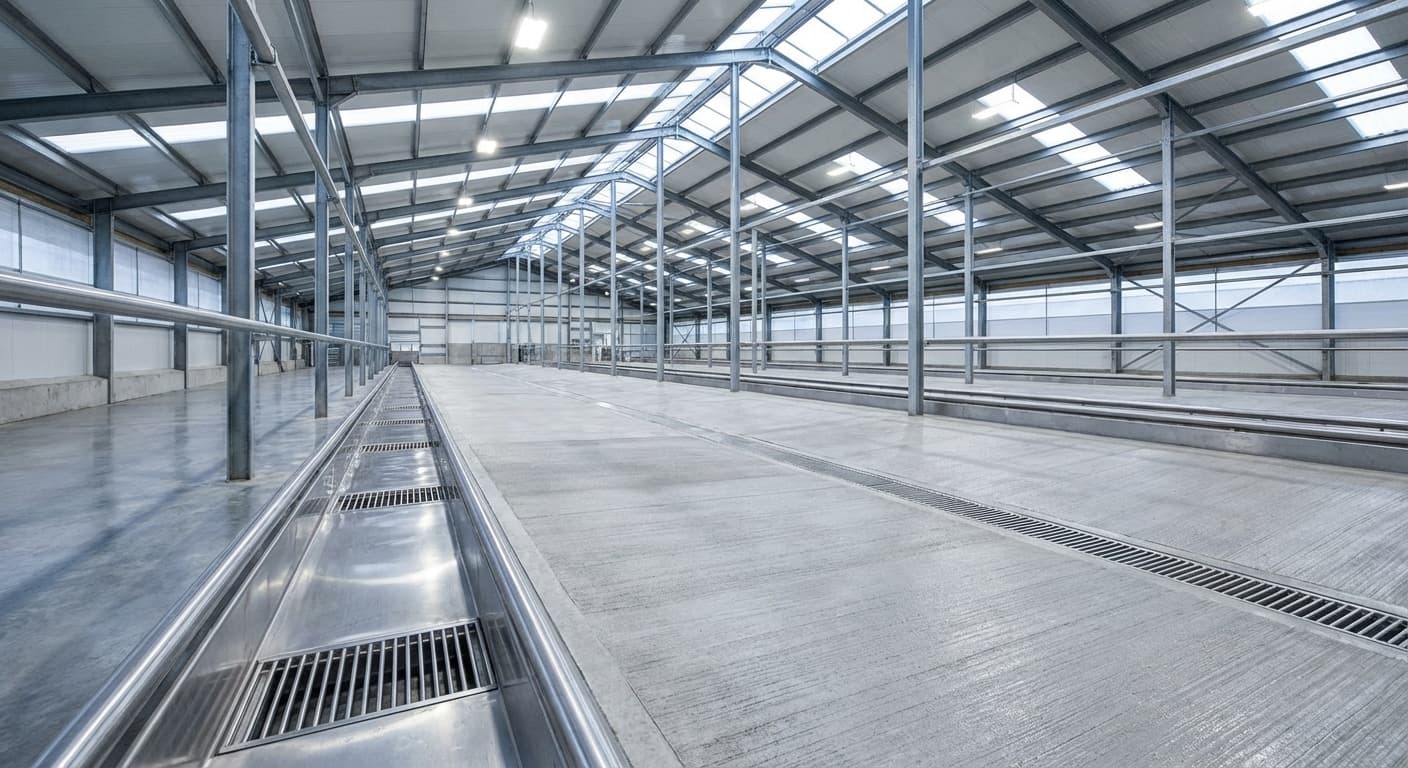

Designing a 40×80 dairy barn that sails through federal wash-down inspections hinges on one deceptively simple detail: the right floor slopes. This article shows how a 2-2.5 % grade toward stainless-steel drains eliminates the puddles where bacteria thrive, cuts cleaning labor by 30 %, and can save millions of gallons of water when paired with flow-meter tracking and high-pressure nozzles. Readers learn the exact slopes for each zone–1:40 for standing areas, 3⁄4 in. drop in feed alleys, 1:100 for drain lines–plus groove dimensions, rubber versus concrete comfort trade-offs, and structural reinforcement around channels so the floor carries heavy loads without cracking. It explains why coordinating linear slot drains with a pre-engineered steel building from day one prevents costly retrofits, how anti-slip aggregates or 70-durometer rubber mats reduce hoof injuries and vet bills, and why single-source construction keeps the vital facility on schedule. Finally, it delivers a practical maintenance playbook: monthly barefoot "cow comfort" checks, timely crack and coating repairs, and documented compliance that keeps USDA, FDA, and PMO inspectors happy and milk flowing safely to market.
Understanding Wash-Down Requirements for 40×80 Dairy Barns
Properly sloped floors and coved floor-wall junctions keep your 40×80 dairy barn compliant while preventing the contamination hotspots that trigger recalls.
Regulatory standards and compliance basics
You need your dairy barn to meet federal wash-down standards–but you don't need regulations dictating every detail of how you operate. The Food Safety and Inspection Service (FSIS) sets performance standards that focus on results, not methods [1]. This means you can develop sanitation procedures that work for your specific operation while still hitting all safety benchmarks. Your barn floors must meet specific design standards to pass inspection.
The Sanitation Performance Standards Compliance Guide requires floors that clean easily yet provide safe footing–smooth surfaces with approved anti-slip treatments [1]. Exterior areas need proper grading to eliminate standing water that breeds bacteria or creates hazards [1]. The Grade A Pasteurized Milk Ordinance (PMO)–the national milk sanitation standard–adds more requirements for your facility [2]. You'll need coved floor-wall junctions that prevent debris buildup and speed cleaning [1].
Your sewage system must prevent any backflow into production areas [1]. Drainage has to handle full wash-down volumes without cross-contamination risks, with drains built to block contamination entry [1]. Working with an experienced
Why slope design matters for hygiene in a 40×80 dairy barn
Your floor slopes determine whether daily wash-downs work efficiently or create bigger problems. Properly sloped floors move water straight to drains, eliminating the puddles where bacteria multiply [4]. In a 40×80 barn, even one low spot can become a contamination hotspot that threatens your entire operation.
Dairy acids–especially from whey–eat through standard drainage materials. You need corrosion-resistant systems, typically stainless steel, to handle the constant chemical exposure [4]. Poor drainage doesn't just fail inspections; it risks cross-contamination that could trigger recalls and shut down your operation [4].
Both USDA and FDA require proper floor slopes as part of your total sanitation system [4]. The right slope keeps water moving without creating slip hazards for your herd. As detailed in the next section on floor design, you'll need consistent grades throughout your 40×80 barn to ensure uniform drainage without dangerous transitions between areas [3].
Key performance metrics for wash-down efficiency
You can't improve what you don't measure. Installing flow meters shows exactly where your water goes–and where you're wasting money. Dairy operations save millions of gallons yearly just by tracking usage and fixing obvious problems [5].
Start measuring total consumption, pressure at each connection point, and flow rates at different hoses to spot losses fast [5]. Track wash-down water use by barn section, monitor how different staff clean, and measure equipment performance during operation [6]. This data drives smart decisions–like switching to water-blaster nozzles that cut flow rates while maintaining cleaning power [5].
One 1,000-cow operation saved 8.9 million gallons per year after installing meters and adjusting their protocols–without compromising cleanliness [6]. In your 40×80 barn, proper floor slopes multiply these savings by moving water directly to drains. No pooling means less water needed and faster cleaning cycles.
Designing Optimal Floor Slopes for Efficient Cleaning
Mark your floor elevations before pouring concrete–a 40-foot alley at 2% slope needs 9.6 inches of drop, and fixing slopes later costs a fortune.
Recommended slope gradients and calculation methods
Getting your floor slopes right saves you time and money on every wash-down. Here's what works for different areas in your 40×80 barn:
Standing areas: Use a 1:40 (2.5%) slope toward drains–steep enough to move liquids, gentle enough to keep cows safe [7].
Open paddocks: A 1:60 (1.67%) grade handles rainwater without erosion [7].
Barn alleys: As covered in the previous section, stick with 2% slope for the best drainage-safety balance [8].
Feed alleys: Slope 3/4 inch from feed rail to stall curb. This extra grade speeds wash-down where feed accumulates [8].
Drainage channels: Keep these at 1:100 slope through settling chambers to your septic system [7].
Transfer lanes: Cap slopes at 5%. For steeper areas, install 6-8 inch steps at least 3 feet apart with treads under 1.5% slope [8].
The math is straightforward. For a 40-foot alley at 2% slope, you need 9.6 inches of drop (40 feet x 0.02 x 12 inches). Mark these elevations before pouring concrete–fixing slopes later costs a fortune.
Your U-shaped drains at covered area ends should measure 30 cm wide by 6-8 cm deep for proper wash-down collection [7].
Integrating drainage systems with steel framing
Your drainage system needs to work seamlessly with your barn's steel structure. Here's how to get it right:
Choose stainless steel drains for areas handling temperature swings–especially near pasteurization zones hitting 161 degreesF [9]. These integrate perfectly with concrete floors and won't corrode from dairy acids.
Look for integrated features that simplify installation:
- Bolt-together flanges that align with your steel frame
- Built-in leveling points
- Concrete integration that distributes loads evenly [10]
Consider linear slot drains over traditional round drains. They need less complex slopes and fewer underground pipes to route around your steel posts [10]. This saves concrete work and reduces weak points in your floor.
Match load ratings to your operation. Cast iron frames handle the heaviest equipment traffic while maintaining structural harmony with your steel building [11]. The right drainage prevents water infiltration that could damage your frame over time.
When you coordinate drainage with your agricultural steel building from the start, you avoid expensive retrofits and structural headaches down the road.
Your cows spend 10-12 hours daily on their feet. The right flooring keeps them healthy and your operation running smoothly.
Concrete grooving specs that work:
- 3/8 to 1/2 inch wide channels
- 3/8 to 1/2 inch deep
- 2-3 inch spacing between grooves [3]
Critical timing: Float your grooves after screeding but before bleed water appears. Miss this window and you'll get rough edges that damage hooves [3].
For high-traffic areas like milking parlors, consider anti-slip aggregates. Mix three parts aluminum oxide with one part Portland cement. This surface lasts 20 years versus seven for standard concrete–nearly triple the lifespan [12].
Rubber flooring options provide cushioning that concrete can't match:
- Reclaimed conveyor belting (3/4 to 1-1/4 inches thick)
- Rolled rubber products
- Interlocking rubber mats [12]
Choose rubber with 70-85 durometer hardness on the A-shore scale. Always select grooved or textured surfaces–smooth rubber becomes a skating rink with manure [3].
Yes, rubber costs more ($2.50-2.75 per square foot). But studies show significantly fewer hoof injuries compared to concrete [12]. That's fewer vet bills and healthier, more productive cows.
Quick test: Walk barefoot on your finished floor. If you're comfortable, your cows will be too [12].
Structural Considerations and Quality Assurance
Proper reinforcement density around drainage channels and careful groove installation prevent costly structural failures while maintaining safe, durable dairy barn floors.
Ensuring structural integrity with sloped floors
Designing sloped floors for dairy barns requires careful structural engineering to maintain building integrity while facilitating drainage. Concrete floors must be reinforced to handle both dead loads (the weight of the structure itself) and live loads from cattle, equipment, and cleaning activities [13]. For a 40×80 dairy barn, floor systems need adequate thickness to distribute concentrated loads from livestock and mobile equipment without cracking or separating at drainage channels.
The Department of Defense Building Code specifies that construction documents must clearly identify floor live load parameters (Section 1603.1.1) and any special loads created by sloped surfaces (Section 1603.1.8) [13]. Sloped floors create uneven load distribution patterns that require additional reinforcement at transition points where slope gradients change. When designing drainage integration, structural engineers must account for potential weakening at channel insertions by increasing reinforcement density around these areas.
For floors subject to regular wash-down, the concrete mix design should include appropriate water-cement ratios and air entrainment to prevent deterioration from frequent moisture exposure while maintaining structural capacity. Steel reinforcement positioning becomes particularly critical in sloped applications–the reinforcement grid should follow the slope profile while maintaining proper cover distance to prevent corrosion from wash-down chemicals.
Quality control checkpoints during erection
Implementing strict quality control during barn construction prevents costly rework and ensures compliance with wash-down requirements. Monitor concrete moisture content carefully during floor construction–install grooves after screeding but before bleed water accumulates on the surface to prevent rough edges that cause excessive hoof abrasion [12]. Check groove dimensions with a gauge to maintain the recommended 3/8 to 1/2 inch width by 3/8 to 1/2 inch depth with 2-3 inch spacing [12].
Test floor slip resistance by walking barefoot on completed surfaces; comfortable barefoot walking indicates acceptable cow comfort [12]. For rubber flooring installations, inspect fastening points regularly as these are common failure points–slightly counter-sink mechanical fasteners to prevent hoof puncture or bruising [12]. Verify proper slope implementation using transit levels at 10-foot intervals; feed alleys require 3/4 inch slope from feed rail to stall curb for optimal drainage [12].
Contractual documents should clearly specify flooring type and minimum acceptance criteria; floors failing to meet specifications should not be accepted until remediated [12]. Document compliance with regulatory standards at each construction phase, creating verification records for inspectors and future reference.
Single-source solutions for seamless project delivery
Single-source solutions streamline dairy barn construction by consolidating responsibility under one contractor. This approach eliminates coordination challenges between multiple subcontractors that often cause delays and quality inconsistencies. When one entity handles the entire building envelope, farm owners avoid tracking various suppliers or worrying about contractor failures mid-construction [15].
Pre-engineered metal buildings exemplify this advantage, arriving as complete kits with clearly bundled and labeled components for efficient installation [15]. Project communication improves with one point of contact for construction questions and future support for expansions or replacements [15]. This model addresses the reality that dairy structures are essential business assets that cannot tolerate extended downtime [14].
With agricultural buildings now recognized as high-importance structures rather than temporary facilities, integrated design and construction prevents situations where competitive bidding might introduce inferior materials that compromise building integrity [14]. The value becomes evident when comparing initial costs against potential expenses from maintenance failures or production losses due to building failure [14].
Operational Benefits and Ongoing Maintenance
Properly sloped barn floors cut your cleaning time by 30% while reducing slip-and-fall incidents and vet bills through naturally better drainage.
Improved workflow and labor savings
Your properly sloped barn floors cut cleaning time by up to 30% compared to flat surfaces–that's real money back in your pocket [16]. When wash-down water flows naturally to drains, your crew stops wasting time pushing water around with squeegees. The linear flow design keeps cleaning simple: start at one end, work to the other, done [16].
You'll see fewer vet bills too. Drier floors mean healthier hooves and fewer hoof disease cases [18]. Your maintenance team works safer and more comfortably–no more awkward bending to direct water flow [17]. With 3% slopes feeding your drains, even automated cleaning equipment runs more efficiently, freeing your people for tasks that actually need human attention [18].
The safety payoff is immediate. No standing water means fewer slip-and-fall incidents, keeping your workers healthy and your insurance costs down [16]. Every minute saved daily adds up–over a year, you're looking at significant labor cost reductions that go straight to your bottom line.
Routine maintenance protocols for longevity
Start with hot water and strong chemicals–they're your best defense against bacteria that laughs at standard cleaning [20]. Set up a simple monthly inspection routine: check for cracks, rough spots, and low areas where water pools. When you spot puddles, fix them fast. They're not just bacteria hotels–they eat away at your concrete and can compromise your entire floor structure [19].
Focus your inspections on high-traffic zones where hooves pound the hardest. Catch small problems early and you'll avoid the nightmare of full floor replacement. Your protective coatings work hard to resist those acidic dairy byproducts, but they need care too [20]. Without coatings, concrete crumbles fast under daily wash-downs and constant hoof traffic [20].
Track wear patterns to schedule recoating–quality applications last 15-20 years when you maintain them properly [19]. Using rubber flooring? Check those fastening points regularly–they're the first to fail and create dangerous conditions [20]. The slip-resistance verification process is covered in the quality control section above, so focus your routine maintenance on keeping surfaces clean and damage-free.
Service excellence: support from design to post-construction
You need more than a building–you need a partner who understands dairy operations. That's why we start by listening to your specific needs, not pushing cookie-cutter solutions [21]. During planning, we evaluate your operational flow and design facilities that boost productivity while keeping your cows comfortable [22].
Construction timing matters. We coordinate with your equipment suppliers to ensure milking systems integrate perfectly with your new
- 1:40 (2.5%) floor slope toward drains balances drainage and cow safety in standing areas.
- Stainless steel drains resist dairy acid corrosion and integrate with concrete floors near 161 degreesF zones.
- Grooved concrete: ⅜-½ in wide, ⅜-½ in deep, 2-3 in spacing; groove before bleed water appears.
- Rubber flooring at 70-85 durometer cuts hoof injuries; costs $2.50-$2.75/ft² but lasts longer.
- Proper slopes cut cleaning time 30 %, reduce slips, and lower annual labor and vet costs.
- Monthly inspections for cracks, pooling, and coating wear prevent structural failure and bacteria hotspots.
- Flow meters can save millions of gallons yearly; one 1,000-cow farm saved 8.9 million gallons.
- http://www.fsis.usda.gov/inspection/compliance-guidance/sanitation-performance-standards-compliance-guide
- https://www.fda.gov/inspections-compliance-enforcement-and-criminal-investigations/inspection-guides/dairy-product-manufacturers-495
- https://www.vet.cornell.edu/animal-health-diagnostic-center/programs/nyschap/modules-documents/considerations-flooring
- https://www.dairyprocessing.com/articles/2441-optimal-drainage-provides-more-than-hygiene-safety
- https://www.dairynz.co.nz/environment/water-use/milking-shed-water-use/
- https://elibrary.asabe.org/azdez.asp?JID=5&AID=20913&CID=por2006&T=2
- https://www.dairyfarmguide.com/shelter-design-and-housing-0137.html
- https://thedairylandinitiative.vetmed.wisc.edu/adult-cow-housing/manure-management/
- https://www.duratrench.com/single-post/everything-there-is-to-know-about-drainage-systems-for-dairy-farms-and-plants/
- https://www.slotdrainsystems.com/blog/farm-barn-drainage-systems/
- https://trenchdrain.com/pages/applications-farm-barn-kennel-animal-facility-drainage/farm-barn-drainage?srsltid=AfmBOorImZO685RCux4KpCB_YvUT3-H8DoxnmEK54ILaNwPjv1uttEH7
- https://dairy-cattle.extension.org/flooring-considerations-for-dairy-cows/
- https://up.codes/viewer/department-of-defense/ibc-2024/chapter/16/structural-design
- https://extension.psu.edu/design-and-build-dairy-structures-for-a-long-useful-life/
- https://norsteelbuildings.com/advantages-of-steel-series/advantages-single-source-responsibility/
- https://agriculture.institute/dairy-mgt-entrepreneurship/designing-dairy-plant-for-optimal-performance/
- https://diy-agriculture-buildings.com/freestall-barn/
- https://kraiburg-elastik.com/guidance/expert-knowledge/rethinking-slatted-floors/
- https://epfloors.com/epoxy-flooring-types/food-processing-floors/slope-to-drains/
- https://info.cpcfloorcoatings.com/3-maintenance-tips-for-your-milking-parlor-floor
- https://cencon.com/facilities/dairy/
- https://www.ckmanufacturing.com/services/design-installation/
- https://mortonbuildings.com/projects/dairy