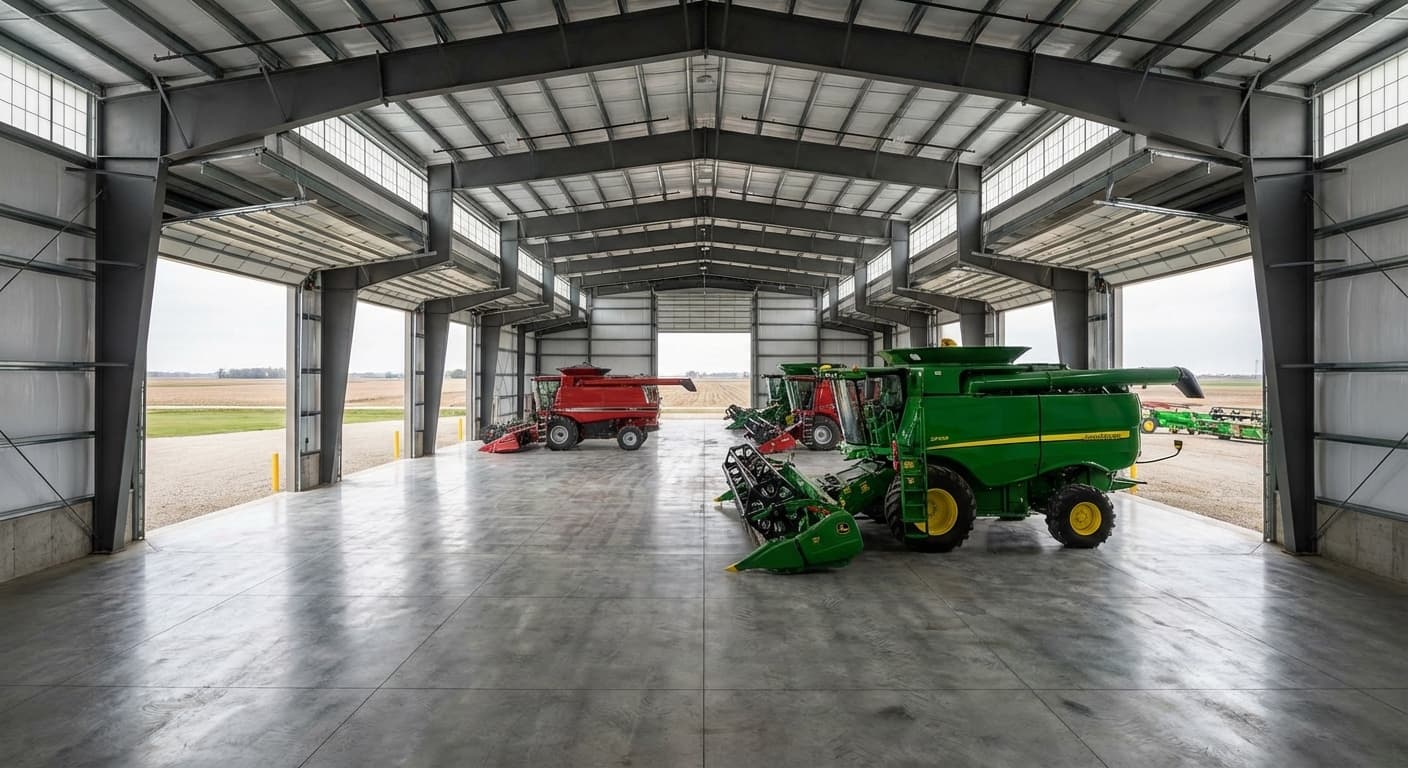

Designing a 40×80 equipment storage building that can safely park, shuffle and service combines topping 36,000 lbs–and whatever heavier, smarter machines you buy next–hinges on one overlooked detail: accurate floor load ratings. This article walks you through the real-world math, showing why "brochure weight" plus headers, grain and fuel can add 6,000 lbs of surprise load, how moving equipment creates spike stresses three times higher than static weight, and where to reinforce entry turns and header zones before cracks start. You'll learn to spec commercial-grade 125 psf steel joists, six inches of steel- and fiber-reinforced concrete over a compacted base, and strategic HDPE mats that pay for themselves in a year by stopping tire damage, while integrated slot drains and vapor barriers keep water from undermining capacity. It decodes IBC agricultural provisions, explains the paperwork insurers and inspectors demand, and maps a quarterly inspection routine that protects both million-dollar combines and resale value. Finally, it future-proofs the slab for 50,000-lb autonomous fleets and modular upgrades, giving farmers, builders and insurers a single, code-compliant blueprint that turns a simple storage shed into a long-term, high-ROI equipment vault.
Load Requirements for Combines in a 40×80 Equipment Storage Building
A 36,000-lb combine creates dynamic loads that spike far beyond its static weight when rolling across your floor, concentrating stress at turning points and requiring design beyond minimum building codes.
Assessing Combine Weight and Dimensions
Your combine's actual weight drives every structural decision in your storage building. Mini combines start at 4,000-8,000 lbs, mid-size units run 15,000-25,000 lbs, and heavy-duty models like the John Deere S790 tip the scales over 36,000 lbs [1]. But here's what catches building owners off guard: those base weights climb fast. Add a high-horsepower engine? That's another 1,500-2,000 lbs. Upgrade to a 400+ bushel grain tank? Tack on 2,000-3,000 lbs more. Headers and attachments pile on additional weight [1].
Size doesn't always equal footprint. Take the John Deere X9–it packs 45% more threshing area and 80% more separating area than older models, yet fits the same floor space as the S7 900 series [2]. Smart engineering, but it still weighs like a small house. Don't forget height clearances either. The New Holland TC5.30's unloading auger stretches 3.85 meters long with a 3.7-meter discharge height [3]. You need clearance for operation, not just parking.
Getting these numbers right upfront saves you from expensive retrofits later. Measure your heaviest combine fully loaded with all attachments–that's your design baseline.
Calculating Live Load vs. Static Load for Combines
Here's the load calculation that matters: your combine sitting still versus rolling across the floor. A parked combine creates static load–steady, predictable pressure spread across its footprint [4]. But when you drive that same machine, you create live loads that spike way beyond the static weight [4].
Picture your 36,000-lb combine rolling into storage. As it moves, weight shifts and concentrates on smaller contact patches, multiplying stress on your floor [5]. Those turning movements at the entrance? Peak stress zones. Headers make it worse–they shift weight forward, creating uneven load patterns that standard calculations miss [6].
Building codes set minimums, but smart planning goes beyond code. The American Society of Civil Engineers says design for maximum anticipated loads over your building's lifetime [6]. Translation: that mid-size combine you run today might be a 40,000-lb monster in five years. Plan for it now [4].
Your floor needs muscle where it counts most. Entry zones take the biggest beating from moving equipment, demanding reinforced concrete that handles those dynamic spikes [5]. Inside, where combines park, you can optimize for static loads. This targeted approach keeps costs reasonable while protecting your investment.
Interpreting Manufacturer Load Specifications for Combines
Manufacturer spec sheets tell only part of the story. That base weight in the brochure? It's your combine stripped down–no header, no fuel, no grain [7]. Your actual floor load runs 15-30% heavier once you add everything needed for harvest [1].
Real-world example: a mid-size combine spec'd at 20,000 lbs actually weighs 26,000 lbs ready to work [1]. That 6,000-lb difference? It's the margin between a floor that lasts and one that cracks.
Don't trust the brochure alone. Get the full weight breakdown from your dealer:
- Base machine weight
- Header weight for each configuration
- Full fuel load
- Maximum grain capacity weight
- Weight distribution (front/rear split)
That last point matters most. Headers shift weight forward, creating concentrated loads your floor design must handle. When you're investing in a
Floor System Design Strategies for a 40×80 Equipment Storage Building
Steel I-beams with 6 inches of concrete and proper base preparation give your 40×80 building the commercial-grade strength to handle combines reliably.
Selecting Steel Joist Profiles Suited for Heavy Combines
You need steel that won't fail when your combines roll in. Hot-rolled I-beam systems deliver the strength your equipment demands–no questions asked [8].
For your 40×80 building, these steel profiles give you clear-span flexibility without interior columns getting in the way. You can position equipment exactly where you need it [8]. Your joist specifications should handle 125 psf live loads plus 15 psf dead loads–that's commercial-grade strength, not residential [9].
Why does this matter? Because residential floors handle just 40 psf. Your combines need three times that capacity [9]. The right steel joists mean no warping, no rotting, no pest damage–just reliable performance year after year [8]. That's why
Determining Concrete Slab Thickness and Reinforcement Levels
Six inches of concrete gets the job done for your combine storage. That's the industry standard–strong enough to handle your heaviest equipment without breaking the bank [10].
Some contractors push for 8-10 inch slabs, but here's perspective: Interstate highways use just 11 inches [12]. You don't need that. What you need is smart reinforcement. Steel rebar or welded wire mesh holds everything together when equipment rolls across [11]. Fiber reinforcement stops cracks before they start [11].
But here's what really matters: your base preparation. A properly compacted aggregate base distributes loads evenly and prevents settling [11]. Skip this step, and even 10 inches of concrete won't save you. Smart money goes into base prep, not excessive concrete thickness [12].
Don't forget moisture barriers beneath the slab. As covered in our Code Compliance section, proper drainage protects your investment from water damage that weakens load capacity over time [11].
Integrating Load‑Distribution Pads and Matting for Even Support
HDPE load-distribution mats protect your concrete from combine tire damage. These heavy-duty systems handle up to 120 tons–far exceeding what your equipment demands [13].
The math is simple. Plywood needs replacing four times yearly. HDPE mats pay for themselves in 13 months through eliminated replacements [15]. That's 100% ROI in just over a year [15].
Strategic placement makes the difference:
- High-traffic entry paths where dynamic loads peak (as discussed in Load Requirements)
- Stationary storage zones where combines park long-term
- Transition areas where equipment turns or pivots
Look for aggressive tread patterns that grip in wet conditions. Your combines need traction when rolling in from muddy fields [14]. Connect mats with specialized hardware to create unified surfaces that won't shift under load.
Build these protective zones into your original floor design. It's cheaper than retrofitting later and gives you designated heavy-load areas from day one. Your concrete stays crack-free, your equipment moves safely, and you avoid expensive repairs down the road.
Code Compliance and Safety for 40×80 Equipment Storage Buildings
Your 40×80 building qualifies for agricultural design flexibility under IBC Appendix C if you maintain 60 feet of open space on all sides.
Meeting IBC Floor Load Standards for Agricultural Equipment
Your 40×80 equipment storage building falls under IBC Group U for agricultural structures–a classification that brings both requirements and opportunities [16]. When you're storing combines weighing over 36,000 pounds, you need floors designed well beyond the standard 20.89 PSF minimum. Most engineers specify 125 PSF live load plus dead loads, matching commercial storage standards [18].
The code gets specific about heavy equipment. Section 1607.8 addresses vehicle loads, while subsection 1607.8.4 covers movable equipment like your combines [17]. These provisions require calculations for both parked machines and the dynamic forces when you move them.
Your building needs load calculations that account for concentrated wheel loads–those small contact points where thousands of pounds focus their weight [18]. Engineers must simulate real-world scenarios: multiple combines moving simultaneously, maintenance operations, equipment repositioning.
Here's good news: agricultural buildings get special consideration under IBC Appendix C. If your building sits on property with 60 feet of open space on all sides, you gain design flexibility while meeting safety requirements [16]. This provision recognizes that farm buildings have unique needs compared to commercial structures.
Ensuring Proper Drainage and Moisture Control Under Heavy Loads
Water is your floor's worst enemy when supporting 36,000-pound combines. Slot drains embedded directly in concrete solve this problem–no weak gratings to bend or break under equipment weight [19]. These channels become part of your floor structure, eliminating failure points where traditional drains meet concrete [19].
Your drainage system faces two challenges: moving equipment creates momentary loads, but parked combines apply sustained pressure for months. Standard drain ratings cover moving traffic, but you need extra reinforcement where combines sit stationary [20]. Install catch basins with strainer baskets at wash-down areas to keep debris from clogging your system [19].
Below-surface moisture poses an equal threat. Water softens subgrade materials, reducing your floor's load capacity over time [21]. In climate-controlled buildings, temperature differences between floor and soil create condensation that weakens concrete. Freeze-thaw cycles crack slabs when moisture gets trapped beneath parked equipment [21].
Your moisture defense strategy needs three elements:
- Floor slope (1/8" to 1/4" per foot) directing water to drains
- Vapor barriers beneath the slab blocking ground moisture
- Perimeter drainage preventing seasonal groundwater intrusion
Choose concrete mixes with chemical resistance–they create an impermeable barrier protecting your investment [21].
Documenting Load Ratings for Insurance and Inspection Purposes
Your floor load documentation serves two masters: insurance companies and building inspectors. Both need proof your floors can handle your combines without overloading [22].
Keep these documents ready:
- Engineered load calculations stamped by qualified engineers
- Architectural drawings showing weight capacities
- Structural certifications for your specific equipment weights
- Floor reinforcement records from any upgrades
- Load distribution diagrams marking parking zones for heaviest machines
Good documentation does more than satisfy inspectors–it can reduce your insurance premiums by proving you've mitigated risks. Most jurisdictions require load certification during the permit process, verifying your building meets agricultural storage requirements [23].
Your documentation must address both static loads (parked combines) and dynamic loads (moving equipment), with safety margins above minimums. For combines over 36,000 pounds, this detail matters.
Update your records when you buy heavier equipment or change storage configurations. Inspectors check whether actual equipment placement matches your documented plans, including proper spacing between machines [22].
Here's the bottom line: inadequate documentation can sink insurance claims. If structural damage occurs and you can't prove proper load ratings, insurers may deny coverage, claiming improper use. Keep your paperwork current–it's as important as the concrete beneath your combines.
When you work with experienced steel building providers who understand agricultural requirements, they help ensure your documentation meets both code requirements and practical farming needs.
Maintenance and Future‑Proofing Your 40×80 Equipment Storage Building
Quarterly inspections costing less than 1% of your investment protect million-dollar equipment and satisfy insurance requirements while building resale value.
Implementing Regular Load Monitoring and Inspections
Regular load monitoring protects your building investment and expensive combines. Schedule quarterly inspections to spot concrete cracks, uneven settling, or joist deflection early [24]. Document your equipment's weight distribution patterns–especially when you change combine configurations that create new stress points [25].
Set up a systematic inspection routine. Check foundation integrity, slab condition, and structural components. Record everything in a digital maintenance system for tracking [24]. This documentation does double duty: it satisfies insurance requirements and builds resale value [25].
Your inspection checklist should focus on high-stress parking areas and load-distribution matting condition [26]. Regular inspections cost less than 1% of your total investment but protect against failures that could damage million-dollar equipment [25]. After equipment upgrades, have technicians evaluate whether heavier machinery needs floor reinforcement or load redistribution [26].
Planning for Future Equipment Upgrades and Load Increases
Your floor system needs to handle tomorrow's equipment, not just today's. The combine market grows at 6.4% annually, pushing $75.6 billion by 2030 [27]. Manufacturers keep building bigger machines–especially in the 300+ HP segment growing fastest [27].
But here's the catch: experts say we're hitting "peak combine" size. Machines over 50,000 pounds cause 10-20% yield loss from soil compaction [28]. The future points toward autonomous fleets of mid-sized combines rather than single giants [28].
Plan for both possibilities. Design floors 25% stronger than current needs. Create high-capacity zones with extra reinforcement. As discussed in our Floor System Design section, proper load distribution becomes even more critical as equipment evolves.
Manufacturers now build modular machines–components upgrade without replacing the whole unit [27]. Your
Leveraging National Steel Buildings' Single‑Source Solutions for Ongoing Support
We streamline your equipment storage project from design through maintenance. Our single-source approach eliminates contractor coordination headaches. Free delivery and installation on all orders means no hidden fees eating your budget [29].
We customize buildings for your specific equipment needs. Our rust and UV-resistant materials protect your expensive machinery year after year [30]. For combine storage, our specialists design proper load capacities and provide ongoing structural assessments as your equipment changes [31].
You get one point of contact for everything–warranty claims, modifications, maintenance support. When equipment upgrades require reinforcement or layout changes, we're already familiar with your building [31]. Our teams know agricultural applications inside out. Just ask Cummings Farm, where we centralized their heavy machinery storage in a purpose-built facility [31].
From initial floor load calculations covered earlier to long-term maintenance planning, we're with you every step.
- Design floors for 40,000-lb combines, not today's 20,000-lb spec, to avoid costly retrofits.
- Add 15-30% to brochure weights for fuel, header, grain to get true floor load.
- Use 125 psf live-load joists and 6-in reinforced slab with compacted base for 36,000-lb machines.
- Slot drains cast in concrete and HDPE mats at entry/turn zones stop dynamic-load cracks.
- IBC 1607.8.4 requires calculations for both parked static and moving dynamic wheel loads.
- Quarterly inspections and stamped load docs protect insurance claims and resale value.
- https://www.fmworldagri.com/How-Much-Does-A-Combine-Harvester-Weigh-id46399216.html
- https://www.deere.com/en/harvesting/x-series-combines/
- https://www.lectura-specs.com/en/model/agricultural-machinery/combine-harvesters-new-holland/tc5-30-11762687
- https://www.barton-supply.com/blog/posts/2018/october/live-loads-vs-dead-loads-in-structural-design/
- https://www.qmhinc.com/static-loading-vs-dynamic-loading-the-surprising-forces-in-warehouses/?srsltid=AfmBOoojcIIyofQKXMOGMg_sf1hpqG2XIDWCyUu1L4s1SPG-XpdfGEfT
- https://mtcopeland.com/blog/live-load-vs-dead-load-vs-environmental-load-differences/
- https://www.lectura-specs.com/en/model/agricultural-machinery/combine-harvesters-john-deere/c120-11772947
- https://armstrongsteel.com/blog/using-light-steel-structures-in-agriculture-an-overview
- https://usframefactory.com/metal-joists-span-tables/
- https://megaslab.com/concrete-slab-design-for-heavy-equipment/
- https://interstateconcreteandasphalt.com/insights/concrete-slabs-for-equipment-and-storage-thickness-reinforcement-and-base-preparation/
- https://www.hansenpolebuildings.com/2018/02/concrete-floor-thickness-heavy-equipment/?srsltid=AfmBOorcF1f7cPo-jT6IeNSZlhu-JTCr7OxPd13gfPiioHBzPMVW7RTd
- https://primamat.com/collections/weight-distribution-mats?srsltid=AfmBOoqiXiG-6AfEts8pOKYP7LAyH4khLt_asRrrfdYLmQ-Gf4oOrrXw
- https://startsafety.com/alturnamat-ground-protection-mat?srsltid=AfmBOoqezvMPo98MPo0QpEaJI0qzPhRJ-QQTlJ9Pvihx0knTRcttEGPx
- https://checkers.justrite.com/news/ground-protection-mats-for-heavy-equipment/?srsltid=AfmBOoqgcVsQ1ylcYC__lZqNYYv6aeMqqLHI-DKaB30JQdVjBIRP9FWD
- https://codes.iccsafe.org/content/IBC2024V2.0/appendix-c-group-u-agricultural-buildings
- https://up.codes/viewer/department-of-defense/ibc-2024/chapter/16/structural-design
- https://norsteelbuildings.com/building-codes-permits/steel-building-codes-loads/
- https://www.slotdrainsystems.com/application/agriculture-drainage/
- https://trenchdrain.com/pages/applications-farm-barn-kennel-animal-facility-drainage/farm-barn-drainage?srsltid=AfmBOorpVrUcPCs0hI09K_J-23WWD7lNcjt-IuTbyWAaqeAHQqK9Y016
- https://megaslab.com/agriculture/
- https://mn.gov/elicense/a-z/index.jsp?id=1083-231168
- https://www.steelcobuildings.com/building-permit-for-agricultural-building/
- https://upkeep.com/learning/maintenance-inspection/
- https://bane-welker.com/blog/education/regular-inspections.html
- https://www.camcode.com/blog/facility-inspection-checklist/?srsltid=AfmBOooc4LyyRWgF9vuhOggIB8riwPnvq8IRw2ajCmgWmHdAnnXCgLLK
- https://www.strategicmarketresearch.com/market-report/combine-harvester-market
- https://www.metaldoglabs.ai/are-we-reaching-peak-combine-harvester/
- https://www.nationalsteelbuildingsinc.com/
- https://yoursteelstructure.com/storage-buildings
- https://usnationalsteel.com/steel-buildings/agricultural-steel-building/