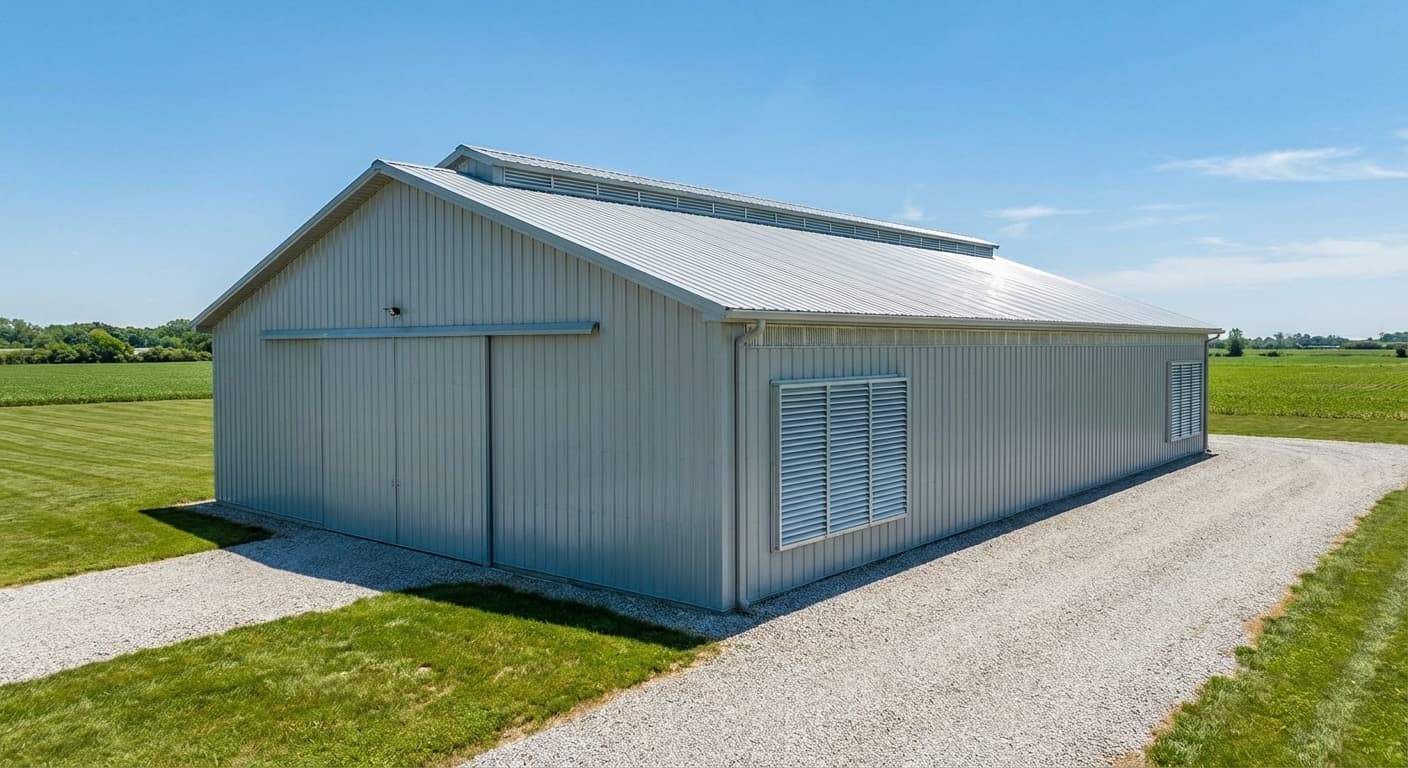

A 40×80 metal barn can turn into a 200 degreesF oven in summer, but the right ventilation package–passive ridge-and-soffit vents, powered fans, and adjustable louvers–flushes that heat, moisture, and corrosive ammonia for a fraction of the $500,000 annual penalty hog farms in Indiana pay when airflow is ignored. The article walks you through sizing the system for 3,200-plus CFM, choosing coatings that cut heat transfer 40%, and balancing intake and exhaust so every cubic foot of the 512,000 cu ft interior is replaced every 5-7 minutes, protecting livestock, equipment, and energy budgets alike. You'll learn to match CFM to use–storage vs. dairy vs. workshop–factor local humidity, and plan for peak loads so you never retrofit later, while maintenance Essentials and single-source service keep the barn breathing reliably year-round.
Assessing Summer Heat Gain in a 40×80 Metal Barn
Metal roofs with polyester coatings reduce heat transfer by 40% compared to galvanized finishes, keeping your 40×80 barn significantly cooler throughout summer.
How heat accumulates in metal structures
Metal conducts heat 400 times faster than wood–that's your first challenge right there [1]. Your 40×80 metal barn collects heat in three ways: conduction (hot roof transfers heat straight into your building), convection (hot air rises and gets trapped), and radiation (sun beats down on metal surfaces) [2].
Your roof takes the worst beating. It can hit 200 degreesF on summer days while trapping all that rising hot air underneath [2]. But here's what matters: surface finish makes a huge difference. A polyester-coated steel roof beats a bright galvanized finish by 40% when it comes to managing heat transfer [3]. Our metal roofing systems come with specialized coatings that reflect more heat and keep your barn cooler from day one.
Effects on livestock, equipment, and energy bills
Skip proper ventilation in your 40×80 barn and you'll pay for it three ways.
Your livestock suffer first. Heat stress hammers productivity and can turn fatal fast [4]. Dairy cows alone put out 4-5 gallons of water daily just from breathing. Add waste moisture and ammonia, and you've got a recipe for respiratory problems [5][6].
Your equipment takes a beating too. Excess heat fries electrical components. Humidity corrodes metal parts and breeds mold that ruins sensitive machinery [5]. That new tractor? It'll age twice as fast in a poorly ventilated barn.
Your energy bills explode. Here's a number that gets attention: the cost difference between mechanical and natural ventilation tops $500,000 annually for Indiana's hog operations alone [6]. You read that right–half a million dollars saved by getting airflow right from the start.
The role of airflow in reducing heat buildup
Good airflow is your secret weapon against summer heat. It works three ways: pulls hot air out the top, brings cool air in below, and keeps air moving across metal surfaces to speed cooling [7][8][9].
Your 40×80 barn has 3,200 square feet of roof collecting heat all day. Without proper airflow, that heat has nowhere to go. But get the ventilation right, and you transform your barn from a solar oven into a workable space–no expensive cooling systems required [8].
Think of ventilation as your barn's breathing system. Hot air naturally rises (thermal stack effect), so you position exhaust vents high and intake vents low [7]. This creates a constant flow that flushes heat out before it builds up. The key? Balance your intake and exhaust so air moves predictably through every corner [9].
Done right, you get stable temperatures that protect equipment, keep animals comfortable, and save thousands on cooling costs. As we'll see in the next sections, choosing the right ventilation components makes all the difference.
Key Ventilation Systems for a 40×80 Metal Barn
Ridge and soffit vents harness natural thermal stack effect to ventilate your 40×80 barn year-round without motors, fans, or electricity costs.
Passive ridge and soffit venting solutions
Ridge and soffit vents deliver year-round ventilation without touching your electric bill. You'll install ridge vents along your roof's peak where hot air naturally escapes, paired with soffit vents at the eaves that pull in fresh air [10]. This setup harnesses the thermal stack effect discussed earlier–hot air rises and exits, creating natural suction that draws cooler air inside without any motors or fans [12].
Your 40×80 barn benefits from this passive system because the large roof area generates strong natural draft. The math is straightforward: every 2,400 square feet needs about 10 feet of ridge ventilation [12]. Balance matters–your soffit vents should match or slightly exceed ridge vent capacity to prevent vacuum effects that disrupt airflow [11].
These weatherproof vents keep rain out while letting hot air escape, and they never quit working–no power outages, no mechanical failures, no service calls [10][11]. For
Powered exhaust fans and strategic placement
Powered exhaust fans give you complete control over your barn's airflow, especially when summer heat overwhelms passive systems. Your 40×80 barn stays comfortable regardless of outdoor conditions–no waiting for a breeze [10].
Mount exhaust fans in the roof directly above heat sources for maximum efficiency [12]. Place intake fans in perimeter walls 8-10 feet up, angling fresh air downward where your livestock and equipment need it most [12]. This dual-fan setup eliminates dead zones that trap heat and moisture in your building's center.
Smart planning saves money: factor fan loads into your structural design early to avoid costly retrofits on purlins and framing [10]. Consider a hybrid approach–let passive vents handle normal days while powered fans kick in during heat waves. You'll cut energy costs without risking animal health or equipment damage during extreme weather [10].
For livestock operations, powered ventilation becomes essential. While passive systems help, only mechanical fans reliably remove the ammonia and corrosive gases that threaten both animal health and your building's lifespan [12].
Adjustable louvers and custom vent options
Adjustable louvers put ventilation control at your fingertips. Open them fully for 77% free air flow on hot days, or seal them tight against storms–all with a simple crank [13].
These self-framing, self-flashing units install anywhere on your walls without special trim or openings [14][15]. Place them strategically for cross-ventilation that targets your specific needs. Choose manual cranks for easy access, chain operators for high installations, or motorized controls for automated climate management [13].
Built-in screens keep birds, insects, and debris out while air flows freely [14][15]. Pick from galvanized steel, aluminum, or stainless options with corrosion-resistant finishes that handle agricultural environments. Sizes range from 18×24" to 30×30", and you can combine multiple units for serious airflow capacity [13][14].
Your 40×80 barn likely has different zones–animal areas need more ventilation than storage spaces. Adjustable louvers let you fine-tune airflow room by room, matching ventilation to actual needs rather than running everything full blast.
Sizing Ventilation Capacity for a 40×80 Metal Barn
Undersizing ventilation can cost livestock operations over $500,000 annually, so match your CFM capacity to your specific barn use and local climate conditions.
Calculating required CFM per square foot
Getting ventilation sizing right saves money and protects your investment. Start with this simple baseline: your 40×80 barn needs approximately 1 CFM (cubic feet per minute) per square foot–about 3,200 CFM total [16]. But that's just the starting point.
Your actual needs depend on what you're doing inside. Storage buildings need less airflow. Livestock operations need much more. Here's why: proper air exchange directly impacts your bottom line. As noted in our heat assessment section, inadequate ventilation in hog facilities can cost over $500,000 annually in operating expenses [6].
For precise sizing, consider your barn's total volume and how often you need complete air replacement [16]. With standard 16-foot sidewalls, your 40×80 structure holds 512,000 cubic feet of air. Warehouses typically need full air exchange every 7 minutes–that's over 73,000 CFM [16]. Agricultural buildings require even faster turnover due to moisture and ammonia production.
Summer and winter needs differ dramatically. Winter ventilation removes moisture while preserving heat. Summer systems prevent dangerous heat buildup. Your specific livestock matters too–as discussed earlier, dairy operations must handle substantial moisture loads from animal respiration [6].
Incorporating climate data and building use
Your location changes everything. Hot, humid regions demand stronger systems to fight condensation–the enemy of steel structures and stored equipment [10]. Factor in your local temperature swings, prevailing winds, and humidity patterns when calculating CFM requirements [17].
What you do in your barn matters just as much as where it sits. Each use has distinct ventilation demands:
- Livestock operations: Maximum airflow for ammonia control and moisture removal
- Equipment storage: Moderate ventilation to prevent rust and corrosion
- Workshop spaces: Targeted extraction for fumes, dust, and vapors
Plan for peak capacity, not average use. If you occasionally stable 20 horses in your 40×80 building, size your system for that scenario [10]. It's far cheaper to install adequate ventilation now than retrofit an undersized system later.
Smart planning here protects your agricultural steel buildings investment for decades. The right ventilation capacity keeps animals healthy, equipment rust-free, and energy costs under control [17].
Simple formulas and online calculators for accurate sizing
Skip the guesswork–use proven tools to nail your ventilation sizing. Online calculators handle the math, letting you focus on your operation [18][19].
Input your barn dimensions and intended use. These calculators factor in:
- Building volume (your 512,000 cubic feet)
- Required air exchanges (typically every 5-10 minutes for agriculture)
- Regional climate data
- Specific use requirements
The best calculators adjust for mixed-use buildings automatically [20]. Your livestock area needs different airflow than your equipment storage zone–calculate each separately for accuracy [19].
Pro tip: Focus on ACH (air changes per hour) rather than raw CFM numbers. ACH tells you how often your entire air volume gets replaced–the metric that actually matters for maintaining healthy conditions [19].
Get this right the first time. Undersized systems create expensive problems: sick animals, damaged equipment, and emergency retrofits that blow your budget [18]. Proper sizing keeps everything running smoothly from day one.
Installation, Maintenance, and Service Excellence for 40×80 Metal Barn Ventilation
Professional installation costs $300-$600 per vent and protects your investment through proper weatherproofing, while twice-yearly inspections keep your system running efficiently year-round.
Step-by-step installation with clear communication
Your 40×80 barn ventilation installation follows a clear path from planning to testing. Start by selecting components that match your specific climate and barn use–ridge and soffit vent combinations deliver reliable results for most agricultural applications [22]. Position exhaust vents at the roof peak where hot air collects, and place intake vents at the eaves to create that essential airflow loop [22].
Professional installation runs $300-$600 per vent but pays for itself through proper weatherproofing and warranty protection [22]. Your installer should account for prevailing winds–typically west to east–to maximize natural airflow [23]. Skip the guesswork: experienced crews know exactly how to balance your system for optimal performance.
The final step makes the difference: thorough testing confirms air moves properly through every section. You'll see hot air exit through ridge vents while cooler air enters below, creating the continuous circulation that protects your investment [21]. When integrated with quality agricultural steel buildings, your ventilation system becomes part of a complete climate control solution.
Routine inspections and troubleshooting best practices
Keep your ventilation running strong with twice-yearly inspections–spring and fall work best, plus checks after major storms [24]. Your three-point inspection hits the essentials: fans (where even light dust cuts efficiency by 40%), vents and louvers (checking for blockages), and mechanical components (bearings, belts, controls) [24][25].
Troubleshooting follows a logical sequence. Poor airflow? Check intake blockages first, then fan operation, then exhaust paths [24]. Humidity problems demand immediate action–look for roof leaks and verify condensation drainage [26]. Document everything in a simple maintenance log. You'll spot patterns, predict needs, and save money on emergency repairs [26].
Winter prep deserves special attention. Your fans run at reduced capacity when it's cold, leaving no room for error. Verify inlet response, check temperature sensor placement, and ensure every component functions properly before temperatures drop [25]. This preventive approach protects your livestock, equipment, and bottom line year-round.
Leveraging single‑source solutions for seamless service
Single-source solutions transform ventilation from a potential headache into a seamless system. When one team handles design through installation, your intake and exhaust components work together perfectly–no gaps, no conflicts, no excuses [27].
This integrated approach treats ventilation, insulation, and vapor barriers as one coordinated defense against moisture damage [28]. Your installation team knows the entire system, catching potential problems before they cost you money. They spot condensation risks during setup, not after damage occurs [28].
Maintenance becomes straightforward when one provider knows every component. No finger-pointing between contractors when issues arise–just clear accountability and fast resolution [29]. Your building maintains steady temperatures, controls moisture, and protects valuable equipment without constant oversight [27].
For agricultural operations, this comprehensive service handles the tough stuff–ammonia, corrosive gases, and moisture that threaten both livestock health and building integrity [27]. As your needs change, your single-source partner adjusts the system accordingly, including emergency service when you need it most [28].
- Metal roofs hit degreesF without airflow, coatings cut heat 40%
- 3,200 ft² roof needs 3,200 CFM minimum summer airflow
- Ridge + soffit vents: 10 ft ridge per 2,400 ft² roof area
- Livestock exhale 4-5 gal water/day; fans stop ammonia buildup
- Wrong ventilation costs hog farms $500k/year in Indiana
- Every 5-10 min full air exchange required for agriculture
- Dusty fans lose 40% efficiency; inspect vents twice yearly
- https://www.duramaxshedsdirect.com/blogs/the-barn-blog/7-ways-to-keep-your-metal-building-cool-during-the-summer-heat?srsltid=AfmBOopRCMOp0cDBBEvaTcrMpOE-ccj36Q71pHjz68MH_7lQyj_kqZ9l
- https://www.linkedin.com/pulse/7-effective-strategies-maintain-cool-metal-building-during-gmtoc?trk=organization_guest_main-feed-card_feed-article-content
- https://steelconstruction.info/Thermal_mass
- https://www.vikingbarns.com/blog/temperature-control-in-livestock-barns-equipment-and-best-practices
- https://theacdoctors.com/why-your-barn-needs-hvac-for-livestock-equipment-and-more/
- https://www.extension.purdue.edu/extmedia/ae/AE-97.html
- https://www.vikingbarns.com/blog/why-ventilation-matters-in-metal-barns
- https://www.coast-to-coastcarports.com/how-to-properly-control-the-airflow-in-a-metal-building?srsltid=AfmBOoo0OGfzLB-byXaiiZdEzZT0fGb-13QxLy-LtxSf6yX8CMxewDNh
- https://www.duramaxshedsdirect.com/blogs/the-barn-blog/8-metal-tips-for-metal-garage-ventilation-for-better-airflow?srsltid=AfmBOorcsRBZVVDs_UWgVc1h_erOlcFuCpXFR6_RVw3uVarZ8AsKKoYF
- https://norsteelbuildings.com/steel-building-planning-design/metal-building-ventilation/
- https://www.worldwidesteelbuildings.com/blog/metal-building-ventilation/
- https://www.alliedbuildings.com/metal-building-ventilation/
- https://www.mpvent.com/louvers/adjustable-louvers/
- https://www.worldwidesteelbuildings.com/construction/components/louvers/
- https://www.bucksteel.com/metal-building-ventilation-options/
- https://industrialfansdirect.com/exhaust-fan-cfm-calculator-chart?srsltid=AfmBOoq18R6qLjNgTfhvGKr9y3mEpegYjnVSEcojKqkzTo5O5z08eJeq
- https://metalprobuildings.com/metal-building-ventilation-everything-you-need-to-know/
- https://industrialfansdirect.com/exhaust-fan-cfm-calculator-chart?srsltid=AfmBOorKnZAHaHtzESEOX-NdegniYgafIQQWE8ps_p2oE8nsuRBkHWia
- https://www.omnicalculator.com/construction/cfm
- https://www.gaf.com/en-us/resources/ventilation-calculator
- https://www.leecompany.com/resources/how-to-ventilate-a-metal-building/
- https://foxhavenroof.com/metal-roof-vents-complete-installation-and-maintenance-guide-for-2025/
- https://greinerbuildings.com/blog/pole-barn-ventilation-a-critical-step-in-the-building-process
- https://harrisconstructorsinc.com/steel-building-ventilation/
- https://www.nationalhogfarmer.com/farming-facilities/preparing-your-barn-for-winter-ventilation-checklist
- https://marbuildingsolutions.com/metal-building-maintenance-care-guide/
- https://lionbuildings.com/the-benefits-of-having-a-proper-metal-building-ventilation-system/
- https://harrisconstructorsinc.com/vent-for-metal-building/