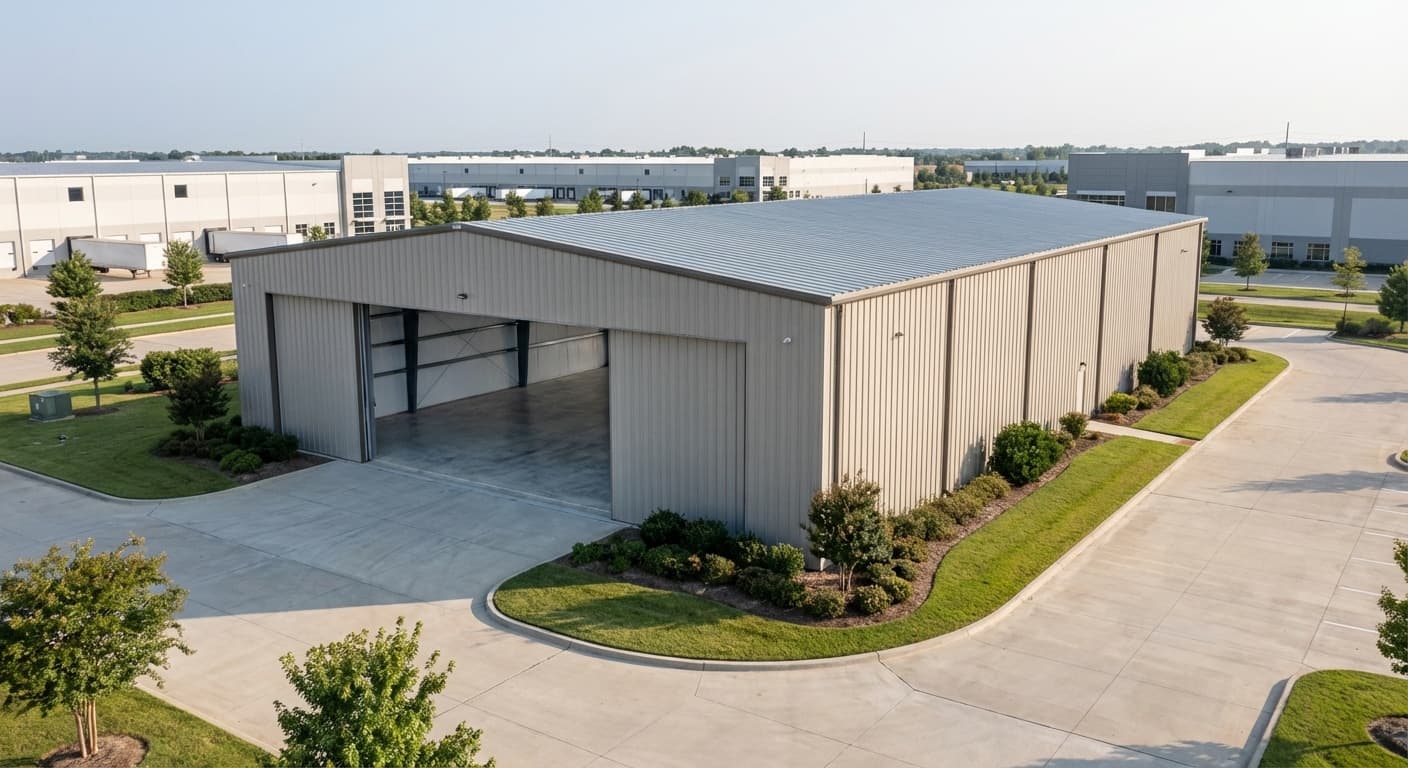

A 40×80 metal building delivers a clear-span 3,200 ft² shell that you can shape into anything–warehouse, workshop, barn, retail showroom, six-bedroom home, or aircraft hangar–without interior posts gobbling up space or dictating layout. The article walks you through every decision that turns the raw frame into a high-performance asset: choosing the right roof pitch and 12-gauge steel for local snow and wind loads, selecting PBR or standing-seam panels and IMP insulation that cut energy bills for decades, positioning doors and windows for workflow and daylight, and pre-wiring for solar, EV chargers, or future expansion so the building grows with you. It demystifies real-world costs–$86k-$129k turnkey–and shows how to drive the price down with Section 179 or bonus depreciation while financing through banks, FSA, or lease-to-own to preserve cash flow. Finally, it maps the permit maze, the 2-4-month build sequence, and the low-maintenance routine that protects your investment for 50-plus years, giving owners the confidence to buy smart, build fast, and own a flexible, tax-advantaged space that starts paying for itself from day one.
Understanding the 40×80 Metal Building Basics
A 40×80 metal building gives you 3,200 square feet of column-free space you can configure for retail, workshops, warehousing, or residential use without layout constraints.
Key dimensions and space advantages of a 40×80 metal building
You get 3,200 square feet of clear, column-free space with a 40×80 metal building [1]. No posts. No obstacles. Just pure, flexible workspace you can configure however your business needs.
These dimensions work perfectly when your lot is narrow but deep–you maximize every square foot of available land [3]. Heights range from 8 to 20 feet in 2-foot increments, so you pick what works for your equipment, inventory, or operations [2]. Planning overhead doors? Factor in a 2-foot clearance above–a 10-foot door needs a 12-foot eave [1].
The open floor plan means you control the layout completely. Run a retail operation? Put your showroom up front and warehouse in back. Building a workshop? Position equipment anywhere without working around columns. Converting to residential? A single story fits four bedrooms comfortably, or go two stories for six bedrooms plus living space [1]. Every inch works harder because nothing's in your way.
Core components and material quality standards
Your 40×80 building starts with industrial-grade steel I-beams–not the light-gauge stuff that bends under pressure [5]. These main frames connect to secondary supports (purlins and girts) that hold your roof and wall panels firmly in place [6].
The exterior uses arch-style PBR metal panels with specialized fasteners and sealants that lock out weather for decades [5]. Below it all sits a reinforced concrete foundation engineered for your specific soil conditions and local codes [6].
Every component meets commercial-grade specs for your location's wind, snow, and seismic requirements [6]. That's why
Why a 40×80 metal building is a versatile solution for many industries
A 40×80 building adapts to whatever you throw at it. The column-free interior means forklifts move freely, equipment sits where you need it, and workflow stays efficient [2]. Got a narrow lot? This footprint maximizes your usable space without fighting width restrictions [8].
Industrial operations run smoother without obstacles. Manufacturing lines flow uninterrupted. Warehouses stack higher and move product faster. Equipment storage stays organized and accessible [2].
Agricultural uses benefit from steel's natural resistance to pests, mold, and moisture. Store feed, house livestock, or protect expensive equipment–your building handles it all while staying maintenance-free for decades [8].
Commercial flexibility sets these buildings apart. Restaurant owners split kitchen from dining areas seamlessly. Retailers combine showrooms with stockrooms. Auto shops position lifts anywhere without structural limitations. Even aircraft fit comfortably in the clear-span space [2].
The adaptability goes further–medical clinics, fitness centers, offices with mezzanines–each configured exactly as needed. Steel construction protects your investment while keeping operating costs low [8]. That's why businesses across every industry choose 40×80 buildings when they need space fast, built right, and built to last.
Design, Customization, and Modern Features
Standing seam panels hide fasteners completely to eliminate leak points and deliver 40-50 years of protection, which is why half of today's commercial buildings rely on them.
Roof styles, pitches, and energy‑efficient insulation options
Your roof choice directly affects your building's performance and your bottom line. The gable roof remains the most popular option–it's economical, drains well, and fits most applications from warehouses to workshops. You can adjust the pitch from nearly flat (1:12) to steeper angles (6:12) based on your snow loads and aesthetic preferences [10]. Need a modern look? Single-slope roofs create clean lines while efficiently directing water and snow away from your main operations, with pitches from 1/2:12 to 6:12 [10]. For maximum interior space, gambrel roofs give you that classic barn look with extra loft room. Monitor roofs add a raised center section–perfect when you need extra height for RV storage or natural ventilation for livestock [10].Your panel choice affects both upfront costs and long-term maintenance.
Through-fastened PBR panels keep your budget in check and work great for 40-foot widths–they're simple to install and get you operational fast [10]. Want maximum weather protection? Standing seam panels hide the fasteners completely, eliminating leak points and lasting 40-50 years [10]. Yes, they cost more upfront, but you'll save on maintenance and energy costs over time. About half of today's commercial buildings use them for good reason [10]. Our Smart insulation choices pay you back every month in lower energy bills. Vinyl-faced fiberglass gives you solid performance at an economical price point.
Need tighter sealing around corners and penetrations? Spray foam fills every gap. For the ultimate in efficiency, insulated metal panels (IMPs) combine steel skins with foam cores–you get superior R-values and faster installation in one package [9] [10]. Your heating and cooling costs drop significantly while your workspace stays comfortable year-round [6]. Add polycarbonate skylights to cut daytime lighting costs–they drop right into your roof panels, flooding your space with natural light [10].
Door, window, and interior layout configurations
Your door choice shapes how you'll use your building every day. Overhead doors get vehicles in and out efficiently. Sliding doors save space and work great for farm equipment. Need security? Rollup doors lock tight. Moving wide loads or aircraft? Bifold doors open up the entire end wall [11]. Where you place these doors matters too–corner placement keeps your walls clear for storage, while centered doors create that balanced, professional look [13].
Just remember the clearance rule mentioned earlier: your eave needs to be 2 feet higher than your tallest door [11].Good window placement saves electricity and creates better workspaces. Since you have no interior columns, you can put windows anywhere along your walls [12]. Running a workshop? North-facing windows give you consistent light without glare. Want free heating in winter? South-facing windows capture solar warmth. You've got options–fixed windows for simplicity, sliding for ventilation, or awning styles that shed rain while staying open [13]. Upgrade to low-E or insulated glass to cut energy costs further.
Place clerestory windows high for privacy with natural light, or go with wall-height windows to connect your workspace with the outdoors [12].With 3,200 square feet of column-free space, you control exactly how your building works for you. As covered in the basics section, residential conversions can include four bedrooms on one level or six with a second story [11]. For business use, you can separate customer areas from production zones and still have room for offices and break rooms–all under one roof [12]. No load-bearing walls inside means you can reconfigure as your business grows. Set up an open workshop with equipment in the center, design retail space with smart customer flow, create modular offices, or combine living and working areas [13]. Use 3D design tools to test layouts before you build–get it right the first time [13].
Integrating smart controls, solar power, and future‑ready upgrades
Your steel building grows with your business. The solid framework supports future additions without expensive structural modifications–add on when you're ready, not before [14]. Today's smart controls put lighting, security, and climate at your fingertips through your phone. When you combine these systems with quality insulation, your building practically runs itself–adjusting temperature based on who's there and what's happening outside [14].
Planning for solar? You've got 3,200 square feet of roof space ready to work for you. The 12-gauge framing handles solar panels with ease, especially when you plan for them upfront [15]. Add battery backup in a utility corner and keep working through outages.
Think ahead: pre-wire for EV charging stations, run conduit for future network upgrades, use modular walls you can move later. Your building should last 50+ years–make sure it stays useful the whole time [15].
Cost Planning, Financing, and Value Optimization
Your 40×80 metal building costs between $86,400 and $128,600 installed, with the structural kit consuming the largest share at $57,600-$70,400.
Transparent price breakdown: kit, foundation, and installation
Your 40×80 metal building investment breaks down into three clear components. Total project cost lands between $86,400 and $128,600, fully installed [16]. Here's exactly where your money goes.
The building kit takes the largest share at $18-$22 per square foot–that's $57,600-$70,400 for your complete structural package [16]. You get all primary and secondary steel framing, arch-style PBR metal panels for roof and walls, plus every fastener and sealant needed. No surprises, no missing pieces.
Your foundation runs $4-$8 per square foot for a standard concrete slab–figure $16,000 for the typical job [16]. Soil conditions and local codes drive the final number. Complex sites with special reinforcement needs push costs toward $25,600 [2].
Installation labor adds $5-$10 per square foot ($16,000-$32,000 total), depending on your location and project complexity [2]. Watch for "free delivery" claims–they usually mean kit delivery only, not the complete installation.
Budget smart: Most quotes exclude site prep and interior finishing. These extras can add 20-30% to your total [2]. Get everything in writing upfront.
Factors that influence cost: steel grade, height, coatings, and location
Four factors control your final 40×80 building price–and knowing them saves you money.
Height makes the biggest impact. Every 2-foot increase adds $3,000-$7,000 to your base cost [2]. Yes, you pay more for taller buildings. You also get dramatically more usable space and operational flexibility. Smart trade-off for most operations.
Steel gauge determines longevity. Choose between 14-gauge frames (standard) or 12-gauge frames with 20-year warranties [2]. The heavier gauge costs more upfront but pays you back in extreme weather protection and decades of trouble-free service. Our
Financing options, tax incentives, and budgeting tips for long‑term ROI
Smart financing starts with understanding your options. Traditional bank loans remain popular–competitive rates, flexible terms, predictable payments [20]. Construction loans release funds as you build, keeping cash in your pocket longer [20]. Farm operations? FSA loans beat most rates and offer farmer-friendly repayment schedules [19]. Manufacturer financing speeds approvals but watch for higher material markups [20].
The IRS puts money back in your pocket–fast. MACRS depreciation recovers your investment over time [18]. Better yet, Section 179 lets you deduct up to $1,160,000 (2024 limit) the year you place your building in service [18]. Bonus depreciation adds another layer–deduct 100% of costs year one (phasing to 80% in 2023, 60% in 2024) [18]. Energy-efficient designs trigger Section 45L credits worth $2,000 per qualifying unit [18]. Your state likely offers additional breaks–property tax reductions, sales tax exemptions, investment credits [18].
Three moves maximize your ROI:
- Buy 12-gauge frames, not 14-gauge. Yes, you pay more today. You also get 20-year warranties and weather any storm [19]. Cheap steel costs more in the long run.
- Include energy features from day one. Proper insulation, reflective coatings, solar-ready wiring–they bump initial cost but slash operating expenses forever [19]. Plus, you capture those tax credits.
- Match financing to cash flow. Lease-to-own works when capital's tight–use the building while building equity [20]. Home equity loans offer great rates for residential projects but risk your house [20]. Government grants take patience but deliver unbeatable terms for qualifying businesses [20].
Your building pays you back for decades. Finance it right, maintain it properly, and watch it become your most profitable square footage.
Permits, Installation Process, and Ongoing Maintenance
Partner with professionals who've navigated permits hundreds of times while you handle site evaluation, foundation work, and the 2-4 month build timeline.
Navigating zoning, permits, and regulatory compliance
You need permits before breaking ground–that's just reality. But here's what makes it manageable: you're working with professionals who've navigated this process hundreds of times. Your local building department will check for code compliance, load requirements, zoning fit, and safety standards [21]. They'll want to see your property deed, engineer-stamped plans, building dimensions, intended use, and exact placement on your property [22].
Before you apply, verify your site doesn't conflict with easements, watersheds, setbacks, or utility lines [22]. Most areas follow the International Building Code (IBC) with local tweaks–hurricane requirements in Florida, earthquake standards in California [21]. Zoning matters too. You can't drop an industrial facility in a residential neighborhood without special approval [21]. If zoning's an issue, consider applying for a variance, especially with neighbor support [21].
Permit costs vary wildly–$150 in rural areas to $7,500 in major cities, with most falling between $550 and $2,000 [21]. Skip permits and you risk fines, removal orders, insurance problems, sale complications, and property liens [21]. Commercial projects face stricter requirements, particularly for public-access buildings [23].
The smart move? Partner with a
Step‑by‑step erection timeline and best‑practice site preparation
Your building goes up in 2-4 months after ordering–plenty of time for permits and prep work [24]. Here's how it unfolds:
Site evaluation comes first. You need soil testing to determine load capacity and spot potential issues. This step drives your foundation design and prevents expensive settling problems later [25]. Clear the vegetation, strip the topsoil, then grade for drainage. Your contractor creates a 1% slope away from the building–enough to keep water moving without creating erosion [25]. The pad gets compacted to 95% Proctor density. No shortcuts here–proper compaction prevents future settling [25].
Foundation work marks the critical phase. After compaction, your concrete crew pours footings, piers, or slab per engineer-stamped plans [25]. Anchor bolt placement demands precision–misaligned bolts remain the most common and costly error in steel building construction [25]. Install underground utilities before the pour. Cutting concrete later wastes time and money [25].
Assembly begins after concrete cures (7-28 days). Your erection crew needs flat, accessible staging space for components [24]. They'll start with main frames, add secondary framing, then attach roof and wall panels–a proven sequence that ensures structural integrity [24]. Inspections happen throughout to verify engineering compliance. The final walkthrough catches any punch-list items before you get your certificate of occupancy [24].
Working with an experienced erection team eliminates guesswork. They've done this before. They know the sequence. They catch problems early. That's how you stay on schedule and within budget.
Maintenance checklist to protect your 40×80 metal building's lifespan
Your steel building is built tough, but smart maintenance keeps it that way. Focus on these five systems:
Roof: Check fasteners, sealants around penetrations, gutters, and panel condition. Schedule professional inspections annually and after major storms–this protects your warranty [26].
Foundation and drainage: Water is your enemy. Keep downspouts extending 5-10 feet from walls. Maintain that 5% grade away from the building. Watch for cracks, pooling, or rust at panel bases [26].
Wall panels: Pressure wash twice yearly. Touch up paint scratches immediately to prevent rust [26].
HVAC and penetrations: Inspect sealants, flashing, and insulation regularly. Small leaks become big problems fast [26].
Hardware: Check fasteners and moving parts. Rusted bolts deform panels. Sticky doors create hazards [26].
Season-specific tasks keep you ahead of problems:
- Spring: Fix winter damage, clean gutters, prep cooling systems [27]
- Summer: Deep clean, paint touch-ups, seal joints while weather's good [27]
- Fall: Check insulation, seal air leaks, verify heating before cold hits [27]
- Winter: Monitor snow loads and ice dams [27]
Document everything–dates, work performed, costs, contractors. This history proves warranty compliance and spots recurring issues [27]. Run quarterly safety checks on exits, emergency lighting, and fire systems to maintain code compliance [27].
Think of maintenance as protecting your investment. Spend a little time now, save major repair bills later. Your building's designed to last 50+ years–proper care ensures it does [28].
- 40×80 steel buildings deliver 3,200 sq ft of unobstructed, reconfigurable space.
- Total installed cost ranges $86k-$129k: kit $57k-$70k, slab ~$16k, erection $16k-$32k.
- Every 2 ft of height adds $3k-$7k but multiplies usable volume and operational flexibility.
- Section 179 and bonus depreciation can let you deduct most costs in year one.
- 12-gauge framing costs more upfront yet carries 20-year warranties and survives extreme weather.
- Clear-span design allows forklifts, aircraft, or residential layouts without interior columns.
- Permits run $550-$2,000 and require engineered plans; skipping them risks fines or forced removal.
- https://www.buildingsguide.com/standard-sizes/40×80-metal-building/?srsltid=AfmBOop27AJSzuFoTsVXrneCzammUq5Pkudbx7agvPN-gTkJkhqt4KJl
- https://chinasteelbuildsales.com/40×80-metal-building-cost/
- https://coastalsteelstructures.com/models/40-x-80-prefab-metal-buildings/
- https://gensteel.com/steel-building-kits/institutional/40×80-institutional/
- https://www.buildingsguide.com/standard-sizes/40×80-metal-building/?srsltid=AfmBOop5-DAWNqmurWpVdfjm1mMzlhL7T3TarOVFze8c5yQP4uFeYYL5
- https://www.uspatriotsteel.com/blog/how-much-does-a-40-x-80-metal-building-cost/
- https://gensteel.com/steel-building-kits/base-building-packages/40×80/
- https://metalgaragecentral.com/endless-uses-for-40×80-metal-buildings
- https://www.buildingsguide.com/products/standard-size/40x80x18-metal-building/?srsltid=AfmBOoo7BkVCQhatPiJ9fhPg1Bvy9doUXmIKFy8cyCdBq81UN_pyc32b
- https://www.buildingsguide.com/design/metal-building-roofs/?srsltid=AfmBOoq-aHRR95Vm4mIAetjEdCg-ybpMQIWvhOzmHGZiY1qIw3MMlR0Z
- https://www.buildingsguide.com/standard-sizes/40×80-metal-building/?srsltid=AfmBOooKJndfaKqMzwKQvj_m3Z1Rw8cXZ6LzsS7lL0g6PAUjwJmH519R
- https://www.metalbuildingoutlet.com/40×80-metal-building-kit/
- https://titansteelstructures.com/metal-structure-tutorials/how-to-design-a-40×80-metal-building-using-our-3d-building-design-tool/
- https://www.buildingsguide.com/products/standard-size/40x80x20-metal-building/?srsltid=AfmBOormBw4usD9QcOQzmSLP1e9og8jPq26KnefKl4ZNzuXKH-BYdbX0
- https://alansfactoryoutlet.com/40×80-steel-building/?srsltid=AfmBOoqHnpp9PsSMLHDhkAzxD7GacmHWykQwMQ4iVOlfkXDN3pO1s7hy
- https://www.buildingsguide.com/standard-sizes/40×80-metal-building/?srsltid=AfmBOoqb8HYeH7QW_QqseNTw1NNtbSPF7BoKAHDZMdVwS3xUNs3b3bXs
- https://qebuildings.com/2025/10/how-much-does-a-40×80-metal-building-cost/?srsltid=AfmBOoqVn3Kjt6R1BVWpirXLHpA6k9ddO-xXmyAEX_3hP8TZhE9dkZX7
- https://www.paramountmetalsystems.com/tax-advantages-of-metal-building-systems-save-money-while-adding-value
- https://roimetalbuildings.com/investing-in-a-metal-building-with-your-fsa-loan-tax-deductible-benefits/
- https://yourbuildingteam.com/resources/financing-options-for-steel-buildings/
- https://www.buildingsguide.com/build/metal-building-codes-permits/?srsltid=AfmBOopuFGf1jPVeyWs-Bu1dwjnmcwGqozReUCe8mpVQ8HMp8g2Rkdo5
- https://www.rhinobldg.com/blog/construction-permits-for-metal-buildings
- https://directmetalstructures.com/blog/permitting-and-regulations-what-to-know-before-you-build-your-metal-building/?srsltid=AfmBOooAthwSPcJgZ4v4e9TSrCM9iMBi7KNYrHvOvKaz2aDvHHhU-iYi
- https://www.buildingsguide.com/build/?srsltid=AfmBOor3l37npRbmfns-jyuJcb-oJbWtAtso4r-B7Nt8orfMgDFAvthe
- https://metalprobuildings.com/preparing-the-site-what-to-do-before-your-steel-building-erection-begins/
- https://seufertconstruction.com/company/blog/metal-building-maintenance-checklist
- https://premierbuildings.com/seasonal-maintenance-guide-for-metal-buildings/
- https://marbuildingsolutions.com/metal-building-maintenance-care-guide/