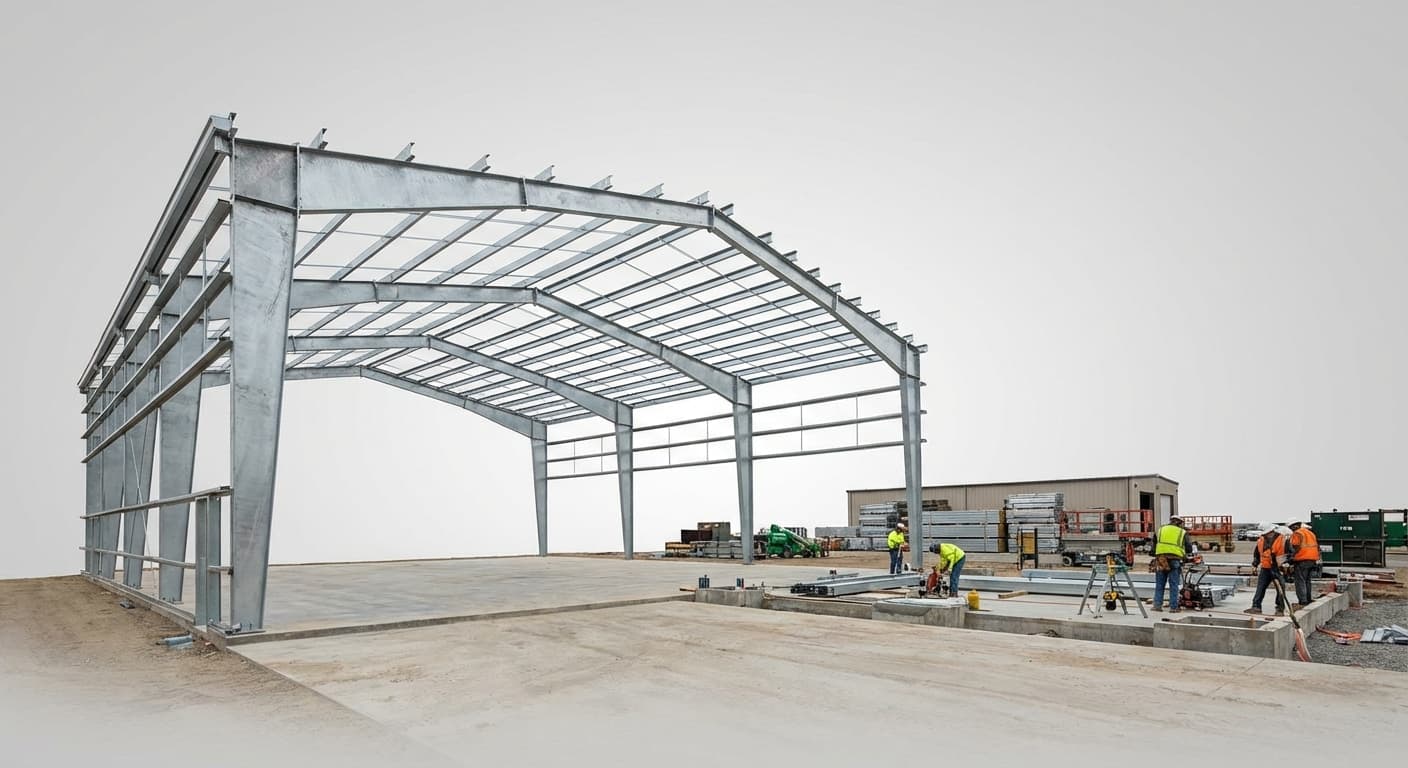

A 40×80 clear-span metal warehouse delivers 3,200 ft² of unobstructed, cost-efficient space, but every pound of snow, equipment, or future mezzanine must travel through the tapered I-frame to the slab–get the load path, local snow/wind data, and dynamic frequencies right from day one or you'll be cutting concrete later. The article shows how to size tapered members for the 40-100 ft sweet spot, decide when straight columns justify the extra steel, route rooftop HVAC without weakening the frame, and cast slab footings that accept tomorrow's mezzanine before the first pour. It warns that resonance from conveyors or cranes can loosen bolts, coastal wind ratings can double inland specs, and a 2:12 roof can trap snow that 4:12 sheds–details ignored by base kits but caught when the engineer uses site-specific loads and welded joints. Quality erection follows a strict bay-by-bay, brace-before-clad sequence with certified welds, tested bolts, and climate-controlled coatings, while single-source design-build coordination keeps seven trades on one live drawing set to eliminate costly field surprises. Budget reality runs $86-129k installed for a standard box, but value-engineered insulation upgrades, simple layouts, and timed steel purchases cut lifetime cost, and a twice-yearly fastener-and-seal inspection plan protects the 20-year performance you paid for. Readers leave knowing how to design once, erect right, and maintain smart so their 40×80 warehouse stays cheap to own, not cheaply built.
Planning the Clear-Span Structure for a 40×80 Metal Warehouse
Tapered I-beams deliver maximum strength exactly where your 40×80 clear-span needs it most, using less steel and keeping costs down.
Understanding Load Paths in a 40×80 metal warehouse
Every pound of weight in your 40×80 clear-span warehouse follows a precise path to the ground. No guesswork. Your rigid frame system channels forces through primary I-beams into columns, then into your slab. [2] With 3,200 square feet of column-free space, you get maximum usability–but it means every load travels through your primary frames alone. [1]
Here's what matters: Your purlins and girts collect weight from roof and wall panels. They transfer it to the main frames. Get this handoff wrong, and you'll undersize a critical connection point. [1] Plan it right from the start, and your building handles everything you throw at it.
Selecting the Right Steel Profile for Unobstructed Spans
Tapered I-beams make the most sense for your 40×80 clear-span. Why? They put steel exactly where you need it–thicker at high-stress points, thinner everywhere else. [3] Your cost stays down. Your strength stays up. The magic happens at the haunch–that knee joint where column meets rafter. It's the deepest, strongest point because it handles the most stress. [3] The tapered side faces in. The flat side faces out for clean purlin connections. [3] Your 40×80 sits in the efficiency sweet spot (40-100 feet) where tapered frames deliver maximum value per square foot. [3]
Straight columns? Save them for specific needs. You'll want straight columns when you're hanging a monorail, installing an under-hung crane, or need flush wall surfaces for equipment. [4] They use more steel–the full width runs top to bottom instead of tapering where loads decrease. [4]
Planning a future bridge crane? Specify straight columns now. It's cheaper than retrofitting later. But for standard storage or manufacturing? Tapered frames give you the same strength for less money. [4] Just remember: wider spans need deeper frames. Plan your eave height to maintain the headroom you need under the haunch. [3]
Integrating HVAC and Lighting Without Compromising Structural Integrity
Your HVAC and lighting affect your structure. Period. Every rooftop unit, every duct penetration, every light fixture adds weight and creates attachment points in your load path.
Rooftop units make the most sense for your 3,200-square-foot space. You keep your floor clear. You get better air distribution.
Maintenance happens above, not in your workspace. [5] But here's the catch: rooftop systems need reinforced framing and ductwork paths. Plan them now, not after your building's up. [5] That's where our
Hidden Loads That Can Surprise Your 40×80 Metal Warehouse Project
Your site's specific snow load, wind speed, and equipment vibrations require engineer verification before construction, not after installation.
Snow and Wind Load Considerations for Large Clear-Span Roofs
Your roof carries two main weather loads: snow pushing down (measured in pounds per square foot) and wind creating both sideways pressure and uplift. [7] Here's what catches people off guard — these loads aren't standardized. A 40×80 in Minnesota needs engineering for 50+ PSF snow loads. Coastal Maine often exceeds 60 PSF. [8] That base-spec building kit you're comparing? It might not meet your local requirements. And you can't fix that after the building's up. Your clear-span frame routes every pound of load outward to the exterior columns — no interior posts to help carry the weight. [7] That's why roof pitch matters. A 4:12 pitch sheds snow before it builds up. The standard 2:12 pitch on most base kits? It holds snow longer, increasing the load on your frames. [7] In heavy snow zones, paying for steeper pitch during design beats dealing with overload later.
Wind works differently. Galvanized steel flexes under pressure instead of cracking. The rigid foundation connection resists uplift better than standard framing. [7] Before you sign any contract, make sure your engineer used your specific site data — not regional averages. Elevation, terrain category, local wind speeds — these details determine whether your building stands strong or struggles. Storm-prone coastal areas require significantly higher ratings than similar inland zones. [7]
Dynamic Equipment Vibrations and Their Impact on Steel Framing
Static loads stay put. Dynamic loads move. Compressors, conveyor systems, vibratory feeders, overhead cranes — they all generate forces that change constantly. When equipment frequencies match your building's natural frequency, the steel doesn't just carry the load. It amplifies it. [9] This resonance effect destroyed the Broughton Suspension Bridge in 1831 when marching soldiers created synchronized vibrations. [10] Your 40×80 clear-span faces the same risk. Without interior columns to break up the load path, vibrations travel the full frame length, concentrating stress at connections.
The damage builds slowly:
- Bolted connections loosen from repeated movement
- Microscopic cracks form at welds and base plates
- Precision equipment starts producing bad parts before you see structural problems [11]
Welded connections beat bolted ones here — they create rigid joints that handle repeated force better than friction-dependent bolts. [11]
Here's the simple fix most people skip: Give your engineer the operating frequencies of all rotating equipment before design. They'll check these against your frame's natural frequency. This calculation costs nothing during planning but can cost thousands to fix after your equipment is running. [9] [10]
Future Expansion Loads: Planning for Mezzanines and Storage Upgrades
Thinking you'll add a mezzanine later? That's an expensive assumption. Mezzanines create concentrated point loads where columns meet slab — completely different from the distributed loads your roof and walls generate. A standard 6-8 inch industrial slab handles about 25,000 pounds per point. [12] If your future mezzanine exceeds that, you're not tweaking details. You're breaking concrete in an occupied building to pour new footings. That costs far more than getting the slab right from the start.
Your eave height determines if a mezzanine even works. You need 15-16 feet minimum to get 7 feet of headroom on both levels after accounting for deck thickness and utilities. [12] The good news? Your 40×80 clear-span design is perfect for mezzanines. No interior columns means you place it exactly where workflow demands.
But here's what varies: load ratings. Storage-only platforms need different engineering than platforms where people work regularly. This affects:
- Column sizing
- Beam layout
- Column spacing [13]
The fix is simple. Tell your engineer about any future mezzanine plans before the slab is poured. Include the intended use and approximate footprint. This builds point load capacity into the foundation instead of retrofitting it later. [13] After completing 1,480+ buildings, we've learned that planning for tomorrow's expansion during today's design saves significant money and headaches down the road.
Quality Construction Practices for Long-Term Performance
Precision erection bay by bay with certified welders and documented quality checkpoints prevents field failures that cost far more than doing it right the first time.
Precision Fabrication and On‑Site Erection Techniques
Your 40×80 warehouse quality starts in the factory, not on your job site. When pre-engineered components arrive — columns, rafters, purlins, base plates — they're already cut, drilled, and painted to exact specs. [14] But here's what matters: even perfect parts fail if you don't follow the right sequence. The MBMA Metal Building Systems Manual spells it out: primary frame first, lock it with bracing and purlins, then add cladding. [15] Skip steps — especially cladding before full bracing — and you've created a wind catcher that can collapse before you're done building. [15]
Your erection crew needs to hit AISC 303-22 tolerances bay by bay, not after the whole frame's up. Why? Because a quarter-inch error in bay one becomes a full inch by bay four. [15] Measure, adjust, lock, repeat — that's how you avoid expensive field fixes.
Field welding adds another checkpoint. AWS D1.1 requires certified welders, approved procedures, and testing that goes beyond visual inspection. [15] Smart crews use welding shelters and schedule repair time upfront. Weather doesn't wait for your deadline, and a bad weld won't show its weakness until it's carrying load. [15]
Quality Control Checkpoints for Welds, Bolts, and Coatings
Start with visual inspection, but don't stop there. Look for cracks, voids, and undercuts at every weld — then bring in the real tools. Ultrasonic testing finds what's hiding inside. Radiography shows internal voids. Magnetic particle testing catches surface cracks your eyes miss. [16] Before welding starts, verify certifications. A MIG-certified welder isn't qualified for TIG work, and mixing them up creates liability you don't need. [17]
For bolted connections, follow this sequence:
- Check torque specs against drawings
- Verify bolt grades match the design
- Document and fix problems before moving to the next bay [17]
Coating failure? It's almost always prep failure. Your steel needs abrasive blasting to create the right surface profile — skip this step and the best coating still peels. [17] During application, measure film thickness regularly. Too thin means rust in two years. Too thick means cracks and delamination. [16]
Watch the weather. Humidity above 85% or steel within 5 degreesF of dew point temperature kills coating adhesion. You won't see the failure until months later when rust starts bleeding through. [17]
Single‑Source Coordination to Streamline Communication and Reduce Errors
Your 40×80 warehouse needs at least seven different trades working from the same drawings. When they talk past each other, you pay for it. Drawing revisions get missed. Specs get interpreted differently. Errors show up during erection — the worst and most expensive time to find them. Shop drawings take the biggest hit from poor coordination. They're supposed to translate design into fabrication, but when your engineer and fabricator aren't talking directly, something gets lost. [18] By the time steel arrives on site, it's too late to fix without delays and change orders.
The solution is simpler than most owners think. Use one document system with controlled access. No more parallel drawing sets or outdated revisions floating around. [18] Get your fabricator involved during design, not after. Let them talk directly to your engineer about technical questions — no telephone game through project managers. [18]
This single-source approach is exactly why design-build contractors like National Steel Buildings streamline projects from concept through completion. When one team handles engineering, fabrication, and erection, coordination problems disappear.
Your schedule needs the same unified approach. Concrete must cure before steel goes up. Primary framing must be set before certain walls can proceed. [19] Track these dependencies on one master schedule, not separate timelines per trade. Hold weekly meetings with all active trades in the room — not individual check-ins that miss the big picture. [19] Find conflicts while they're still planning problems, not field problems.
Cost‑Effective Solutions and Service Excellence
Smart value engineering–like upgrading insulation for $4,800 to recover costs through energy savings–delivers real budget control without compromising your warehouse performance.
Estimating Realistic Budgets for a 40×80 Metal Warehouse Build
Your 40×80 metal warehouse budget has three main parts: the steel building kit, the concrete slab, and erection labor. Here's what you're looking at: $18-$22 per square foot for the kit, $4-$8 for the slab, and $5-$10 for labor. Total installed cost? Between $86,400 and $128,600 for a standard build. [20] But that's just the starting point. Need rooftop HVAC curbs? Snow load upgrades for your region? Custom door layouts? Mezzanine-ready footings? Each addition bumps your budget independently. A basic prefab kit might start at $20,000-$25,000, but that bare-bones price excludes insulation, doors, windows, and any structural upgrades you'll actually need. [22] For complete builds with mechanical, electrical, and finish work, expect $110-$150 per square foot. [21]
The real key to accurate budgeting? Get itemized quotes that spell out exactly what's included. Two quotes $10,000 apart might cover completely different scopes — one includes insulation and permits, the other bills them separately. With
Leveraging Value‑Engineered Options Without Sacrificing Quality
Here's the difference between value engineering and simple cost-cutting: one saves you money now and later, the other just kicks expenses down the road. [23] Take roofing panels. Sure, you can spec cheaper materials to hit your target bid. But when those panels fail years early and you're paying for full replacement while your competitor's quality roof keeps performing? That's not savings — that's deferred expense with interest. Same story with undersized HVAC. It'll run at max capacity from day one, wear out fast, and need replacement before its time. [23]
Smart value engineering targets real savings without compromising performance:
- Insulation upgrades — Going from basic double-bubble ($1.50/sq ft) to R-17 ($3.00/sq ft) adds about $4,800 to your 3,200-square-foot build. You'll recover that through lower energy bills, not hope. [24]
- Simple design choices — Straightforward layouts mean faster fabrication, fewer specialty parts, and lower labor costs. You save money without sacrificing an ounce of structural strength. [25]
- Strategic steel buying — Steel prices swing with global markets. If your schedule has flexibility, timing purchases during market dips can save thousands on materials alone. [25]
- Manufacturer scale — National buying power matters. Large-volume manufacturers get better steel prices than smaller shops — savings that show up in your kit price, not their profit margin. [25]
The test for any cost decision? Simple. Does it reduce today's cost or tomorrow's headache? Real value engineering does both. [23]
Post‑Construction Support and Maintenance Planning
Your maintenance plan starts day one after we finish erection — because what you do in year one determines how your building performs in year twenty. Your inspection schedule: Walk the perimeter twice yearly (spring and fall). Check panels, fasteners, doors, windows, gutters, and insulation. After severe weather? Do an extra walk-through. [26]
Focus areas that matter most:
- Roof ridges, corners, and frame joints — they take the most abuse from wind and temperature swings [26]
- Roof fasteners — your #1 leak risk when they work loose [27]
- Door and window seals — replace them at first sign of wear, not after water gets in [26]
Simple maintenance that prevents big problems:
- Clean surfaces every 3-4 months with mild detergent to prevent moisture-trapping buildup
- Treat rust spots immediately — sand, prime, and topcoat before it spreads
- In dusty or high-pollution areas, pressure wash carefully (don't force water behind panel laps) [26]
Why documentation matters: Keep written records of every inspection and repair. You'll need them for warranty claims, and they'll show you patterns — like whether those loose fasteners are isolated wear or a bigger issue. [27]
The bottom line? Steel buildings are low-maintenance, not no-maintenance. Spend a few hours on prevention now, or spend thousands on repairs later. With proper care, your
- Tapered I-beams cut steel use and cost for 40-80 ft clear-span warehouses.
- Snow loads vary from 50 PSF inland to 60+ PSF coastal; verify local data.
- Dynamic equipment resonance can loosen bolts and crack welds without early detection.
- Future mezzanines need point-load footings poured now; retrofits cost far more.
- Rooftop HVAC units require pre-planned reinforced framing and duct paths.
- Use single-source design-build to avoid costly drawing and schedule misalignment.
- Itemized quotes prevent hidden extras; full builds run $110-$150 per square foot.
- https://www.buildingsguide.com/standard-sizes/40×80-metal-building/?srsltid=AfmBOoohgI-w5-kHVuHQFMqvtbR24O07MiKyY-g8uK3R76y_FzIZnz_n
- https://armstrongsteel.com/steel-frame-buildings
- https://www.buildingsguide.com/build/clear-span-buildings/?srsltid=AfmBOopLGG60bPhLRZdV8uXu-X1XsJJyvHcH_7XYDgWilPEyCTfKJNlp
- https://renegadesteelbuildings.com/steel-building-columns-tapered-vs-straight/
- https://www.longstarsteel.com/hvac-installation-tips-for-metal-warehouses-and-garages/?srsltid=AfmBOoquk_2BQbF3XgOqfLk9QM5fl_IAgzG72H_ivSJaOQ8OmCWrRmzt
- https://designandbuildwithmetal.com/featured-content/2025/03/27/with-highly-customizable-packages-mbmi-pushes-the-limits-of-the-metal-building-approach
- https://directmetalstructures.com/blog/how-clear-span-metal-buildings-handle-snow-loads-and-high-winds/?srsltid=AfmBOoqQRWsWDD_36aDi_1wcV60xohUq_X6F970SbyvtqSoTq_tA0l47
- https://mbmisteelbuildings.com/blog/cold-weather-steel-building-design/
- https://vulcraft.com/insight/TacklingVibrationIssues
- https://www.neuralconcept.com/post/structural-vibration-predicting-and-mitigating-dynamic-effects
- https://anglelock.com/blog/design-of-structures-and-foundations-for-vibrating-machines-framing
- https://metalprobuildings.com/adding-mezzanines-to-steel-buildings/
- https://www.panelbuilt.com/blog/consider-this-when-building-a-structural-mezzanine/
- https://steelcommandercorp.com/clear-span-steel-buildings-guide/
- https://pebsteel.com/en/steel-building-peb-guide-structure-codes-and-construction-steps/
- https://iconsteelbuildings.com/construction-quality-control-checklist/
- https://goaudits.com/checklist/structural-steel-quality-control-checklist/903/101/
- https://bayoucitysteel.com/structural-detailing-accuracy-ensuring-precision-in-steel-shop-drawings-through-quality-assurance-and-proper-erection-sequencing/
- https://cookshellcontractors.com/how-general-contractors-manage-subcontractor-relationships/
- https://www.buildingsguide.com/standard-sizes/40×80-metal-building/?srsltid=AfmBOopU9tHo30Pnh_lctsPkrhuioYjIa19t78L2M25pR2yiu0VLyKAT
- https://www.steelcobuildings.com/cost-to-build-metal-warehouse/
- https://www.uspatriotsteel.com/blog/how-much-does-a-40-x-80-metal-building-cost/
- https://gp-inc.com/the-hidden-costs-of-poor-value-engineering-and-how-to-avoid-them/
- https://chinasteelbuildsales.com/40×80-metal-building-cost/
- https://www.alliedbuildings.com/pemb-cost-considerations/
- https://prestigesteelstructures.com/metal-building-maintenance-checklist-for-long-term-performance/?srsltid=AfmBOoqM7drXkf0JBSkT1bfJXIGb8I-vvp2rPyxTnegp0ArHR-BSLOGl
- https://futurebuildings.com/blog/steel-building-maintenance.html