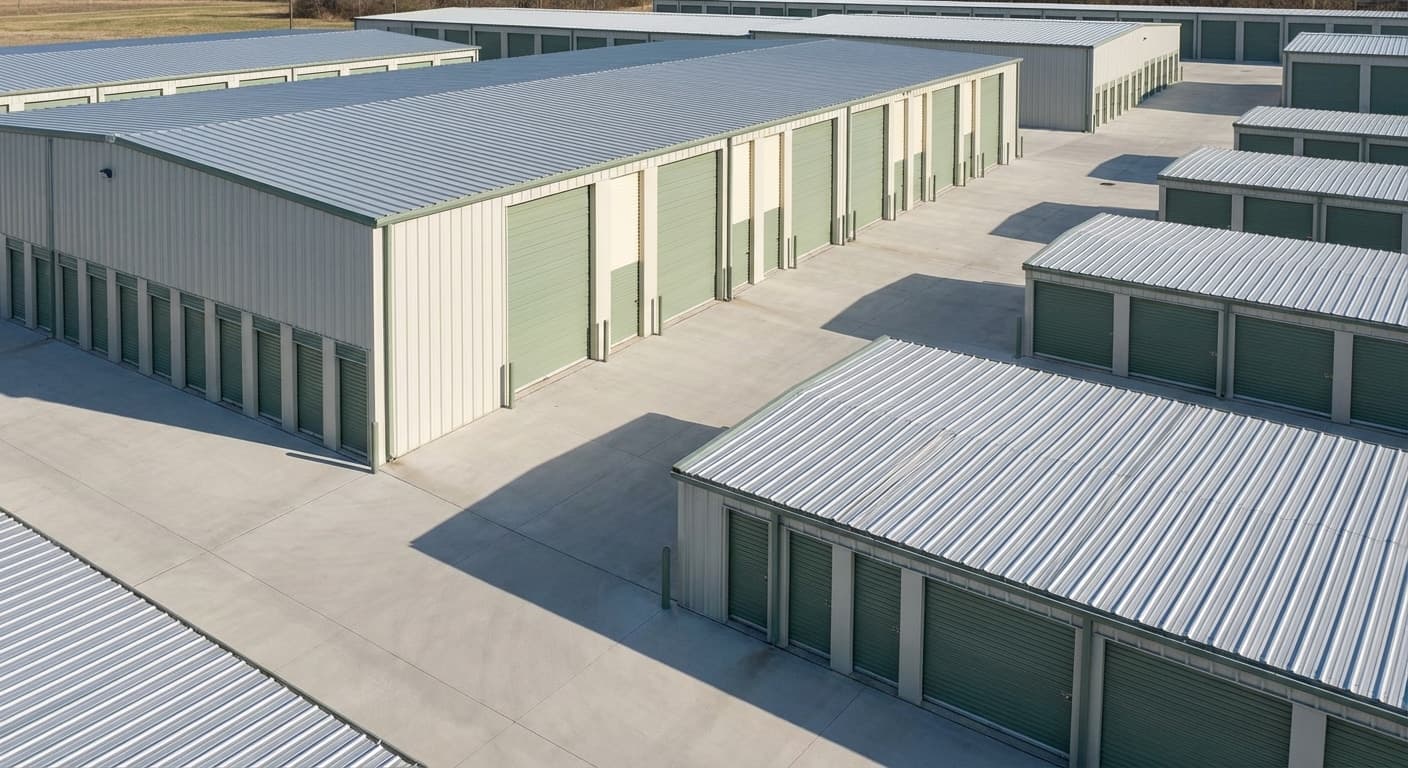

Designing a 40×80 mini-storage building that maximizes rentable square footage hinges on a data-driven door mix, disciplined site planning, and materials chosen for durability, not just price. The article shows how skewing the layout toward smaller, higher-rate units–5x5s yield 2.5x the revenue per square foot of 10x30s–while using roll-up doors, 35-foot aisles, and optional mezzanines can recapture dead space, boost occupancy above 93%, and compound monthly income. Readers learn to match unit sizes to local demand, allocate 44% of doors to climate control, install 8-foot heights and multi-point locks up-front, and leave structural flexibility for quick re-partitioning when market preferences shift. It quantifies the financial stakes: every foot of wasted aisle can erase $16,000 a year, land and site costs inflate true construction price to $3-8 per rentable foot, and modular reconfiguration plus dynamic pricing can raise revenue 4-8% by closing the gap between physical and economic occupancy. With maintenance set at 5% of gross income and steel choices like 24-gauge Galvalume panels cutting lifetime upkeep, the piece delivers a concise playbook for turning a standard 3,200-ft² shell into a resilient, high-yield asset that outperforms fixed-layout competitors.
Designing the Optimal Door Mix for a 40×80 Mini Storage Building
Smaller units generate 2.5x more revenue per square foot than large ones, so right-sizing your door mix directly protects your profit margin.
Assessing tenant needs and unit size distribution
Your door mix directly drives revenue. Get it wrong, and you're stuck with empty units eating your profit margin.
Start with hard data. Check your competitors' occupancy rates by unit size. Review your own rental history if you're upgrading an existing facility. The numbers tell a clear story: smaller units generate more revenue per square foot. A 5×5 unit pulls $2.24/sf while a 10×30 averages just $0.88/sf. [1] That's not a minor difference–it's a 2.5x revenue multiplier that compounds month after month.
Location shapes demand. Urban facilities fill 5×5 and 5×10 units fast. Suburban and rural markets need more 10×20 and larger drive-up spaces. [2] Match your door configuration to your market, not a generic template.
Large units create vacancy headaches. One empty 10×30 unit represents massive lost revenue potential. Split that same space into smaller units, and you recover faster when tenants leave. [2] You also spread your risk across more renters.
Climate control adds another layer to your planning. Nearly 44% of storage renters now want temperature-controlled units–almost equal to standard storage demand. [1] Factor this into your door allocation from the start, not as an afterthought.
Choosing door types that maximize usable square footage
Roll-up doors dominate the industry–85% market share–for one reason: they maximize rentable space. [5] When open, the door coils around a steel axle overhead. Your tenant gets full access to every square foot they're paying for.
Swing doors waste space. They need several feet of clearance outside the unit to open. That clearance directly cuts into your drive aisles–space covered in detail in our layout planning section. [4] In a 40×80 building, every foot counts. Roll-up doors give that space back.
Door sizing follows proven standards:
- Small units (5×5, 5×10): 3-4 feet wide by 7 feet tall
- Medium/large units (10×10 to 10×30): 8-9 feet wide by 7 feet tall [5]
Width matches unit width, not depth. A 10×30 and 10×10 use the same door size.
Height makes the difference. Eight-foot doors beat the traditional 7-foot standard. They handle modern pickup trucks and tall furniture without damage. Cost difference? About $50-100 per door. [5] That small investment prevents damage claims and keeps tenants happy–both direct hits to your bottom line.
Swing doors work in specific situations. They free up full ceiling height for tall items. Tenants can load right to the threshold. [4] But in drive-up configurations–your most common 40×80 layout–they create traffic conflicts. Save them for interior climate-controlled corridors where you control traffic flow better.
For
Balancing security, accessibility, and cost efficiency
Security eats 3-5% of your total construction budget. [6] Stay within that range while maximizing protection.
Door hardware gives you the clearest cost-benefit choices:
- Hardwired alarms: Cheapest per unit
- Wireless alarms: Mid-range pricing
- Electronic locks: $50-250 per door, but slash unauthorized access [6]
Multi-point locking pays off on exterior units. These systems engage the frame at several points, stopping forced entry where it's most likely. [7]
Facility-wide security adds up fast:
- Access control systems: $7,700-30,000
- Cameras: $300-400 each, installed [6]
Build these costs into your initial budget. Adding security after construction blows your numbers and leaves gaps tenants notice.
Door durability matters as much as locks. Use minimum 16-gauge galvanized steel–it handles daily abuse for years. [7] Choose models with enclosed pre-greased springs and dead-axle assemblies. Spring seizure is your biggest maintenance headache. When a tenant can't open their unit, you've got both a security and service problem. [7]
Smart operators treat security as a budget line from day one. You'll allocate better across hardware, cameras, and access control. Your tenants see the difference–and stay longer.
Strategic Layout Planning to Increase Rentable Space
Every two feet of unnecessary aisle width costs over $16,000 annually, making aisle discipline a financial decision that compounds throughout your facility's operating life.
Configuring aisle widths and circulation paths
Aisle width is one of the most consequential layout decisions in a 40×80 project because it directly determines how many unit rows the site can support. Standard drive aisles run 25 to 30 feet between building rows, with 30 feet at building ends to give vehicles room to turn out cleanly. [9] Over-widening by even two feet across a full site can eliminate enough land to fit an entire additional row of units–and losing 1,000 rentable square feet to unnecessarily wide aisles costs over $16,000 annually at current national averages, compounding every year the facility operates. [8] That makes aisle discipline a financial decision, not just a layout preference.Circulation design carries equal weight.
Dead ends are the most common traffic planning mistake in drive-up facilities: they force drivers handling rented trucks or unfamiliar trailers to reverse, which raises the probability of vehicle-to-building contact. [9] Minimizing them–or eliminating them entirely–reduces both damage claims and the operational friction tenants remember. Entrance design works the same way: a minimum 30-foot entrance width, with stacking space for at least three vehicles before the security gate, prevents access bottlenecks during peak hours. [10] In northern climates, bump the standard 25-28-foot aisle up to 35 feet to preserve snow storage capacity without blocking unit doors after a plowdown. [9] On orientation, aligning buildings parallel to the property's longest dimension cuts the total number of drive aisles required, which directly raises the percentage of the site dedicated to rentable space. [10]
Integrating mezzanine and loft options within 40×80 dimensions
A mezzanine adds a second rentable floor within your existing 40×80 envelope–no footprint expansion, no additional land–making it one of the highest-leverage moves you can make when the building's eave height supports it. [12] The mechanism is straightforward: by increasing the floor-to-ceiling height at the design stage, you create room to stack units vertically, converting a single layer of 5×5 lockers into two stacked tiers and effectively doubling your unit count in that section without adding gross floor area. [11] That floor-area distinction matters in markets where zoning applies floor-area ratio (FAR) caps, since vertical storage gains through mezzanines may not count against the allowable limit the same way a horizontal addition would–a point worth confirming with local zoning review during due diligence. [11] For operators converting existing space, the same logic applies to underused areas: old mechanical rooms, oversized elevator lobbies, and abandoned shaft ways can be redesigned into storage units, and the irregular shapes these spaces create are often well-suited to smaller locker configurations that a mezzanine framework supports. [11]Access and code compliance are where mezzanine plans most often stall if you don't address them early.
Your tenants storing items in upper-tier lockers need rolling step ladders to reach them, which requires a designated staging area on the mezzanine level itself–square footage you need to subtract from the unit-count projection before the revenue math looks real. [11] Fire and sprinkler codes add a harder constraint: any new rentable mezzanine level in a sprinklered building requires extending coverage to that level, and in facilities that weren't originally sprinklered, the addition can cross a threshold that triggers a full retrofit of your existing structure. [11] The economics still typically favor mezzanines in high-density configurations–especially when you're working with
Optimizing unit placement for peak occupancy
Unit placement within your 40×80 footprint shapes occupancy as much as any pricing decision, and the highest-leverage moves are often structural.
Building ends are the clearest example: placing 5×10 or 10×10 units at the terminus of each row captures space that might otherwise become an irregular filler section, while simultaneously increasing your count of smaller, faster-turning units in the parts of the building tenants pass first. [9] Orienting buildings perpendicular to the main road compounds this by creating visible sightlines between rows, which discourages loitering and makes your facility feel more secure to prospective tenants evaluating it from the street. [9] As detailed in the earlier door mix section, your placement strategy must match local demand patterns–but the key is building in flexibility from day one.
Once your facility is operating, a rolling 12-month review of occupancy by unit type becomes your most reliable tool for catching mismatches: if 10x15s sit empty while 5x10s have a waitlist, that's your direct signal to reconfigure using modular steel partitions, which let you split larger units without structural modification. [1] The unit mix isn't a fixed decision–it's a variable you should adjust as demand shifts, and building with partition flexibility from the start is what makes those adjustments financially practical rather than prohibitively disruptive. [1]
Material Selection and Construction Best Practices
Upgrade from 29-gauge to 26-gauge steel and you'll eliminate costly callbacks while keeping tenants satisfied through snow loads and weather extremes.
Selecting high-quality steel panels for durability
Here's what you need to know about steel gauges: smaller numbers mean thicker steel. A 22-gauge panel beats 29-gauge every time. [15] For your 40×80 storage building, 26-gauge handles most jobs, but if you're building where snow piles up or wind howls, go with 24-gauge–it carries heavier loads without extra supports. [13] In post-frame buildings, where panels span between supports with no backup sheathing, thicker panels pay for themselves. They bridge longer distances, so you need fewer interior posts eating up rentable space. [13] Don't fall for the 29-gauge trap. Sure, it costs less up front and works fine on barns, but when snow loads exceed expectations or rust shows up early, you'll lose tenants and trust while scrambling for repairs. [14]
Galvalume coating is your maintenance-free answer. This protective layer stops corrosion without painting or yearly upkeep, saving you money and headaches in wet or salty climates. [15] Bottom line: match your gauge to your location's actual demands. That small price bump from 29- to 26-gauge protects you from callbacks and keeps tenants happy. [14]
Ensuring precise erection for door alignment and structural integrity
Your doors will only align if your foundation starts right. Misplaced anchor bolts create expensive problems that ripple through the entire frame. [16] Before concrete trucks arrive, double-check bolt templates with laser levels–not just tape measures–and verify your ground compaction meets specs. These steps prevent the costly rework that kills schedules. [17]
Standard storage buildings use post-and-purlin framing: columns every 5 feet across, 10 feet lengthwise, with overlapping roof purlins creating one continuous structure. [18] Miss those measurements by inches, and you'll see it when doors won't close or panels gap.
Here's what goes wrong: contractors make field "improvements" without checking engineering specs. They modify connections. They change sequences. They think they're helping. Instead, they void your warranty and fail inspection. [16]
The fix is simple: walk every drawing before work starts. Compare site conditions to plans. When something doesn't match, stop and call. No guessing, no shortcuts. Every change needs approval–that's how you get doors that work and buildings that last. [16]
Single-source solutions for fast, reliable installation
When one company handles your entire 40×80 project–engineering, materials, and installation–coordination headaches disappear. You get one phone number for everything: drawing changes, delivery updates, field questions. No three-way confusion, no finger-pointing, just answers. [19]
Here's your timeline with a single-source partner: stamped plans in 2-4 weeks for standard projects (8-16 for complex ones), materials delivered 4 weeks after approval, construction complete in 1-2 weeks with licensed, insured installers. [19]
Choose kit-only if you have a trusted contractor ready to go–you'll control the schedule tighter. Pick turnkey if you want fewer moving parts and don't have a crew lined up. Either way, you keep that single point of contact. [19]
Financial Impact and ROI of an Effective Door Mix
Door mix optimization reduces your effective cost per rentable square foot by amortizing fixed site and construction expenses across more revenue-generating space.
Calculating rentable square feet versus construction cost
The number that actually matters in a 40×80 build isn't gross square footage–it's cost per rentable square foot, which is always higher than the headline construction figure.
Single-story construction runs $50-$65 per gross square foot before land or site work, but that number understates true cost because roughly 40% of your total developed area goes to drive aisles, common areas, and circulation–space tenants never pay for. [21] Once you account for that overhead, every dollar spent on gross square footage gets distributed across a smaller rentable base, which means door mix decisions that recover even modest amounts of otherwise dead interior space directly reduce your effective cost per rentable foot.
Land follows a parallel logic: the rule of thumb puts land at 25-30% of total development cost, and if land runs $1.25 per gross square foot at 40% site coverage, the true land burden per rentable foot climbs to $3.13–before a single panel is erected. [22] Site development costs add another $4.25-$8.00 per square foot for grading, drainage, and utility runs, and those costs don't scale with unit count, so a door configuration that fits more rentable units into the same footprint amortizes those fixed site expenses across more revenue-generating space. [21] The practical implication: a door mix weighted toward smaller units doesn't just affect monthly rent rates–it directly improves the ratio of rentable area to total construction spend, which is the calculation that determines whether a 40×80 project reaches the 93% occupancy threshold that well-designed facilities in good locations can sustain. [22]
Projecting revenue uplift from flexible door configurations
A door configuration that lets you reconfigure unit sizes on demand doesn't just protect occupancy–it creates a compounding revenue advantage that fixed layouts can't replicate.
The core mechanism is economic occupancy: a facility can be 90% physically occupied while generating only 75% of its potential revenue if the wrong unit sizes are filled and high-yield units sit empty. [23] When a door mix supports modular reconfiguration, you can close that gap by shifting supply toward sizes the market is actively absorbing rather than waiting for slow-turning units to fill.
Operators using dynamic pricing on top of a flexible unit mix report 4-8% higher revenues through occupancy-based rate adjustments alone–and those gains compound when the underlying unit mix is already weighted toward the sizes commanding the highest rates per square foot. [23] Smaller units also create a natural upsell pipeline: tenants who initially rent a 5×5 can graduate to a 5×10 or 10×10 as their needs grow, which keeps revenue inside the facility rather than losing a tenant to a competitor with the right size available. [23] The practical projection model starts with your current unit mix, identifies which sizes have the widest gap between physical occupancy and revenue contribution, and maps the reconfiguration cost against the rent differential recovered–a calculation that consistently favors splitting underperforming large units into smaller configurations that lease faster, churn less, and price at a per-square-foot premium that a single large-unit tenant will never match. [23]
Maintenance planning to preserve long-term value
Maintenance is a fixed cost regardless of occupancy, so the question isn't whether to budget for it but how precisely.
Steel mini storage buildings run $0.10-$0.25 per square foot annually in maintenance–covering cleaning, minor repairs, repainting, and pest control–which is meaningfully lower than traditional construction due to steel's resistance to weather, pests, and structural degradation over time. [24] A practical budgeting rule is to allocate 5% of gross monthly income to maintenance and repairs: on a facility generating $13,500 per month, that's $675 set aside before net income is calculated, which funds reactive repairs without disrupting cash flow. [21] Beyond the dollar allocation, a structured maintenance plan–addressing drainage, door hardware lubrication, panel corrosion checks, and pest control on a defined schedule–catches the small failures that compound into tenant complaints and lease terminations when ignored. [25] The long-term value case for quality materials closes here: operators who select durable, low-maintenance steel panels and professional installation at the outset consistently carry lower per-square-foot maintenance costs across the facility's lifetime, while those who cut material costs upfront absorb the difference through accelerated repair cycles that erode the ROI the original budget projected. [24]
- Smaller 5×5 units earn $2.24/sf vs $0.88/sf for 10×30, a 2.5x revenue multiplier
- Roll-up doors reclaim drive-aisle space; swing doors waste 3-4 ft of clearance per unit
- Mezzanines inside a 40×80 shell can double 5×5 locker count without adding land or FAR
- Every extra 2 ft of aisle width can erase 1,000 rentable sf, costing $16k+ annually
- 26-gauge steel beats 29-gauge for snow/wind loads, cutting posts and freeing rentable space
- Reconfigurable partitions let operators shift supply to high-demand sizes, lifting revenue 4-8%
- Land + site costs convert to $7-$11/sf rentable; denser door mix amortizes these fixed costs faster
- https://www.whitelabelstorage.com/blog/how-to-optimize-your-self-storage-unit-mix?hsCtaAttrib=183394436121
- https://www.linkedin.com/pulse/unit-mix-most-critical-decision-you-can-make-self-storage-harless-ob1sc
- https://www.storagepug.com/blog/planning-your-self-storage-security-budget
- https://www.insideselfstorage.com/site-layout/guidelines-for-a-successful-self-storage-site-layout-plus-tips-for-unit-mix
- https://www.ministorageoutlet.com/site-planning/
- https://www.insideselfstorage.com/conversions-renovations/maximizing-your-net-rentable-square-footage-in-self-storage-inventive-use-of-space
- https://www.americansurplus.com/self-storage-mezzanines/?srsltid=AfmBOooD_24qK4JDmBQk9xFDKZYIw1Lv_BG3ImUHo6Gw9JIpNfiV5C8e
- https://www.metalsales.us.com/blog/selecting-gauge/
- https://www.alpha-labor-co.com/blog/metal-building-erection-mistakes
- https://www.modernstoragemedia.com/msm-exclusives/structural-integrity-framing-systems-for-self-storage
- https://stora.co/blog/how-much-does-it-cost-to-build-100-storage-units
- https://blog.metrolinabuilders.com/calculating-the-cost-of-a-self-storage-facility-build
- https://www.modernstoragemedia.com/msm-exclusives/operational-innovations-driving-self-storage-facility-profitability