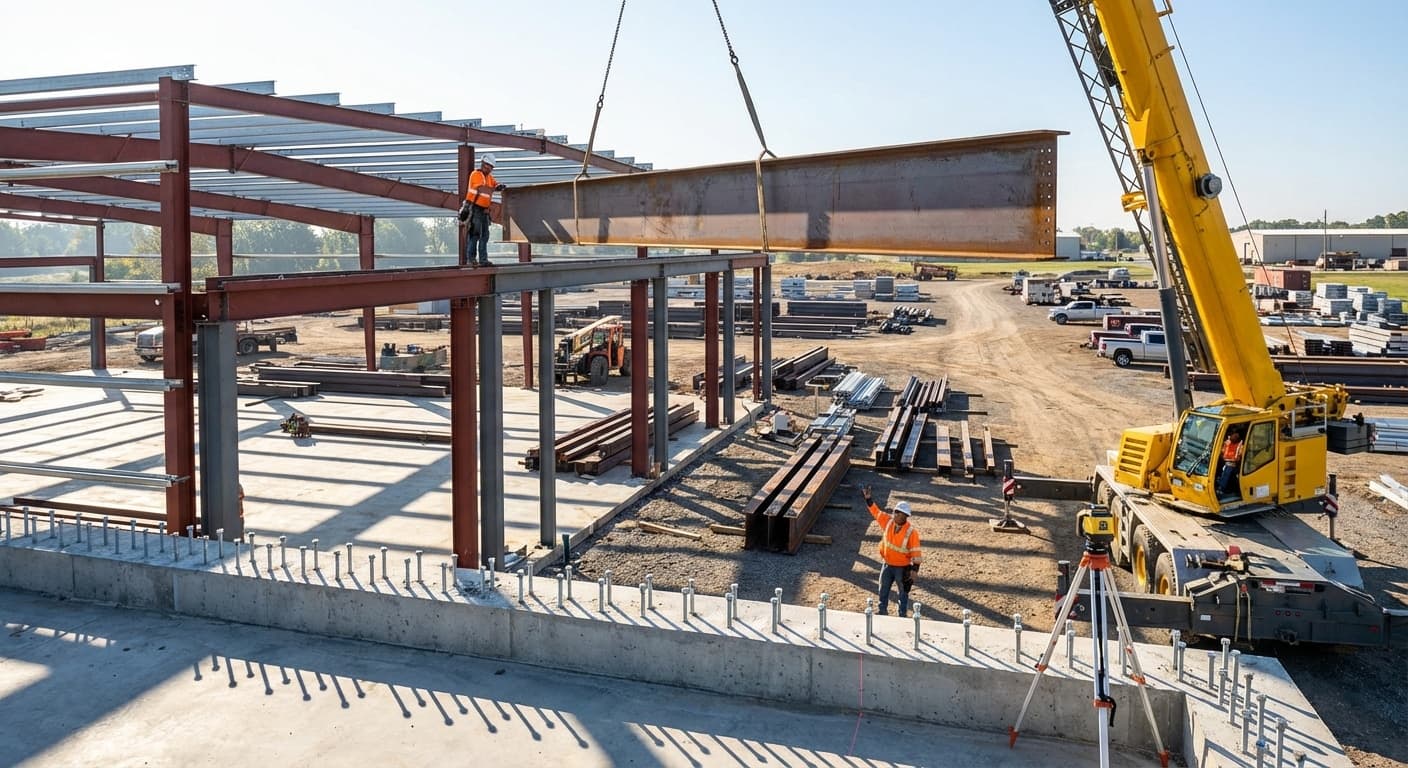

Hiring pros for a 40×80 steel building turns a risky DIY gamble into a predictable, on-time, on-budget success: they start with geotechnical testing and engineered foundation layout that prevent costly fixes later, coordinate multi-permit stacks and 12- to 20-week steel lead times so crews and materials arrive together, and erect the frame with laser-guided precision, OSHA-compliant fall protection, and sequential bracing that eliminates the wobble and rework that plague amateur jobs. A single-source provider who designs, fabricates, and erects under one contract compresses schedules, locks in steel pricing against market spikes, removes finger-pointing warranty gaps, and delivers drawings that already reflect real-world site constraints. After the last bolt is torqued, the same expertise guides insulation choices that cut HVAC costs 50 %, seals hidden air leaks before they rust the frame, and assembles the inspection package that keeps final payment and occupancy on track. Readers walk away knowing exactly why soil data, anchor-bolt tolerances, integrated procurement, safety roles, and post-erection envelope sealing determine whether their 3,200 ft² building stands maintenance-free for decades or bleeds money from day one.
Strategic Planning for 40×80 steel building erection
Geotechnical testing translates your soil conditions into precise foundation specs, protecting you from thousands in post-steel fixes.
Site assessment and foundation layout for a 40×80 build
Your 40×80 steel building starts below ground–and the soil beneath your footprint tells you exactly what foundation you need. Professional geotechnical testing isn't red tape; it's your insurance against the expensive surprises that derail projects. [1]
Here's what matters: Clay soils expand when wet and shrink when dry, creating forces that crack slabs and stress connections. Sandy soils drain well but offer less support. Your soil test translates these realities into clear specs–foundation depth, rebar requirements, and whether you need soil treatment before pouring concrete. [2] Skip this $500-1,500 test, and you risk thousands in fixes after steel's already ordered. [2]
For stable soil, you'll typically use a monolithic slab–footer and floor poured as one unit. The slab runs 4-6 inches thick, thickening to 12-18 inches where columns sit. [2] Got a slope? Pier foundations often beat the cost of grading flat, following your natural terrain while still reaching solid bearing. [2]
The anchor bolt layout is where precision pays off most. Your manufacturer provides an exact bolt plan, and staying within tolerance matters–even small deviations create alignment headaches during erection (covered in detail in our Professional Erection Process section). Templates or positioning jigs during the pour keep bolts precisely where they belong. [2]
Permitting, engineering stamps, and code compliance checklist
You need more than one permit for your 40×80 steel building–you need a coordinated stack that all align before breaking ground:
- Building permit for structural and foundation work
- Zoning permit confirming your use matches the land classification
- Site development permits for grading or drainage changes
- Separate electrical, plumbing, and mechanical permits [3]
Before submitting anything, call your local building department. Ask which IBC edition they've adopted, what wind and snow loads they require, and whether they mandate special inspections. These details vary dramatically between jurisdictions–assumptions cost money. [3] Your location drives the design: hurricane-zone wind ratings, seismic requirements, heavy snow loads all factor into calculations your building must satisfy. [3]
The Engineer of Record (EoR) stamp makes everything official. Your manufacturer provides drawings; the EoR confirms they meet code for your specific site and conditions. No stamp, no permit approval. [3] That's where
Coordinating material ordering and delivery timelines
Steel takes 12-20 weeks from order to delivery–the longest lead time in your entire 40×80 project. [5] Order late, and you compress everything downstream. The math is unforgiving: your foundation needs curing time before steel goes up, your crew needs steel on site before they mobilize, and none of this coordination happens by itself. [5]
Late materials create chain reactions: crews sit idle, subs leave for other jobs, and your schedule slips while the manufacturer's production timeline stays locked. [6] Smart project managers work backward from erection day:
- Steel components: 12-20 weeks
- Roofing panels: 4-6 weeks
- Electrical components: 3-5 weeks [6]
Lock in specific delivery windows, not "sometime that week" promises. Build 1-2 week buffers into long-lead items and track shipments actively–scheduled arrival times are targets, not guarantees. [6]
Don't forget site logistics. Your steel arrives on flatbed trailers needing clear, solid access roads and staging areas where forklifts can operate safely. [4] Confirm these details before dispatch, or watch your delivery fail–or worse, damage components during improvised unloading.
Just-in-time delivery saves storage headaches on your 40×80 footprint but leaves zero margin when trucks run late. Balance your risk: some on-site storage beats explaining to your erection crew why they're standing around an empty foundation.
Professional Erection Process vs DIY
Professional crews hold tolerances within millimeters using laser plumbs and electronic theodolites, preventing ground-level errors from compounding into inch-wide misalignments at your roofline.
Sequencing the frame: columns, beams, and bracing
You'll see the difference between professional and DIY erection in the first hour on site. Professional crews work from a fixed sequence where precision compounds–get the first column wrong, and you're fighting that error through every subsequent connection. Your columns seat onto anchor bolts and base plates first, with grouting beneath to distribute loads evenly. Our crews verify vertical alignment using laser plumbs and electronic theodolites, holding tolerances within millimeters because we know a quarter-inch error at ground level becomes an inch at the roofline. [7] Starting position depends on your site: we'll typically erect from the center bay outward or from one end bay, letting site geometry dictate the most efficient sequence. That first column-and-rafter pair sets the alignment reference for your entire building. [8] Once columns are plumb, mobile cranes position beams while rigging teams guide them onto connections–then high-strength bolts or field welds lock everything in place based on your structural requirements, not what's convenient. [7]
Bracing comes last but it's not optional. Those diagonal steel members between columns and beams are what keep your building from racking under wind load. Professional crews install cross-bracing or K-bracing per engineering specs before releasing crane holds–because an unbraced bay in a windstorm isn't a future problem, it's an immediate collapse risk. [7] [8]
Precision anchoring and alignment techniques for 40×80 steel building erection
As discussed in the foundation layout section, anchor bolt precision determines whether your 40×80 building goes up smoothly or fights you at every connection. What separates professional crews from DIY attempts isn't just accuracy–it's knowing how to maintain that accuracy through the entire erection sequence. [11]
Professional erection teams bring a systematic approach to alignment that DIY crews often miss. We verify plumb and square bay by bay using laser levels and digital tools, but here's the key: we keep connections slightly loose across an entire section before final torquing. This gives us the adjustment window to correct cumulative errors before they're locked in permanently. [9]
When foundation issues do surface–and they will–professional crews have the fixes ready. Minor deviations get handled with approved methods like slotted base plates. Major problems require engineered solutions, never field workarounds. The difference? We've seen these issues hundreds of times across our 1,480+ completed buildings. You're seeing them for the first time. [10]
Safety protocols and crew management on site
Steel erection is dangerous work–approximately 35 fatalities and 2,279 lost-workday injuries happen annually among structural metal workers. [12] That's why professional crews operate under strict safety protocols you won't find on DIY sites. OSHA's Subpart R sets fall protection at 15 feet for steel erection rather than the standard 6 feet–because workers balance on narrow beams above open bays where anchor points don't exist yet. [12]
On your 40×80 build, fall exposure starts at the first column and continues until decking and perimeter cables are installed. Professional crews know this window and protect against it from day one.Professional erection sites run on defined safety roles, not casual assignments. Your site needs a competent person who can spot hazards and has authority to stop work–they're inspecting the crane before any lift, checking controls, wire rope, hydraulics, and ground conditions. [12] A qualified rigger inspects all rigging equipment each shift. The crane operator can refuse any unsafe load regardless of schedule pressure–that's regulatory authority, not company policy. [12]
These aren't bureaucratic checkboxes. On your 40×80 site with one crane making every structural lift, these three people determine whether work proceeds safely or stops.Connectors–the ironworkers placing beams while cranes hover overhead–work under specialized protection rules. Between 15 and 30 feet, they need fall arrest systems and proper tie-off points. Above 30 feet, full protection is mandatory. [12]
For decking work, professional crews may establish Controlled Decking Zones (CDZs) with strict limits: trained workers only, 3,000 square feet maximum, clear boundaries, and never above 30 feet. On your single-story 40×80 build, CDZs are an option–but only with proper setup and trained crews. [12]Professional crews don't just show up trained–they show up with the right training for each specific task. Everyone gets baseline fall protection training, but specialized work requires specialized preparation. Connectors learn double-connection procedures. Riggers train on multi-lift hazards. CDZ workers complete zone-specific safety courses. [12]
This matters because falls cause over 50% of steel erection fatalities. Professional crews install horizontal lifelines from the first beam, shrinking fall zones throughout your project. [13] Our competent person knows exactly who's qualified for which tasks–and has authority to keep unqualified workers out of danger zones. That's how professional erection teams maintain their safety records across hundreds of projects.
Benefits of NSB's Single‑Source Solution
Single-source delivery eliminates communication gaps by running design, fabrication, and erection concurrently under one point of accountability, reducing RFIs and change orders.
Integrated design‑to‑erection communication workflow
The most persistent source of delay and cost overrun in steel building projects isn't a single failure–it's the communication gap between parties who designed the building and parties erecting it. Traditional project delivery fragments this relationship across separate contracts, meaning the fabricator learns about field constraints after drawings are locked, and the erection crew encounters design decisions that were never vetted against site reality.
Single-source delivery closes that gap structurally. When design, fabrication, and erection sit under one roof, communications between all parties are based on 2-D and 3-D digital documentation with full coordination of all building systems and components–meaning details at the level of fabrication drawings are input during design, which eliminates shop drawing review cycles later. [15] The practical effect is that design and construction run concurrently rather than sequentially: as soon as the building structure is designed, foundation requirements are finalized, allowing site and concrete work to begin while the building package is still being fabricated. [15] For the erection crew, this means arriving on site with drawings that were built around the actual structure they're assembling–not generic shop drawings that have drifted through multiple revision cycles.
Managing the entire PEMB scope under one point of accountability also reduces RFIs, change orders, and crew downtime caused by information gaps between trades. [16] Where multi-vendor projects force project managers to arbitrate between conflicting interpretations of the same drawings, integrated teams resolve those conflicts before fabrication begins, when changes cost time instead of money.
Cost control through market‑monitored pricing and single‑source procurement
Splitting a 40×80 steel building project across separate vendors for design, fabrication, and erection doesn't just introduce coordination risk–it actively erodes your pricing position at every transaction. When spend is fragmented, volume leverage disappears: each vendor sees only its slice of the project, which means none of them have the consolidated spend needed to offer meaningful pricing concessions.
Retailers consolidating suppliers have achieved up to 12% cost reductions through scale effects alone, and the same logic applies directly to construction procurement. [17] Beyond the unit price, multi-vendor projects multiply administrative overhead–multiple quotes, contracts, invoices, and compliance audits–with industry data showing procurement teams managing multiple vendors spend 30 to 40% of their time on administrative coordination tasks that produce no direct project value. [17] Single-source procurement eliminates that overhead structurally, reducing the entire procurement footprint to one accountable relationship. The cost control benefit isn't just transactional, either.
Locking in pricing through a single-source contract converts what would otherwise be open exposure to steel market volatility into a defined, manageable cost–a form of cost avoidance that doesn't show up as a line-item saving but prevents budget overruns that multi-vendor projects absorb late in the schedule when changes cost money rather than time. [18] Avoiding a future price escalation through smarter contract terms is every bit as valuable as negotiating a lower upfront price, and in a category as volatile as structural steel, market-monitored pricing through an integrated provider is one of the clearest mechanisms available for protecting a project budget from the point of order through erection completion. [18]
Warranty protection and post‑erection support services
Warranty coverage on a steel building splits into two distinct layers that protect different failure modes over different timeframes–and understanding that split determines whether a future claim succeeds. Workmanship warranties cover erection-related defects: misaligned connections, improper fastening, and installation errors that surface in the months after the building is occupied.
These typically run 90 days to 5 years depending on the provider. [19] Structural and coating warranties operate on a different scale entirely–40-year limited coverage on factory-painted siding, roofing, and structural framing is the industry standard, covering rust-through and long-term deterioration under normal conditions. [20] The distinction matters because warranty voidance usually comes from the owner's side, not the manufacturer's: unauthorized modifications–drilling into frames, removing bracing, or adding load-bearing elements without engineering review–can void all or part of coverage regardless of how many years remain. [20] A single-source provider simplifies this exposure significantly. When one entity holds accountability for both fabrication and erection, there's no jurisdictional ambiguity over whether a defect originated in manufacturing or installation–a gap that multi-vendor projects routinely exploit when claims arise.
Maximizing coverage over the building's life comes down to three practices: scheduled inspections, post-weather walkthroughs to catch minor damage before it compounds, and organized documentation of warranty certificates and installation paperwork so claims can move without delay. [20]
Optimizing Performance After Erection
Seal every gap before insulating to prevent air leaks that kill performance, then choose insulation based on your climate to cut heating and cooling costs by up to 50 percent.
Weatherproofing, insulation, and energy‑efficiency upgrades
Steel transfers heat faster than you want–warm interior air hits cold steel and creates condensation that breeds rust and mold while ruining your insulation. [21] Start with the envelope. Before you even think about insulation type, seal every gap. Air leaks kill insulation performance no matter the R-value. Use caulk for small openings, expanding foam for the bigger ones around windows, doors, and frame joints. [22] Once you've sealed it tight, pick insulation based on your location and use. Hot climate? Reflective foil bounces heat away and cuts cooling costs. [23] Cold or variable climate? Fiberglass blankets fit between your wall and roof panels without any structural changes. [22] Spray foam works everywhere–it fills irregular gaps, blocks moisture, and deadens sound. Perfect for a 40×80 space where machinery noise would otherwise echo off bare metal. [23] Need maximum R-value in tight spaces? Rigid board insulation keeps its shape and performance for the building's lifetime. [22]
Here's what matters to your budget: properly insulated steel buildings cut heating and cooling costs by up to 50% versus uninsulated structures. Install it right after erection–waiting costs you money every month. [23]
Final inspection, punch‑list completion, and documentation
The last 10% of your project is where profits vanish–not from big mistakes, but from small details that pile up under deadline pressure. Rework alone eats 5% of project value. On a mid-size build, that's your margin gone. [24] Don't work faster–work smarter. Run a systematic walkthrough covering every phase: structural framing, sheeting and trim, weatherproofing, accessories, site cleanup. Check them off in order. [24] That unsealed ridge vent? Takes 45 minutes to fix now. Leave it for the first storm and you're looking at $10,000 in damage–failed insulation, corroded steel, occupancy delays, warranty fights. [24]
The licensed inspector from your local building department runs the official final inspection. They verify every system meets code before issuing your certificate of occupancy. No CO means no occupancy–and for contractors, no final payment. [25]
Documentation saves deals. Your inspection package needs erection logs, bolting records, NDE reports, welding logs, and timestamped photos of everything that'll be hidden behind walls or above ceilings. Once it's closed up, that evidence is gone forever. [26] Here's why it matters: 63% of construction pros say documentation gaps are the top reason for payment delays. Show up with organized records and you turn negotiation into a formality. [24]
Maintenance‑free upkeep and long‑term ROI for 40×80 steel building erection
Your 40×80 steel building pays you back two ways: what you don't spend on maintenance and what you keep in resale value.
Steel doesn't rot, warp, or feed termites.
Modern protective coatings and
- Geotechnical soil testing ($500-1,500) prevents foundation failures that cost thousands after steel is ordered.
- Steel delivery takes 12-20 weeks–late orders idle crews and cascade delays across the entire project schedule.
- Professional crews keep connections loose across bays to correct cumulative errors before final torquing.
- Single-source design-build cuts RFIs, change orders, and procurement overhead by consolidating accountability.
- Proper insulation installed right after erection can slash heating/cooling costs by up to 50%.
- https://lionbuildings.com/the-ultimate-guide-for-foundations-for-metal-buildings/
- https://mbmisteelbuildings.com/blog/steel-building-foundation/
- https://www.arcosteel.com/what-permits-and-codes-are-required-for-steel-buildings/
- https://unionsteelstructures.com/what-to-expect-during-a-steel-building-delivery-and-setup/
- https://cookshellcontractors.com/timeline-management-for-projects/
- https://affiliated-lumber.com/avoiding-project-delays-with-proper-material-scheduling/
- https://www.allaboutlgsf.com/post/steel-structure-erection-process-comprehensive-step-by-step-engineering-guide
- https://hgptsteel.com/5-standard-steps-for-erecting-a-pre-engineered-steel-building/
- https://iconsteelbuildings.com/how-to-erect-a-metal-building/
- https://greatwesternbuildings.com/anchor-bolt-troubleshooting-pre-engineered-metal-building-install/
- https://www.fortifybuildingsolutions.com/resources/blog/how-to-read-steel-building-anchor-bolt-plans/
- http://www.osha.gov/laws-regs/federalregister/2001-01-18-0
- https://www.hcsteelstructure.com/a-comprehensive-guide-to-steel-erection-best-practices-safety-and-structural-excellence/
- http://www.osha.gov/steel-erection
- https://continuingeducation.bnpmedia.com/architect/course_lms.php?l=metal-building-manufacturers-association&c=specifying-the-latest-in-metal-buildings
- https://m2steelsystems.com/
- https://acopia.co.uk/resources/retail/single-source-procurement-vs-multiple-suppliers-retail-cost-savings/
- https://www.redbearnegotiation.com/blog/cost-avoidance-vs-cost-savings
- https://www.millerbldgs.com/pre-engineered-steel-buildings/
- https://atlanticsteelstructures.com/warranty/
- https://armstrongsteel.com/blog/weatherproofing-your-steel-structure-tips-for-extreme-climates
- https://mbmisteelbuildings.com/blog/insulating-a-steel-building-a-comprehensive-guide/
- https://www.steelcobuildings.com/effective-strategies-for-insulating-steel-buildings/
- https://www.tylerbuilding.com/post/the-metal-building-checklist-that-protects-your-margins
- https://www.procore.com/library/final-inspection
- https://safetyculture.com/checklists/structural-steel-inspection
- https://www.summitsteelbuildings.com/20-year-cost-comparison
- https://idadevelops.com/what-is-the-life-expectancy-of-a-steel-building/