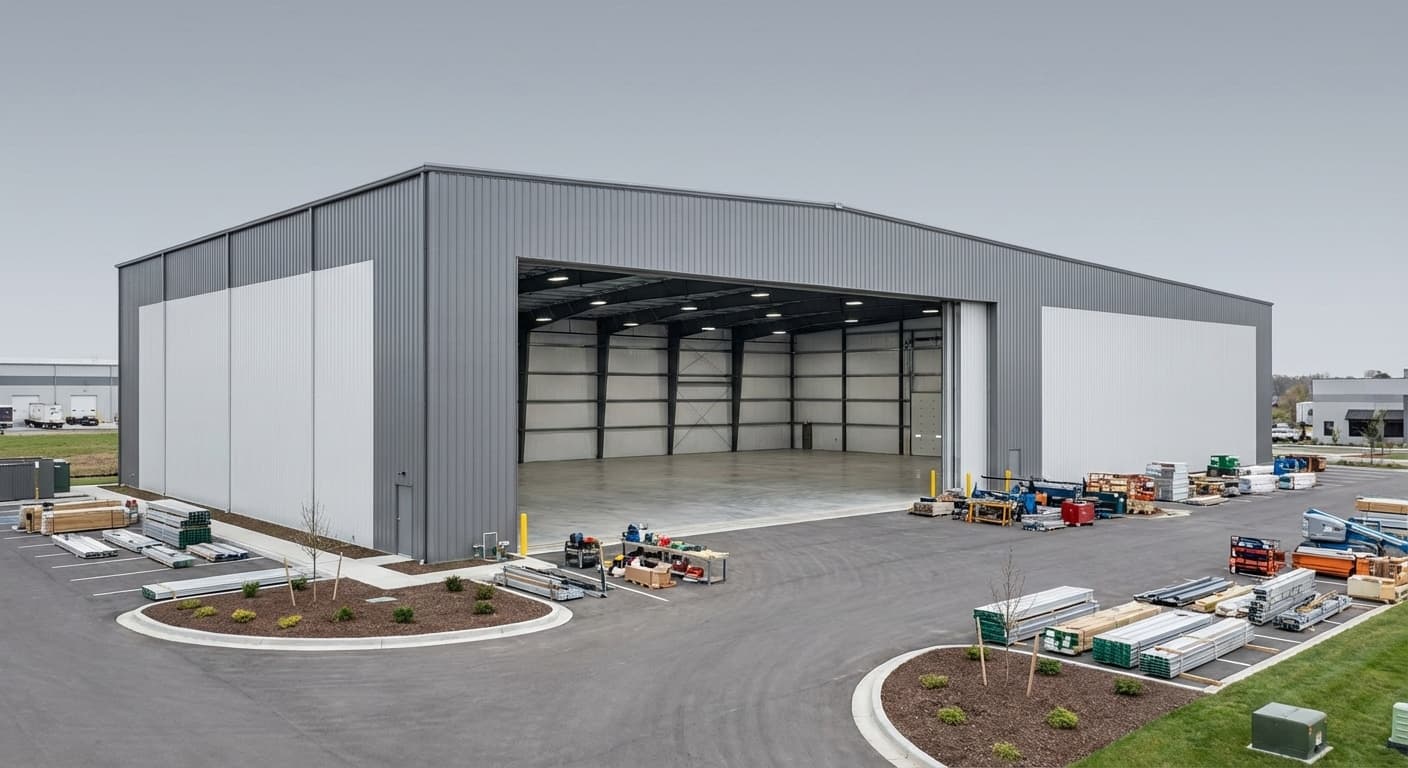

A 50×100 metal building delivers 5,000 square feet of column-free, adaptable space that slashes per-square-foot costs while outlasting wood structures against fire, rot, and storms, and this guide walks you through every decision–choosing clear-span versus traditional framing, budgeting $125k-$230k all-in, engineering foundations for soil and code loads, selecting insulation and doors that prevent condensation and energy waste, navigating permits in weeks instead of months, and managing a 7-10-week professional build–so owners can confidently design, finance, and maintain a single, scalable envelope that works as hard for manufacturing, agriculture, or mixed-use growth as it does for long-term savings and 40-year durability.
Benefits and Ideal Uses of a 50×100 Metal Building
A 50×100 steel building gives you 5,000 square feet of column-free workspace that adapts to your business while costing less per square foot than smaller structures.
Key advantages of the 50×100 footprint
You get 5,000 square feet of uninterrupted workspace with a 50×100 steel building–enough room to grow without wasting an inch [1]. Your cost per square foot drops as you go bigger, making this size a smart investment compared to piecing together smaller structures [2]. The magic is in the engineering: just three frame lines create four 25-foot bays, cutting your material costs, foundation expenses, and construction time [3]. You keep full structural strength while eliminating support columns that get in the way of forklifts, production lines, or whatever moves through your space.The 50×100 footprint gives you flexibility to design it your way.
You can add overhead doors, windows, and access points wherever you need them–just keep large openings away from corners if you're in high-wind country [3]. Choose clear-span construction and you eliminate interior columns completely, leaving every square foot available for equipment, inventory, or specialized work areas [2]. With 5,000 square feet to work with, you can combine everything under one roof–office up front, manufacturing in the middle, storage in back–all in one cost-effective structure [1].Your 50×100 building works harder than just providing space. You have room to install large equipment, move vehicles freely, and design workflows that actually flow [1].
The rectangular shape saves you money–less exterior wall per square foot means lower material costs, while still giving you plenty of wall space for doors, windows, and utility connections [2]. Steel construction protects your investment from fire, termites, rot, and storms that destroy wood buildings. You build it once and it stays standing, saving maintenance costs year after year [1][2].
Top industries and applications
Your 50×100 steel building adapts to whatever business you run. Manufacturing?
You get open floor space for equipment that can be reconfigured as you grow [4]. Agriculture?
Store tractors, house livestock, or create an indoor riding arena–all protected from weather that would rot wood structures [5][6]. Our
Clear‑span design versus traditional framing
Your biggest decision: clear-span or traditional framing. Clear-span eliminates all interior columns–you get 5,000 square feet with nothing in the way [7]. The self-supporting rigid frames carry all loads to the exterior walls, perfect when you need to move equipment, vehicles, or materials without dodging posts [7]. Manufacturing plants, farm buildings, indoor arenas–anywhere you need room to maneuver, clear-span delivers [7].
Change your layout anytime without working around columns [8].Traditional framing uses interior support columns to share the load, which means lighter steel members and lower material costs [7]. For your 50×100 building, the price difference between clear-span and traditional framing stays small [7]. Go wider than 80 feet, and traditional framing starts saving serious money. At 150 feet wide, the savings become substantial–unless you absolutely need that open space for operations [7].The engineering tells the story: clear-span needs heavier steel members to carry the full load across 50 feet [7].
Add interior columns with traditional framing, and you can use lighter steel throughout [7]. At 50×100, clear-span stays cost-competitive while giving you maximum flexibility [9]. Your choice comes down to operations–if you need every square foot clear, go clear-span. If a few columns won't hurt your workflow, traditional framing saves money on larger buildings [8].
Accurate Cost Planning and Financing for Your 50×100 Metal Building
Your 50×100 metal building costs $125,000-$230,000 installed, with foundation work and professional erection claiming the largest portions of your budget.
Current material pricing trends and total installed cost
Your 50×100 metal building investment ranges from $125,000-$230,000 fully installed [10][12]. Here's what drives your total cost:
Base Components:
- Steel materials: $12-$14 per square foot ($60,000-$70,000 total)
- Concrete foundation: $3-$20 per square foot ($29,000-$100,000)
- Professional erection: $5-$12 per square foot ($35,000-$60,000) [10][12]
Steel prices shift with market conditions, but national buying power helps control costs. Your location determines the exact engineering requirements–Florida needs hurricane-rated components, while Colorado requires heavy snow loads [11]. Each adjustment affects your bottom line.
What's included in that base quote? The structural shell: primary framing, secondary supports, roof and wall sheeting [11][12]. What's not? Everything that makes it functional–electrical, plumbing, HVAC, insulation, interior walls, and finishes. Don't skip insulation to save money. Without it, condensation forms on cold metal surfaces, leading to rust and shortened building life [11]. Smart budgeting includes these essentials from day one.
Breakdown of site work, foundation, and labor expenses
Your site needs 0.115 acres of level ground–that's step one [13]. Foundation work claims 10-15% of your total budget, and soil conditions drive the final number [14].
Foundation Cost Reality:
- Basic 4-inch slab (62 cubic yards): $29,000-$30,000
- Heavy-duty 6-inch foundation (93 cubic yards): $75,000-$100,000 [10][13]
Why the wide range? Poor soil requires deeper footings. High water tables need special drainage. Your engineer determines what's necessary–not what's cheapest.
Professional erection runs $5-$12 per square foot, typically landing at $35,000-$60,000 for your 5,000 square feet [10][13]. Yes, you need pros. A 6-10 person crew knocks it out in 7-10 days. Try DIY? You're looking at weeks of work, safety risks, and voided insurance–most commercial policies require professional installation for buildings over 3,000 square feet [14].
Skip the headaches. Professional installation keeps you safe, on schedule, and properly insured.
Optional upgrades and financing options that affect the budget
Your base building kit delivers the bones–primary framing, secondary supports, roof and wall sheeting. That's it [15]. Making it work for your business means upgrades.
Door Options:
- Sectional doors: Budget-friendly, manual or motorized
- Roll-up doors: Commercial-grade, coil overhead, save floor space [16]
Insulation Choices:
- Batt insulation: Most economical, gets the job done
- Insulated panels: Premium performance, higher cost
- Spray foam: Skip it–restricts metal panel movement [16]
Want curb appeal? Color schemes cost little. Stucco or faux stone applications transform plain metal into an architectural statement [16]. Need more function? Add porches, overhangs, lean-to storage, or mezzanine space. Each requires engineering but multiplies your usable area [15].
Complex designs, special heights, remote delivery–they all push costs up [10]. Your base kit starts around $85,000. By the time you add everything needed for a functional building, you're approaching $125,000-$230,000 [15].
Smart money manages these decisions upfront. Single-source suppliers like
Design Strategies for Efficiency and Longevity in a 50×100 Metal Building
Rigid continuous insulation boards eliminate thermal bridging while meeting current energy codes, delivering superior R-values of R-6 to R-8 per inch for both roofs and walls.
Roof, wall, and insulation choices for energy performance
Insulation in 50×100 metal buildings serves three critical functions: temperature control, condensation prevention, and energy cost reduction. Fiberglass blanket insulation provides the most economical solution, with R-values from R-8 to R-30 depending on thickness [18]. For metal roofs, standard single-layer systems install between purlins, while higher-performing systems use multiple layers–either banded liner systems with vapor barriers spanning beneath purlins or long tab banded systems installed both between and perpendicular to structural members [18].
Rigid continuous insulation boards (polyisocyanurate or polyurethane) deliver superior performance with R-6 to R-8 per inch and create an uninterrupted thermal envelope that eliminates thermal bridging through metal framing [19]. These systems meet mandatory air barrier requirements in current energy codes and can be installed on both roofs and walls [18]. Closed-cell spray foam insulation (R-6 to R-8 per inch) creates a seamless thermal barrier but should not be used on standing seam roofs as it restricts panel movement [18][19].
The vapor retarder facing the building interior represents a critical moisture control component–select products with perm ratings below 0.1 to prevent condensation damage and metal corrosion [17]. For maximum performance in commercial applications, insulated metal panels (IMPs) integrate foam cores between exterior and interior metal panels, combining structure and insulation in a single component at premium cost [17][18].
Custom door, window, and interior layout solutions
Door selection in 50×100 metal buildings balances function with accessibility needs. Standard options include traditional 3070 walk doors for personnel access, sectional doors that open manually or by motor along ceiling-parallel tracks, and commercial roll-up doors that coil into drums above openings [20][16]. For exceptional clearance requirements, specialized bifold or hangar doors accommodate oversized equipment or aircraft [20].
Window placement requires strategic planning–adding natural light while maintaining structural integrity and energy efficiency [21]. The clear-span design of 50×100 buildings allows complete interior layout flexibility with optional interior wall systems and partitions that create dedicated spaces without compromising the structure [21]. This adaptability supports diverse configurations from office areas to manufacturing zones within the same structure.
The column-free interior enables unrestricted floor plan adjustments as operational needs evolve, making these buildings particularly valuable for businesses anticipating growth or workflow changes [21]. Custom exterior finishing options include unique color schemes and specialized materials like stucco-applied insulated panels or faux stone directly attached to metal siding, allowing owners to create distinctive appearances that complement surroundings while maintaining structural performance [16].
Integrating smart systems and value‑engineered features
Value engineering in 50×100 metal buildings creates cost savings without compromising functionality. Designing with just three frame lines (creating four 25-foot bays) reduces steel costs, foundation expenses, and construction time compared to using four frame lines (five 20-foot bays) [3]. Strategic placement of openings enhances structural integrity–placing large framed openings away from corners improves performance in high-wind areas and eliminates the need for costly structural reinforcement [3].
Smart building layouts maximize efficiency by utilizing the entire 5,000 square feet without wasteful design elements. A flexible floor plan accommodates evolving operational needs, allowing owners to reconfigure spaces, add partitions, or create multi-use areas without structural modifications [22]. Modern metal buildings incorporate advanced features like moisture barriers to prevent condensation damage, vinyl-backed insulation options in both white and black finishes to control interior climate, and interior liner panels that protect wall insulation while enhancing aesthetics [23].
The structures can be enhanced with technological systems including programmable HVAC controls, motion-activated lighting, electronic access systems, and network infrastructure without compromising the building envelope [23]. For environments requiring specialized climate control, these buildings accept various insulation configurations–typical options include 6-inch R19 in the roof and 4-inch R13 in the walls–that balance energy efficiency with cost effectiveness [23].
Construction, Compliance, and Ongoing Maintenance for a 50×100 Metal Building
Complete documentation upfront eliminates 90% of permit delays, typically reducing processing time from months to 2-4 weeks.
Permitting, code compliance, and fast‑track approvals
Your 50×100 metal building needs permits–no surprise there. Most jurisdictions require building permits regardless of size, though some rural areas exempt agricultural buildings [24]. You'll need multiple approvals: building permits for the structure, electrical for wiring, plumbing for water systems, and mechanical for HVAC [24]. Projects in environmentally sensitive areas may need additional permits. Speed up approvals with complete documentation–engineered plans stamped by a licensed structural engineer, site plans with property boundaries, foundation designs for your soil conditions, and structural calculations proving code compliance [24]. Working with experienced builders who know local requirements saves weeks of back-and-forth with building departments.Code compliance keeps your building standing when nature throws a tantrum. Wind loads matter most in severe weather regions–your building must handle specific wind speeds for your zone, typically 140 to 180+ MPH in coastal areas [24].
These requirements drive every detail: foundation anchors, roof attachments, and bracing components. High Velocity Hurricane Zones (HVHZ) demand even more–upgraded wind bracing and specialized anchors [24]. Beyond weather resistance, codes cover fire safety, commercial accessibility, energy efficiency standards, and structural calculations proving your building handles all anticipated loads [24]. With 1,480+ completed projects nationwide, we've navigated every local code variation you'll encounter.Fast permits start with smart preparation. Standard processing takes 2-4 weeks but stretches longer in complex jurisdictions or peak construction seasons [24]. Here's how to move faster: Schedule pre-application meetings with officials to spot issues early. Submit complete documentation–incomplete packages cause 90% of delays [24].
Use pre-approved plans when available since they've already passed structural review. Pay expediting fees where offered–they're worth every penny. Common rejection triggers? Underestimated wind loads, weak foundation specs, missing calculations, and overlooked local amendments [24]. Your best move: work with builders who know the local permit office by name. Experience cuts approval time in half.
Step‑by‑step erection timeline and quality checkpoints
The typical 50×100 metal building construction spans 7-10 weeks with a professional crew, covering critical phases from site preparation through final inspection. Site preparation and foundation work consume the first 1-2 weeks, starting with excavation, setting anchor bolts, and pouring concrete that requires 5-7 days to cure [25]. Before concrete pouring, verify soil conditions match geotechnical reports and confirm proper rebar placement with sufficient concrete coverage to prevent future corrosion [26]. Foundation quality checks must include accurate anchor bolt placement, as misaligned bolts can force complete column teardown later [27].Weeks 3-4 bring steel delivery and framing start. Stage materials in erection sequence–columns first, then girts and purlins [25]. A skilled four-person crew installs about 400 feet of purlins daily [25].
Quality checkpoints: verify columns are plumb, bolts properly torqued, and everything aligned using laser levels [25]. Week 5 completes framing with cross-bracing and final alignment checks. Smart builders bring in the structural engineer now to catch issues before they become expensive fixes [25]. Professional crews make this look easy–DIY attempts typically double the timeline.Week 6: roof goes on. Crews install 26-gauge metal sheeting at 1-2 panels per worker-hour [25]. Watch the weather–high winds mean stopping work for safety and quality [25].
Every panel overlap and penetration needs proper sealant, no exceptions [25]. Final week covers walls, doors, accessories, and punch list items [25]. Throughout construction, you'll have three mandatory inspections: open foundation, steel frame, and final building [26]. Pass these milestones or work stops until corrections are made [26]. Document everything with time-stamped photos–they're your protection if questions arise later [27].
Maintenance plan, corrosion protection, and lifespan optimization
Your 50×100 metal building lasts decades with simple, systematic maintenance. Inspect twice yearly–spring and fall work best–plus after any severe weather [28]. Focus on trouble spots: roof seams, panel overlaps, foundation connections, and anywhere different materials meet [28]. These areas trap moisture and start corrosion. Found rust? Attack it immediately–wire brush the area clean, apply rust inhibitor, then recoat [28]. Basic cleaning with mild detergent removes salt and pollutants that eat metal. Quality exterior paint isn't just cosmetic–it's your first defense against moisture and UV damage [28][29].Water management keeps your building healthy. Clean gutters and downspouts regularly–clogged drainage backs water against your structure and foundation [28][30]. In tree-heavy areas, gutter guards pay for themselves by cutting maintenance time [28]. Seal every gap, especially around doors, windows, and roof penetrations. Good weatherstripping and caulk stop moisture that accelerates corrosion [28].
Remember what we covered about insulation choices? They matter for maintenance too. Proper insulation prevents condensation–that silent killer of metal buildings [30]. When warm air hits cold metal, water forms and rust follows. Right insulation keeps metal surfaces above dew point, stopping this cycle [28][30].
Stay proactive. Fix small problems before they become big expenses. Document every inspection and repair–this history proves valuable for warranty claims and resale [28][30]. Follow this simple system and your metal building easily exceeds 30-40 years of service [30]. That's the beauty of steel construction: minimal maintenance for maximum lifespan.
- 50×100 metal buildings deliver 5,000 ft² of clear-span space for ~$125k-$230k installed.
- Three 25-ft frame bays cut steel, foundation and labor costs versus tighter spacing.
- Insulation is mandatory: skip it and condensation rusts the structure from the inside.
- Foundation alone runs $29k-$100k; soil quality and slab thickness drive the swing.
- Permits take 2-4 weeks; stamped engineered plans and wind-load docs prevent delays.
- Pro crews finish erecting in 7-10 days; DIY doubles time and voids most insurance.
- Biannual roof/seam inspections and gutter cleaning push lifespan past 40 years.
- https://nordicsteel.construction/the-benefits-of-investing-in-a-50×100-steel-building-for-your-business/
- https://www.carportsadvisor.com/blog/why-a-50×100-metal-building-is-perfect-for-your-dream-hobby-space?srsltid=AfmBOoooTBnbJ6WmeO19bKLSll6Sab8Xw22h5RiqcxB25JEEfavqnenx
- https://www.bucksteel.com/blog/steel-buildings/value-engineering-a-50×100-steel-building/
- https://www.buildingsguide.com/standard-sizes/50×100-metal-building/?srsltid=AfmBOoroO6dtMyzoLvrfVndCDNElIqiohPYqctcuDF6YIIKIVuP2xLB1
- https://mbmisteelbuildings.com/popular-steel-building-sizes/50-x-100/
- https://bulldogsteelstructures.com/blog/5-industries-that-can-benefit-from-commercial-metal-buildings/
- https://www.rhinobldg.com/blog/7-types-of-pre-engineered-red-iron-steel-buildings-part-1
- https://torosteelbuildings.com/blog/clear-span-vs-multi-span-metal-shop/
- https://www.vikingsteelstructures.com/blog/difference-between-clear-span-buildings-and-multi-span-buildings?srsltid=AfmBOop0Rb6lIjJOkpCIAOGzdTIwyiuRI3xv6dNWuyduP09D8b7n3vGW
- https://www.metalbuildingoutlet.com/how-much-does-a-50×100-steel-building-cost/
- https://mavericksteelbuildings.com/how-much-does-a-50×100-steel-building-cost/
- https://www.buildingsguide.com/standard-sizes/50×100-metal-building/?srsltid=AfmBOopH_MhThIUTdYOcUdeI9VoU3cDO2rtB06XjHfaw7Ad0hzfLrhvA
- https://www.buildingsguide.com/standard-sizes/50×100-metal-building/?srsltid=AfmBOoqN89hrHqnIVNGAQwjQnr3UuR0p0-k90I1FfvobX4TegYq7azr9
- https://www.metal-buildings.org/50-x-100-metal-building/
- https://www.buildingsguide.com/standard-sizes/50×100-metal-building/?srsltid=ARcRdnpybgG6glB5CGDogb-4ndiKN843M76yohMnIB37M8D18XEoMUwH
- https://gensteel.com/steel-building-kits/base-building-packages/50×100/
- https://www.buildingsguide.com/build/metal-building-insulation/?srsltid=AfmBOoqhQZdXEZYt7xRaxlWHD-U2YK8WYnkygmGxDfWTtq-aJuxhefpb
- https://therm-all.com/a-guide-to-metal-building-insulation/
- https://www.westernstatesmetalroofing.com/blog/metal-roofing-building-insulation
- https://www.metalbuildingoutlet.com/50×100-metal-building-kit/
- https://renegadesteelbuildings.com/50×100-metal-building/
- https://mavericksteelbuildings.com/steel-buildings/commercial/strip-malls/50×100/
- https://trusteelbuildings.com/steel-buildings/flex-space/50×100/
- https://www.probuiltsteel.com/blog/permits-and-foundation-requirements-for-metal-buildings-in-florida/?srsltid=AfmBOorRSUUQ4xwExOQn5ejhIJymnE2Q8vHLCTNVXqeysyL3kxXVS5cX
- https://www.alpha-labor-co.com/blog/pemb-erection-timeline
- https://incosteelbuildings.com/timeline-metal-building-construction/
- https://iconsteelbuildings.com/construction-quality-control-checklist/
- https://bulldogsteelstructures.com/blog/9-tips-for-maintaining-your-metal-building-to-ensure-longevity/
- https://www.intechdesigns.com/metal-building-maintenance-tips-for-longevity-and-efficiency/
- https://marbuildingsolutions.com/metal-building-maintenance-care-guide/