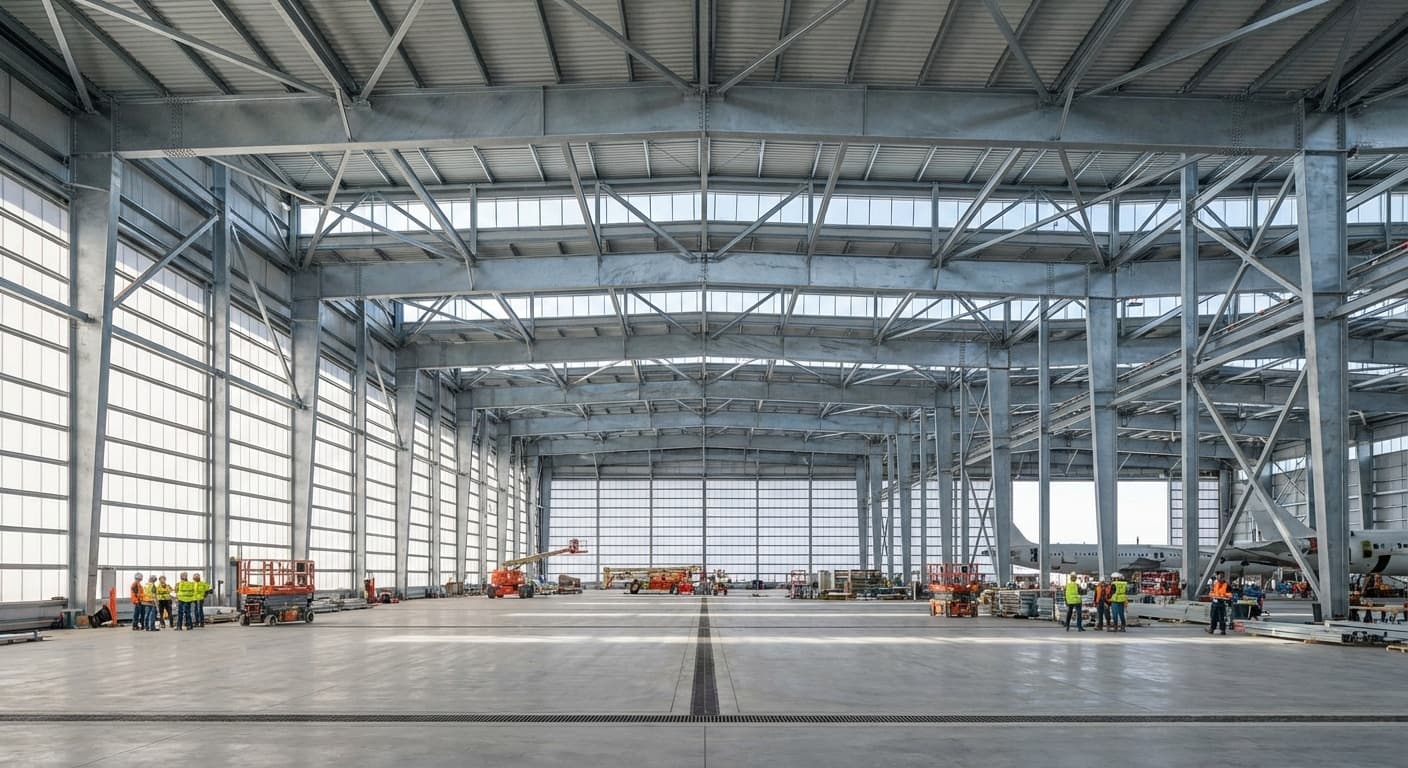

From sizing your first bay to commissioning a 20,000-ft MRO facility, this guide walks owners, architects, and contractors through every high-stakes decision that separates a future-proof hangar from an expensive mistake: match the aircraft envelope plus roof structure before codes, zoning, and FAA grants lock you in; weigh shell-only, turnkey, or full-maintenance scopes against door widths, foundation conditions, and fire-group requirements that can swing foam costs by seven figures; leverage steel clear-span frames, radiant heat, and daylighting polycarbonate to cut energy 20% while meeting Risk Category IV wind/seismic loads; and lock single-source, prefabricated procurement to compress schedules, eliminate supplier gaps, and protect budgets that run $55-$220/ft and millions in lead time. Readers learn why early scope definition, NFPA 409 group classification, and coordinated inspections trump change orders, how 2022 foam exemptions and drainage-floor alternatives can save $1 M in claims, and what commissioning, training, and digital documentation keep the facility compliant and corrosion-free for 50+ years–knowledge that turns a complex aviation project into a controlled, on-time, on-budget asset.
Planning Your Aircraft Hangar Construction Project
Plan your hangar around tomorrow's aircraft and today's regulations, or you'll face structural changes that cost triple down the road.
Defining Purpose, Size, and Aircraft Compatibility
Start with three questions: What aircraft will you house? What maintenance will you perform? What else needs space–offices, workshops, parts storage?
Build only for today's aircraft, and you'll outgrow it fast. The next generation always runs larger and heavier. [1] A single-prop Cessna needs 50×60 feet. A commercial fleet demands clear spans over 500 feet. [2] That's not just a size difference–it's a completely different building.
Once you've identified your aircraft, gather the numbers that matter: wingspan, fuselage length, tail height, and the turning radius when attached to a tug. Map these dimensions on scaled templates. Test different parking configurations. Check minimum clearances between aircraft and walls–these distances aren't suggestions, they're code requirements. [1]
Here's what catches most owners: tail height plus structural depth. Your King Air stands 15 feet tall, but add roof trusses and suddenly you need 20-foot doors. [1] Plan for the full envelope, not just the aircraft.
Fire protection costs scale with hangar size–NFPA 409 splits hangars into four groups, and smaller facilities carry lighter requirements. [1] (We cover the specifics in Design Engineering and Quality Control sections.) Will you rent bays? Mix helicopters with fixed-wing? Add a maintenance shop? Nail down these uses now. Structural changes later cost triple. [2] [3]
Site Selection, Zoning, and FAA/ICAO Compliance
Your site location triggers different rules. Build on a federally funded airport? You're locked into aeronautical use only–no side businesses, no non-aviation storage. The FAA enforces this through the Airport Layout Plan to keep grant money supporting actual aviation. [4]
Build off-airport on private land? You set your own rules. Non-obligated airports fall somewhere between–more flexibility than federal sites, but check the specifics. [4]
Local zoning hits next. What can you build? How big? What activities are allowed? These answers need to be rock-solid before design starts. Discovering zoning conflicts mid-project means expensive redesigns and schedule delays. [5]
Aviation compliance adds the final layer: clearances from taxiways, runway setbacks, approach path restrictions. Plus environmental requirements–stormwater management, noise limits, wetland buffers–based on your site's surroundings. [5]
Run every site through all three filters before you commit:
- Federal aeronautical obligations
- Local zoning and land use
- Aviation authority standards
Miss one, and you'll be redrawing plans after concrete's poured. (Our Construction Management section details the permitting timeline to keep you on track.)
Budgeting and Financing for Aircraft Hangar Construction
Hangar costs range from $55 to $220 per square foot–but that spread shrinks fast once you define your scope:
- Shell-only storage: $58-$100/sqft
- Turnkey basic hangar: $88-$165/sqft
- Full MRO facility: $120-$220/sqft [6]
Real numbers? A 5,000-sqft single-aircraft hangar runs $300,000-$700,000. A standard 15,000-sqft facility lands at $900,000-$1,800,000. Over 20,000 sqft pushes past $8 million. [7] The wild variance comes from comparing apples to oranges–storage shells versus maintenance operations. Define scope first, then every bid makes sense. [6]
Four factors drive 80% of your budget:
1. Door width–Going from 60 to 100 feet adds hundreds of thousands. Wider doors need heavier steel, stiffer frames, pricier hardware. [6] Bi-fold doors: $50,000-$150,000. Hydraulic doors for big openings: six figures easy. [6]
2. Foundation conditions–Site soils swing costs by $10-$30/sqft. Get a geotechnical report early. Best $5,000 you'll spend. [6]
3. Regional factors–Labor and materials multiply by 0.85 to 1.30 depending on location. Remote sites hit the high end. [6]
4. Interior buildout–Basic shell or full operation? The gap between empty space and working facility is where budgets balloon.
Add-on costs you can't skip:
- Utilities/HVAC: $20,000-$100,000
- Permits/compliance: $5,000-$30,000
- Engineering (10-15% of construction)
- Custom features: $15,000-$50,000 (but command $2-$4/sqft rent premiums) [7] [8]
Protect your budget: Start with 20% contingency at concept, drop to 15% during design, hold 10% once you lock pricing. Steel and doors need 10-24 week lead times–order early or watch your schedule slip. [6]
Design-build keeps it simple–one team owns design and construction, no finger-pointing, no gaps.
Design Engineering and Sustainable Solutions
Emergency aircraft hangars must meet Risk Category IV standards, requiring design wind speeds calibrated to a 1.6% probability of exceedance over 50 years.
Structural Design, Load Calculations, and Wind/Seismic Standards
Before any steel gets ordered, a hangar's structural classification determines the stringency of every load calculation that follows. The International Building Code assigns buildings to risk categories based on use, and emergency aircraft hangars land in Risk Category IV–the highest tier, alongside fire stations and emergency shelters–while standard general aviation hangars typically fall into Risk Category II. [9] That distinction matters because wind speed maps in the IBC are risk-category-specific: a Risk Category IV structure pulls design wind speeds from a map calibrated to a 1.6% probability of exceedance over 50 years, compared to 7% for Risk Category II. [10] In practical terms, the same location can yield meaningfully different design wind pressures depending solely on how the hangar is classified, which feeds directly into frame sizing, anchor bolt design, and cladding specifications.Wind governs more hangar structural decisions than any other load type, particularly for wide clear-span frames where large surface areas amplify lateral pressure.
IBC Section 1609 requires wind loads to be determined using ASCE 7 Chapters 26-30, with wind assumed to act from any horizontal direction and applied normal to each surface. [10] Construction documents must record the basic design wind speed, exposure category, applicable internal pressure coefficients, and design wind pressures by zone–not as a formality, but because these values drive the design of roof cladding, wall panels, and door framing independently of the primary structural frame. [10] Hangars built on open airport terrain typically fall into Exposure Category C (open terrain with scattered obstructions under 30 feet), which produces higher wind pressure coefficients than suburban Exposure B, so assuming the wrong exposure category at the start of design can result in a structurally undersized building that fails inspection or, worse, fails in service.Seismic design runs parallel to wind design and cannot be skipped even when wind loads govern the lateral system. IBC Section 1604.9 explicitly requires lateral force-resisting systems to meet seismic detailing requirements under ASCE 7 Chapters 11, 12, 13, 15, 17, and 18 regardless of whether wind or seismic forces are larger. [10] The seismic design category–ranging from A through F–is determined by mapped spectral acceleration parameters (S_S and S_1), the site class based on soil properties, and the risk category of the structure. [10] For sites where soil data isn't available, the IBC defaults to Site Class D, which applies amplification factors that increase design forces compared to rock sites; running a basic geotechnical investigation to confirm actual site class often reduces seismic design forces enough to offset the cost of the investigation itself.
Construction documents must show the seismic design category, design base shear, response modification coefficient, and analysis procedure used–information the structural engineer of record calculates during design and the building official verifies during permit review. [10]Beyond lateral loads, hangars carry several vertical load demands that influence frame depth and foundation size. Roof live loads, snow drift accumulation at parapet walls and equipment curbs, rain ponding on low-slope roofs, and the dead weight of rooftop HVAC equipment or photovoltaic systems all combine in code-prescribed load combinations under ASCE 7 Sections 2.3 and 2.4. [10] For hangars incorporating maintenance cranes, IBC Section 1607.15 requires increasing maximum crane wheel loads by a vertical impact factor–20% for motor-driven hoists and 50% for reciprocating equipment–and calculating separate lateral and longitudinal crane runway forces that act independently of wind and seismic loads. [10] Clear-span steel frames handle these combined loads without interior columns, preserving the unobstructed floor area that aircraft maneuvering requires, while multi-span frames introduce intermediate columns that reduce steel weight but constrain aircraft movement and towing paths. [11] The structural engineer's job is to find the frame geometry where load path efficiency and operational floor plan are simultaneously satisfied.
Energy‑Efficient Envelope and Green Building Certifications
Aircraft hangars present a specific problem for energy performance: massive door openings, extreme clear heights, and continuous aircraft movement make it nearly impossible to maintain a stable thermal envelope using conventional HVAC logic. The most effective approach treats the envelope and mechanical systems as one integrated system.
At the Southwest Airlines maintenance hangar at Denver International Airport–the first Southwest facility to earn LEED certification–the project team solved the air infiltration problem at the door by specifying a five-leaf overhead hoist-up fabric door with a superior seal over alternatives, limiting mass airflow during aircraft ingress and egress. [12] For heating, overhead radiant heaters were used instead of forced-air systems, which lose efficiency the moment cold air enters through the door. High-volume, low-speed fans handle summer cooling and can be reversed in winter to push stratified warm air back down to floor level–a low-cost measure that meaningfully reduces heating loads in tall clear-span spaces. [12] The envelope itself combined insulated prefabricated concrete panels, insulated metal panels, and a PVC membrane roof; interior lighting used LED fixtures with integrated daylight and occupancy sensors throughout. [12] Together, these measures produced energy savings exceeding 20% below reference standards. [12]Daylighting is the second major lever, and it works differently in hangars than in office buildings.
At HAECO Americas' LEED Silver-certified hangar at Piedmont Triad International Airport, translucent polycarbonate panels were installed across more than 26,600 square feet of wall area–including clerestory sections, corners, and the three hangar doors themselves. [13] The system delivers diffuse natural light deep into the maintenance bay, reducing electrical lighting demand while controlling solar heat gain, which matters in a space where 500 technicians are performing precision maintenance work. [13] The polycarbonate-and-aluminum assembly weighs roughly one-fifth of a comparable glass system, which reduces the structural load on door hardware and frames–a direct cost offset against the daylighting investment. [13] Unlike fiberglass systems common on older hangars, cellular polycarbonate with co-extruded UV-resistant coating resists yellowing and is fully recyclable at end of life, supporting both performance and long-term material circularity goals. [13]Pursuing LEED for an aircraft hangar requires documenting the building as a connected system–envelope, mechanical, lighting, water, and site–rather than treating each element as a standalone specification. The Denver hangar also addressed water efficiency through low-flow fixtures and native plantings that require no irrigation, directly responding to regional drought conditions. [12] Both the Denver and PTI projects used design-build delivery with teams that embedded sustainability goals from schematic design forward; in the PTI case, the daylighting system was explicitly protected from value engineering because the owner prioritized it early in the process. [13] LEED certification for hangars is achievable, but only when energy, envelope, and operational decisions are coordinated from the start rather than layered on after the structural frame is set.
Advanced Door Systems, Fire Protection, and Security Integration
Fire protection in aircraft hangars operates under NFPA 409, the industry benchmark referenced by the International Building Code, the International Fire Code, and most state and local ordinances.
The standard classifies hangars into four groups based on size, aircraft type, and operations conducted inside–and the group determines every fire protection requirement that follows. [14] Group I hangars, the largest facilities storing significant fuel volumes, carry the most stringent requirements.
Group II hangars are smaller and, following 2022 revisions, are no longer required to install foam suppression systems–a meaningful cost reduction, since foam systems are expensive to install and maintain. [14] Group III covers row hangars, open-bay multi-aircraft facilities, and freestanding single-aircraft units, while Group IV applies to membrane-covered rigid steel frame structures with aircraft bays exceeding Group III dimensions. [15] Understanding which group applies before finalizing structural design is essential, because fire protection requirements–drainage assemblies, suppression system type, sprinkler density–feed directly into slab design, ceiling height, and mechanical rough-in decisions that are difficult to reverse once construction begins.The three primary suppression mechanisms NFPA 409 addresses are ignitable liquid drainage floor assemblies, automatic sprinkler systems, and foam or alternative suppression systems. [14] The drainage floor assembly, added in 2021, addresses the specific hazard of fuel spills by removing flammable liquid from the floor before it can ignite or spread–the NFPA technical committee rated it equivalent in protection to traditional foam-based suppression. [14] For Group II facilities, the 2022 edition opened the door to water-based sprinkler and drain systems as a complete alternative to foam, responding to risk-analysis data showing foam's protective margin was disproportionate for that hangar class. [15] Where foam or alternative suppression agents are still required, the 2022 revisions also permit encapsulator agents–fluorine-free, non-corrosive, and biodegradable formulations–as a compliant replacement for AFFF and AR-AFFF foams, which are increasingly restricted due to environmental and health concerns. [14] NFPA 409 now explicitly encourages performance-based design, meaning fire protection plans can be customized around actual tail height, aircraft size, and hangar-specific operations rather than defaulting to prescriptive minimums–an approach that often produces a more cost-effective and operationally compatible system than standard templates. [14]
Materials, Prefabrication, and Single‑Source Procurement
Steel delivers 300 feet of column-free span while outlasting wood by 20 years, making material choice the single biggest driver of your hangar's lifespan and maintenance costs.
Materials Selection for Aircraft Hangar Construction
Your material choice drives 30-50% of your total hangar budget–and it shapes every maintenance bill you'll pay for decades. [16] Steel wins this decision for one simple reason: you get massive, column-free space without compromising strength. Need 300 feet of clear span for your fleet? Steel delivers it without a single interior column blocking your tow paths. [7]
Galvanized steel panels shrug off what destroys other materials. Those corrugated ridges aren't just for looks–they absorb hail impacts, resist UV damage, and laugh at humidity while wood rots and pests move in. [17] You want steel rated for 170 mph winds and 40-pound snow loads? That's standard inventory, not a special order. [17] The math is straightforward: wood hangars tap out around 30 years, but your steel hangar keeps working past 50. [16]Concrete plays its part where steel can't–your foundation and slab. It bears your aircraft loads, handles tow vehicle stress, and stays put so your doors align perfectly year after year. [16] But concrete as your main structure? You'll pay more to transport and place it, and you still won't match steel's spanning power. [16]
Sure, engineered wood costs less upfront for small, single-plane hangars. But introduce fuel spills, water exposure, and daily humidity swings? Watch it fail while your neighbor's
Low‑Maintenance Coatings, Interior Finishes, and Corrosion Protection
Why hangar environments accelerate corrosion
Your hangar battles corrosion every day. Oxygen plus moisture equals rust–and you've got both in abundance. [18] Mix different metals together? Now you've triggered galvanic reactions that eat through surfaces faster. [19] Add coastal salt, hydraulic fluid drips, and humidity surging through open doors, and you see why material choice alone won't save you. You need the right base materials, protective coatings, and environmental controls working as a team. [19]### Floor and structural coatings Skip polished concrete–it's slippery and stains on contact with fuel. Commercial airlines and military bases choose epoxy because it works. [20] Fuel spills wipe clean. Hydraulic fluid doesn't stain. Need more grip for tow vehicles? Add aggregate to the mix and dial in your traction. [20]
Don't stop at the floor. Seal your concrete perimeter and walls–water sneaking through feeds corrosion on every nearby metal surface. [20] For your structural steel and equipment, electrostatic painting beats spray guns every time. Those charged particles wrap completely around components, coating edges conventional methods miss. [20]### Surface treatments for stored aircraft and metal components Anodizing aluminum parts builds their natural protection without adding weight–perfect for your aluminum hangar components. [19] Need to protect steel? Zinc-nickel coatings match cadmium's performance without the disposal headaches. [19]
When aircraft sit idle, coatings aren't enough. Run dehumidifiers. Place desiccants. Control that moisture before it starts the corrosion cycle your paint can't stop alone–especially near the coast. [19]
Think beyond the aircraft. Coat your door tracks, overhead hoists, structural steel–anywhere fuel or hydraulic fluid might touch. Prevention costs pennies compared to fixing corroded structures. [20]
Coordinated Procurement: Single‑Source Solution for Materials and Services
Juggling steel suppliers, door vendors, concrete contractors, and mechanical subs? You're managing a circus where nobody talks to each other. That's how schedules slip and budgets explode. A single-source supplier handles everything under one contract–you make one call, not twenty. [21] You focus on permits and site prep while your supplier coordinates the entire material package. [21]
For prefabricated steel hangars, single-source wins three ways. First, factory-controlled quality beats field-assembled randomness every time. Second, pre-punched holes and engineered connections cut assembly from months to weeks. Third, you lock your price at signing–no steel market surprises halfway through. [22]
Look at any blown hangar budget and you'll find the same story. It's never one big mistake–it's death by a thousand cuts from disconnected suppliers. Labor conflicts here, supply delays there, quality issues everywhere. Your contingency evaporates before you're halfway done. [23] Single-source procurement stops this pattern cold.
Construction Management, Quality Assurance, and Handover
Treat every inspection as a hard milestone with buffer time and contingency work packages ready so crews stay productive when delays inevitably hit.
Project Scheduling, Permitting Timeline, and On‑Site Coordination
Your hangar schedule lives or dies by inspection sequencing. Standard building inspections need 24-48 hours notice. Specialized ones–fire suppression, structural steel, electrical–need 1-2 weeks. [24] Miss that lead time, and you'll watch your schedule cascade into chaos: foundation inspection delays the slab pour, fire system rough-in delays the steel closure, and that final fire inspection you scheduled too late delays your certificate of occupancy. [24] Here's what smart scheduling looks like: treat every inspection as a hard milestone with buffer time built in. When delays hit–and they will–have contingency work packages ready. Tasks that don't need inspection clearance keep crews productive instead of standing around burning dayroll. [24] Real-time communication between trades prevents the domino effect where one delayed inspection knocks every subcontractor off schedule. [24]
Airport projects add their own wrinkles. You're coordinating with active runway operations, meeting FAA height restrictions for equipment, and navigating airside access requirements that don't exist in standard commercial construction. [8] As discussed in Site Selection and FAA/ICAO Compliance, these airport-specific requirements start during planning but carry through every day of construction.
Design-build delivery cuts through permitting complexity by keeping design and construction under one roof. Your
Quality Control, Inspections, and NFPA 409 Fire Safety Compliance
NFPA 409 drives every fire protection decision in your hangar–and getting the group classification wrong will cost you. As covered in Advanced Door Systems, Fire Protection, and Security Integration, the standard splits hangars into four groups that determine everything from drainage design to suppression systems. [26] Group I facilities over 40,000 square feet need foam systems. Group IV membrane structures can use standard sprinklers if no fueling happens inside. [26] Change your hangar's use mid-project, and you'll be ripping out fire systems to match the new classification.
The 2022 NFPA update changed the game for Group II hangars. Foam isn't mandatory anymore–and that matters when a single foam discharge costs minimum $1 million in aircraft damage claims, fire or no fire. [27] You now have three paths: install fuel drainage floors that channel spills before they pool, use risk-based design tailored to your specific operations, or go performance-based with engineering proof of equivalent safety. [27]
Here's the catch: many jurisdictions haven't adopted the 2022 edition yet. Your fire protection engineer needs to work directly with local authorities to get alternative approaches approved. [27] And compliance doesn't stop at occupancy–you'll be testing and documenting these systems forever. [26]
Quality control means treating fire protection as inspection hold points, not punch list items. Verify foam rough-in before steel closes the ceiling. Confirm drainage assemblies before finishing the slab. Document detection placement before closing walls. Miss these windows, and you'll tear apart finished work to fix what should have been caught earlier. [27]
Commissioning, Training, and Ongoing Support for Aircraft Hangar Construction
Commissioning your MRO hangar means more than checking boxes–it's making sure the space actually works. Parts storage, supply points, and shipping docks need to be where technicians can reach them, not stuffed in leftover corners. [28] Ground support equipment gets designated spots where it's ready to roll, not hidden where crews waste time hunting for it. [28] That perfectly level slab you thought you had? Wait until you jack up an aircraft–any slope or settlement shows up fast when you're supporting 100,000 pounds on stands. [28] Safety training before opening prevents the worst kind of learning–during an emergency. Drill evacuation routes until they're automatic. Post exit signs all you want, but muscle memory is what saves lives when alarms sound. [29] Stage PPE throughout the hangar where people actually work. Hearing protection does no good locked in an office when you're under a running turbine. [29] Fall protection isn't optional when your techs work 20 feet up on scaffolding every day. Train them on lift inspection, brake checks, and railing verification–and keep training them. [29]
Your hangar stays safe and compliant through documentation and regular audits. Digital platforms beat paper trails for tracking maintenance records and catching problems before inspectors do. [30] Update training as technology changes. Review quality standards before they drift. [30]
The hangars that fail aren't the ones with structural problems–they're the ones that let their systems decay after opening. Keep your documentation current, your training fresh, and your audits regular. That's how you protect your investment long after the construction crews leave.
- Plan hangar for next-gen aircraft size; tail height plus roof depth sets door height.
- Steel clear-span frames give 300 ft unobstructed bay; wood caps at 30-year life.
- NFPA 409 Group II (2022) no longer mandates foam; drainage floors suffice.
- Wind Exposure C on open airport terrain drives 20-30% higher frame loads than suburban.
- Single-source prefab steel locks price, cuts weeks off build, ends multi-supplier chaos.
- https://www.wbdg.org/building-types/aviation/aviation-hangar
- https://coastalsteelstructures.com/a-complete-guide-to-designing-and-constructing-an-airplane-hangar/
- https://ludwigbuildings.com/blog/designing-the-perfect-aircraft-hangar
- https://www.faa.gov/airports/airport_compliance/hangar_use
- https://apxconstructiongroup.com/aircraft-hangar-requirements/
- https://www.ibeehivesteelstructures.com/blog/airplane-hangar-cost-in-2025-realistic-budgets-cost-per-square-foot-and-smart-ways-to-save/
- https://roimetalbuildings.com/guide-to-aircraft-hangar-construction-costs/
- https://www.scbconstructiongroup.com/aircraft-hangar-construction-build-checklist-design-trends-and-developer-roi/
- https://roimetalbuildings.com/aircraft-hangar-building-codes/
- https://codes.iccsafe.org/lookup/HCMDBC2021P2_Ch16_Sec1607.19.1
- https://sunwardsteel.com/considerations-for-your-steel-airplane-hangar-design/
- https://www.ghafari.com/news-insights/southwest-airlines-denver-maintenance-hangar-earns-leed-certification
- https://www.buildingenclosureonline.com/articles/87864-hangar-features-energy-efficient-daylight-system
- https://hct-world.com/what-is-nfpa-409/
- https://pyebarkerfs.com/understanding-nfpa-409-fire-suppression-for-aircraft-hangars/
- https://chinasteelbuildsales.com/best-materials-for-airplane-hangar-construction/
- https://www.vikingbarns.com/blog/the-definitive-guide-to-choosing-the-right-steel-hangar-for-your-aircraft
- https://www.duncanaviation.aero/intelligence/protecting-your-aircraft-s-paint-to-ensure-structural-strength-and-corrosion-resistance
- https://blog.katoadvanex.com/aircraft-corrosion-prevention-best-practices-for-aerospace-engineers
- https://www.alpinepainting.com/blog/protect-your-aircraft-with-industrial-coatings-for-your-hangar
- https://snowlineengineering.com/the-benefits-of-a-single-source-aerospace-manufacturing-supplier/
- https://torosteelbuildings.com/blog/pre-engineered-steel-buildings-for-aircraft-hangars/
- https://www.ibeehivesteelstructures.com/blog/steel-hangar-construction/
- https://www.myshyft.com/blog/permit-inspection-scheduling/
- https://silvermaple.com/blog/aircraft-hangar-design-construction/
- https://pyebarkerfs.com/how-does-nfpa-409-impact-aircraft-hangar-fire-safety-requirements/
- https://pbfpe.com/post/nfpa-409-aircraft-hangar-fire-protection
- https://www.tronair.com/blogs/articles/aircraft-maintenance-hangar-checklist
- https://monmouthjetcenter.com/hangar-tips-for-preventing-accidents/
- https://audit-now.com/audit-guides/aircraft-maintenance-hangar-checklists/