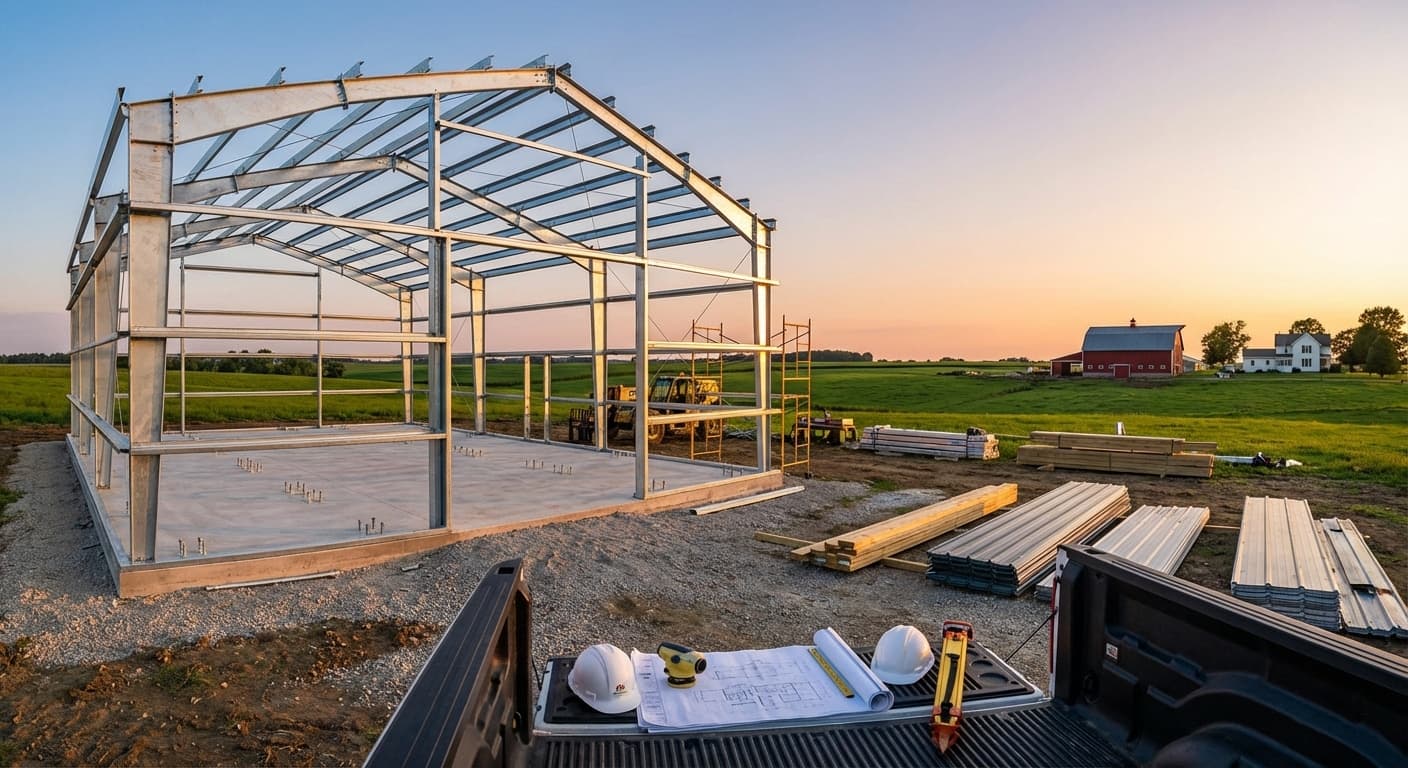

A 30×40 agricultural building only delivers its promised 1,200 sq ft of flexible, regulation-ready space if you plan the interior for one primary use–dairy, hay, or horses–because wall thickness, aisle width, stall size, ventilation rates, and waste or feed flow differ dramatically and fixed walls can't be moved later. Readers learn to start with county zoning and ag-district perks, then lock in a clear-span steel frame whose roof pitch, eave-slot and ridge-vent sizing, and door placement are matched to the moisture, ammonia, snow, or machinery loads the operation will generate for the next 40 years. The article walks through cost reality: a $15-26 k kit becomes $28-100 k installed once foundation, erection, doors, insulation, and freight are added, and it shows how to keep that number low by packaging engineering, stamped permit docs, concrete, and labor through a single-source steel supplier who already knows local codes and can stage delivery so every anchor bolt, inspection, and trade hits a pre-scheduled slot. Financing options–FSA, Farm Credit, Microloans, Farmer Mac–are tied to harvest cash flow, while design choices like 14-16 ft aisles, grouped plumbing walls, exterior feed doors, and strategic manure setback save daily steps, vet bills, insurance claims, and rebuilds. Mastering these details turns a basic shell into a durable, expandable, permit-safe barn that protects animals, feed, and profit while outlasting wood alternatives and positioning the farm for the next generation.
Planning Your 30×40 Agricultural Building Layout
Your 1,200 square feet requires careful planning for your specific use–dairy, horses, or hay storage each demand completely different layouts to avoid costly inefficiency.
Assessing Farm Needs and Usage Scenarios
Your 30×40 structure starts with one critical decision: what's it for? Dairy, hay, and horses each need completely different layouts–and mixing uses without a plan costs you money and efficiency. [1]
Here's what you're working with: 1,200 square feet sounds spacious, but walls eat space. Two rows of 10×10 stalls with a 10-foot alley between them? They won't fit in a 30-foot exterior width once you account for wall thickness. [1] Get your interior dimensions right before you commit.
Horse operations? Think livestock housing, not pretty barns. Your horses generate serious moisture through breathing and bedding–ventilation requirements covered in detail in our Structural Essentials section. [2]
Storing hay in the same building? Here's a better plan: keep feed and bedding separate. You'll cut fire risk and save money compared to building up instead of out. [1]
Dairy setups? Different game entirely. You need sanitation flow, milking access, and waste management systems that don't work for horses or hay.
Your daily workflow drives every layout decision. Where you place doors, alleys, and utilities depends on how you move animals, equipment, and feed every single day. [1] Clear-span construction gives you the flexibility to adapt–no interior columns boxing you in when your operation grows. [1] Our
Optimizing Space Flow for Dairy, Hay, and Horses
Your barn hits bottlenecks at the same times every day–chore time, turnout, tacking up. Fix it with smart layout choices that save steps and prevent traffic jams. Aisle width matters most. Go 14 to 16 feet wide for active facilities. That 12-foot aisle you're considering? It's cramped once you add crossties, tack trunks, and horses moving both directions. [3]
Size stalls right. 12×12 beats 10×10 every time. Your horses need room to turn, lie down, and stand comfortably. [4]
Plan these spaces strategically:
- Wash bay: Concrete floor, drain, hot and cold water–keeps grooming mess out of your main aisle [4]
- Tack room: Center placement cuts travel distance during peak times and avoids dead-air corners where ammonia builds [3]
- Plumbing zones: Group wash bay, restroom, and water supply on one wall to slash installation costs [3]
- Feed storage: Exterior access door means deliveries don't cross through working areas [3]
- Manure site: Far enough from entries to control flies and odor, accessible for tractor dumping [3]
Every decision saves you time, money, or both. That's efficient design.
Ensuring Site Compatibility and Zoning Compliance
Agricultural zoning works in your favor–it's designed to protect farm operations. Barns, hay storage, livestock shelters, and equipment buildings are typically allowed, but every county has its quirks. [5] Before you break ground:
- Call your planning department about setbacks, lot dimensions, and site requirements [6]
- Check if you're in a certified agricultural district–you might skip environmental reviews and stamped plans entirely [7]
- Outside a district? You'll need full permits and documentation [6]
Don't skip permits. Unpermitted buildings face fines, forced demolition, insurance denial, and kill property sales. [6] The permit timeline runs 6-12 weeks for agricultural structures–build it into your schedule now. [6]
Pro tip: Schedule a pre-application meeting with your building department. It costs little and catches requirements that would otherwise delay your project mid-stream. [6] We handle these conversations daily–local code compliance is built into every project. (See our Structural Essentials section for how pre-engineered steel simplifies the permit process.)
Structural Essentials and Quality Standards for a 30×40 Agricultural Building
Match your roof pitch to your primary use–dairy needs steep slopes for airflow, hay storage needs height and drainage, and this decision determines how well your building performs for the next 40 years.
Selecting the Right Steel Gauge and Roof Pitch
Your roof pitch choice directly impacts your building's performance and your operation's efficiency. For hay sheds and machinery storage, you'll want a 7.5-degree pitch (roughly 1.5/12)–it handles rain runoff perfectly without driving up your material costs. [9] Running a dairy operation? You need steeper: an 18-degree pitch keeps air moving through your barn, cutting ammonia levels and heat stress without expensive mechanical systems. [9] In snow country, the math changes. Go with 5/12 or steeper to shed snow naturally–otherwise you're looking at accumulated weight that bends frames and shortens building life. [8] That extra pitch pays you back in other ways too: more clearance for stacking square bales high, room to hang circulation fans, and easier equipment maneuvering near the walls. [10]
Yes, custom pitches cost more than standard options. Longer steel runs and modified trusses add to your quote. [9] But here's the bottom line: match your pitch to your primary use. Dairy needs airflow-driving slope. Hay storage needs height and drainage. Horse facilities typically land between the two. Get this decision right upfront–it determines how well your building works for the next 40 years.
Incorporating Durable Doors, Windows, and Ventilation
Proper ventilation keeps your building–and everything in it–healthy. Natural ventilation costs nothing to operate and handles most conditions year-round, but it only works when you orient your building correctly. Position the long axis perpendicular to prevailing winds. Check for obstacles within ten times your ridge height–tree lines, other buildings, hills–because they'll force you to add mechanical ventilation. [13]
For horse barns, your most important feature is the continuous eave opening. Size it at 1 inch per 10 feet of building width–that's 3 inches of continuous slot on each sidewall for your 30-foot barn. [12] At 10-12 feet above the floor, cold air mixes before reaching your horses, eliminating drafts without closing windows. Add matching ridge vents–at least 1 square foot per horse–but skip residential products. They clog with dust in months and deliver a third of the airflow you need. [12] Never use perforated soffits or insect screens at eave inlets. They restrict airflow and trap chaff. [12] For summer, install Dutch doors on exterior stall walls and open grillwork between stalls. Air quality matters most inside the stall, not the aisle. [12]
Dairy operations demand more aggressive ventilation. You need 4 complete air changes per hour in winter–that's fresh air every 15 minutes. [11] Summer requirements jump to 40-60 air changes per hour to prevent heat stress that cuts milk production. [11] Most dairy barns use curtain sidewalls for winter natural ventilation, then switch to mechanical fans when summer demands exceed what nature provides. Choose BESS Lab-certified fans with high VER ratings–dusty shutters alone can cut efficiency 10-40%. [11] Keep static pressure under 0.15 inches H₂O. Higher readings mean undersized inlets that waste energy and reduce actual airflow. [11]
Door placement drives both ventilation and workflow. End-wall doors create essential summer through-drafts. Large sliding doors on the sidewalls let you move equipment without disrupting animal areas. [13] Each stall needs windows opening directly outside–not into the aisle–sized at 5-10% of floor area. For a 12×12 stall, that's a 3×2.5-foot window minimum. [12] In hay storage areas, focus on moisture control. Blocked vents trap humidity that causes mold and fire risk. Install operable vents at both eave and gable positions, even when you're not housing animals. [12]
Meeting Code Requirements and Longevity Goals
Pre-engineered steel buildings arrive with your permit documentation already complete. Every load calculation–wind, snow, seismic–comes finished from the factory with stamped engineering drawings. [14] Your building inspector gets professional calculations, not guesswork. For your 30×40 project, this cuts weeks off permit approval when your county requires stamped plans. The engineering is done. The back-and-forth is eliminated. [15]
Steel buildings outlast wood construction without the maintenance headaches. Your frame won't rot, warp, or feed termites and carpenter ants–problems that destroy traditional pole barns, especially where stored grain attracts pests. [15] Fire safety comes built in: steel won't fuel a fire like wood framing, buying you critical time to move livestock and equipment. [15]
You're looking at 30+ year structural warranties and 40-50 year service life–enough to cover your operation and the next generation without major reinvestment. [15] When your needs change, your building adapts. Clear-span design lets you reconfigure stalls, move walls, and modify doors without touching the frame. Need more space? Remove the end sheeting, pour a new slab, and add another bay. [14]
That's the advantage of choosing
Cost Management and Financing Solutions for Your 30×40 Agricultural Building
Your 30×40 agricultural building will actually cost $28,000 to $100,000 installed, and USDA Farm Service Agency loans can cover construction with payments aligned to your harvest income.
Breaking Down the 30×40 Agricultural Building Budget
Kit cost versus turnkey cost–understand the difference or watch your budget blow up. A 30×40 steel building kit runs $15,000-$26,000 and includes the frame, roof panels, wall panels, and hardware. [16] What's missing? Everything else that makes it a building: foundation, erection labor, doors, windows, insulation, electrical, permits. [16] Your real investment ranges from $28,000 for a basic shell to $100,000+ for a climate-controlled facility. [17] The foundation alone–6 inches of reinforced concrete for agricultural loads–costs $8,500-$13,500 depending on your location. [17]
Four factors drive your final cost:
- Steel gauge (thicker = stronger = pricier)
- Site prep needs
- Local wind and snow loads
- Interior finish level [16]
In snow country, expect 10-15% more for engineered loads and steeper roof pitch. [17] At $24-$43 per square foot installed, you can compare options–but only a custom quote for your exact site and use gives you real numbers. [18]
Evaluating Financing Options and ROI
Agricultural loans work differently than residential construction financing–match the loan to your cash flow or pay the price.
USDA's Farm Service Agency offers two paths:
- Direct loans from FSA
- Guaranteed loans from approved lenders (FSA backs up to 95%) [19]
Farm Ownership Loans cover building construction. Operating Loans handle livestock, equipment, and other needs–letting you stage your project. [19] Small farms and beginners? FSA Microloans cut the red tape. [19]
The Farm Credit Network goes beyond FSA. These cooperatives offer facility loans tailored for barns, storage, and milking parlors–with payments that align with harvest income, not monthly deadlines. [20] Even better: eligible borrowers get cash-back dividends yearly (since 2004), effectively reducing your borrowing cost. [20]
Additional options:
- Farmer Mac: Fixed-rate, long-term loans through nationwide lenders
- State programs: Missouri's Agricultural and Small Business Development Authority and others fill gaps for specific situations [21]
Your first move? Get firm cost estimates. Approaching lenders with vague numbers leads to underfunding mid-build–far more expensive than taking time for accurate quotes now. [21]
Leveraging Single-Source Solutions for Savings
Why does a $20,000 kit become a $60,000 building? Multiple vendors, multiple markups.
Buy the kit here, hire concrete there, find erectors somewhere else–each handoff adds cost. Freight alone costs $500-$2,500. Custom features added after ordering?
That's 20-50% more than getting them upfront. [23] Erection labor for your 30×40? Another $8,400-$14,400 at $7-$12 per square foot. [24]
Construction Process and Contractor Collaboration on a 30×40 Agricultural Building
Hire a steel-experienced contractor from your supplier's preferred erector list to eliminate costly learning curves and ensure precise anchor bolt placement before concrete sets.
Choosing a Reliable 30×40 Steel Building Contractor
You need a contractor who knows steel isn't wood–and treats your agricultural building like the specialized project it is. Pre-engineered steel demands precise sequencing, connection expertise, and manufacturer-specific know-how that general contractors learn the hard way.
Start by asking point-blank: have you erected pre-engineered steel structures? Then get proof–a portfolio of completed 30×40 agricultural projects, not promises. [25] Your steel supplier's preferred erector list cuts through the noise.
These contractors already work with your specific framing system, which eliminates the learning curve on your dime. [25] Or consider the single-source advantage: suppliers with
Coordinating Delivery, Foundation, and Erection
Your 6-to-8-week order window is foundation time–use every day. Clear and grade your site, map utility routes, and get soil tested now. Your ground must support the structure before concrete ever arrives. [28] Underground utilities go in before the slab–plumbers and electricians rough in services first, pour second. Retrofitting through cured concrete multiplies costs and delays. [28] Slab thickness matters: 4 inches handles standard agricultural use, but bump to 6 inches when tractors, skid steers, or dairy equipment will work inside. [28] Anchor bolt placement is your single biggest risk point–misaligned bolts force column teardowns mid-erection, adding days and dollars you didn't budget. Double-check placement before that concrete sets. [29]
Your kit ships 4 to 16 weeks after ordering, with final payment due on delivery–have funds ready when the truck rolls up. [28] Stage components by erection sequence, not convenience. Framing, girts, purlins, and panels belong near the foundation in installation order. Get lifting equipment on-site before unloading starts–a backhoe or forklift keeps your crew moving and safe. [28]
Experienced crews of 6 to 8 erectors complete a 30×40 frame in 3 to 4 days. Smaller or greener teams stretch that to two weeks. [29] The sequence never varies: primary columns (plumbed and braced), then girts and purlins from center out, then cross-bracing, then roof panels and trim. [29] Check alignment while you can still fix it–after structural framing, before roof panels. Catch bolt torque and shim issues now, not after dismantling finished work. [29]
Book inspections before your slab cures. Municipal calendars run 2 to 3 weeks out–waiting until you need them adds that full delay to occupancy. [29] Three decisions separate smooth builds from stalled ones: components delivered in erection order, staging areas kept clear, and every inspection pre-scheduled. Master these, and you're weeks ahead of the typical timeline. [29]
Maintaining Clear Communication Throughout Build
Bad communication costs construction $177.5 billion yearly in rework–your agricultural build doesn't need to contribute. [30] Set your chain of command before breaking ground: owner, contractor, engineers, and subs each get defined roles and one contact point. No exceptions. When owners call trades directly or subs take orders from anyone but the GC, you get conflicting instructions that snowball into delays and disputed change orders. [30] Write down every verbal decision the same day. Not tomorrow. Today. Well-meaning people misremember conversations after weeks pass, and by then you've built mistakes into concrete. [31] Your electricians, plumbers, and concrete crews need written scope documents–not assumptions based on last job. Every steel building carries unique specs, and assuming your regular sub "knows what you want" is how errors get permanently poured. [32]
Weekly site meetings with all active trades catch problems while they're small. Schedule conflicts, buried issues, pending decisions–surface them now, not when they've hardened into disputes. [31] Respond to every message touching scope, cost, or timeline. Treat silence as risk. One missed email about anchor bolts or door framing costs more to fix than your entire communication system costs to run. [31]
Single-source suppliers eliminate most communication failures by design. When one company handles everything from engineering through erection, you get one number to call, one point of accountability, and zero finger-pointing between trades. That's how projects finish on time, on budget, and without the surprise invoices that plague multi-vendor builds.
- 30×40 interior shrinks fast: 10-ft stalls plus 10-ft aisle won't fit after wall thickness.
- Match roof pitch to use: 7.5 degrees for hay, 18 degrees for dairy airflow, ≥5/12 for snow country.
- Ventilation: 3-in. eave slot + 1 sq ft ridge vent per horse; skip screens that clog.
- Budget reality: $15-26k kit → $28-100k+ turnkey; foundation alone adds $8.5-13.5k.
- Permits take 6-12 weeks; unpermitted builds risk fines, demo, insurance denial.
- Clear-span steel lets you reconfigure stalls or add bays without touching the frame.
- Anchor-bolt misalignment mid-pour forces column teardown–check placement twice.
- https://horses.extension.org/equine-facilities-farm-design-and-layout/
- https://extension.psu.edu/horse-farm-design-an-agricultural-engineering-approach/
- https://stablemanagement.com/articles/creating-a-chore-efficient-barn-layout/
- https://www.wickbuildings.com/blog/a-dozen-tips-for-building-horse-stalls-and-barn-storage-space/
- https://millmanland.com/knowledge/what-structures-can-built-agricultural-land/
- https://www.steelcobuildings.com/building-permit-for-agricultural-building/
- https://smallfarms.cornell.edu/guide/guide-to-farming/zoning-regulations-farming/
- https://garagebuildings.com/roof-pitch-101-decoding-right-roof-slope-for-your-steel-building
- https://www.actionsteel.com.au/what-is-the-best-roof-pitch-for-farm-sheds/
- https://www.alliedbuildings.com/metal-building-roof-pitch/
- https://dairy.extension.wisc.edu/articles/ventilation-in-dairy-buildings/
- https://extension.psu.edu/horse-stable-ventilation/
- https://www.conestogabuildings.com/blog/consider-ventilation-designing-horse-barn/
- https://www.buildingsguide.com/metal-building-kits/farm/?srsltid=AfmBOop_zjMF4iUcmXclTh88AXvlzYSloF0O9Y-QPQ_9OaKp8FWZI-VY
- https://renegadesteelbuildings.com/why-steel-is-the-best-material-for-your-agricultural-building/
- https://www.probuiltsteel.com/blog/30×40-metal-building-cost/?srsltid=AfmBOopq8OlbJfVBpvoit_GgVzhK_3qUVave4YbRg4Jcq3e9QJYEDPDc
- https://www.steelcobuildings.com/how-much-does-a-30×40-steel-building-cost-in-2026/
- https://www.buildingsguide.com/metal-building-prices/?srsltid=AfmBOop3iwKjb00_22TOiWE46wwUJuISuxVjF_WUPVE07DWh-MLnZd2P
- https://www.fsa.usda.gov/resources/farm-loan-programs
- https://www.fcsamerica.com/financing/facility-loans
- https://armstrongsteel.com/blog/how-to-find-financing-for-your-metal-barn
- https://www.buildingsguide.com/metal-building-prices/?srsltid=AfmBOootiFDICRm9p8X4aCADU9WZG22na6n7GjSC87mpn85VmiCVukOz
- https://www.uspatriotsteel.com/blog/how-much-does-a-30×40-metal-building-cost/
- https://www.metalbuildingoutlet.com/how-much-does-a-30×40-steel-building-cost/
- https://pbsbuildings.com/choosing-the-right-contractor/
- https://www.weatherstarcompany.net/2024/05/25/how-to-choose-the-right-steel-building-contractor/
- https://premierbuildings.com/top-9-questions-to-ask-when-choosing-a-prefab-metal-building-contractor/
- https://www.buildingsguide.com/build/30×40-building-construction/?srsltid=AfmBOooj4NgkGv_NvarNn5UgEyUZGYU1nxFlyaujT9GBjU8CUZST_CeU
- https://www.alpha-labor-co.com/blog/pemb-erection-timeline
- https://www.cedarcorp.com/blog/6/the-importance-of-communication-during-construction
- https://www.gouldratner.com/publication/10-tips-to-improve-construction-site-project-communications
- https://armstrongsteel.com/blog/tips-to-managing-steel-building-subcontractors