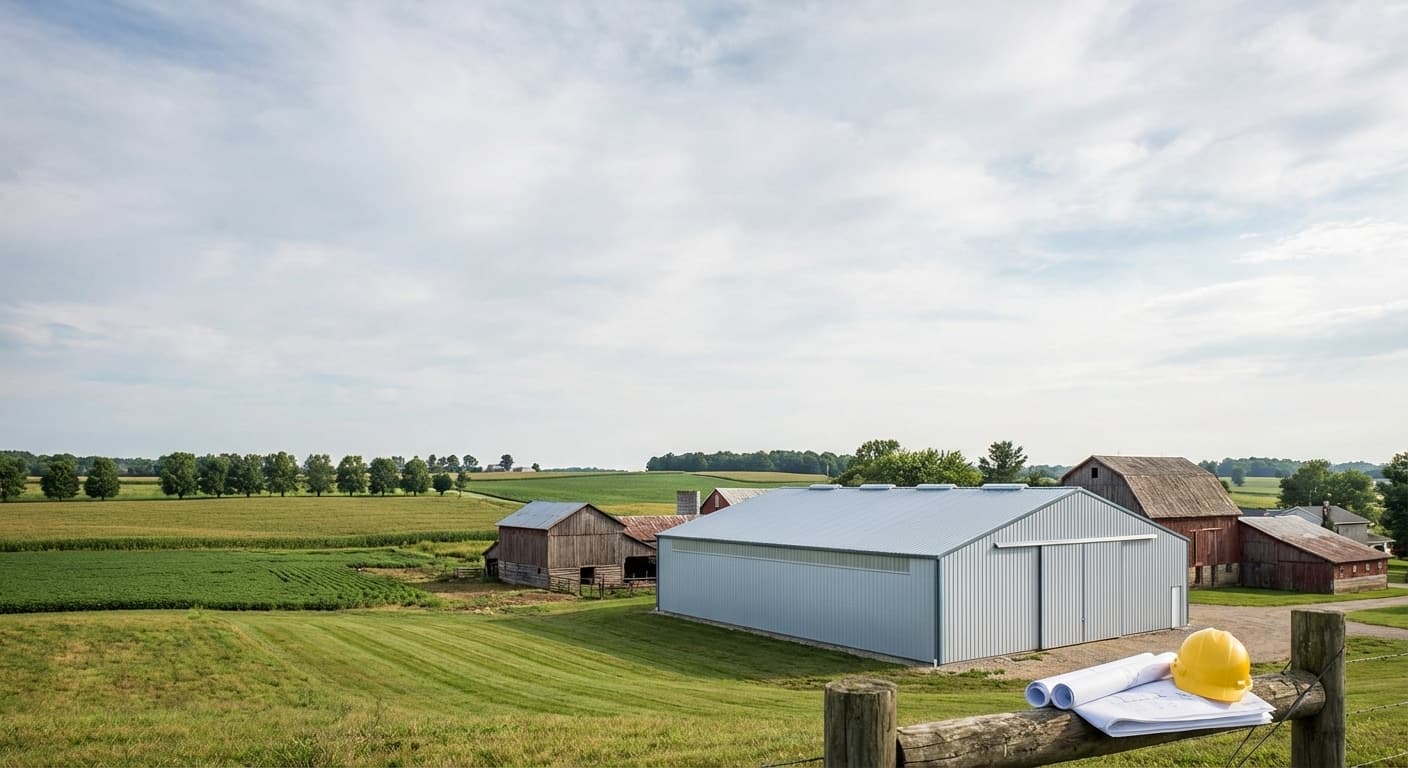

We help you build agricultural structures on budget by providing accurate cost estimation, regional pricing data, and strategic financing options tailored to farm cash flow. Smart planning upfront prevents costly surprises and ensures your investment delivers measurable returns for decades.
Introduction to the Agricultural Building Cost Guide
Lock in steel prices now and phase construction strategically to protect your farm budget against 2025 material cost increases.
Why accurate cost estimation matters for farm success
Your building budget makes or breaks your farm project. Get it wrong, and you're looking at depleted capital, loan defaults, or half-finished buildings [1]. Get it right, and you secure the financing you need, manage cash flow smoothly, and keep construction on track [2].
Smart budgeting does more than prevent disasters. You can:
- Compare true ROI across different building options
- Calculate exact production targets to recoup your investment
- Spot savings opportunities without cutting corners
- Avoid expensive mid-project changes that blow budgets
When you know your real costs upfront, you evaluate steel versus wood, storage versus multipurpose, and basic versus upgraded–all based on actual returns, not guesswork [3]. That's how you stretch farm capital further while building exactly what your operation needs [2].
2025 market trends and steel price outlook
The 2025 market hits you with challenges–and opportunities. Steel tariffs just jumped 25%, pushing metal building prices up 10-12% already, with more increases coming [4]. Construction materials overall climbed 3.1% year-over-year [5]. An anti-dumping investigation covering ten countries could tighten steel supply even further [6].
The pressure points stack up:
- 35% Canadian lumber tariff (though weak housing demand keeps lumber prices stable) [4]
- Copper pipe prices up 40% year-over-year [4]
- Steel inventory running low as suppliers burn through pre-tariff stock
Here's your action plan:
- Lock in steel prices now before the next hike
- Consider steel-efficient designs that use less material
- Phase construction to spread costs across quarters
- Get multiple quotes fast–prices change weekly
Despite material headaches, nonresidential construction stays strong [5]. Smart farmers who move quickly can still build within budget by timing purchases right and choosing
How this guide will help you plan and budget effectively
This guide gives you the tools to build smart and avoid expensive mistakes. You get:
Accurate Cost Estimation
- Spec sheets that capture every detail
- Digital calculators with real regional pricing
- Seasonal price tracking for volatile markets [7]
Project Management That Works
- Critical Path Method to sequence farm-friendly construction
- Gantt charts that work around planting and harvest
- Resource planning that prevents delays [9]
Real Cost Breakdowns
- Site prep expenses for your actual soil conditions
- Foundation options that match your budget and land
- Material trade-offs: where to invest, where to save [8]
Financing Strategies
- Traditional loans versus USDA Rural Development programs
- Phased construction that matches farm cash flow
- Payment timing that works with seasonal income [9]
Long-Term Value You learn lifecycle cost analysis–the difference between cheap upfront and smart long-term. Factor in energy efficiency, maintenance costs, and tax benefits to calculate true ROI. That's how you spot the difference between necessary expenses and money pits [7][8].
Bottom line: You'll know exactly what your building costs, how to pay for it, and why every dollar spent delivers returns.
Types of Agricultural Buildings and Their Cost Drivers
Steel buildings cost more upfront but save thousands in maintenance over 50+ years, while post-frame construction gets your standard farm structure up 50% faster and cheaper.
Steel, wood, and hybrid options: cost comparison
Your choice of building material directly impacts both your upfront investment and long-term costs. Steel buildings run $15-43 per square foot in 2025–yes, that's more than wood initially, but you'll save thousands on maintenance over the building's 50+ year lifespan [10]. Post-frame construction dominates farm building–over 70% of new agricultural structures use this method because it goes up 50% faster than stick-built and costs less [11]. Post-frame cuts your foundation costs dramatically for single-story buildings.
Need a second story or custom features? Stick-built prices jump fast [11]. Timber-frame sits at the premium end–you'll pay more, but those exposed beams can boost property value and knock 10-15% off insurance premiums [11]. Here's what matters for your bottom line: steel lasts 50+ years with minimal upkeep, while wood demands regular treatments for rot, mold, and pests–especially in harsh climates [12].
Pick steel when you need maximum weather resistance, fire safety, and hands-off maintenance. Choose post-frame wood when upfront budget matters most and you're building standard farm structures [12].
Common building categories: storage sheds, livestock barns, equipment shelters
Your agricultural building needs fall into three main categories–each with its own price point. Storage sheds give you the most bang for your buck at $17-$20 per square foot for basic materials [7]. They're perfect for protecting feed, tools, and seasonal equipment without breaking the bank. Metal sheds deliver exceptional value for basic storage needs [14].
Livestock barns cost more–and for good reason. You need specialized ventilation, proper stall layouts, and flooring tough enough to handle daily animal traffic [7]. Horse barns push costs higher with specialized features: sliding stall doors, Dutch doors, and ventilation systems designed for equine health and handler safety [13]. Equipment shelters sit in the middle price-wise.
You'll need wider clearances, beefier door supports, and room to work on machinery [7]. A 30×50 or 40×60 pole barn hits the sweet spot for equipment storage–plenty of room for multiple machines without the premium price of a livestock facility [13]. The cost difference between building types comes down to complexity: storage sheds need basic walls and a roof, while livestock barns require engineered ventilation, drainage systems, and specialized access points [14].
Pre‑engineered vs custom designs: budgeting implications
Pre-engineered metal buildings save you 20-30% compared to custom designs–real money when you're watching every dollar [7]. In hard numbers: pre-engineered steel runs $19-$28 per square foot, while custom construction hits $25-$35 in Ontario [15]. You save time too. Pre-engineered buildings arrive ready to assemble–everything pre-cut, pre-drilled, and measured. Professional crews finish most agricultural installations in 5-10 days versus 2-4 weeks for custom builds [16]. That speed matters when you're racing against planting season or harvest deadlines.
Don't forget engineering costs. Pre-engineered buildings include engineer stamps standard. Custom designs? Add $1,500-$3,500 for certification after the fact [16]. Pre-engineered also means predictable budgeting–you get firm quotes covering all components upfront, while custom projects often hit surprise expenses mid-build. Planning to expand later?
Pre-engineered buildings make it easy with removable end walls–expansions cost just 40-50% of your original per-square-foot price. Custom buildings? You'll pay 60-75% of new construction costs to expand [16]. Still, custom makes sense when you need unusual dimensions, special door placements, or interior layouts that pre-engineered can't deliver. For standard agricultural needs,
Choosing the right building purpose for cost efficiency
Smart building selection starts with matching structure to purpose–no point paying for features you won't use. Purpose-built designs give you exactly what you need without expensive extras. Basic storage runs $17-20 per square foot, perfect for protecting equipment, feed, and tools from the elements [7]. Equipment buildings cost more but pay you back through operational efficiency–wider clearances and heavy-duty door systems keep your machinery accessible and protected [7]. Livestock facilities sit at the top of the price range, and rightfully so.
Proper ventilation, drainage, and animal welfare features aren't optional–they're essential [7]. Consider the multi-purpose approach. One steel building can handle storage during harvest, equipment maintenance in winter, and emergency livestock shelter during storms [17]. You'll save 30-40% compared to building separate structures for each need [17]. Future-proof your investment.
Steel buildings expand easily with modular designs and removable end walls–detailed expansion costs are covered in our financing section [7]. Map your seasonal workflow before building. Structures supporting revenue-critical activities–grain storage at harvest, equipment protection year-round–deliver the best returns [18]. The real measure of cost-effectiveness? How much time and money your building saves during daily operations, not just the price tag [18].
Core Cost Factors and Regional Adjustments
Every extra foot of sidewall height adds 5-7% to your project cost, so choose your 16-foot minimum clearance carefully to avoid expensive regrets later.
Size, dimensions, and sidewall height impact
Size drives your building costs in predictable ways. You'll pay less per square foot as buildings get larger, but your total investment still climbs [7]. Here's what you need to know:
Height costs money. Every extra foot of sidewall height adds 5-7% to your project cost [19]. Your modern combines and tractors need at least 16-foot clearance–don't skimp here and regret it later [20].
Standard sizes save money. Stick with common dimensions like 30'x40', 40'x60', or 60'x100'. Manufacturers optimize production for these sizes, and you pocket the savings [7]. Rectangular buildings with a 1.5:1 to 2:1 length-to-width ratio use materials most efficiently [20].
Foundation costs don't double. When you double your building size, foundation expenses only increase 40-60%–not the 100% you might expect [19]. That's real savings on larger projects.
Your budget reality check: A 40'x60' storage building at $17-20 per square foot means $40,800-$48,000. Jump to 60'x120' and you're looking at $122,400-$144,000 [7]. Know these numbers before you commit.
Site preparation, foundation types, and local soil conditions
Your foundation starts with understanding what's beneath your feet. Spend $500-$1,500 on soil testing now or risk thousands in foundation repairs later [21].
Foundation options and costs:
- Concrete slab: $4-$8 per square foot–your best bet for stable soils and warm climates
- Pier and beam: Better for problem soils where clay expands and contracts
- Stem wall: Costs 25-40% more than slabs but protects against frost heaving [21]
Critical foundation factors you can't ignore:
Frost depth matters. Southern states need minimal protection, but northern regions require foundations 48+ inches deep to prevent frost damage [21]. Get this wrong and watch your building crack.
Site prep saves money. Level ground beats hillsides every time–those cut-and-fill operations blow budgets fast [8]. Clear all vegetation and organic material first, or settling will haunt you later [21].
Drainage prevents disaster. Slope everything away from your building. Water is foundation enemy number one [8].
Compaction can't be rushed. Every 4-6 inch gravel layer needs proper compaction to 95% density. Rent the right equipment–hand tamping won't cut it [21].
High water tables need special attention. You might need deeper foundations, drainage systems, or site elevation. Address it now or pay for it later [21].
Material quality, insulation, and finish choices
Material choices determine both your upfront costs and long-term savings. Here's what actually moves the needle:
Steel gauge matters. Thicker steel costs more initially but handles weather and heavy use better. You get what you pay for [7].
Insulation pays you back. Spend more now on quality insulation, save on heating and cooling forever [7].
Real cost comparisons:
- Pre-engineered steel: $19-$28 per square foot
- Traditional wood-frame: $25-$35 per square foot
- Installed turnkey steel: $24-$43 per square foot nationwide [15][22]
Maintenance reality check: Your
Labor, permits, and regulatory fees across states
Location drives your labor and permit costs more than you might expect. The 2023 labor rule changes hit agricultural construction hard–workers now get reclassified into higher-paying categories, pushing total farm labor costs past $53 billion in 2025 [23].
Labor cost reality by region:
- California: Construction workers earn $11.83 more per hour than farmworkers
- Georgia: Supervisors command $18.61 premiums–double the standard wage [23]
Permit fees vary wildly:
- High-cost states (California): $5-$12 per $1,000 of construction value
- Central states: Significantly lower rates
- Residential permits: $200-$3,000 based on location
- Commercial structures: 1-5% of total construction value [24]
Hidden permit costs that bite:
- Plan reviews: $200-$500
- Failed inspections: $100-$500 each
- Impact fees for infrastructure
- Re-inspections and specialized reviews: Add 15-30% to permit budget [24]
Construction costs by state:
- California: $250-$600 per square foot
- Iowa: $90-$200 per square foot [25]
Why the gap? Coastal states pile on environmental and structural requirements that drive up compliance costs [24].
Your action plan: Research your specific county requirements before budgeting. Call ahead–many fees aren't posted online. Factor in potential re-inspection costs. Budget 15-30% above the posted permit fees to cover the extras [24].
Modern Estimation Tools and Methodology
A detailed spec sheet with structure basics, site conditions, access needs, and special requirements gives contractors the clarity needed to catch cost issues before construction begins.
Essential measurements and creating a detailed spec sheet
Your agricultural building starts with a solid spec sheet. Get the basics down first: length, width, and sidewall height. These three numbers drive your material costs and foundation needs [26].
Next, document your site conditions. You'll need soil test results (as covered in Core Cost Factors), ground slope measurements, and drainage patterns [26]. Don't forget practical details like clearance heights–your combines and large tractors need at least 16 feet of clearance [27].
Break your spec sheet into clear sections:
- Structure basics: dimensions, snow loads, wind ratings
- Site specifics: soil conditions, water table, existing utilities
- Access needs: door sizes, locations, equipment paths
- Special requirements: ventilation, waste management, future expansion
For steel buildings, specify material gauge–thicker steel costs more upfront but saves you money long-term through reduced maintenance [27]. Include separate sections for foundation type, framing system, and finish options. This organized approach helps contractors spot potential issues early and keeps your project on budget [26].
The clearer your specs, the more accurate your estimate. And accurate estimates mean no surprises when construction starts.
Using the latest digital cost calculators and software
Today's digital tools put accurate cost estimation at your fingertips. No more wrestling with complex spreadsheets or outdated pricing guides.
Professional-Grade Software Buildertrend and Estimator360 give you real-time material pricing that updates daily from major suppliers [28]. These platforms include agricultural building templates that speed up estimation while catching costs you might miss. AI tools like Buildxact's Blu can generate initial estimates from just your project description and zip code [28].
Specialized Agricultural Tools The National Building Cost Estimator provides region-specific data for farm structures, creating detailed reports you can hand to your lender or insurance agent [29]. For operational planning, the University of Nebraska's free Agricultural Budget Calculator integrates building costs with projected farm returns–essential for calculating true ROI [30].
Making Tools Work for You Pick software that fits your project size. Small equipment sheds? Basic calculators work fine. Large livestock facilities or
Incorporating regional price indices and seasonal fluctuations (2025 data)
Your building costs vary dramatically by location and timing in 2025. Production costs have jumped 50% since 2011 while farm revenue climbed just 21%–that 34-point gap hits your bottom line hard [31].
Regional Price Reality Construction costs follow different patterns across the country. Midsouth states see steeper increases (Oklahoma up 6.9%, Texas up 5.4%) while West Coast growth stays modest (California at 3.5%) [33]. Your estimation software needs these regional adjustments built in, or you'll miss your budget by thousands.
Timing Your Project Good news ahead: commodity prices are projected to drop 7% in 2026, with energy costs falling 10% after 2025's 12% decline [32]. For steel buildings, where energy drives manufacturing costs, waiting a few months could mean significant savings.
Smart Scheduling Strategies
- Lock in prices during projected declines
- Schedule major purchases after harvest income
- Phase construction to spread costs across better pricing periods
- Use quarterly adjustment factors in your estimates
The volatile market demands flexibility. Build contingency into your budget and stay ready to move when prices dip. Your patience can pay off in five-figure savings on larger projects.
Validating estimates with the Douglas Agricultural Cost Guide and other resources
Don't trust your estimate until you validate it against industry benchmarks. One miscalculation can leave you scrambling for funds mid-project.
The Douglas Agricultural Cost Guide For Canadian farmers, the Douglas guide sets the standard with 30+ years of agricultural building data [34]. Banks, insurance companies, and contractors all use it–that widespread adoption tells you it's reliable [34].
To use the guide effectively:
- Measure from interior floor to ceiling line for accurate heights [35]
- Break complex buildings into simple shapes (rectangles, squares, triangles)
- Apply regional adjustments for your specific market
- Use the 2026 platform features for real-time market conditions [36]
Cross-Checking Your Numbers Smart farmers validate estimates three ways:
- Industry guides like Douglas for baseline costs
- Local contractor quotes for real-world pricing
- Recent comparable projects in your area
Red Flags to Watch If your estimate falls 20% below benchmark guides, you've probably missed something. Common oversights include site work, permit costs, or finishing details. Better to catch these gaps now than face change orders later.
Remember: guides provide averages. Your specific site conditions, timeline, and quality requirements will shift final costs. Use benchmarks as reality checks, not gospel.
Strategic Budgeting and Financing Strategies
Allocate 5-15% contingency based on your project's specific risks–site conditions, complexity, and material volatility–then track every withdrawal to protect both your budget and future estimates.
Building a realistic project budget with contingency reserves
Contingency reserves function as essential financial buffers against the unexpected in agricultural building projects. Most construction projects allocate 5-10% of the total budget for contingency, though higher-risk or complex agricultural facilities may require 10-15% [37]. The specific amount depends on your project's risk profile–standard equipment storage might need only 5%, while specialized livestock facilities with complex systems might warrant 10-15% [38]. Agricultural projects should incorporate three distinct contingency types: owner contingency (5-10%) covers scope changes and unforeseen conditions; contractor contingency (3-8%) addresses estimation errors and minor scope clarifications; and design contingency (2-5%) handles architectural changes and engineering modifications discovered during construction [38].
Calculate your reserve using a straightforward formula: Contingency Budget = Total Project Cost x Contingency Percentage, but don't rely on a one-size-fits-all approach [38]. Instead, analyze specific risk factors including site conditions, project complexity, material price volatility, and regional weather patterns. Agricultural builders should establish clear usage protocols in contracts, specifying exactly when contingency can be accessed–for issues like incomplete designs, construction delays, substitute subcontractors, or price increases [38]. Track contingency expenditures in real-time rather than waiting until project completion, and require written justification for significant withdrawals [38].
Avoid common mistakes like treating contingency as extra profit or using a standard percentage regardless of project specifics [38]. Your contingency management approach should include detailed documentation of every expenditure to protect you legally and improve future estimation accuracy [38]. This disciplined approach ensures funds remain available for genuine emergencies while providing financial stability throughout your agricultural building project [39].
Phased construction and cash‑flow management techniques
Phased construction divides large agricultural building projects into manageable stages that align with farm cash flow patterns, reducing financial strain during seasonal income fluctuations. Instead of building an entire structure at once, farmers can strategically sequence construction–completing foundation work during winter months when labor costs may be lower, framing during spring before planting demands increase, and finishing interior work during harvest downtime [40]. This approach requires creating a detailed cashflow calendar that maps both construction phases and expected farm income periods including harvest sales, government payments, and tax refunds against predictable expense periods like planting, equipment maintenance, and loan payments [42].
For optimal cash management, develop realistic income estimates based on historical yield data, contracted prices, and market projections while tracking all cash expenses–both variable (production costs) and fixed (overhead) [42]. The implementation phase demands strong project management with clear communication channels among team members, suppliers, and stakeholders, supported by robust monitoring systems to track progress against planned timelines and budgets [41]. Practical phasing strategies include securing necessary permits and conducting site preparation during low-cash periods, scheduling major material purchases after significant income events, and negotiating payment terms with contractors that align with your farm's cash flow cycle [41].
Throughout construction, continuously review actual versus projected expenses and be prepared to adjust plans if yields, prices, or costs change–digital tools like dedicated agricultural financial software can simplify this tracking process by automatically updating projections based on real-time data [42]. This disciplined approach ensures capital-intensive components like concrete work or steel framing can be timed for periods of cash surplus rather than forcing emergency borrowing to cover construction costs during cash deficits [40].
Financing options: loans, equipment leasing, and USDA Rural Development programs
Agricultural building projects can access multiple USDA financing pathways tailored to different farm needs and financial situations. The Farm Service Agency (FSA) offers both direct loans (funded directly by FSA) and guaranteed loans (provided through traditional lenders with FSA backing) that can be used for construction projects [43]. Farm Ownership Loans specifically support building purchases or construction, allowing farmers to "construct or improve buildings on the farm" with terms designed for agricultural operations [43].
For smaller projects, Microloans provide a streamlined application process with reduced paperwork requirements–particularly beneficial for beginning farmers needing modest infrastructure investments [43]. Farmers recovering from natural disasters can access Emergency Loans to rebuild damaged structures or replace essential buildings lost to floods, droughts, or other events [43]. USDA Rural Development programs provide additional financing options beyond traditional FSA loans, including grants for rural businesses and cooperatives that support infrastructure development [44].
These programs forge "partnerships with rural communities, funding projects that bring housing, community facilities, business guarantees, utilities and other services to rural America" [44]. The Rural Economic Development Loan & Grant Programs offer another financing avenue, though farmers must contact their state's Business Programs Specialist to determine specific eligibility requirements before applying [45]. Beginning farmers receive special consideration through targeted loan funding, with FSA setting aside portions of loan funds specifically for those starting their farming journey–providing a critical pathway to finance first farm structures [43][44].
Enhancing Long‑Term Value and Return on Investment
Combining renewable energy systems with smart automation can reduce your farm's energy consumption by 83% while generating returns exceeding $36,000 over eight years.
Energy‑efficient designs and renewable options
Energy-efficient agricultural buildings feature well-insulated walls, ceilings, and foundations that minimize heat transfer, paired with high-performance windows and doors to prevent air leakage [46]. Energy-efficient ventilation systems with programmable controls and variable-speed fans cut electricity usage without compromising performance, particularly in livestock facilities where proper airflow directly impacts productivity and animal health [46]. These design elements decrease heating and cooling demands by minimizing air leaks while reducing operational costs [46]. Solar electric systems provide reliable power for remote agricultural operations, eliminating the expense of extending utility lines while powering lighting, electric fencing, and irrigation systems [47]. For locations far from utility connections, photovoltaic systems can power critical equipment at a lower cost than extending power lines, with simple pumping systems starting around $2,500 [47]. Solar water heating can reduce costs by up to 85% annually compared to electric alternatives, with typical payback periods of 4-8 years [47].
Wind energy systems offer another viable option for farms with average wind speeds of at least 10-12 mph, typically costing $3,000-$5,000 per kilowatt for residential-scale installations [47]. Smart technology enhances efficiency by automatically adapting systems based on real-time data [46]. Digital twin technology creates virtual replicas of buildings, allowing farmers to monitor, predict, and optimize energy use while testing improvements before implementation [46]. One study found combining renewables with automation reduced farm energy consumption by approximately 83%, generating ROI exceeding $36,000 over eight years [46]. Several government programs help farmers implement energy-efficient designs. The Rural Energy for America Program (REAP) assists small and medium-sized farms through funding for energy-efficient products, renewable systems, energy audits, and feasibility studies [48].
Additional support comes from the Environmental Quality Incentive Program (EQIP), which funds improvements that reduce emissions through renewable energy adoption [48]. When evaluating energy improvements, farmers should weigh implementation costs against potential returns [48]. LED lighting and equipment upgrades deliver immediate savings, while larger investments in insulation and renewable energy systems provide substantial long-term benefits [48]. For new agricultural buildings, incorporating energy-efficient designs from the planning stage typically adds only 2-5% to initial construction costs while reducing operating expenses by 20-30% over the structure's lifetime [46].
Planning for future expansion and modular upgrades
Agricultural operations inevitably evolve, making expansion-ready building design essential for long-term cost efficiency. Modular designs with removable end walls and movable internal partitions allow buildings to transform as needs change without extensive rework [49]. When planning your initial structure, incorporate designated expansion zones and ensure foundation footings extend beyond current needs to accommodate future additions [50].
Steel buildings particularly excel in expansion scenarios, as their pre-engineered components enable straightforward additions that maintain structural integrity–a key factor in avoiding the 60-75% premium typically associated with expanding traditional buildings [49]. Practical implementation strategies include designing electrical and plumbing systems with future connection points, oversizing utility services for increased capacity, and installing wider doorways than immediately needed to accommodate larger equipment purchases [51]. Strategic placement of non-load-bearing walls allows interior reconfiguration without structural modifications, while modular roof systems can be extended without complete replacement [50].
For phased expansion, consider constructing your building's full foundation initially while completing only a portion of the superstructure–this approach spreads costs over time while minimizing rework expenses [51]. Multi-purpose designs further enhance expansion value by allowing a single structure to serve multiple functions (equipment storage, livestock housing, processing) as operational needs shift seasonally or annually [50]. Most crucially, document your expansion plans during initial construction–preserving engineering specifications, structural calculations, and foundation details will significantly reduce engineering costs when expansion becomes necessary [49].
Maintenance scheduling and lifecycle cost analysis
Lifecycle cost analysis (LCCA) evaluates the total ownership cost of agricultural buildings beyond initial construction expenses. LCCA examines costs throughout a facility's entire lifespan including acquisition, operation, maintenance, replacement, and disposal [52]. For farm structures, this approach prevents costly mid-life surprises and optimizes maintenance timing. Over a typical 30-year period, initial building costs represent just 2% of total expenditures, while operations and maintenance account for 6%–highlighting why long-term planning matters [52].
Effective maintenance scheduling through LCCA requires documenting all anticipated expenses: yearly operational costs (energy, water, utilities), routine maintenance (equipment servicing, structural inspections), periodic repairs, and major system replacements [52]. The LCCA formula (LCC = I + Repl – Res + E + W + OM&R + O) incorporates initial investment, replacement costs, residual value, energy, water, maintenance, and other expenses to provide comprehensive cost projections [52]. Agricultural buildings particularly benefit from this analysis as harsh environments, seasonal usage patterns, and equipment-related stresses accelerate deterioration. For practical implementation, start by establishing a regular inspection schedule identifying key components (roofing, structural systems, mechanical equipment) with their expected lifespans [54].
Document maintenance requirements for each system, then create a digital calendar with automated alerts for scheduled service. LCCA helps farmers identify which building systems warrant higher upfront investment–a more expensive but durable roofing system might cost $220,000 initially versus $150,000 for a standard option, but could last twice as long (30 years versus 15) with lower annual maintenance, ultimately proving more economical [54]. Several tools support farm-specific LCCA implementation: the Building Life-Cycle Cost Program (BLCC) evaluates energy and water efficiency projects, while standards like ASTM E917 provide established frameworks for agricultural applications [54]. By shifting from reactive to planned maintenance through LCCA, farm operations avoid disruptions during critical seasons while maximizing the productive lifespan of agricultural buildings.
Calculating true ROI beyond initial construction cost
Agricultural buildings deliver value far beyond their initial price tag, making comprehensive ROI calculations essential for informed investment decisions. The standard ROI formula (ROI = (Net Profit/Cost of Investment) x 100) provides baseline measurement but fails to capture the full financial picture [55]. True ROI calculations must incorporate lifecycle costs through the formula LCC = I + Repl – Res + E + W + OM&R + O, where initial costs (I), replacements (Repl), residual value (Res), energy (E), water (W), and operations/maintenance (OM&R) collectively determine actual ownership costs [56].
This becomes particularly significant when comparing the 30-year cost distribution of agricultural buildings–where initial construction represents just 2% of total expenditures while operations and maintenance account for 6% [56]. For energy-efficient designs, calculate payback period by dividing initial project cost by estimated annual energy savings, but remember this formula overlooks critical factors like equipment lifespan and maintenance savings [55]. More sophisticated analysis includes operational benefits that traditional ROI misses, such as improved livestock comfort affecting production rates or better ventilation extending equipment life [55].
When evaluating multiple building alternatives, measure both initial costs and long-term performance by documenting all anticipated expenses including annual operational costs, routine maintenance, periodic repairs, and major system replacements [52]. For accurate comparison of structural options with different lifespans, use present value calculations that discount future expenses using appropriate rates–either the FEMP discount rates for energy projects or OMB rates for general projects [52]. Complementary measures like Net Savings (operational savings minus capital investment difference) and Savings-to-Investment Ratio provide additional validation for your ROI calculations [52].
Real‑World Cost Scenarios and Next Steps
A 30'x50' steel building delivers 1,500 square feet of working space for $40,000-$60,000 complete, undercutting wood at $150+ per square foot.
Example 1: 30′x50′ storage building – detailed cost breakdown
Your 30'x50' steel storage building delivers 1,500 square feet of working space for $40,000-$60,000 complete. Here's your real budget breakdown:
Foundation: $9,000 (6-inch concrete slab at $6/sq ft) [57][59] Steel package: $27,000-$38,000 ($18-$25/sq ft for materials) [57] Labor: $7,500-$22,500 ($5-$15/sq ft based on location) [57] Permits: $800-$1,800 (2-3% of project) [57] Insulation: $2,475-$5,100 (prevents condensation damage) [59]
Height changes everything. A standard 10-foot garage runs $21,000. Jump to 14-foot sidewalls for modern equipment clearance? You're at $41,000 [57].
Smart money goes to 12-gauge frames–yes, they cost more than 14-gauge, but you get wind ratings that matter when storms hit. Same with panels: 26-gauge outlasts 29-gauge and looks better doing it [57].
Add three roll-up doors, a walk door, and windows? Budget another $24,000. But you're still ahead–steel runs $25-$45 per square foot turnkey versus wood at $150+ or concrete at $110+ [57]. Plus you dodge those annual maintenance headaches covered in earlier sections.
Example 2: Large livestock facility – budgeting tips and savings
A 50,000 square foot cattle barn runs $750,000-$1,200,000. Smart operators cut that number without cutting corners.
Start with your cash reality. Map every income source against fixed costs (mortgage, insurance, taxes) and variables (utilities, maintenance). Build in 5-10% contingency–livestock projects always surprise you [60].
Question every equipment purchase. That specialized handling system looks great in the catalog. But will custom operators cost less than ownership? In 2025's tight margins (production costs up 50% since 2011, revenue up just 21%), every dollar counts [61].
Analyze field by field, not crop by crop. One weak field kills your average. Know which acres actually pay [61].
Phase your construction like Section 5 outlined. Pour concrete in winter when crews need work. Frame during spring before planting hits. Finish interiors during harvest downtime. Your animals keep producing while you build around them [60].
Digital tracking tools make this manageable. Watch actual costs versus projections weekly, not monthly. Adjust before small overruns become big problems [60].
Example 3: Equipment storage – comparing steel vs wood options
Your equipment deserves protection that works as hard as you do. Here's the steel versus wood reality for 2025:
Steel wins on day one: $15-$35 per square foot beats wood's $30-$45 [62]. But the real savings show up in year two–and every year after. As discussed in Section 2, steel needs occasional washing while wood demands $4,000-$6,000 yearly in painting, sealing, and pest control [62].
Clear-span steel changes how you work. No posts blocking your combine's path. Full building width for maneuvering. Try that with wood trusses [63].
Weather ratings matter. Certified 12-gauge steel handles 180 mph winds and 80 PSF snow loads. Your insurance company notices–and prices accordingly [62].
For equipment storage specifically, factor these budget percentages:
- Site prep: 10-15%
- Foundation: 15-25%
- Materials: 30-40%
- Labor: 15-30%
- Finishing: 10-20%
Steel's faster assembly cuts labor costs.
Action checklist: resources, professional consultation, and next steps
Your next steps start now:
1. Gather your foundation documents
- Soil test results (bearing capacity matters)
- Property survey with setback lines
- Local building codes and snow/wind loads
- Utility locations marked and verified
2. Define what you actually need Primary goals first: What must this building do? Secondary goals next: What would be nice to have? Skip the wishlist. Focus on function [65].
3. Prepare smart questions Not "How can I improve my building?" But "What gauge steel handles our 70 mph wind zone?" [65]
4. Document everything Use an Agricultural Consultant Estimate Form. Get specifications, costs, and timelines in writing. Paper trails prevent surprises [64].
5. Set up cost tracking before you start Monthly reports catch problems early. Weather delays and material changes happen–have a process ready [66].
6. Plan for changes Agricultural projects shift. Markets move. Weather hits. Build flexibility into your contracts and budgets [66].
Track decisions in a simple journal. Review what worked, what didn't. Your next building goes up even smoother [65].
- Steel buildings cost $15-43 per square foot in 2025 but save thousands on maintenance over 50+ year lifespans compared to wood requiring $4,000-6,000 yearly upkeep.
- Post-frame construction dominates farm buildings at over 70% of new structures due to 50% faster assembly and lower costs than stick-built alternatives.
- Pre-engineered metal buildings save 20-30% compared to custom designs and reduce assembly time from 2-4 weeks to 5-10 days for standard agricultural needs.
- Steel tariffs jumped 25% in 2025, pushing metal building prices up 10-12% already, making price-locking and phased construction critical strategies.
- Initial construction costs represent only 2% of total 30-year building ownership expenses, while operations and maintenance account for 6%, emphasizing long-term value planning.
- Contingency reserves of 5-15% protect against unexpected costs, with livestock facilities requiring higher reserves than equipment storage due to increased complexity.
- Energy-efficient designs add only 2-5% to initial construction costs while reducing operating expenses by 20-30% over the building's lifetime through insulation and smart systems.
- https://agriculture.institute/farm-cost-mgt/agri-cost-budget-importance/
- https://zionestimating.com/farming-estimation/
- https://extension.psu.edu/budgeting-for-agricultural-decision-making/
- https://interactive.usa.skanska.com/skanska/2025-fall-construction-market-trends
- https://www.adamsbrowncpa.com/blog/construction-economic-forecast/
- https://www.steelcobuildings.com/2025-steel-tariffs-and-rising-metal-building-costs/
- https://www.steelcobuildings.com/steel-agricultural-buildings-prices/
- https://constrofacilitator.com/cost-effective-building-solutions-for-agricultural-properties/
- https://agriculture.institute/project-management-in-agribusiness/essential-tools-techniques-time-cost-planning/
- https://americansteelinc.com/blog/steel-building-costs-prices-guide/
- https://www.steelcobuildings.com/stick-built-vs-post-frame-vs-timber-frame-the-ultimate-wood-building-comparison-2025-edition/
- https://ccr-mag.com/steel-vs-wood-whats-best-for-farm-buildings/
- https://cmtcomponents.com/blog/pole-barn-prices-sizes-and-uses/
- https://www.metalbuildingoutfitters.com/10-best-budget-friendly-metal-barn-options-for-agriculture/
- https://ruthvengreenhouse.com/agricultural-buildings/
- https://www.metal-buildings.org/pole-barn-vs-metal-building-for-farms/
- https://www.vikingsteelstructures.com/blog/the-cost-efficiency-of-metal-farm-buildings-a-smart-investment-for-farmers?srsltid=AfmBOoogVE3l2-r7lGLxH-jhA6XYnAAhTup2Xh9_v911Nek3wdpV30K6
- https://pacesetterconstruction.com/2023/10/02/agricultural-steel-buildings-advantages-and-cost/
- https://americansteelinc.com/blog/agricultural-barn-cost-factors/
- https://www.kypolebuildings.com/8-major-factors-that-determine-your-pole-barn-price
- https://mbmisteelbuildings.com/blog/steel-building-foundation/
- https://www.buildingsguide.com/metal-building-prices/?srsltid=AfmBOooVNjMy4ck8g3Na4D97ZKw5CSzvdAJFBi0MzlA8EzGUfvTS09QB
- https://www.fb.org/market-intel/2025s-latest-hit-to-farm-labor-costs
- https://jdj-consulting.com/how-much-does-a-construction-permit-cost-in-every-us-state/
- http://www.247pro.com/blog/your-state-by-state-guide-to-construction-costs-and-calculations-in-the-us
- https://www.fao.org/4/x5744e/x5744e08.htm
- http://www.247pro.com/blog/step-by-step-guide-to-estimating-the-cost-of-pre-engineered-metal-buildings-pembs-and-steel-structures
- https://www.forbes.com/advisor/business/software/best-construction-estimating-software/
- https://craftsman-book.com/national-building-cost-estimator-estimating-software-download-2025?srsltid=AfmBOorhOwYy9zbp6D11H0UnzZmMYvfn-oTK2nY5kTaZw2E_jtrm5nMB
- https://cap.unl.edu/abc/
- https://investigatemidwest.org/2025/12/29/the-gap-between-farm-costs-and-prices-received-hits-a-decade-high/
- https://blogs.worldbank.org/en/developmenttalk/the-commodity-markets-outlook-in-eight-charts2
- https://farmermac.com/thefeed/q2-2025-farmland-price-index-update/
- https://www.douglascostguide.com/
- https://www.douglascostguide.com/test/
- https://canadianunderwriter.ca/partner-content/announcements/inspress/douglas-cost-guides-launches-advanced-valuation-platform-and-unveils-new-brand-identity/
- https://www.mastt.com/blogs/contingency-budget
- https://blazeestimating.ca/what-is-construction-contingency/
- https://www.procore.com/library/construction-contingency
- https://farms.extension.wisc.edu/articles/cash-flow-budgeting/
- https://agriculture.institute/project-management-in-agribusiness/key-phases-in-project-preparation/
- https://www.tractionag.com/blog/how-to-build-a-farm-budget-cashflow-plan
- https://www.fsa.usda.gov/resources/farm-loan-programs
- https://www.usda.gov/farming-and-ranching/financial-resources-farmers-and-ranchers/grants-and-loans
- https://www.rd.usda.gov/programs-services/business-programs/rural-economic-development-loan-grant-programs
- https://www.morningagclips.com/energy-efficient-farm-buildings-how-smart-technology-can-reduce-operational-costs/
- https://attra.ncat.org/publication/renewable-energy-opportunities-on-the-farm/
- https://www.shipleyenergy.com/resources/commercial/energy-efficiency-for-agriculture/
- https://peb.steelprogroup.com/peb-structure/agricultural/farm-structure-vs-building/
- https://mbmisteelbuildings.com/blog/multi-purpose-agricultural-steel-building/
- https://agrisysintl.com/key-considerations-when-planning-an-agricultural-construction-project/
- https://www.wbdg.org/resources/life-cycle-cost-analysis-lcca
- https://www.mdpi.com/2311-7524/9/12/1263
- https://www.greendesignconsulting.com/single-post/lifecycle-cost-analysis-building-for-the-long-haul
- https://www.saveenergynb.ca/en/education-and-tips/energy-efficiency-articles/how-to-calculate-roi-payback-for-your-energy-efficiency-projects/?lang=fr-ca
- https://www.fs.usda.gov/t-d/pubs/htmlpubs/htm08732839/page01.htm
- https://www.vikingsteelstructures.com/blog/how-much-does-30×50-steel-building-cost?srsltid=AfmBOop7vJ_06kWSS1abIY64rm7aAvjqeB-c_ONwL6vPcyr8o435tip_
- https://norsteelbuildings.com/steel-building-news-industry-trends/how-much-do-steel-buildings-cost/
- https://mavericksteelbuildings.com/how-much-does-a-30×50-steel-building-cost/
- https://janusfarmloans.com/the-ultimate-guide-for-creating-a-farm-budget-in-2025/
- https://www.farmprogress.com/farm-business-planning/break-down-the-farm-budget-for-2025
- https://www.vikingbarns.com/blog/a-cost-comparison-between-metal-barn-buildings-and-wood-barns
- https://www.aametalbuildings.com/blog/comparative-cost-analysis-metal-buildings-vs-traditional-wooden-buildings?srsltid=AfmBOop1WGlmukWiTuXfZw79BuJaGa_Gp7KJ1-tqa545S7EVohnImB7n&srsltid=AfmBOooKWmnVVxzSKs-wyA7w-TMh807Ij7iJS5tsfeX0kVLuESwfVydN
- https://www.jotform.com/form-templates/agricultural-consultant-estimate-form
- https://commercial.justvertical.com/blogs/learning/agricultural-consulting-sessions-the-ultimate-preparation-guide
- https://agriculture.institute/project-management-in-agribusiness/understanding-project-costs/