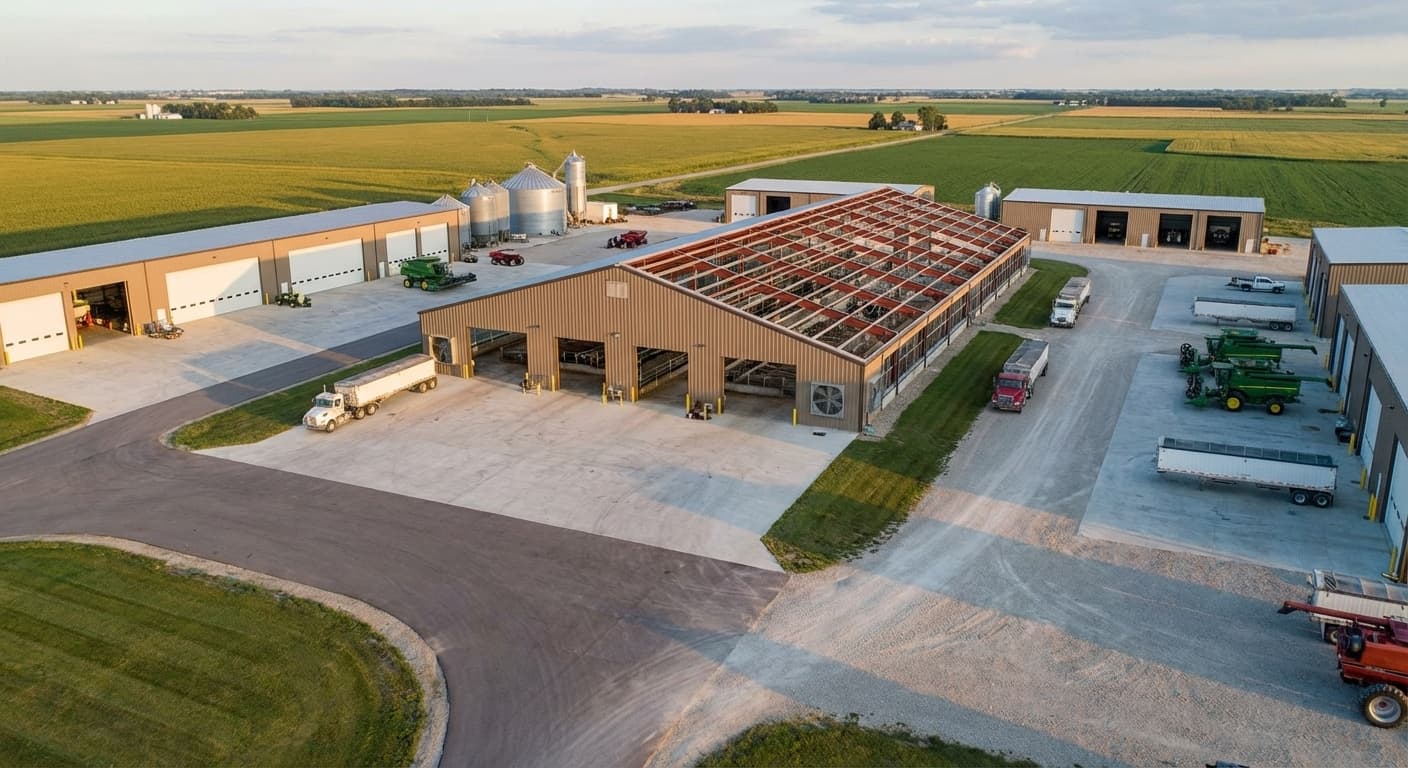

Designing an agricultural building that truly serves your operation starts with mapping today's and tomorrow's workflow–equipment paths, peak-season bottlenecks, and expansion plans–then translating that data into a footprint and column-free steel frame sized for real-world clearances, turning radii, and surge capacity, not just static square footage. The article walks you through species-specific livestock space rules, grain and hay storage multipliers, and machinery bay layouts that minimize travel time, protect feed and equipment with climate-smart vertical storage, and meet current ANSI/AISC 360-22 structural standards so the building is code-ready from day one. It compares cost-effective starter sizes (30×40, 40×60) all the way up to 150-ft mega-dairy spans, shows why pre-engineered steel beats pole-barn life-cycle costs, and details a streamlined 6- to 16-week build process that overlaps permitting, fabrication, and site prep to avoid costly retrofits. By choosing a single-source partner who integrates design, engineering, permitting, and construction, farmers lock in door placements, ventilation, insulation, and future expansion bays early, ensuring the final structure matches seasonal workflow demands, scales modularly, and delivers maximum uptime during harvest or livestock surges.
Understanding Farm Workflow and Building Footprint
Design your farm building around peak demand weeks–not average July–so harvest gridlock becomes seamless equipment flow.
Analyzing Farm Operations to Define Space Needs
Start with your actual workflow, not wishful square footage.
Map where equipment moves, what you process today, and what you'll add in five years. [2] Your current combine might clear 13 feet, but next year's model needs 15–and retrofitting height costs triple what planning ahead does. [2] Factor in the human side too: that family member joining next year or new revenue stream you're eyeing both change how space works, not just how much you need. [2] Site selection drives efficiency–put your building near access roads and working fields to cut equipment travel time and eliminate harvest bottlenecks. [1] These factors together–purpose, equipment scale, growth plans, and smart siting–create a sizing strategy that works harder than any square footage calculation. [2] [3]
Mapping Seasonal Workflow Patterns
Your farm runs different speeds through the year. Harvest slams every zone at once–equipment bays, staging areas, and storage all need access yesterday. You don't need more square footage–you need smarter zones. Design distinct areas for feed, machinery, and processing that connect without cramming, so your harvest rush doesn't turn into gridlock. [4] Track when your operations actually collide: Which weeks do all your tractors need service?
When do feed deliveries stack up with equipment maintenance? That data shows your real space needs–not the quiet July average, but the September surge. [5] Start with a footprint that handles today's peak demand, then add modular bays as you grow. New harvest window? Add a bay.
Livestock expansion? Extend the storage zone. Build for now, design for later. [4]
Aligning Building Layout with Equipment Flow
Smart layout cuts travel time and equipment wear. Put your shop right off the main farm route, next to machinery storage–equipment moves from parking to service to repair without scenic detours. [7] Get door sizing right from day one: grain equipment needs 13-15 feet clearance minimum (detailed specifications covered in our Size Options section). Your service door can run 4 feet narrower than repair doors since different equipment uses each. [7] Leave 40 feet of turning room outside standard doors, 60 feet for semi-trailer access–tight aprons create expensive paint jobs. [7]
Inside, group work by tool sharing. Welding and machining share equipment, so they share walls. Put lubrication near the service entrance where daily maintenance happens. [7] Create clear paths between storage, maintenance, and wash zones wide enough for your biggest equipment–when you're moving a combine through, everything else needs to keep working. [8] This zone planning during design costs nothing. Fixing bad workflow after construction? That's where budgets die. [6] Our
Core Principles of an Agricultural Building Size Guide
A mature cow needs 85 to 120 square feet total when you account for feeding alleys, bunk space, and waterer access–not just the 18 square feet her body occupies.
Calculating Square Footage Based on Livestock Capacity
Your livestock capacity calculations start with a simple truth: animals need more space than their bodies occupy. A feeder calf standing still takes up 10 square feet. But you'll need 40 to 60 square feet per head in a bedded barn. [9] Why the difference? Three zones eat up that extra space:
- Feeding alleys wide enough for movement (10 feet minimum for feeders, 12 for cows)
- Linear bunk space (18-24 inches per feeder, 30-36 inches per cow)
- Waterer access areas (20-40 square feet per pen) [9]
A mature cow physically occupies 18 square feet but needs 85 to 120 square feet total when you factor in these functional zones. [9] Each species brings its own requirements. Pigs need 50 square feet minimum. Horses require at least a 12×12 stall. Goats use 16 square feet per animal. Free-range chickens need 8 to 10 square feet each. [10]
Start with the animal's actual size. Add the movement zones. Factor in feeding and water access. That calculation–based on how animals actually move and compete for resources–gives you a barn that works, not just one that fits. When you're ready to translate these calculations into a durable
Integrating Storage Requirements for Feed and Machinery
Feed storage and machinery space compete for your building footprint–but you can optimize both with smart planning. For grain storage, take your biggest yield projection and add 20%. Budget 0.8 cubic metres per tonne stored. [12] Hay and straw each need 0.5 cubic metres per bale, plus airflow gaps between stacks. Skip those gaps and watch spoilage eat your capacity. [12]
Machinery demands more than floor space. As discussed in the workflow planning section, door heights and turning radius matter as much as square footage. Your combine's height and your handler's turning arc dictate the real space requirement. [12]
Inside, think vertical. Wall-mounted storage and overhead systems free floor space for equipment and work zones without expanding your footprint. [11] Keep parts and supplies in the machinery storage area, restocking the shop as needed–this approach keeps repair bays clear for actual repairs. [7]
Aisle planning follows one rule: measure your biggest equipment, add a buffer, and stick to it. Main aisles get that full width. Secondary paths narrow only where machinery never travels. [11]
Climate control pays double dividends–protecting feed from spoilage and equipment from rust. Route ductwork along ceilings and walls, not through work zones. You maintain function while hitting the temperature and humidity targets that preserve both inventory and investment. [11]
Applying Structural Standards for Steel Buildings
Your steel agricultural building needs to meet ANSI/AISC 360-22–the current structural steel standard in the U.S. [13] This isn't just paperwork. The right engineering method makes your building both safe and cost-effective. Two design approaches exist:
- LRFD (Load and Resistance Factor Design) for larger clear-span structures with variable loads
- ASD (Allowable Stress Design) for simpler, lighter buildings [13]
The 2022 edition brought clearer terminology between design and construction phases. That matters when your fabricator and builder work from the same plans–less confusion, fewer delays. [15]
Your site conditions trigger additional standards. High-wind zones need the Code of Standard Practice (ANSI/AISC 303-22). Seismic areas require Seismic Provisions (ANSI/AISC 341-22). Both are free PDFs from AISC–no excuse for outdated specs. [14]
Before signing any contract, check one thing: do the structural drawings reference 360-22? Some suppliers still use 360-16 templates. That gap creates compliance headaches if your jurisdiction adopted the newer codes.
Bottom line: proper standards mean your building goes up right the first time. Your local codes get met. Your structure handles the loads. And you avoid expensive fixes after the fact.
Size Options from Small Barns to Mega Dairies
A 40×60 costs less per square foot than a 30×40 while doubling your usable space for equipment, livestock, and storage.
30×40 and 40×60 Barns: Ideal for Small Farms
Starting your first farm building? The 30×40 and 40×60 footprints handle 90% of small-farm needs without overbuilding. A 30×40 gives you 1,200 square feet of column-free space. Park two vehicles, store hay and feed, or house small livestock–all under one roof. Professional crews install it in 2-3 days, so you're not missing planting or harvest windows. [16] Step up to 40×60 and those 2,400 square feet change everything.
Run multiple equipment bays. Add a wash station next to storage. Keep livestock and feed separate from machinery traffic. [17] Here's the budget math: bigger buildings cost less per square foot. That jump from 1,200 to 2,400 square feet? Lower cost per foot than your 30×40 baseline. [16] Already tight on space with two machines and growing feed inventory?
Planning to add livestock in the next five years? Build the 40×60 now. Retrofitting or adding a second building later costs twice as much. [17]
60×100 to 80×120 Structures: Scaling Up for Mid‑Size Operations
Moving up to 60×100 or 80×120 buildings? You're entering red iron territory. Spans over 60 feet need I-beam construction–C-channel and tubular frames can't handle these widths. [20] A 60×100 delivers 6,000 square feet with zero columns. Park your combine in one bay, stack hay in another, run livestock operations in a third–each with its own access.
Clear-span framing handles whatever height your biggest equipment needs. [18] An 80×120 gives you 9,600 square feet to truly separate operations. Combine bay here. Maintenance shop there. Staging area over there.
No more equipment traffic jams at harvest time. [20] Need arena space plus support facilities? A 60×120 Budget reality: 60×100 frame packages run $85,000-$125,000. An 80×120 runs $145,000-$195,000. [20] That 15-25% premium for wider spans? It's the heavier beams and stronger connections, not markup. [20] Get your eave height right the first time–16-20 feet minimum for grain equipment. Raising a roof later costs triple what you'd save by going short now. [20]
100+ Foot Span Dairies and Processing Facilities: Mega Solutions
Your operation needs 100+ foot clear spans? Now you're building at dairy and processing scale. Zero columns across 100 feet means your dairy parlor or processing floor follows your workflow, not the building's structure. Position milking equipment, holding pens, and wash zones exactly where they make sense. [21] Pre-engineered components arrive cut and drilled.
Your crew assembles faster, which matters when you're building around active livestock operations. [22] Standard engineering handles spans up to 150 feet. Go wider and you'll need custom calculations. [23] The columns taper–narrow at ground level, wider at the roofline. That shape distributes massive roof loads without overbuilding the entire column. [23] Standard bay spacing runs 20-25 feet, giving you door placement flexibility. Milk tankers enter here.
Feed trucks there. Livestock moves through a third entrance. No traffic conflicts. [22] Processing facilities need height for future growth. Design for overhead conveyors and mezzanine additions now, or pay for structural retrofits every time you upgrade equipment. [23]
Cost, Build Process, and Choosing a Single-Source Partner
Steel buildings cost $15-$43 per square foot upfront with minimal maintenance, matching pole barn pricing while eliminating decades of replacement expenses.
Estimating Costs Using the Agricultural Building Size Guide
Here's what makes steel smart: pre-engineered steel buildings land at $15-$43 per square foot for the complete project. [26] You pay the same as pole barn construction upfront, but you skip decades of maintenance headaches and replacement costs. Our agricultural steel buildings deliver that value equation–competitive initial cost, minimal upkeep, maximum lifespan.
Labor runs another $10-$75 per square foot. [24] The more trades you need–electrical, plumbing, HVAC–the faster that number climbs. Keep it simple where you can.
Don't let site prep catch you off guard. Budget $1,200-$8,000 for grading and clearing before the first beam goes up. [25] Rocky or sloped sites push that higher. Factor it in now, not after you've committed to a building price.
Permits cost $420-$2,500 and you can't skip them. [24] [25] They protect your resale value, keep your insurance valid, and ensure your building meets code. Build them into your budget from day one.
Your best move? Get three quotes minimum. Add 10% for surprises. Schedule construction in late fall or winter when crews have openings and prices drop. [25] That's how you turn estimates into reality without breaking your budget.
Streamlining Permits and Construction Timelines
Your steel building permits clear in 2-4 weeks for agricultural and residential projects when you submit complete paperwork. Commercial projects take 4-8 weeks, and complex industrial applications need 8-12 weeks or more. [27] You avoid the three most common rejection triggers–mismatched foundation and structural plans, incomplete wind load calculations, and missing electrical documentation–by submitting everything correctly the first time. Every correction request restarts the clock, so getting it right upfront saves weeks. [27] Here's the schedule game-changer: submit your permit paperwork while engineering drawings are still being finalized, not after. [28] When you run permits and engineering in parallel, your 3-6 week fabrication window overlaps with permit review. By the time your Site prep works the same way.
Start grading, anchor bolts, and foundation work during fabrication, not after. A finished slab waiting for steel saves time. Steel sitting beside an unfinished foundation loses it. [29] With permits approved and site ready, your building goes up in one to three weeks for standard multi-bay designs. Total timeline from first concept to moving in: 6 to 16 weeks, depending on size, custom features, and weather. [28] [29] Meet with your building department before you submit anything.
Most people skip this step and pay for it later. That 30-minute meeting surfaces local requirements–specific wind speeds, foundation specs, code quirks–before you pay for full drawings. It's the difference between approval on the first try and weeks of back-and-forth revisions. [27]
Leveraging One‑Stop Solutions for Quality and Service Excellence
Working with a single partner who handles design, permitting, site preparation, and construction eliminates the coordination gaps that drive cost overruns and schedule delays on agricultural projects.
When planning, permitting, and build phases run through separate contractors, each handoff creates a potential revision cycle–drawings that don't match permit submissions, site prep that doesn't account for the structural engineer's anchor bolt layout, or foundation work that precedes a framing change.
A provider who manages the full sequence from initial design through occupancy keeps those phases synchronized, so changes in one phase propagate correctly through the rest rather than generating rework. [30] Because agricultural construction is genuinely different from commercial or residential work–equipment clearances, livestock welfare requirements, and seasonal workflow pressures all shape what a functional layout looks like–the most durable value a single-source partner delivers is translating those operational realities into building specifications that don't require correction after the structure is up. [31] Customization should extend beyond standard size options: door placement, ventilation strategy, insulation specification, and interior zone layout are all variables that affect daily workflow, and a partner who locks those in during design rather than treating them as add-ons after the frame is set produces a building that performs correctly from day one rather than requiring retrofits as operations scale. [30]
- Plan building footprint for peak harvest surge, not average July workflow.
- Combine clearance: 13-15 ft doors, 40 ft outside turning room, 60 ft for semis.
- Livestock space: cow 85-120 ft², pig 50 ft², horse 12×12 stall, chicken 8-10 ft².
- Build 40×60 now; retrofitting later costs double and stalls operations.
- Pre-engineered steel runs $15-43/ft², up in winter, permits add $420-$2.5k.
- Run permits parallel to engineering to cut total build time to 6-16 weeks.
- Single-source partner prevents rework by synchronizing design, permits, site prep.
- https://builtmorbuildings.com/blog/agricultural-storage-size-and-space-planning/
- https://www.farmprogress.com/farm-life/evaluating-your-farm-building-infrastructure
- https://www.shergain.com/how-to-choose-the-right-type-of-agricultural-building-for-your-needs
- https://mcgregorstructures.com/how-an-agricultural-shed-improves-farm-storage-and-workflow/
- https://www.farmbrite.com/features/season-planning-and-schedule
- https://farmplanning.ces.ncsu.edu/land-and-water/farm-layout-and-infrastructure/
- https://www.extension.purdue.edu/extmedia/ae/ae-104.html
- https://builtmorbuildings.com/blog/complete-guide-to-workshop-design-planning-your-agricultural-workspace/?utm_source=openai
- https://www.nationalbeefwire.com/how-much-barn-space-is-needed
- https://ozarkpremierbuildings.com/blog/loafing-shed-sizing-guide/
- https://www.lesterbuildings.com/blogs/tips-for-maximizing-agricultural-storage-building-space/
- https://www.robinsons-group.com/finding-the-perfect-size-for-your-agricultural-steel-building/?srsltid=AfmBOopip5Q1TT4h5KHgzY0JdoxZS4FPbHxwDc_G7RbfSvXuCPsOWMCh
- https://www.aisc.org/aisc/explore-aisc/aisc-360/
- https://www.aisc.org/aisc/publications/current-standards/
- https://www.aisc.org/news/aisc-releases-new-version-of-specification-for-structural-steel-buildings-ansiaisc-360-22/
- https://www.buildingsguide.com/standard-sizes/?srsltid=AfmBOooAXKo6nji47VYkTedZwPTxgv6QyaQcm0mQCdlmpzCDijGfM62l
- https://www.getcarports.com/30×40-metal-building-vs-40×60-metal-building?srsltid=AfmBOopfi8vtonaw2yuu0ulVjtJc091WNBCVKliwvWdDJ7GO6C2RFagE
- https://mavericksteelbuildings.com/steel-buildings/agricultural/60×100/
- https://trusteelbuildings.com/steel-buildings/agricultural-kits/60×120/
- https://metalbuildingshop.com/red-iron-steel-buildings/
- https://www.vikingbarns.com/clear-span-metal-barns
- https://renegadesteelbuildings.com/by-size/100-wide-steel-buildings/
- https://www.vikingsteelstructures.com/blog/enhance-your-large-scale-project-with-a-clear-span-metal-barn-building?srsltid=AfmBOopj8yQjgnzh7I4f9R3BR9qJpbNcsr7fWJIREHCIPQ2Tjj5diOp-
- https://www.homeadvisor.com/cost/additions-and-remodels/build-a-barn-shed-or-playhouse/
- https://www.angi.com/articles/how-much-does-it-cost-build-pole-barn.htm
- https://americansteelinc.com/blog/steel-building-costs-prices-guide/
- https://mbmisteelbuildings.com/blog/steel-building-permits/
- https://metalprobuildings.com/pre-engineered-steel-building-timeline/
- https://www.eaglecarports.com/blog/how-long-does-metal-building-installation-take
- https://www.shergain.com/how-agricultural-buildings-can-benefit-your-farm-or-business
- https://www.calahan.com/aspects-of-agricultural-construction/