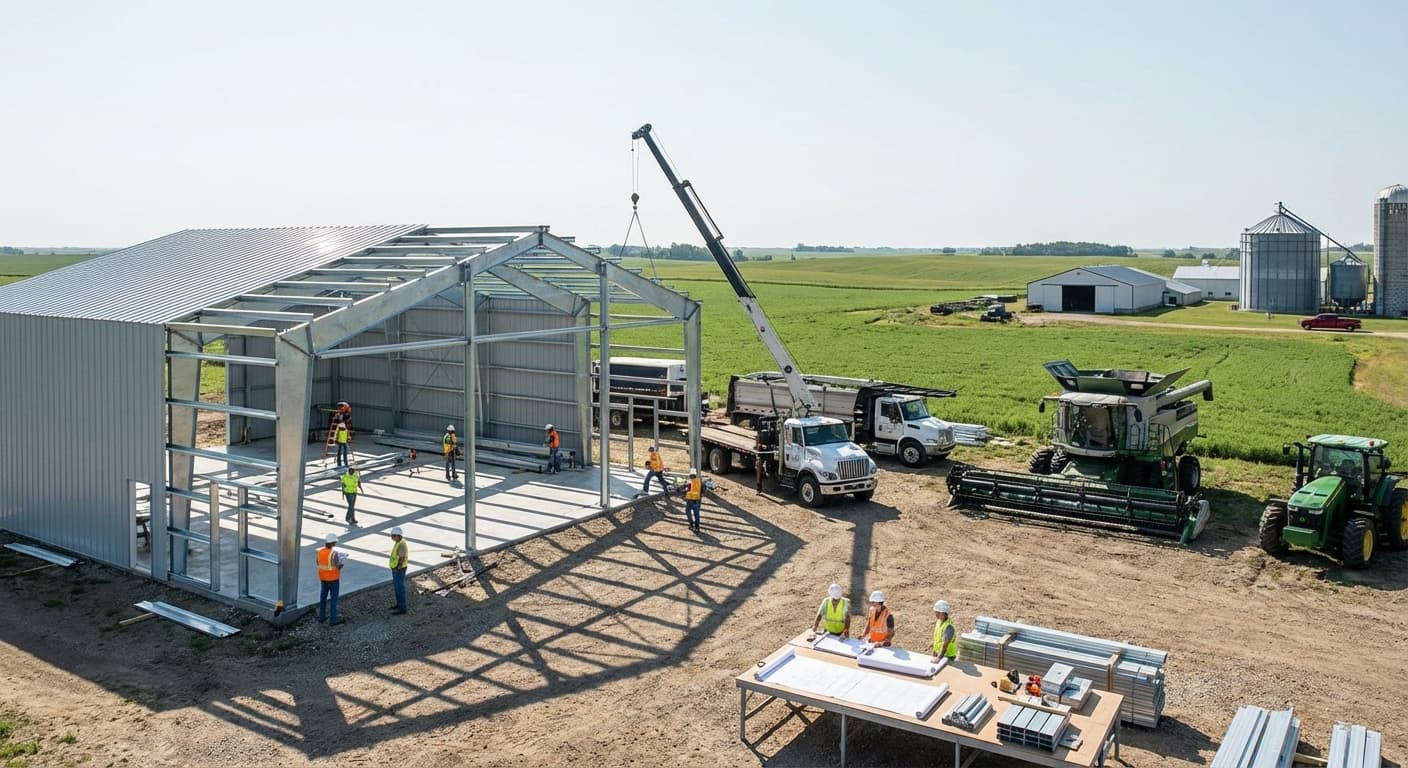

Hiring a full-service, local agricultural steel-building contractor who controls every phase–from soil to final bolt–eliminates finger-pointing, schedule slips, and hidden costs while protecting your warranty, because the same team that handles local permits, custom engineering, and precision fabrication also erects the building, coordinates deliveries, and meets county-specific codes in one accountability chain. The article shows you how to compare true turnkey quotes ($24-43/sq ft installed vs. $15-20 for a kit alone), lock in volatile steel prices through high-volume suppliers, and design for real farm demands: clear-span heights for combines, livestock space standards, expandable bays for growth, and ventilation/insulation tuned to your micro-climate and herd density. Readers learn to spot red flags–vague lump-sum bids, prorated warranties from young companies, third-party installers that void coverage–and to demand itemized breakdowns, engineered drawings before fabrication, and proof of insurance, ensuring the building lasts 40-60 years with minimal upkeep and lower insurance premiums. Ultimately, you'll understand why the right single-source partner turns steel's fire resistance, pest-proof longevity, and energy efficiency into lifetime savings that dwarf the upfront cost, while poor coordination turns small oversights into expensive retrofits or stalled projects.
Why Choose a Full-Service Agricultural Steel Building Contractor
A single-source contractor owns every build phase, catching problems before they compound and keeping your schedule and budget intact.
Assessing Experience and Single-Source Capabilities
The first thing to verify with any agricultural steel building contractor is whether they control the entire build — from site prep through final steel erection. When separate companies handle each phase, accountability gaps open fast. A concrete crew pours a slab slightly off spec, collects payment, and leaves. The steel crew arrives weeks later and finds a foundation they can't build on. Both crews point fingers at each other while your project stalls and costs climb. [1] A single-source contractor owns every phase. Problems get caught before they compound.
Your schedule stays intact. Your budget stays whole.Experience claims need scrutiny beyond headline numbers. A contractor with decades building backyard carports has a fundamentally different skill set than one who's engineered large-span agricultural structures. Ask to see their portfolio — real projects, different sizes, varied uses. [2] A contractor who only knows one building system will force-fit it to every project. [1] The ones worth hiring review your plans before ordering steel. They spot foundation issues on paper. They flag clearance problems before they're poured in concrete.
That foresight comes from completing hundreds of builds and learning what goes wrong — like our Local knowledge multiplies the value of single-source capability. Your county's soil conditions, snow loads, and zoning rules aren't theoretical to a contractor who builds there regularly. [1] They know which inspector requires extra documentation. They understand your area's frost line. National suppliers design from a distance — local contractors build from experience. Confirm your contractor handles permits directly and has working relationships with local authorities. The permit process alone can add months if mishandled (detailed in our turnkey process section). [2]
Ensuring Clear Communication from Design to Erection
Steel building projects run on a fixed sequence where each phase locks in the next — and once fabrication starts, changes become expensive or impossible. Production orders don't allow modifications after submission. That door placement you're reconsidering? Already cut and welded. [3] This is why contractors worth hiring establish clear milestones before ordering steel: anchor bolt layouts, permit drawings, final erection plans, delivery schedules.
Each requires your sign-off before advancing. No surprises. [3] A single-source contractor manages these handoffs internally. No finger-pointing between vendors. No lost emails between companies.
Late design changes, site prep problems, and delivery confusion cause most project delays — all preventable with upfront coordination. [3] You need a dedicated project coordinator tracking every phase. Regular updates. Clear next steps. That's how minor issues stay minor instead of becoming major delays. [4]
Evaluating Quality Standards and Warranty Coverage
Steel building warranties split into two categories with different coverage windows: structural frame warranties typically run around 20 years, while paint and panel warranties now extend 30-40 years due to improved UV-resistant coatings. [5] Neither number means much without the fine print. Prorated warranties look impressive but shift repair costs to you over time. A 40-year warranty from a five-year-old company? Worthless. [5] Ask directly: Is this a manufacturer warranty or pass-through?
How long has the company operated? What's their financial standing? Get answers in writing. [5] Third-party installation voids most manufacturer warranties. Period.
A contractor who subs out erection eliminates your workmanship coverage the moment steel goes up. [5] Single-source matters for warranty protection, not just coordination. Also verify insurance — both general liability for property damage and worker's comp for crew injuries. Legitimate contractors provide proof without prompting. [6]
The Turnkey Process: From Site Planning to Final Build
Navigate federal, state, and local agricultural permits faster with a contractor who knows which inspectors review applications and what they flag first.
Site Assessment and Permitting Made Simple
Agricultural permits hit you from three directions — federal standards for food production, state construction rules, and local county requirements that actually hold up your project. [7] You could spend weeks decoding permit applications, chasing down the right forms, and still miss a critical requirement that sends you back to square one. [8] Standard permits run 6-12 weeks and cost $457 to $2,859, but that's assuming everything goes right the first time. [7]
Zoning throws another wrench in the works before you even think about permits. Your county decides how tall you can build, how far from property lines, and what activities you can run — and those rules change completely just one county over. [8] Here's where a contractor who works your area saves you real time and money. We know which inspector reviews ag applications, what they flag most often, and exactly which documents they need upfront. That local knowledge cuts weeks off your timeline and keeps revision requests to a minimum. [9]
Smart move: schedule a pre-application meeting with your building department before filing anything formal. These meetings are usually free, catch problems early, and can knock weeks off your approval time. [7] Better yet, let us handle the entire permit process while you focus on running your operation.
Custom Engineering that Meets Local Codes and Farm Workflow
Engineering is where your building either saves you money or bleeds it. Every structure must hit exact load requirements for your location — snow, wind, seismic — or it fails inspection. [10] But here's the catch: overengineer to be "safe" and you're buying steel you don't need. That's money straight out of your pocket. Our in-house engineers know exactly where that line sits. We design each framing member to carry required loads without an ounce of excess steel, keeping your material costs lean. [11] More importantly, we engineer around how you actually work. Clear-span design means no interior columns blocking your combine's path. Door heights and widths match your exact equipment — because a 20-foot header needs more than a standard opening. [12]
We position ridge vents and wall louvers based on what you're storing and how many head you're running, not some generic template. [12] Your
Coordinated Fabrication, Delivery, and Erection by One Team
This is where the single-source advantage we discussed earlier becomes real money in your pocket. Split fabrication, delivery, and erection between different companies and you've created three chances for finger-pointing when something goes sideways. [13]
Our crews fabricate to the exact specs they'll erect — no surprises, no "that's not what the drawing shows" delays. [14] Components arrive ready to go up because the same team that builds them installs them.
Delivery day shows the difference. We handle the offload with our own equipment and crew, protecting your investment from truck to foundation. [15] When other contractors inherit a delivery they didn't manage, damaged components and missing hardware turn into disputes about who pays. Not our problem — we own the package from the moment it's loaded until the last bolt goes home. [15]
The sequence runs like clockwork: anchor bolts set precisely, framing raised in order, panels installed per plan. We file your final inspection with the same building department where we pulled your permit. [15] One team, one accountability chain, one number to call if anything needs attention. That completion certificate we hand you covers everything from first permit to final walkthrough — no gaps, no excuses, just a finished building ready to work.
Cost‑Effective Solutions Without Hidden Surprises
A fully itemized quote breaks down every cost–structural steel, labor, delivery, permits–so you can budget accurately and hold contractors accountable for what they promised.
Transparent Pricing and Itemized Quotes
A steel building quote that shows a single lump sum tells you nothing. You can't budget against numbers you can't see. You can't hold a contractor accountable for line items that were never defined. A complete quote itemizes every component separately: structural steel and framing, wall and roof panels, fasteners, engineering drawings, freight, foundation work, erection labor, doors and windows, insulation, and permit fees. [16] When any of those categories is missing, it's not an oversight — exclusions are where margin gets hidden. [16] Here's what happens: You get a $45,000 quote on a 40×60 building.
Looks great. Then delivery, insulation, and installation add another $29,000. Your $45,000 project just became $74,000. [17] The gap between a kit-only price and a fully installed building is significant — installed turnkey steel buildings run $24 to $43 per square foot versus $15 to $20 per square foot for the kit alone — and that spread is exactly what disappears in a vague quote. [18] When you compare bids, make them equal first. If one contractor includes erection and another doesn't, add the missing labor cost before you compare. Installation alone runs $3-$6 per square foot, so a quote that appears $5,000 cheaper may actually cost more once the gap is filled. [17] A contractor running the whole job shows you every number.
The itemized breakdown proves they've covered every phase. It gives you a clear baseline if questions come up later. [16]
Market‑Driven Buying Power Keeps Materials Competitive
Steel prices shift with global markets, tariffs, and supply chains. Smaller contractors eat those swings and pass them straight to your quote. Large-volume manufacturers work directly with steel mills.
They negotiate bulk pricing and lock in rates before market spikes hit your project. [19] Our That volume protects you both ways. When steel costs drop, you save. When costs spike, your project takes a smaller hit. [19] Buying power doesn't stop at raw steel, either — high-volume manufacturers secure better access to components, faster lead times, and more refined fabrication processes that reduce soft costs like delays and change orders. [19] The savings add up fast.
Scale purchasing frees up budget for upgrades — thicker insulation, UV-resistant panels, wider doors — without touching your base price. You can't get that value from suppliers buying at spot-market rates. [19]
Lifecycle Savings: Durability, Maintenance‑Free Design, and Insurance Benefits
Steel saves you money long after the build is done. The real savings show up year after year. Coated steel doesn't rot, attract termites, or warp from moisture. These aren't theoretical problems on farms — they're real forces eating away at wood structures right now. [12] Galvanized coatings protect your building for 50+ years. Metal agricultural buildings last 40-60 years with minimal upkeep. That lifespan turns the higher upfront cost into simple math — you're buying decades of service, not just a structure. [12] Steel doesn't need the constant attention wood demands.
No treatment cycles. No rot repairs. No repainting schedules. Your building stands for decades without the maintenance treadmill. [20] Every dollar you don't spend on maintenance stays in your operation. Steel resists fire better than wood — a fact your insurance company notices. When they calculate risk on your equipment, livestock, and stored commodities, that fire resistance translates to lower premiums. [20] Add insulated walls and your energy bills drop.
You cut heating and cooling costs all year, and that insulation investment pays itself back faster. [21] Add it up: Lower maintenance. Longer life. Fire resistance. Reduced utilities. Your steel agricultural building costs far less over its lifetime than that first quote suggests.
Optimizing Building Design for Farm Operations
Right-sized equipment storage and livestock spacing prevent costly mistakes, while modular steel buildings let you expand as your operation grows without shutting down current operations.
Sizing Your Steel Building for Equipment and Livestock
Getting the footprint wrong in either direction is costly — too small and you're maneuvering equipment in inadequate clearance, too large and you're paying for steel and foundation you don't use. For equipment storage, your largest machine with attachments still attached sets the non-negotiable door clearance. Combines need doorways at least 5 meters high.
Loading bays require 4.5 meters wide by 4.8 meters high minimum to stay functional year-round. [22] Standard machinery buildings run 60×80 feet. Combined livestock and equipment storage typically fits a 40×60 footprint. Commercial operations often need 50×100 to 100×200 feet based on herd size and workflow. [23] Livestock spacing directly impacts your productivity — dairy cows need 1.25 square meters per animal just for feeding, beef cattle require 2.5-3 square meters each.
Those figures don't include handling systems, feed storage, or access lanes for your cleaning equipment. [22] For grain storage, calculate your peak yield and add 20% — you'll need about 0.8 cubic meters per tonne. Standard hay bales take 0.5 cubic meters each, plus clearance for airflow between stacks. [22] Ridge height determines your natural ventilation — it should sit at 1.5 times your building width for proper airflow without mechanical assist. That ratio also shapes your frame spec and eave height for equipment clearance. [22] The right contractor sizes your
Integrating Future Expansion and Add‑On Flexibility
The most undervalued decision in any agricultural building project is how the structure handles what you don't need yet. Pre-engineered steel buildings are modular by default. You can add bays, lean-tos, or new sections as your operation grows — without shutting down what's already running. [25] That matters on a working farm where you can't just pause operations.
Phased expansion matches your capital outlay to actual growth instead of paying for steel you won't use for years. [25] The scalability goes beyond square footage. Your frame can include solar-ready roof configurations, future insulation provisions, and mounting points for automation you'll add later — robotic milking systems, conveyors, whatever your operation needs next. [26] When your contractor builds expansion provisions into the original design — end-wall framing that accepts future bays, foundations sized for additional loads — your future costs stay predictable. No expensive retrofitting.
No structural compromises. Just growth that works. [26]
Designing for Climate, Ventilation, and Energy Efficiency
Ventilation strategy starts with building orientation, not the mechanical equipment inside it. Position your long axis east-west for maximum summer shade and winter wind protection. That simple orientation cuts your mechanical costs before you install a single fan. [28] Natural ventilation works through pressure differential — wind over the ridge creates suction that pulls warm, moist air out while drawing fresh air in through eave inlets. [28] Summer changes the equation. Ridge vents do less work — you need sidewall openings covering one-third to one-half of each wall for proper cross-flow. [28] Roof slope controls effectiveness. Anything below 3/12 pitch underperforms.
Wider buildings need steeper slopes to move the larger air volume. [28] Livestock buildings with 20-30 degreesF temperature differentials need R-4 to R-5 insulation minimum under the roof. Why? A single dairy cow respires four to five gallons of water daily. Without insulation, that moisture hits cold roof steel and starts corrosion from the inside. [28] Modified open-front swine buildings need R-13 in roof and sidewalls to stay above 45 degreesF without running heaters constantly. [28] Temperature swings hit your bottom line directly. Animals exposed to unstable conditions show reduced growth rates, lower milk output, and decreased productivity across the board. [27] The right ventilation design prevents those losses.
Your contractor should size ridge and eave openings for your specific livestock density. Orient the building for your site's prevailing winds. Match insulation to your seasonal swings. Get it right in engineering — not as expensive field fixes after the building's up. [28]
- Single-source contractors eliminate finger-pointing by owning site prep, steel fab, erection, and warranty.
- Permits take 6-12 weeks and $457-$2,859 if done right; local contractors cut delays via inspector relationships.
- Turnkey installed price runs $24-$43/sq ft; kit-only quotes hide freight, labor, insulation that can add 60 %.
- Steel lifespan 40-60 yrs, fire/pest resistance, and lower insurance offset higher upfront cost vs wood.
- Design doors around largest machine: combines need 5 m height, loading bays 4.5 m x 4.8 m minimum.
- Engineer ventilation ridge height = 1.5 x building width; undersized openings cause moisture and livestock losses.
- Pre-plan expansion by orienting long axis east-west, sizing foundations for future bays, and solar-ready roof.
- https://www.btsteel.net/blog/how-to-choose-a-commercial-metal-building-contractor
- https://pbsbuildings.com/choosing-the-right-contractor/
- https://www.metalconstructionnews.com/articles/delivering-metal-buildings-on-time/
- https://coastalsteelstructures.com/uses/agriculture-metal-buildings-farms-barns/
- https://garagebuildings.com/steel-building-warranties-explained-whats-really-covered-in-2025-2026
- https://apbuildersusa.com/top-qualities-to-look-for-in-a-reliable-metal-building-contractor/
- https://www.steelcobuildings.com/building-permit-for-agricultural-building/
- https://www.cfisherconstruction.com/6-things-to-consider-before-constructing-agricultural-steel-buildings/
- https://questarconstructionlp.com/montgomery-commercial-developers-trust-professional-steel-building-expertise/
- https://www.buildingsguide.com/build/metal-building-codes-permits/?srsltid=AfmBOoprnza3KWcAIp4_gKZb_L2b8OcA5aZw_5H6kpVC3z3M1tsU9v_P
- https://armstrongsteel.com/blog/the-future-of-farming-steel-buildings-and-modern-agriculture
- https://www.steelcobuildings.com/agricultural-metal-buildings-common-uses-design-options-and-cost-factors/
- https://m2steelsystems.com/
- https://www.davidconstructioninc.com/commercial-building-erection
- https://incosteelbuildings.com/process/
- https://metalprobuildings.com/steel-metal-buildings-what-you-need-to-know-before-signing-a-contract/
- https://roimetalbuildings.com/how-to-vet-a-metal-building-quote/
- https://www.buildingsguide.com/metal-building-prices/?srsltid=AfmBOoohsr6tU-E2yjgQJRzGJAYToytha-yMvg22BwYmf6WxYBEcDzw0
- https://www.alliedbuildings.com/pemb-leveraging-buying-power-to-recduce-costs/
- https://www.universalsteel.com/farm-steel-buildings-the-durable-solution-for-agricultural-needs/
- https://bulldogsteelstructures.com/blog/exploring-the-cost-efficiency-of-metal-buildings-vs-traditional-construction/
- https://www.robinsons-group.com/finding-the-perfect-size-for-your-agricultural-steel-building/?srsltid=AfmBOoqn3bIj3nEKLFJ06d55O4sYlc59Iz6e5kVMQ9iI2OvwRxKE7Wpf
- https://www.vikingbarns.com/blog/choose-the-right-dimensions-for-your-custom-steel-barn
- https://iconsteelbuildings.com/metal-agricultural-buildings/
- https://www.steelcobuildings.com/steel-buildings/agricultural-buildings/
- https://pbsbuildings.com/modernize-agricultural-operations-with-steel/
- https://meyerbuildings.com/article/how-custom-agricultural-buildings-can-improve-your-farms-efficiency/
- https://www.extension.purdue.edu/extmedia/ae/AE-97.html