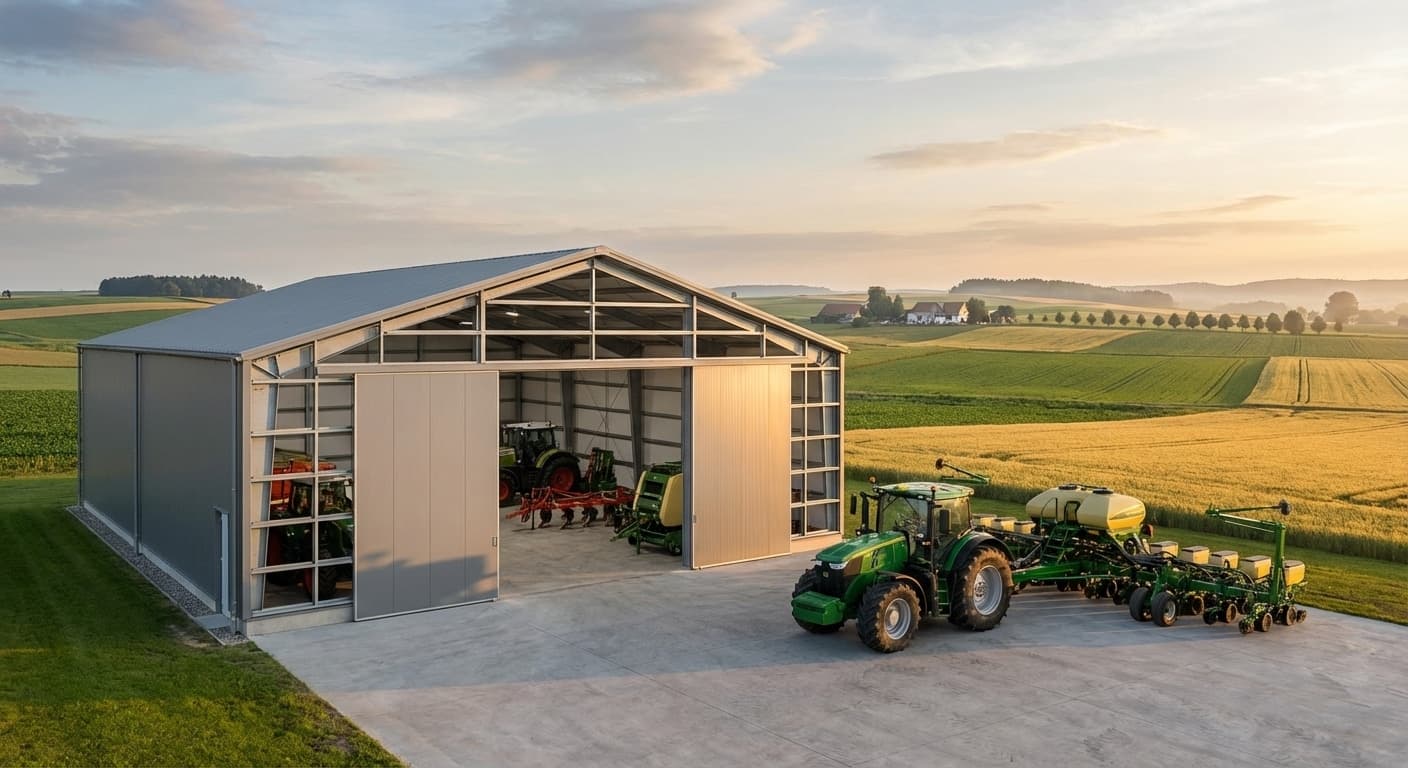

We help you size, price and specify cold-formed steel barns that go up fast, stay clear-span and cost less to own. You'll break ground this season, protect your crops and livestock sooner and watch your lifetime costs drop against wood.
Cold-Formed Steel Advantages for Modern Farms
Cold-formed steel cuts your agricultural building timeline from months to weeks while reducing labor costs by $25,000 to $45,000 on a 10,000-square-foot structure.
Faster Erection & Lower Labor Costs
Speed matters on a working farm where every delayed week means deferred operations. Cold-formed steel components arrive pre-cut, pre-sorted, and sequenced for installation order, letting crews move from foundation to enclosed structure in a fraction of the time traditional builds require.
Panelized CFS wall systems, for example, reduced per-floor installation at a Tennessee hotel project from three weeks to just three days compared to CMU block construction–and the overall project finished three months ahead of schedule. [1] That same compression applies directly to agricultural projects, where faster enclosure means stored crops, equipment, and livestock reach protection sooner. The labor savings are just as concrete.
For a 10,000-square-foot agricultural building in Ontario, steel construction typically runs $50,000-$70,000 in labor versus $75,000-$95,000 for traditional wood-frame methods. [2] That gap widens on larger structures. Prefabrication shifts most of the skilled-labor burden off-site into a controlled manufacturing environment, so fewer specialized tradespeople are needed on your property at any given time. [3] In regions where skilled crews are booked months out, that reduction in on-site labor hours isn't just a cost line–it's the difference between breaking ground this season or next.
Sizing Guide for Every Agricultural Need
Wrong dimensions stress your animals and waste capital, so match your stall sizes precisely to your operation's specific livestock type and numbers.
Livestock Housing Dimensions: Cattle, Dairy, Swine & Poultry
Wrong dimensions cost you twice–stressed animals produce less, and overbuilt structures waste your capital. Cattle need 4 feet by 9 feet minimum per stall. Two cows? You're looking at 10×12 minimum to avoid crowding. [6] Dairy and beef cattle have different requirements–spec for your specific operation. [4]
The 12×12 stall works across the board: cattle, horses, goats, pigs. Need flexibility? Expand to 12×24 with removable interior fencing when seasons change. [5] Swine require 50 square feet minimum. No exercise yard? That jumps to 100 square feet per pig. [4] Chickens need just 8 to 10 square feet per bird. [6]
Height drives function. Animal stalls work at 10 feet. But your access corridors and breezeways? Plan for 14 to 16 feet–your next tractor won't fit through yesterday's clearance. [5]
Crop & Equipment Storage: Clear-Span Widths & Peak Heights
Traditional framed buildings waste 30% of your floor space on support columns. Try pivoting a combine around those posts. [7] Clear-span steel transfers all loads to the exterior frame–100% of your width stays usable.
Most machinery storage needs 60 to 100 feet of clear span. Running multiple large machines or air seeders? You might push to 150 feet. [8] [9] Door sizing follows one rule: beat your widest header. That's why 36-foot sliding doors are standard on equipment sheds that mean business. [9]
Height is money left on the floor. Machinery bays run 5 to 7 meters at the eaves. Grain storage pushes 9 meters for auger clearance. [8] Hay storage demands 3.5 meters minimum–less than that restricts airflow, builds heat, risks mold or combustion. [9]
Started with 8-foot walls? Jump to 14 or 16 feet and double your vertical capacity without touching your footprint. It's the cheapest expansion you'll ever make. [9]
Custom Bay Spacing for Feedlots, Hay Barns & Commodity Sheds
Bay spacing drives daily efficiency. Get it wrong and you'll fight your building every shift.
Hay barns work best at 26 to 28 feet between columns. That fits three large square bales with airflow gaps to prevent heat buildup. [10] Machinery sheds push 8 to 9 meters. Need air seeder access? Girder trusses span double-bay openings–no middle post. Drive-through configurations eliminate dead-end maneuvering. [10]
Standard steel buildings land at 20 to 25 feet for good reason: wider spacing needs heavier columns, tighter spacing multiplies column count. Either direction hits your wallet. [11]
Feedlot commodity sheds play by different rules. Multiple bays per ingredient enable true first-in, first-out rotation. Deep bays shield dry ingredients from wind–less shrink on corn and soybean meal over a feeding season. [12] Pour concrete aprons, not asphalt. Asphalt can't handle loader pivoting. Position high-use ingredients near the mixer to cut travel distance and compound shrink. Semi-trailers back straight in without blocking operations. [12]
Transparent Pricing & Value Engineering
Steel buildings cost less over 30-50 years than wood, require minimal maintenance, and qualify for lower insurance premiums that protect your operating budget.
Price-per-Square-Foot Breakdown vs. Wood/Concrete
You'll spend $25-$100 per square foot on a wood pole barn. Steel? $17-$30. The broader steel market runs $15-$43 per square foot, depending on your building size, design complexity, and location. [https://www.americanmetalbuildings.com/blog/steel-barn-buildings-vs-wood-barns-a-cost-comparison/] [https://americansteelinc.com/blog/steel-building-costs-prices-guide/] But those wood quotes won't tell you this: you'll waterproof annually, paint regularly, seal constantly, and fix rot, warping, and termite damage for decades. That "cheaper" wood barn becomes a maintenance budget that never stops growing.
Your steel building needs a fresh coat of paint every 20 years. That's it. Over the 30 to 50 years you'll run that building, steel wins on total cost–no contest. [https://www.alliedbuildings.com/steel-barn-or-wooden-barn-how-do-they-compare/] Your insurance company knows this too.
Steel buildings anchor to concrete foundations and meet permanent structure codes. Pole barns shift in the ground and often don't qualify as permanent buildings. That classification difference saves you thousands in annual premiums–money that stays in your operating budget where it belongs. [https://www.alliedbuildings.com/steel-barn-or-wooden-barn-how-do-they-compare/]
Standard Packages vs. Tailored Upgrades: Where to Invest
Start with a standard package–you'll save 20-30% compared to full custom design. For rectangular storage buildings or basic livestock shelters, standard works perfectly. [https://www.steelcobuildings.com/steel-agricultural-buildings-prices/] Custom components change the math. Specialized doors, ventilation, internal modifications–each adds cost, but not all pay you back equally. [https://www.steelcobuildings.com/steel-agricultural-buildings-prices/]
Where to invest: Insulation returns your money fastest. Insulated metal panels cut energy bills 10-20%–that's $2,000-$5,000 saved annually on a mid-size agricultural facility. [https://www.summitsteelbuildings.com/20-year-cost-comparison] You'll break even in years, not decades. Thicker steel gauge makes sense for heavy equipment storage or high wind/snow loads–the durability boost cuts repair costs and adds years to your building's life. [https://www.steelcobuildings.com/steel-agricultural-buildings-prices/]
Your best value play? Size. Larger buildings cost less per square foot. If expansion's in your five-year plan, build for it now. Those economies of scale disappear once concrete's poured. [https://www.summitsteelbuildings.com/20-year-cost-comparison] Skip the upgrades that don't work: decorative finishes, custom colors, doors bigger than your current equipment needs. Save those for when specific operations demand them.
National Steel Buildings Service & Support
Complete, accurate permit packages submitted upfront compress timelines from months to weeks, while partnering with one experienced coordinator prevents costly mid-review surprises.
Engineered Drawings & Permits Handled Start-to-Finish
Permit timelines are often the biggest schedule variable in a steel building project–rural jurisdictions may process applications in two to three weeks, while metropolitan areas can take three to six months. [17] Submitting a complete, accurate permit package from the start is the single most effective way to compress that window.
That package typically includes structural drawings stamped by a licensed engineer, a site plan showing building location and setbacks, a foundation plan, and any supplemental documentation required by the local authority. [18] For pre-engineered steel buildings, the manufacturer's engineering team produces the structural drawings based on your building dimensions and load requirements, then a local licensed engineer reviews and stamps them for your jurisdiction–a process that works well when coordinated by one experienced party rather than juggled between separate contractors. [19] Skipping permits entirely carries consequences that far outweigh any perceived time savings: stop-work orders, forced demolition, fines, and insurance that may refuse to cover an unpermitted structure. [17] Nationally, permit costs run between $457 and $2,859 with an average of $1,658–a minor line item compared to the exposure of building without one. [17] Scheduling a pre-application meeting with the local planning department before formal submission costs little and regularly surfaces jurisdiction-specific requirements that would otherwise surface as expensive surprises mid-review. [17]
50-Year Warranty & Dedicated After-Sales Team
A 50-year structural warranty covers the frame, columns, and rafters against manufacturing defects, premature corrosion, and failure to meet specified load requirements–but its practical value depends entirely on the company still operating when you need to file a claim. [20] Manufacturers who have been in business at least 20 years give you a credible basis for trusting a multi-decade guarantee; a warranty certificate from a company that folds in year three is unenforceable. [21] Beyond the frame, panels, roofing, and paint carry separate warranties–panel coverage often runs prorated, meaning a failure in year 15 of a 25-year term returns a discount on replacement material rather than a free panel, while labor for installation typically comes out of the owner's pocket regardless of fault. [21] Paint and finish warranties generally run 20 to 30 years on a straightforward pass/fail basis: documented degradation triggers repair. [21] Two details determine whether coverage holds when you need it: transferability and documented maintenance.
Non-transferable warranties reduce resale value and leave buyers of existing structures exposed, so confirm in writing whether the warranty follows the building or the original purchaser. [21] Maintenance requirements are frequently vague–claims have been denied when owners couldn't produce annual inspection records or had made minor repairs without notifying the manufacturer first–so document everything from delivery forward: installation records, inspection dates, repair work, and all correspondence with the after-sales team. [21]
- Cold-formed steel cuts labor 25-40% and enclosure time by weeks versus wood.
- Size stalls 12×12 ft for universal cattle/horse/goat use; expand 12×24 with removable fence.
- Clear-span steel keeps 100% width usable–ideal for 60-150 ft machinery storage.
- Steel barns cost $17-30/ft² up-front, beat wood on 30-year total cost with 20-year paint cycle.
- Insulated panels save $2-5k/year energy; build bigger now to lock lower $/ft².
- Permits take 2-6 months; submit engineered package early to avoid stop-work.
- 50-year frame warranty value hinges on builder's 20-year+ survival and your maintenance logs.
- https://buildsteel.org/why-steel/cold-formed-steel-101/5-reasons-why-cold-formed-steel-saves-time-money/
- https://ruthvengreenhouse.com/agricultural-buildings/
- https://www.walltechinc.com/blog/cfs-cost-saving-solution
- https://www.versatube.com/news/right_size_barn_cattle_horses_goats_pigs_blog/?srsltid=AfmBOoqYAcsCGim3Ug0Q8nygEv1qcSM6gyD5Ad0ihDjPBhXz_YSYV1Z3
- https://homesteadingfamily.com/barn-design-must-haves/
- https://ozarkpremierbuildings.com/blog/loafing-shed-sizing-guide/
- https://www.vikingbarns.com/blog/clear-span-metal-buildings-guide
- https://pebsteel.com/en/farm-shed-size-guide/
- https://www.wrightsheds.com/agricultural-storage-shed/
- https://www.actionsteel.com.au/whats-the-best-bay-spacing-for-your-farm-shed/
- https://www.probuiltsteel.com/blog/bay-spacing-in-metal-buildings-why-is-it-important/?srsltid=AfmBOoocANbMFcrcG53OHY1StVU3V9khOwCcl7QLioj45qVGcBJsKXDm
- https://thedairylandinitiative.vetmed.wisc.edu/feed-center-design/commodity-storage/