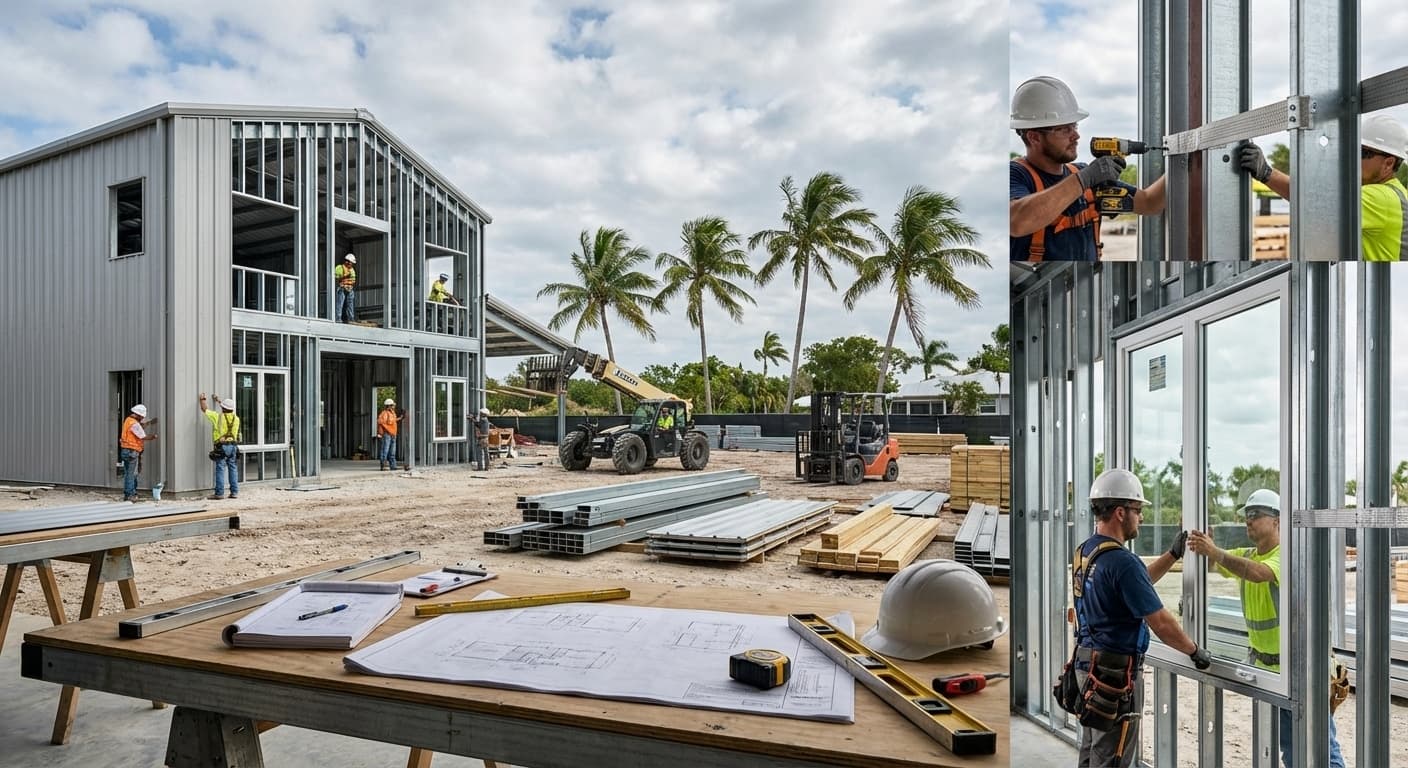

We help you navigate Florida's hurricane codes, zoning quirks and hidden costs so your barndominium sails through permits and budgets stay intact. With our engineered steel packages you gain wind-rated confidence and a faster path to occupancy anywhere from the Panhandle to the Keys.
Why Florida Barndominiums Are Different
Florida's statewide hurricane code ensures structural rigor, but local zoning boards hold the real key to approval–confirm metal residential use is permitted on your specific parcel before breaking ground.
Statewide Hurricane Code Meets Patchwork Zoning
{"heading":"Why Florida Barndominiums Are Different","subsections":[{"subheading":"Statewide Hurricane Code Meets Patchwork Zoning","paragraphs":["Florida's barndominium landscape is shaped by a dual regulatory system: a rigorous statewide hurricane code that demands every fastener be engineered and documented, overlaid by county zoning boards that treat metal homes with wildly different attitudes. While the state mandates wind resistance from 115 mph in the interior to 180+ mph on the coast, the real hurdle is often the local planner who may never have processed a residential steel building.","The result is a patchwork where rural counties like Levy and Marion rubber-stamp agricultural barndos, while urban and coastal jurisdictions write ordinances that quietly outlaw visible metal siding or require brick façades. Before a shovel hits dirt, owners must confirm that their specific parcel is zoned for metal residential use–an approval that can swing from routine to impossible within the same county line.","Even when zoning smiles on the concept, the hurricane code adds layers of third-party inspections: uplift calculations, impact-rated glazing, corrosion-resistant fasteners, and engineered roof-to-wall connections that must survive 45-90 lb/ft² of uplift. The paperwork trail is as critical as the concrete; missing a single stamped form can stall a certificate of occupancy for weeks."]},{"subheading":"Coastal vs. Inland Wind-Speed Mandates","paragraphs":["Drive two hours inland from Miami-Dade and the required design wind speed drops by 65 mph–enough to shave $15,000 off hurricane upgrades and allow thinner 26-gauge panels instead of 24-gauge steel.
Coastal High-Velocity Hurricane Zones demand impact glass or certified shutters, ¼-inch anchor bolts every 16 inches, and corrosion-resistant coatings that can handle salt spray.","Northern inland counties such as Escambia and Leon operate under the same Florida Building Code but at the lowest wind-speed tier, letting builders use standard garage-door bracing and skip HVHZ-rated hardware. The savings ripple through the budget: foundations need less rebar, roof clips are lighter, and window packages cost thousands less.","Yet the line is precise–cross into a designated debris zone and every opening must resist a nine-pound 2×4 fired at 34 mph. Miss that detail during design and the inspector will require a full re-submittal, adding weeks and five-figure change orders to the schedule."]},{"subheading":"Agricultural Zones vs. HOA Bans","paragraphs":["Agricultural classifications are the sweet spot: counties eager to keep land in farming allow barndominiums as "accessory dwellings," often with relaxed setbacks and no architectural review. In these zones, owners can erect a 40×60 ft steel shell, finish half as living quarters, and still comply with land-use rules that prohibit traditional subdivisions.","The opposite extreme shows up in deed-restricted subdivisions where HOA covenants explicitly ban "metal buildings," "agricultural structures," or any roof profile that isn't 6/12 asphalt shingles.
Even if county zoning approves, a single neighbor's complaint can trigger litigation that forces removal or costly façade renovations.","Between those poles lie residential estates that allow metal framing but require stucco or brick veneer, hurricane-rated tile roofs, and color palettes pre-approved by an architectural committee. The takeaway: buy the dirt only after you've read both the county land-development code and the HOA declaration–because one paragraph in either document can turn your dream barn home into a prohibited use."}]}
2026 Cost Breakdown by Region
Florida's 2026 barndominium costs range from $95 to $185 per square foot, driven primarily by hurricane code requirements that add 15-25% in hidden upgrades.
Price-per-Square-Foot From Panhandle to Keys
{"heading":"2026 Cost Breakdown by Region","subsections":[{"subheading":"Price-per-Square-Foot From Panhandle to Keys","paragraphs":["Florida's 2026 barndominium pricing spreads across a $95-$185 spectrum that tracks hurricane exposure more than geography. In the inland Panhandle–Escambia, Santa Rosa, Walton–simple 26-gauge shells still hit the low end of the range, but add $10-$15 per square foot once you cross into coastal wind-borne debris zones.","Central corridors from Ocala to Sebring sit in the middle at $110-$150, balancing moderate wind speeds with higher labor demand from booming growth. South of Lake Okeechobee the numbers jump fast: Palm Beach, Broward, and Miami-Dade routinely quote $165-$185 because every component must meet 175-180 mph ratings and salt-spray corrosion specs.","The Keys push even higher; Monroe County pricing starts at $185 and climbs when you factor in barge freight, rock-key foundations, and limited contractor availability. Wherever you buy, request a county-specific wind-speed map before you budget–crossing one coastal road can add $20 per square foot overnight."]},{"subheading":"Hidden Hurricane Up-Charges: 15-25 %","paragraphs":["State code mandates more than thicker metal; it triggers a cascade of upgrades most owners never see on the first estimate. Hurricane straps move from single to double clips, uplift anchors jump from ½-inch to ¾-inch rods, and every roof penetration needs a redundant sealed flange–line items that quietly add $8,000-$15,000 on an average 2,400-square-foot shell.","Impact-rated glazing is another sticker shock.
A standard 3'x4' window that costs $180 in Georgia runs $425 in Florida wind-borne debris zones, and you need dozens. Pair that with Miami-Dade-certified garage doors at $2,200 each and the surcharge easily hits the upper end of the 25 % range.","Engineering paperwork also costs more. Third-party roof uplift tests, fastener pull-out calcs, and continuous special inspections run $3,000-$7,000 per project–fees almost unknown in non-hurricane states. Bundle these extras early; waiting until permit review adds rush charges and can push your timeline back months."]},{"subheading":"Land-Prep Surprises: Water Table & Fill Costs","paragraphs":["Flat sandy lots look buildable until the soil borings hit water at four feet. High water tables force either a raised stem-wall foundation or full engineered fill, each adding $12,000-$25,000 before the first slab is poured.
In citrus belt counties like Hardee and DeSoto, seasonal perched water can double that if you need additional retention ponds to satisfy storm-water rules.","Coastal ridge sites present the opposite headache: thin topsoil over coral or limestone. Blasting or rock-hauling runs $18-$30 per cubic yard, and a single footing trench can chew through $10,000 quickly. Don't rely on standard excavation allowances; insist on a geotech report so the estimate reflects reality, not optimism.","Fill isn't just dirt–Florida counties often require clean limerock or ASTM-grade sand to maintain percolation. Trucking that material from the nearest pit can tack another $6-$9 per mile. Between water management, rock removal, and code-mandated elevation surveys, land prep frequently outruns the shell budget if you price it last."}]}
Engineering for 180 mph Winds
Upgrading to 24-gauge metal panels and engineered hurricane straps rated for 1,500-3,000 lbs of uplift protects your roof diaphragm from catastrophic failure in 180 mph winds.
26- vs. 24-Gauge Metal and Uplift Clips
{"heading":"Engineering for 180 mph Winds","subsections":[{"subheading":"26- vs. 24-Gauge Metal and Uplift Clips","paragraphs":["Florida's wind-borne debris zones and High-Velocity Hurricane Zones (HVHZ) demand thicker steel. Inland counties accept 26-gauge panels, but coastal builds must step up to 24-gauge or heavier to resist denting and panel fatigue at 180 mph. The jump adds roughly $1.25 per square foot to the shell budget, yet prevents catastrophic envelope failure that triggers internal pressurization and roof lift-off.","Every screw, purlin, and clip is part of an engineered load path. Hurricane straps rated for 1,500-3,000 lbs of uplift are stitched along rafters at 12-inch centers, while continuous ridge ties and reinforced eave connections keep the roof diaphragm married to the walls. Miss one clip or use the wrong fastener pattern and the entire structural chain is compromised; third-party special inspectors check each connection with torque wrenches and load tables before drywall goes up."]},{"subheading":"Impact Glass, Shutters & Debris-Zone Rules","paragraphs":["In debris zones, every exterior opening must either carry a 9-pound 2×4 shot at 50 fps or be protected by an approved system.
Impact-resistant laminated glass with a .090 interlayer is standard, but homeowners often pair it with accordion or roll-down shutters to cut replacement costs after a storm. Impact units run 40 % more than conventional windows, yet insurers reward the combination with wind-premium credits that can repay the upgrade in five to seven years.","Garage doors are the weak link; a single 16-foot panel can surrender to 120-mph internal pressure, peeling the end wall outward. Code-compliant assemblies use 24-gauge steel skins, reinforced struts, and positive locking hardware tied into the structure. Inspectors want to see manufacturer's labels, installation manuals, and impact test certificates staged on-site before they'll sign the pressure envelope inspection–no paperwork, no power release."},{"subheading":"Third-Party Inspections & Documentation Chains","paragraphs":["Florida mandates a special inspector–either a licensed structural engineer or certified building official–for all metal structures in wind zones above 140 mph. These inspectors verify anchor-bolt torque, weld continuity, and uplift connector placement against sealed shop drawings, then stamp a Structural Observation Report that travels with the permit file.
A missing signature can stall drywall delivery and trigger re-inspection fees north of $500.","Documentation doesn't end at certificate of occupancy. Owners receive a "windstorm package" containing fastener schedules, uplift diagrams, and product approvals required for future insurance renewals or resale. Lenders often demand the same packet before releasing final draws on construction-to-perm loans, making meticulous record-keeping as critical as the steel itself."]}]}
Humidity, Mold & Coastal Corrosion Defense
Closed-cell spray foam sealed with continuous 2-inch overlaps and a white elastomeric top coat keeps Florida humidity below 55%, stopping rust and mold before they start.
Closed-Cell Spray Foam Vapor Barriers
Florida's tropical humidity turns metal walls into condensation factories unless the envelope is sealed like a refrigerator. Closed-cell spray foam–2 to 3 lb density, 3 inches on walls and 5 on the roof deck–creates both an R-20 thermal break and an impermeable vapor shield at 0.8 perms or less. The foam's adhesive strength also glues the shell together, adding racking resistance that Miami-Dade now accepts as partial hurricane bracing.
Unlike open-cell or fiberglass, closed-cell foam won't hold water if the roof leaks; it simply beads and drains. The key is continuity–every seam, window buck, and purlin must be overlapped 2 inches so warm, moist air can't ride pressure differential through micro-gaps. Budget $3-$4 per board foot installed; skipping this step usually costs $15,000-$25,000 later to strip rusted panels and remediate mold.
Pair the foam with a white, high-build elastomeric top coat on the exterior skin. The coating lowers surface temperature 15-20 degreesF, cutting the dew-point drive that sucks vapor inward. Together they drop interior humidity below 55 % year-round, the threshold where steel corrosion and mold colonies stall.
Dedicated Dehumidification Systems
Standard residential HVAC can't keep pace with 90 % outdoor dew points and the latent load from cooking, showers, and respiration in a tight steel shell. A dedicated whole-house dehumidifier–rated 90-120 pints per day for a 2,000 ft² barndo–pulls moisture independent of thermostat calls, holding 45-50 % RH even when the A/C is idle.
Duct the unit into the supply plenum with a 20 % bypass so dry air reaches every room without creating hot spots. Condensate drains must terminate outside the slab; otherwise the extracted water simply re-evaporates into the crawlspace. Expect $2,500-$3,800 for equipment plus install, a fraction of the $12,000-$18,000 insurers later charge to rip out saturated insulation.
Coastal owners should choose marine-grade cabinets and coated coils; salt aerosol will pit standard aluminum within three seasons. Pair the system with smart thermostats that ramp fan speed when humidity spikes, preventing the musty "Florida smell" that permeates porous finishes and voids warranties on metal panels.
Galvanized Fasteners & Coatings for Salt Air
Regular zinc-plated screws turn into rust blooms within months in salt-laden breeze zones. Specify G-90 hot-dip galvanized fasteners–0.90 oz/ft² zinc on both sides–plus 300-series stainless washers for roof and wall sheeting. The dissimilar-metal buffer stops galvanic cells that eat holes around every penetration, a common failure point during 180 mph wind cycling.
For coastal counties, upgrade to ZMAX or mechanically plated fasteners that meet ASTM A153; the thicker zinc layer sacrifices itself for 25-30 years instead of 5. All exposed steel edges, including window jamb extensions and base track, should get two coats of a zinc-rich urethane primer followed by a fluoropolymer top coat rated for 3,000 hours salt-spray.
Galvanized cold-formed framing members–NSB's standard–add only pennies per foot yet push corrosion resistance from C3 moderate to C5 very high, the same category used for offshore rigs. The payoff: no rust-through warranty claims, no surprise red-iron repairs after the first tropical storm, and eligibility for coastal insurance credits that shave 8-12 % off annual premiums.
Financing, Insurance & Container Alternatives
Regional banks and credit unions familiar with agricultural construction can finance barndominiums with 20-30 percent down, though you'll need engineered plans and hurricane compliance proof ready.
Regional Banks, 20-30 % Down Construction Loans
{"heading":"Financing, Insurance & Container Alternatives","subsections":[{"subheading":"Regional Banks, 20-30 % Down Construction Loans","paragraphs":["Traditional mortgage lenders routinely reject barndominium projects in Florida, forcing buyers toward regional banks and credit unions that understand agricultural or metal construction. These lenders typically structure construction-to-permanent loans requiring 20-30 percent down, plus higher interest rates and shorter amortization periods than conventional mortgages.","Regional lenders familiar with rural land values and ag-use exemptions often underwrite loans in counties like Levy and Marion where barndominiums are common, but coastal or urban parcels trigger additional scrutiny. Borrowers should prepare engineered plans, cost breakdowns, and proof of hurricane compliance before application to avoid costly delays.","Because appraisals lack comparable sales in many counties, lenders may cap loan-to-cost ratios at 70-75 percent, so budgeting an extra 5-10 percent cushion beyond the down payment prevents cash shortfalls mid-build."]},{"subheading":"Ag vs. Specialty Metal Policies at +30 % Premium","paragraphs":["Standard homeowner carriers frequently decline metal residential structures, pushing owners toward farm-ranch policies or specialty metal-building insurers that charge 15-30 percent premiums over frame construction.
Coastal wind-pool territories and HVHZ zones add another surcharge layer, especially if the structure lacks third-party wind certification.","Agricultural insurers will extend coverage when the owner maintains a qualifying farm-use exemption, but any future zoning change or residential resale can void the policy and trigger a costly rewrite. Documenting hurricane-rated windows, 24-gauge skin, and proper uplift clips at build time keeps premiums closer to the lower end of the surcharge range."]},{"subheading":"Pre-Engineered Container Shells for Faster Permits","paragraphs":["Conexwest's Florida-compliant shipping containers arrive pre-engineered to 180-mph wind loads, eliminating weeks of structural calculations and third-party inspections that slow conventional barndominium approvals. The modular units shave 30-40 percent off permitting timelines because the state's building departments treat them as manufactured products rather than site-built structures.","Each container shell includes galvanized framing, impact-rated openings, and stamped engineering packets accepted by coastal and inland counties alike, reducing lender and insurer pushback.
Buyers gain a durable, humidity-tolerant core that can be finished inside like a traditional barndominium while sidestepping HOA bans on visible metal siding, since exterior finishes can be applied directly to the corrugated skin."}]}
- Florida barndos face dual hurdles: statewide 180 mph wind code and county zoning that may ban visible metal.
- Crossing one coastal road can add $20/ft² because wind-borne debris zones demand 24-gauge steel and impact glass.
- High water tables or coral rock can add $25k in land prep before the slab is poured–get a geotech report early.
- Closed-cell foam ($3-4/board ft) is mandatory to stop mold and rust inside the humid steel shell; skipping it risks $25k redo.
- Regional banks require 20-30 % down and engineered hurricane docs; most national lenders reject metal homes outright.
- Ag-classified land allows easier permitting and lower setbacks, but HOA covenants can still outlaw metal roofs outright.
- Pre-engineered 180-mph container shells cut permit time 30-40 % and dodge some HOA bans on visible metal siding.