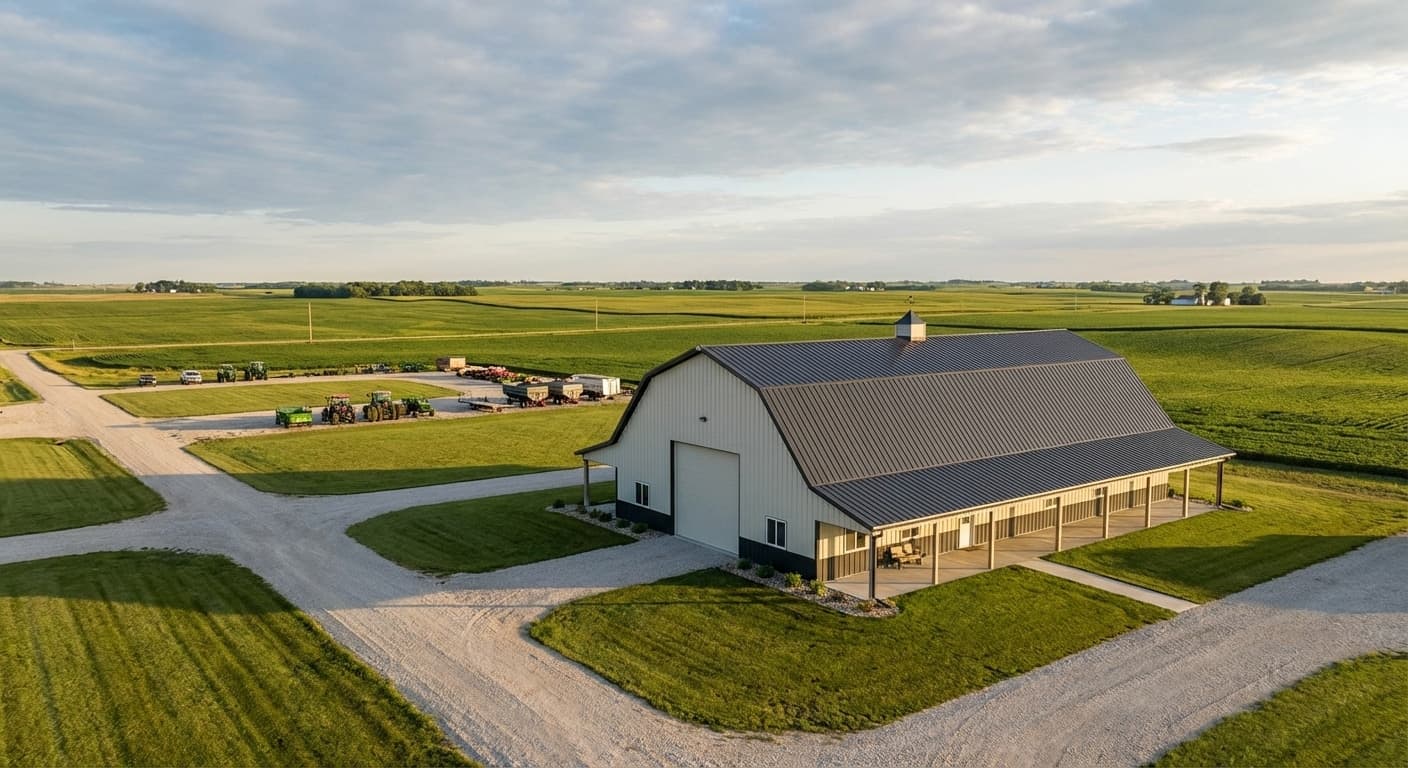

Steel farm buildings outlast and outperform wood by every metric that matters to a working farm–shrinking maintenance to 1-3 % of cost per year, eliminating interior posts so combines and feed lines move unhindered, and cutting energy bills up to 40 % with smart insulation, cool roofing, and solar-ready steel that can flip a building from expense to revenue in 5-7 years. The guide walks you through sizing stalls, bays, and clear-span widths for today's bigger equipment and tomorrow's expansion; matching pre-engineered, light-gauge, or structural systems to livestock, hay, or machinery shelters; and orienting the site for natural ventilation, drainage, and future bays without rebuilding. It demystifies 2025 code changes, USDA loans up to $600 k, factory-direct savings of 15-25 %, and the permits that clear in weeks when you front-load soil reports and stamped plans, while showing how fire-resistant steel earns insurance cuts up to 30 %. Readers learn to compare quotes using terms like bay spacing, purlins, and 26-gauge panels, vet suppliers by IAS AC472 and 40-year rust warranties, and lock in turnkey costs of $24-43/ft² before site prep surprises–turning the single most important infrastructure decision on a modern farm into a data-driven, rebate-backed investment that protects livestock, feed, and six-figure equipment for decades.
Understanding Steel Farm Buildings and the Steel Farm Building Guide Essentials
Steel farm buildings protect your equipment and livestock through engineered frames and metal panels while requiring only 1-3% annual maintenance versus constant wooden barn upkeep.
Defining steel farm buildings and why they matter
You need farm buildings that work as hard as you do. Steel farm buildings combine engineered steel frames with metal panels to create spaces that protect your equipment, livestock, and feed better than any wooden barn ever could [1]. Your operation faces real challenges–extreme weather, pests, fire risks–and steel handles them all without breaking a sweat [3].
You get clear-span interiors with no support columns blocking your workflow. Move your largest equipment freely. Store more in less space. Customize the look to match your property–many steel buildings look just like traditional barns but perform infinitely better [2]. Every building gets engineered for your specific location's wind and snow loads, keeping you compliant with local codes while protecting your investment [3].
Modern farming means bigger equipment, tighter margins, and zero room for infrastructure failures. Your combine harvester, feed inventory, and livestock represent serious capital. Steel buildings protect these assets while adapting to your changing needs over decades, not just years [1]. That's why smart farmers choose steel–it's built for the realities of agriculture, not the romance of it.
Key benefits highlighted in the steel farm building guide
Here's what you actually get with a steel farm building–benefits that show up in your bottom line, not just brochures:
Durability that saves money. Your building shrugs off extreme weather, fire threats, and pest damage that destroy wooden structures [4][5]. You spend less on maintenance and repairs–often just 1-3% of building cost annually versus constant wooden barn upkeep [5].
Fast construction, faster ROI. Steel buildings go up quickly with reduced labor costs. You're operational sooner and seeing returns while others are still building [2][5]. The clear-span design means no posts cluttering your workspace–park combines, stack feed, or expand operations without navigating obstacles [4].
Customization without compromise. Want it to look like a traditional barn? Done. Need specialized ventilation for livestock or insulated panels for temperature control? Built in. Solar-ready roof? Standard option. You get exactly what your operation needs [4][2].
Energy efficiency that pays daily. Proper insulation cuts heating and cooling costs significantly. Your livestock stay comfortable. Your stored crops maintain quality. Your utility bills drop [2][5]. For detailed energy-saving strategies, see our discussion in Section 4.
Environmental responsibility. Steel is completely recyclable. No chemical treatments leaching into your soil. Less construction waste. You farm sustainably–your buildings should too [4][5].
Common industry terminology and classifications
Understanding steel building terms helps you compare quotes accurately and avoid costly misunderstandings. Here's what matters when you're reviewing proposals:
Building Types:
- Pre-engineered metal buildings (PEMBs) – Your best bet for farm use. Cost-effective, quick to assemble, engineered for your exact needs [8]
- Light-gauge steel – Good for smaller sheds and outbuildings
- Structural steel framing – When you need massive clear spans for large operations
Key Terms You'll See in Quotes:
- Main frames (bents) – The primary columns and rafters holding everything up [7]
- Clear span – Unobstructed interior space. No posts. Maximum usable area [6]
- Bay spacing – Distance between main frames. Affects cost and structural capacity
- Purlins and girts – Horizontal supports for your roof and walls [7]
- Base plates and anchor rods – Critical connections to your foundation [6]
Building Classifications: Most farm buildings fall under Type 2 non-combustible construction–fire-resistant without the extreme ratings needed for public buildings [8]. Your structure gets classified as an "agricultural building"–designed for implements, livestock, and storage, not public occupancy [6].
What This Means for You: When reviewing proposals from companies like
How modern engineering improves durability and efficiency
Modern engineering makes today's steel farm buildings work smarter, not just harder. Here's how these advances benefit your operation:
Precision before production. Engineers use advanced modeling to test your building against local weather extremes before cutting a single piece of steel [10]. You get a structure proven to handle your specific conditions–no guesswork, no overbuilding, no waste.
Stronger steel, bigger spaces. High-strength alloys mean thinner components that hold more weight. You get clear spans up to 300 feet for massive equipment storage without sacrificing durability [10]. Advanced coatings protect against everything your farm throws at them–moisture, chemicals, temperature swings [10].
Faster, cleaner construction. Prefabrication and modular assembly slash on-site build time [9]. Components arrive pre-cut, pre-drilled, and ready to assemble. Less weather exposure during construction. Precise connections that stay tight for decades [9].
Built-in efficiency. Strategic insulation placement cuts energy loss by up to 40%. Specialized roof and wall designs minimize heat transfer naturally [11]. Your buildings use less energy from day one–details we explore fully in Section 4.
Smart building integration. IoT sensors and automated controls optimize ventilation and climate without constant manual adjustments [10]. Monitor conditions remotely. Respond to changes automatically. Create ideal environments for livestock and stored crops while cutting energy use [10].
Solar-ready from the start. Steel roofs handle solar panels perfectly–no structural modifications needed. Transform your building from energy user to energy producer [11]. The payback often hits within 5-7 years through utility savings alone.
Assessing Farm Needs and Site Conditions for Optimal Design
Proper space planning–from livestock square footage to equipment clearances–prevents productivity losses and safety hazards throughout your building's lifetime.
Analyzing livestock, equipment, and workflow requirements
Before selecting a steel farm building, you need a clear picture of what you'll actually use it for. Start with your livestock. Count heads, measure space per animal, and map out daily care routines [12]. The right stall design keeps animals healthy and productive–proper sizing, good bedding access, and easy feed and water systems matter [13].
For equipment storage, list every piece of machinery by size and how often you move it. Plan clearances that prevent bottlenecks during your busiest seasons [12]. Think in zones: livestock here, equipment there, workspace in between. Clear pathways between zones save time and prevent accidents [13].
Your operations change with the seasons. That combine harvester needs winter storage. The same space might house processing equipment during harvest [14]. Build in flexibility from day one.
Don't forget ventilation and climate control–they directly impact animal health and stored crop quality [12][14]. Position frequently accessed areas for shortest travel distances. Make doorways wide enough for your biggest equipment plus some breathing room [14]. Smart layout planning now saves thousands of hours over your building's lifetime.
Sizing, clear‑span, and layout considerations
Clear-span buildings give you wall-to-wall space with zero support columns in your way [15]. Yes, they can span up to 300 feet, but the sweet spot for your budget sits between 40 and 100 feet [15]. Need wider? Multi-span designs use minimal support columns to reach 600 feet–perfect for large dairy operations or equipment warehouses [16].
Space requirements are non-negotiable. Dairy cows need 1.25 square meters each just for feeding, plus movement space. Beef cattle require 2.5-3 square meters per animal [17]. Skimp here and you'll pay in reduced productivity.
Your combine harvester needs at least 5 meters of clearance. That telescopic handler needs turning room [17]. Plan doorways for your biggest equipment plus whatever you might buy in five years.
Height matters too. For natural ventilation that actually works, make your ridge height about 1.5 times the building width [17]. This isn't just theory–it's what keeps your animals healthy and feed dry.
Build bigger than today's needs:
- Farm equipment gets larger every year
- Grain storage needs 20% buffer beyond your best yield (figure 0.8 cubic meters per tonne) [17]
- Hay needs 0.5 cubic meters per bale plus airflow space [17]
- Loading bays require 4.5 meters width and 4.8 meters height minimum [17]
Evaluating climate, soil, and site‑grading factors
Get your site right or pay for it forever. Walk your land, mark the high spots and low spots, and map where water naturally flows [18]. Water is your steel building's enemy–control it from day one.
In wet regions, raise your building pad 6-12 inches above grade. Slope everything away from the foundation at minimum 2% (that's 1/4" per foot) [18]. This simple step prevents thousands in moisture damage down the road.
Test your soil. Don't guess. Poor soil means poor support, and that means cracks, settling, and expensive repairs [19]. Clay soils swell when wet. Sandy soils wash away. Both will wreck your foundation if you ignore them [18].
Never build in natural low spots. Water finds them. Always [18].
Smart drainage uses both approaches:
- Surface: swales and berms to redirect water
- Subsurface: French drains and perforated pipes for groundwater [18]
Use cut-and-fill grading to create your level pad without trucking in expensive fill. Compact every layer properly–no shortcuts [18].
Costly mistakes we see repeatedly:
- Skipping soil compaction to save time
- Forgetting to slope the concrete slab
- Thinking surface drainage alone will work
- Ignoring groundwater completely [18]
Planning for future expansion and multi‑use flexibility
Your farm won't look the same in ten years. Build for that reality now.
Steel buildings expand easily. Add bays, raise the roof, extend the length–all without tearing down what you've built [14]. Our
Choosing the Right Building Type and Feature Set
Steel barns outlast pole barns by 30-80 years while cutting insurance premiums up to 30% and eliminating costly realignment every five to seven years.
Pole barns vs. full‑frame steel barns: performance comparisonYou're weighing pole barns against full-frame steel barns? Here's what actually matters for your operation. Pole barns embed wooden posts directly in the ground with horizontal girts for support [21]. Full-frame steel barns bolt engineered steel components to concrete foundations–no wood, no ground contact [22][23].
That structural difference changes everything. Your steel barn resists rot, fire, termites, and mold that eat away at wooden structures [21][23]. You get 50 to 100 years of service versus 15-20 years from pole barns [22][23]. The clear-span advantage we covered earlier? Steel delivers it without compromise.
Quality shows in the details. Steel buildings use 26-gauge panels with 1-1/4" corrugations. Pole barns? They typically run thinner 29-gauge panels with just 5/8" corrugations [23]. You'll spend money realigning shifted wooden poles every 5-7 years. Steel stays put [23].
Your insurance company knows the difference too–expect premium cuts up to 30% for non-combustible steel [23]. Permitting goes smoother with engineer-stamped steel building plans versus the documentation gaps common with pole barns [23]. Even disposal differs: steel recycles completely while chemically-treated wood poses environmental concerns [23].
The choice comes down to this: temporary savings or permanent value.
Specialized structures: loafing sheds, equipment shelters, hay storage
Your farm needs more than one-size-fits-all solutions. Let's match structure types to your specific operations.
Loafing Sheds: Your livestock need shelter without confinement. Open-sided loafing sheds let animals come and go freely while protecting them from sun, storms, and temperature extremes [24]. Natural ventilation keeps them healthy. No daily management required–they seek shelter when they need it.
Equipment Shelters: That combine cost you six figures. Left outside, UV rays, moisture, and temperature swings eat away at its value daily. Clear-span equipment buildings stretch 200 feet or more without posts in your way [25]. You maneuver freely. Your machinery stays protected. Your investment holds its value.
Hay Storage: Spoiled feed costs you twice–in replacement expense and animal health. Purpose-built hay barns create the airflow patterns that keep feed dry and mold-free [26]. Vertical roof designs shed snow and rain while preventing the leaks that ruin your inventory [24]. Plan on 0.5 cubic meters per standard bale plus air circulation space [24].
Each structure type solves a specific problem. Choose based on what keeps you up at night–animal welfare, equipment depreciation, or feed quality. The right specialized building turns that problem into a non-issue.
Energy‑saving options: insulation, reflective panels, solar integration
Your energy bill doesn't have to drain your operating budget. Smart choices during design slash long-term costs. Insulated panels stop your biggest energy thief–thermal bridging that leaks 20-70% of your heating and cooling through steel connections [29]. Polyurethane or mineral wool cores regulate temperatures year-round while preventing the condensation that damages stored equipment and feed [27].
Cool metal roofing with reflective coatings drops interior temperatures up to 30 degrees in summer [28]. Less heat absorption means lower cooling costs and longer roof life–the coating pays for itself through reduced AC runtime and fewer replacements [27].
Solar-ready design turns your roof into a revenue generator. Standing-seam metal roofing accepts clamp-mounted panels without drilling holes that compromise weatherproofing [29]. Add battery storage to run essential systems during outages. Your investment typically returns in 5-7 years through utility savings and ag incentives [29].
Stack these strategies: insulated panels plus cool roofing plus solar cuts energy use 20-40% [29]. For livestock buildings, add automated controls that adjust ventilation based on temperature and humidity–healthier animals, lower utility bills [28].
The upfront investment? Consider it prepaid utilities at a discount. Every efficiency measure reduces monthly expenses for decades.
Designing for ventilation, natural lighting, and operational flow
Good design works with you, not against you. Three factors determine whether your building helps or hinders daily operations. Ventilation That Works: Match airflow to function. Your livestock area needs different ventilation than your equipment bay [31]. Ridge vents paired with eave openings create natural circulation–no electricity required [30]. Size sidewall openings at 14 inches per 10 feet of building width for proper air exchange [30]. As discussed in the site assessment section, orientation matters–east-west positioning maximizes summer shade in most regions [31].
Natural Light Saves Money: Large windows, skylights, or light tubes cut your daytime electrical costs to zero [32]. Better light means safer working conditions and fewer mistakes during detail work. Your crew works better when they can actually see what they're doing.
Workflow That Flows: Zone your building by task. Storage here, processing there, wide aisles between [32]. You eliminate wasted steps and equipment bottlenecks. Movable partitions let you reconfigure for seasonal needs–hay storage in winter becomes processing space at harvest [32].
Multi-use buildings need separated ventilation zones. Keep livestock moisture and odors away from your stored equipment [31]. One building, multiple functions, zero compromises.
Design it right once. Work efficiently forever.
Financial Planning, ROI, and Sustainable Funding Options
A 30×40 steel farm building costs roughly $24,000 for the kit alone, but budget $24,000 to $43,200 total when you factor in foundation, delivery, and construction.
Detailed cost breakdown: materials, labor, and ancillary expenses
You need real numbers to make smart decisions about your steel farm building investment. Basic metal building kits run $15 to $20 per square foot–that's roughly $24,000 for a 30×40 structure, $43,200 for a 40×60, or $75,000 for a 50×100 facility [34]. But that's just the kit. Your turnkey project, including foundation, delivery, and construction, typically lands between $24 and $43 per square foot [34]. Material choices drive costs significantly. Thicker gauge steel costs more upfront but delivers decades of extra life. Your decisions on insulation, roofing materials, and protective coatings all affect the bottom line [33]. Don't forget site preparation–it's the budget item that catches many farmers off guard. Poor soil conditions or significant grading needs can add thousands to your project [33].
Labor rates vary by region and complexity. Yes, experienced crews cost more per hour, but they prevent the expensive mistakes that plague rushed installations [33]. Custom features like automated doors or specialized ventilation systems add 20-30% to pre-engineered designs–choose modifications that directly support your operation [33].
Your complete budget should include:
- Permits: $500-$2,000 depending on your county
- Engineering fees for stamped drawings
- Utility connections for power and water
- Equipment rental during construction
- Construction insurance coverage [33]
Plan for annual maintenance at 1-3% of building cost–a small price for protecting your investment [33]. In high snow-load or hurricane zones, expect 5-15% additional structural costs for required reinforcement [33].
Financing pathways: loans, leases, USDA and state programs
Your steel farm building doesn't have to strain your cash flow. The USDA Farm Service Agency backs multiple loan programs specifically for agricultural infrastructure. Farm Ownership Loans go up to $600,000 and cover building construction, expansion, and site improvements [35][37]. Need something smaller? Microloans streamline the process with less paperwork–perfect for specialty farms or your first building project [35][37].
Natural disaster recovery? Emergency Loans help you rebuild essential infrastructure quickly [37]. If you have established credit, FSA Guaranteed Loans work through your local bank but with USDA backing for better rates [35]. Beginning farmers get priority access to dedicated funding pools [35].
The application process is simpler than you think:
- Use the online Loan Assistance Tool to check eligibility
- Submit applications directly through the Online Loan Application portal
- Work with your local USDA Service Center for guidance [35][37]
Climate-smart features like solar-ready roofing or high-efficiency ventilation? USDA loans can be structured specifically for these sustainable improvements [37]. Already carrying operating debt? The Debt Consolidation Tool shows how rolling existing loans into one package could lower your payments [37].
Rural Development programs offer additional options for infrastructure that supports your operation. While direct grants for buildings are limited, your local Service Center knows about state-specific opportunities that could supplement your financing [36][37].
Cost‑saving strategies without compromising quality or service excellence
Smart farmers save money without cutting corners. Factory-direct purchasing cuts out middleman markups, saving 15-25% on your total project while maintaining full quality standards [38]. Choose customizations that earn their keep–automated doors for high-traffic areas make sense, decorative cupolas don't [38]. Time your purchase during slower seasons for better pricing and faster delivery [38].
Consider DIY assembly if you have the skills. Pre-engineered kits come with pre-drilled holes and detailed instructions. Just be honest about your capabilities–fixing assembly mistakes costs more than hiring pros from the start [38].
Material choices make or break your budget:
- Standardized dimensions cost less than custom sizes
- Match steel gauge to actual needs, not theoretical worst cases
- Use modular designs to minimize waste [40]
For energy savings strategies that complement your
Compliance, Quality Assurance, and Partner Selection
Meet the January 2025 Farm Building Code updates by ensuring proper truss spacing, fire safety systems, and energy standards for your agricultural structure.
Current building codes, zoning, and USDA guidelines (2025‑2026 updates)
Your new steel farm building needs to meet current codes–and those codes just got updated. The Farm Building Code amendments that kicked in January 1, 2025, bring agricultural construction in line with national standards while adding new classification systems based on your building's size, use, and potential hazards [41].
Here's what matters for your project: Buildings over 6,500 square feet now need closer truss spacing and tighter stud spacing on end and side walls to handle increased snow and wind loads [41]. Fire safety requirements expanded too, especially for livestock buildings and larger structures, with new rules for fire separation and alarm systems in certain facilities [41]. You'll also need to meet updated energy standards–better insulation, efficient lighting, and improved ventilation, particularly if you're housing animals [41]. The good news? These requirements often align with renewable energy options you might already be considering [41].
Every jurisdiction handles permits differently, but most want the same core documents: stamped structural plans, site maps, property surveys, environmental assessments, and engineering analyses [42]. Federal USDA and EPA standards set the baseline for waste management, water runoff, and air quality–your local officials build their requirements from there [42].
On the financial side, the One Big Beautiful Bill Act brings welcome changes. Individual payment limits jumped from $125,000 to $155,000 (and they're now indexed to inflation), plus LLC and S-Corporation members who actively farm can qualify for separate limits [43]. The Act also opens up 30 million new base acres nationwide, better matching today's farming operations [43]. Latest guidance suggests 2025 limits might hit $160,000 per person [43].
Permitting process, inspections, and timeline management
Getting your permits approved quickly starts with knowing the timeline. Farm and residential projects typically clear in 2-4 weeks, commercial buildings take 4-8 weeks, and industrial facilities can stretch to 12+ weeks–but only if you submit everything correctly the first time [42].
Start with the right documents: stamped engineering drawings, site surveys, soil reports, and utility connection plans tailored to your agricultural needs [44]. Your building department wants a detailed site map showing drainage patterns, elevation changes, and existing structures. Pay special attention to foundation details–steel buildings transfer loads differently than traditional structures, and inspectors know it [44].
Expect inspections at key milestones. Foundation inspection comes first, before you pour concrete, to verify excavation dimensions, rebar placement, and anchor bolt positions [44]. Structural inspections check frame assembly, connections, and bracing–down to bolt torque specs and weld quality [44]. Final inspection confirms everything matches your approved plans before you get your certificate of occupancy [44].
Here's a time-saving tip: Schedule a 30-minute pre-application meeting with your local building officials [42]. This simple conversation clarifies their expectations for wind calculations, foundation details, and any local code quirks–potentially saving weeks of back-and-forth revisions [44]. If your jurisdiction rarely sees steel buildings, bring an engineer who speaks their language. The right professional translates steel construction into terms inspectors understand, often cutting approval time significantly [44].
Plan for seasonal delays. Winter submissions face longer processing as building departments deal with weather-related workloads [44]. Remember that agricultural buildings often get special zoning treatment–some areas exempt small farm structures or have specific rules for historic barns [42]. Every region differs: California focuses on earthquakes, Florida worries about hurricanes, and the Midwest watches snow loads. Know your local requirements before you submit [44].
Selecting a trusted supplier: certifications, warranty, single‑source solutions
Your steel building supplier choice determines whether your project runs smoothly or becomes a coordination nightmare. Start by checking certifications–IAS AC472 represents the gold standard for steel building manufacturing, covering everything from structural welding to engineering design [47]. Top suppliers also carry American Welding Society certifications and regional approvals for your specific wind and seismic requirements [47].
Warranty coverage tells you how much a supplier trusts their own product. Industry leaders offer 40-year rust-through protection plus 60-year structural guarantees–not because you'll need them, but because they know you won't [45]. The best warranty programs give you options: workmanship coverage, finish protection, and weathertightness guarantees that actually mean something when storms hit [46].
Single-source solutions save more than money–they save your sanity. When one company handles engineering and fabrication in-house, you get consistent quality and someone who answers the phone when questions arise [47]. Watch out for suppliers who outsource to overseas contractors; you want everything from primary framing to trim pieces made under one roof for perfect fit during assembly [47].
The right partner combines design expertise with manufacturing muscle. They'll work with you to create exactly what your farm needs while keeping your budget intact [45]. After completing over 1,480 projects nationwide,
Ensuring proper installation, project management, and after‑sales support
Quality installation starts before the first bolt goes in. Smart project management prevents problems instead of fixing them later–saving you time, money, and headaches [48]. The key? Clear expectations set during preconstruction meetings where everyone understands their role and potential trouble spots get flagged early [50].
Professional installation teams know that details matter. Every connection, every fastener, every weld affects your building's strength and lifespan [50]. That's why experienced crews use continuous inspection–senior team members check work as it progresses, catching issues immediately instead of after they're buried under more construction [50]. Digital documentation helps too. Photos and videos create a clear record of what's done right and what needs attention [50].
Your supplier's certifications matter here. AWS (American Welding Society) credentials and ISO 9001 systems aren't just paperwork–they're proof that quality control runs through the entire organization [49]. The best partners stay involved from first contact through final occupancy, treating your building like the major investment it is [50].
After-sales support separates good suppliers from great ones. You should get thorough final inspections, complete system documentation, and real technical support when questions come up during those first few months [49]. This isn't about warranties–it's about making sure your building performs exactly as promised, delivering the durability and return on investment you're counting on [50].
When you choose a single-source partner who handles everything from design through construction, accountability stays clear. No finger-pointing between suppliers, no gaps in responsibility–just one team focused on getting your project done right the first time.
- Steel farm buildings cost 1-3% of purchase price annually to maintain versus constant wooden barn repairs.
- Pre-engineered steel kits run $15-20/sq ft; turnkey projects land $24-43/sq ft including foundation and labor.
- USDA Farm Ownership Loans cover up to $600,000 for steel farm buildings with priority for beginning farmers.
- Buildings over 6,500 sq ft must meet stricter 2025 codes: closer truss spacing, updated fire and energy rules.
- Clear-span steel frames reach 300 ft without posts; optimal farm width is 40-100 ft for cost and usability.
- Cool metal roofing plus insulation cuts energy use 20-40%; solar-ready roofs pay back in 5-7 years.
- Soil testing and 2% grade away from foundation prevent costly moisture damage and structural failure.
- https://designandbuildwithmetal.com/featured-content/2025/09/11/steel-agricultural-buildings-exploring-the-many-benefits
- https://armstrongsteel.com/blog/key-benefits-of-adding-a-steel-building-to-your-farm
- https://renegadesteelbuildings.com/products/building-types/steel-farm-building/
- https://mbmisteelbuildings.com/blog/advantages-agricultural-steel-buildings/
- https://www.newmartbuildersinc.com/blog/benefits-of-steel-farm-buildings/
- https://www.buildingsguide.com/build/comprehensive-glossary-of-steel-building-terms/?srsltid=AfmBOorwOuyLIP606oKSwF_C-nMCHvTkKFeymKasP_LnvaLjOuxx0O7Q
- https://www.starbuildings.com/resources/metal-buildings-101/
- https://ecosteel.com/ecosteelprefab/the-definitive-guide-to-metal-building-construction-types-and-classifications/
- https://eoxs.com/new_blog/how-modern-steel-construction-is-revolutionizing-farming-infrastructure/
- https://mirinbuildingsystems.com/importance-of-steel-building-engineering-in-agriculture/
- https://americansteelinc.com/blog/engineering-advances-steel-buildings/
- https://www.intelligentliving.co/how-to-design-efficient-farm-buildings/
- https://www.1st-choiceconstruction.com/the-perfect-farm-barn-special-design-features-to-consider/
- https://mbmisteelbuildings.com/blog/multi-purpose-agricultural-steel-building/
- https://www.buildingsguide.com/build/clear-span-buildings/?srsltid=AfmBOopGZA-RVShih-AH4yS2X1QPGXQeaTbSU4TNt9q82wQYpA0rHKNR
- https://www.vikingsteelstructures.com/blog/multi-span-metal-buildings-for-agricultural-purposes?srsltid=AfmBOorWSsFCUehs1KZqfKHC5DtnuUxfBNR3RAhKKmpHUEFi0MFDyScV
- https://www.robinsons-group.com/finding-the-perfect-size-for-your-agricultural-steel-building/?srsltid=AfmBOormnXo1NZZwgPH31UX5cqva54VBsXBj9-yT0LWDCp4kv5QOp5zZ
- https://metalprobuildings.com/drainage-grading-tips-for-steel-building-sites/
- https://lionbuildings.com/how-do-i-prepare-my-site-for-a-steel-building-install/
- https://xtdsteel.com/blogs/steel-framed-agricultural-buildings/
- https://futurebuildings.com/blog/pole-barn-steel-barn-comparison.html
- https://koehnbuildings.com/pole-barn-builders
- https://www.rhinobldg.com/metal-pole-barns-vs-rhino-steel-buildings
- https://www.vikingbarns.com/blog/choose-best-metal-structure-for-farm
- https://www.rhinobldg.com/blog/metal-barns-and-buildings-for-rural-life
- https://www.wrightsheds.com/farm-shed-ultimate-guide/
- https://www.metalbuildingoutfitters.com/5-best-energy-efficient-custom-metal-buildings-options/
- https://mbmisteelbuildings.com/blog/energy-efficient-commercial-steel-buildings/
- https://metalprobuildings.com/energy-efficiency-in-steel-buildings/
- https://norsteelbuildings.com/steel-building-planning-design/metal-building-ventilation/
- https://builtmorbuildings.com/blog/ventilation-systems-for-agricultural-buildings/
- https://www.metalbuildingoutfitters.com/10-tips-for-custom-metal-farm-building-designs/
- https://www.steelcobuildings.com/steel-agricultural-buildings-prices/
- https://www.buildingsguide.com/metal-building-prices/?srsltid=AfmBOoogNZd5qxVQGf-qv2Gty5kFAOeqsYcQkv6XsRNwkMV2zFiDj3K9
- https://www.fsa.usda.gov/resources/farm-loan-programs
- https://www.usda.gov/farming-and-ranching/financial-resources-farmers-and-ranchers/grants-and-loans
- https://www.farmers.gov/loans
- https://armstrongsteel.com/blog/tips-for-saving-money-on-steel-barn-buildings
- https://www.vikingsteelstructures.com/blog/the-hidden-economics-of-metal-buildings-saving-more-than-just-money?srsltid=AfmBOoo-DjHVJoFp6TcVPnl-DNsQorYtc3ADuyFhY3HxBZ5fNM-SsnW7
- https://www.metalbuildingoutfitters.com/building-cost-effective-steel-structures-a-how-to-guide/
- https://www.ivesinsurance.com/2025/01/20/farm-building-code-changes/
- https://www.steelcobuildings.com/building-permit-for-agricultural-building/
- https://ccf.us/obbba-farms/
- https://mbmisteelbuildings.com/blog/steel-building-permits/
- https://steelcommandercorp.com/steel-farm-buildings-for-agriculture/
- https://www.nucorbuildingsystems.com/resources/warranty/
- https://ironbuiltbuildings.com/manufacturing/
- https://www.calahan.com/a-guide-to-metal-building-quality-control-in-construction/
- https://sanpetesteel.com/what-does-a-steel-fabrication-company-do-a-complete-guide-to-steel-manufacturing-in-utah/
- https://www.summitsteelbuildings.com/a-quality-control-process-ensures-an-excellent-build