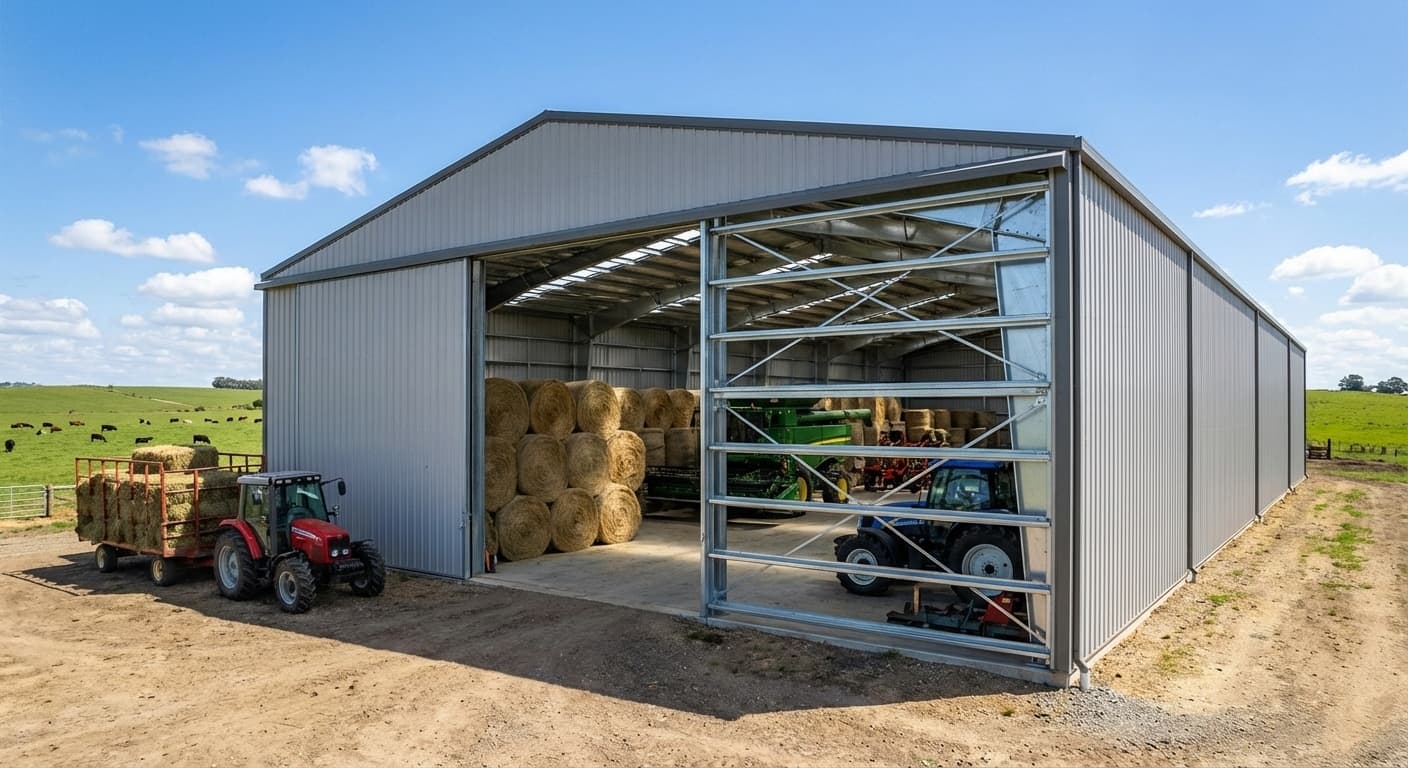

We engineer cold-formed steel ag buildings that are 12% lighter yet stronger, cutting your material, freight and foundation costs from day one. Our precision G90-galvanized frames go up 30% faster, shrug off decades of wash-down, and carry a 50-year warranty we honor ourselves.
Why National Steel's Cold-Formed Steel Buildings Outperform
G90 galvanized cold-formed steel eliminates welding delays while protecting your operation against ammonia, chemicals, and daily wash-downs for the building's lifetime.
Precision-roll forming that trims 12% of the steel weight without losing strength
You'll buy 12% less steel and still get the strength you need.
That's the precision advantage of cold-forming.
Galvanized G90 coating for decades of feedlot and dairy wash-down resistance
Your feedlot runs 24/7. Your dairy gets pressure-washed daily. Standard steel can't take that punishment–but G90 galvanized cold-formed steel can.
Ammonia from animal waste attacks unprotected metal. Caustic cleaning chemicals eat through light coatings. High-pressure wash-downs find every weakness. In these environments, standard steel fails in years, not decades.
G90 changes the equation entirely. Every cold-formed member starts as galvanized sheet steel–the zinc protection is bonded into the material before it's even formed, not sprayed on after. [4] That 0.90 oz of zinc per square foot creates a barrier tough enough to handle whatever your operation throws at it: manure gases, alkaline cleaners, humidity swings, daily wash-downs. The protection lasts as long as the building does–no recoating, no rust-through, no structural compromise from corrosion.
Pre-punched, bolt-up frames that go up 30% faster than welded rigid frames
Your building goes up 30% faster when you eliminate welding–and that's exactly what pre-punched cold-formed frames do.
Every member arrives with holes already punched, ready for bolts and screws. No welding rigs. No certified welders. No waiting for weld inspections to clear before the next trade can start. Your crew picks up a C-channel–light enough to handle without a crane–lines up the pre-punched holes, and bolts it in place.
The precision matters as much as the speed. Factory-punched holes mean your field crew isn't measuring, drilling, or making it work. They're assembling a system engineered to go together one way–the right way. While welded rigid-frame projects wait on skilled welders and deal with schedule variance from on-site fabrication, your bolt-up frame is already taking shape. Less labor cost, tighter schedule, same structural integrity.
Agricultural Applications Engineered for Your Operation
Cold-formed steel with continuous exterior insulation and thermal breaks maintains steady temperatures from -20 degreesF to 120 degreesF, eliminating condensation and protecting your product year-round.
Hay, equipment and livestock shelters clear-span up to 100' with cold-formed trusses
Cold storage, packing and processing barns that hold steady at -20 degreesF to 120 degreesF Your cold storage faces extreme temperature swings–frozen interior at -20 degreesF, summer exterior above 100 degreesF. That 140 degreesF differential across your walls would destroy most buildings through condensation, corrosion, and runaway HVAC costs.
Cold-formed steel solves this with two smart strategies. First, continuous exterior insulation wraps your entire building–EPS, XPS, GPS, or polyiso creating an unbroken thermal barrier. [10] Second, thermal breaks at connection points stop heat transfer cold. Strips, shims, or slotted studs cut the metal-to-metal conduction path that lets heat sneak through. [10]
What you get: rock-steady temperatures that protect your product. No condensation pooling on floors creating food safety hazards. No moisture attacking your G90 galvanized frame. [10]
Expandable loafing sheds, calving barns and feed bunks that grow with your herd
Your herd grows on its own schedule–your buildings should too. Cold-formed steel expands through simple end-wall additions. When you need more space, order additional frames that bolt onto either end. No new foundation. No disrupting active pens. Just more capacity when you need it. [13]
Loafing sheds keep it simple: three-sided, open-front structures that shelter cattle, horses, and goats from sun, wind, and snow. They double as feeding and watering stations–no separate infrastructure needed. [12]
Calving barn packages scale from 24×60 to 36×100 feet. Each includes continuous fencing, integrated feed bunks, and working equipment setups. One building handles cow-calf pairs, pen sorting, and routine herd management. [14]
This bolt-on expansion matters. You add capacity when you actually need it, not when you hope you might five years down the road. Your building investment matches your actual operation, not your best guess.
Performance & Engineering Specs That Cut Costs
A single 12-gauge stud carries 8,000 lbs at just 20 lbs, eliminating costly oversizing while your components arrive factory-precise and stay that way through construction.
50 ksi steel yield plus 1:1 strength-to-weight ratio equals 12% less steel to buy
You're buying steel rated at 50 ksi yield strength–that's 50,000 pounds per square inch before permanent deformation.
Most structural grades can't touch that. [15] Your engineers can spec thinner members that still carry full design loads because the material itself works harder per pound. [15] In your building, that means a single 12-gauge stud supports 8,000 lbs while weighing just 20 lbs–a 400:1 strength-to-weight ratio that doubles what wood delivers. [16] Where conventional framing needs oversized members for safety margins, your cold-formed steel structure uses precisely what each load path requires. [17] As covered in our precision-roll forming section, this engineering advantage delivers real savings–lower material costs on your order, cheaper freight to your site, and less concrete in your foundation. [15]
Factory tolerance +/-1 mm keeps concrete, sheeting and doors tight–no field fixes
When your frame member arrives 5 mm off spec, every trade pays for it. Your concrete contractor adjusts anchor bolts. Your sheeting crew burns hours shimming panels.
Your door installer fabricates fixes no bid covered. Cold-formed steel stops that domino effect before it starts–components arrive factory-precise and stay that way. [18] You're not dealing with welded joints that shrink 1 mm per 3 m longitudinally or contract up to 3 mm transversely from heat distortion. [19] Your steel won't swell with humidity or warp like wood. It arrives true, stays true, and goes up true. [18] Your foundation anchors hit their marks.
Your sheeting sits flush without packing. Your doors hang square first try. No field fixes, no schedule slips, no surprise labor costs.
Seismic and 170 mph wind ratings certified so you meet county permits first pass
Your county plan reviewer checks two things first: wind loads (IBC Section 1609) and seismic loads (IBC Section 1613). Miss either one, your permit stalls. [21] Your cold-formed steel package arrives with both–170 mph wind ratings and location-specific seismic certifications already calculated for your address. [20] You also get anchor plans matched to your foundation type, eliminating the second-biggest permit killer. [20] As detailed in our service section, National Steel's in-house engineers produce these PE-stamped drawings in 48 hours–but the real win is what happens at the permit counter.
You submit once. You get approved.
You start building while others wait for corrections.
Quietly Confident Service from National Steel Buildings
In-house engineers deliver PE-stamped, site-specific drawings within 48 hours, eliminating third-party delays that cost you money in extended financing and idle contractors.
In-house engineers stamp drawings in 48 hrs; no third-party delays
Permit timelines hinge on one document: PE-stamped engineering drawings. When those drawings go to a third-party engineer, you lose control of the clock.
County plan reviewers move on to the next application while you wait for an outside firm to complete, revise, and seal your package–and every week of that delay costs money in extended financing, idle contractors, and materials sitting exposed on-site. [22] National Steel's in-house engineers eliminate that bottleneck entirely, producing stamped drawings within 48 hours of order confirmation. Because the engineers who designed your building are also the engineers who stamp it, there's no handoff, no translation between firms, and no waiting on a third party who doesn't know your project.
The drawings they produce are site-specific–calibrated to your county's wind zone, snow load, and seismic category–which is exactly what plan reviewers require before an agricultural permit advances. [23] Submissions built on generic or third-party plans frequently bounce back for missing load calculations or state-licensing mismatches; a stamp from an engineer not licensed in your state is grounds for automatic rejection regardless of how thorough the drawings are. [24] When the engineering team is in-house and accountable to your project from design through permit, that correction cycle simply doesn't happen.
Dedicated project manager answers your call until the last gable trim is on
Most steel building companies hand you off–a salesperson closes the deal, a coordinator pulls permits, and by the time erection starts, you're explaining your project to someone who's never seen the drawings. National Steel assigns one project manager at order confirmation, and that person stays accountable through final trim installation on your building.
The difference matters because agricultural builds don't pause for business hours: a gate-width discrepancy, a delayed sheeting drop, a county inspector who needs a revised anchor plan–these problems need someone who already knows your site, your permit history, and your schedule. A dedicated PM who has been on your project since day one resolves those calls in minutes rather than routing you through a support queue where context gets lost with every transfer. [25] That continuity also protects your budget: when change orders arise–and on any agricultural build they will–a PM who's been tracking your project from the bid phase can evaluate the cost and schedule impact immediately, walk you through the trade-offs, and keep the decision from stalling the crew. [26] The PM coordinates materials procurement, delivery logistics, and crew scheduling so that those dependencies don't fall to you to manage across separate vendors. [27]
50-year structural warranty backed by a 60-year family company–no shell games
A warranty is only as good as the company standing behind it–a fact that exposes a quiet problem in the steel building industry.
Many suppliers pass through a one-year manufacturer's warranty, and even those offering 30- or 40-year coverage often tie it to the fabricator rather than the company you actually bought from. [28] That distinction matters because fabricators consolidate, rebrand, and close; a warranty claim filed 20 years from now against a company that no longer exists pays nothing. [28] National Steel's 50-year structural warranty covers defects in materials and workmanship on the primary frame–not roofing or paint, but the structural skeleton the entire building depends on–and it's backed by National Steel directly. [29] That coverage aligns with what steel-framed structures are actually built to deliver: properly maintained, they're engineered for a service life of up to 60 years. [30] For agricultural owners committing to a building that needs to outlast a mortgage and a generation of equipment, the warranty's value lives entirely in who's signing it and whether they'll still be in business to honor it.
- Cold-formed steel delivers equal strength with 12% less material than hot-rolled
- G90 galvanized coating provides decades of corrosion resistance in harsh agricultural environments
- Pre-punched bolt-up system reduces construction time by up to 30% compared to welded frames
- Lightweight design allows single-pour slab foundations, cutting concrete costs by 25%
- Cold-formed steel maintains dimensional stability across 140 degreesF temperature swings
- Buildings can be expanded by unbolting endwalls without disturbing existing roof structure
- Engineering specs include pre-validated ratings for 170 mph winds and 50 psf live loads
- https://americansteelinc.com/blog/cold-formed-steel-buildings/
- https://futurebuildings.com/blog/discover-6-advantages-of-cold-formed-steel-buildings-over-red-iron-steel-structures.html
- https://www.carportcentral.com/blog/why-cold-formed-steel-is-quite-possibly-the-perfect-building-material?srsltid=AfmBOooF1q7N_GI56H0JmJ34kZ7bCw-g4r3j3D3rigmnPnpwAOv82NNY
- https://www.colorguardcentral.com/beyond-the-basics-why-cold-formed-steel-buildings-outlast-traditional-structures-in-maines-climate/
- https://www.cecobuildings.com/blog/cold-formed-vs-rigid-frame-metal-buildings-choosing-the-right-system-for-your-project/
- https://metalprobuildings.com/how-to-choose-between-i-beam-cold-form-and-tube-frame-steel-structures/
- https://www.metalbuildingoutlet.com/cold-formed-vs-rigid/
- https://www.uspatriotsteel.com/metal-barns/metal-hay-barns/
- https://peb.steelprogroup.com/peb-structure/agricultural/metal-livestock-shelters-guide/
- https://metalbuildermagazine.com/thermal-bridging-in-cold-formed-steel-buildings/
- https://www.buildingsguide.com/build/cold-formed-steel-buildings/?srsltid=AfmBOop0s8HLUwssbek5lsXmoIMuBdHO-U6kXaDK5Sqy8wdt5tAdcQfn
- https://peakpolebarns.com/articles/steel-agricultural-buildings-guide/
- https://www.rhinobldg.com/agricultural-steel-buildings
- https://www.siouxsteel.com/explore-our-products/pro-tec-buildings/calving-barn
- https://metalzenith.com/blogs/steel-properties/50-ksi-steel-properties-and-key-applications
- https://www.scottsdalesteelframes.com/building-with-steel/strength-to-weight-ratio-advantages-of-cold-formed-steel
- https://metalprobuildings.com/how-strong-is-cold-formed-steel/
- https://metalbuildermagazine.com/10-ways-cold-formed-steel-framing-can-lower-your-total-construction-costs/
- https://steelconstruction.info/Accuracy_of_steel_fabrication
- https://www.bossbuildings.com/certification-requirements/?srsltid=AfmBOopoY5j0mV1HhOt9_mqfnoxETDQbT-_KGebWVdPVPKS45uGtPwOD
- https://up.codes/viewer/philadelphia/ibc-2018/chapter/16/structural-design
- https://mbmisteelbuildings.com/blog/steel-building-permits/
- https://metalprobuildings.com/steel-building-blueprints-everything-you-need-to-know-before-you-build/
- https://www.worldwidesteelbuildings.com/blog/pe-stamped-drawings-for-metal-buildings/
- https://heckconstruction.com/project-management-the-key-to-commercial-construction-success/
- https://tbicontracting.com/the-clients-role-during-construction/
- https://info.fbibuildings.com/blog/project-managment
- https://csisteelbuildings.com/about-capital-steel/capital-steel-warranties
- https://www.worldwidesteelbuildings.com/about/50-year-structural-warranty/
- https://www.europeanfinancialreview.com/how-long-do-modular-buildings-last/