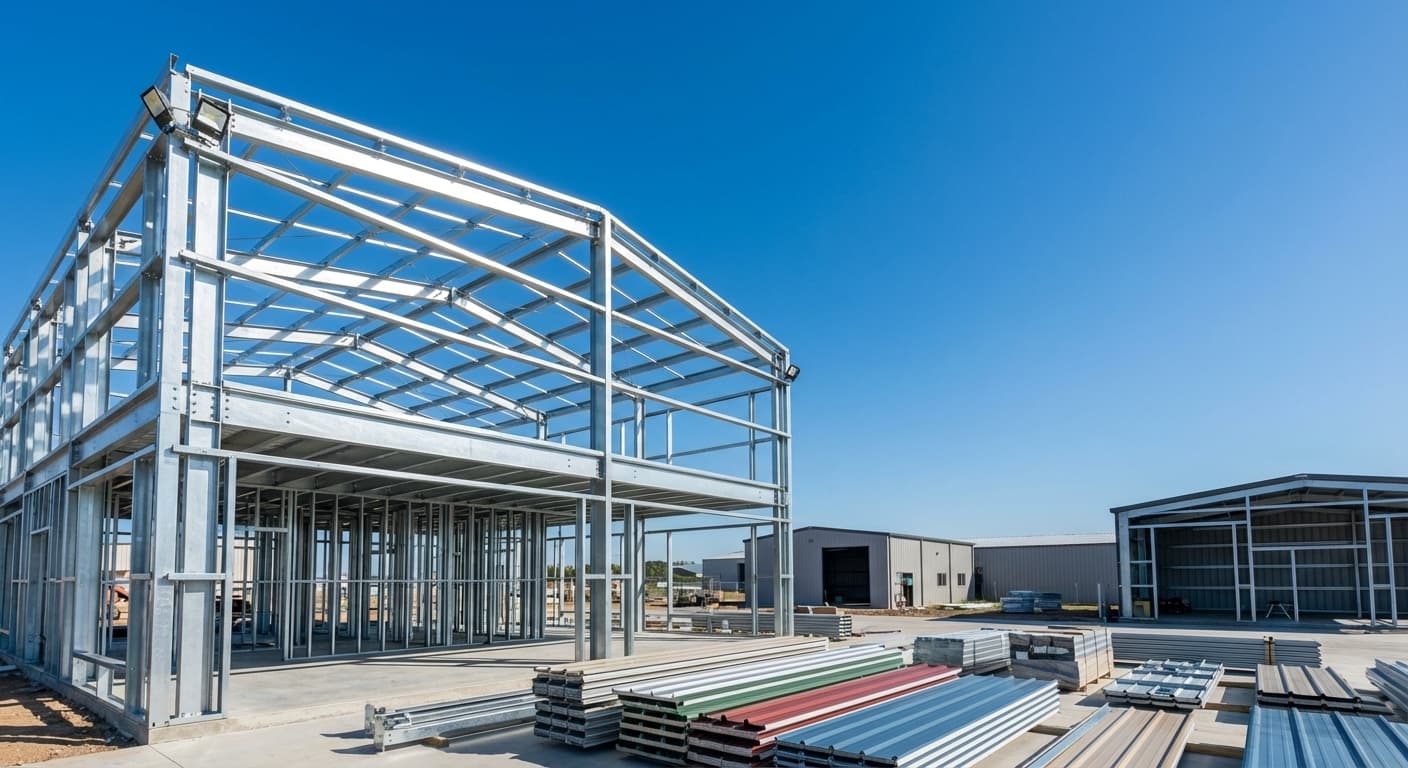

Metal house kits slash construction time and cost by up to 70 % and 50 % respectively, delivering hurricane-, fire- and pest-proof steel frames that bolt together without field welding, while Galvalume coatings, thermal-bridge-free insulation and 40-year warranties lock in decades of near-zero maintenance and lower energy bills. The article walks you through choosing the right kit–whether a 1,200 sq ft starter shell, an expandable modular system, a live-work barndominium or an off-grid tiny home–by matching precision-engineered sizes and finishes to your budget, site conditions and local wind, snow and seismic codes. It demystifies true ownership costs: $15-$20/sq ft for the shell, $24-$43/sq ft finished, offset by tax credits, 1 % annual upkeep versus 4 % for wood, and 20-30 % resale appreciation. Finally, it provides a decision framework that weighs DIY, hybrid or turnkey installation, hidden expenses like foundations and permits, and supplier vetting so you buy once, build fast and profit for life.
Metal House Kits: Fundamentals and Benefits
Steel-framed kits arrive precision-manufactured and bolt together without field welding, cutting your build time by up to 70% while delivering 25 times the strength-to-weight ratio of wood.
Defining metal house kits and how they are engineered
Metal house kits are complete building packages with every component you need to construct a steel-framed structure–structural framing, fasteners, hardware–delivered straight to your site [1]. Every piece arrives precision-manufactured using CAD/CAM technology, ready to bolt together. No surprises, no field modifications. This predictable assembly process cuts your costs by up to 50% compared to traditional construction [1][2].The engineering is straightforward but powerful. Steel frames deliver 25 times the strength-to-weight ratio of wood while weighing less [1].
Your building handles whatever nature throws at it–hurricane-force winds, heavy snow loads, earthquakes–while meeting every local code requirement [1]. Pre-punched openings and bolt-together connections mean no field welding. Just clean, fast assembly that cuts your build time by up to 70% [1][2].Clear span engineering gives you 100% usable interior space–no columns in your way [3]. Want an open floor plan? Done.
Need partitioned rooms? Your choice. For buildings under 2,000 square feet, you can handle assembly yourself with basic construction skills and our detailed plans [1]. When your needs change, the modular design adapts right along with you. Remove an end wall, add more space–it's built for growth [1][3].
Core components, steel grades, and insulation options
Your kit arrives with everything cut, drilled, and marked for assembly [6]. Quality matters here–you get pre-welded clips (no field welding), high-strength bolts, and self-drilling screws with weatherproof EPDM washers [6]. We're talking 26-gauge PBR panels for walls and roof, not the thinner 28 or 29-gauge stuff that leaks [6]. Plus all the details that matter: base trim to prevent rust at the foundation, ridge caps that actually seal, closure strips with mastic tape for condensation protection [6].
These aren't extras–they're standard. Insulation keeps your building comfortable and condensation-free. Fiberglass remains the smart, budget-friendly choice–single layers for basic needs (R-8 to R-11) or multi-layer systems for serious performance (up to R-30) [5]. For maximum efficiency, continuous insulation eliminates thermal bridging entirely [5].
Whatever you choose, proper vapor barriers are non-negotiable. Metal buildings need protection from condensation that causes rust and structural problems [4]. As covered in our energy performance section, getting this right from the start saves money and headaches down the road.
Primary advantages: durability, energy efficiency, rapid construction
Steel doesn't rot. Termites ignore it. Mold can't grow on it. Fire won't destroy it. Your building stands up to hurricane-force winds, heavy snow, and earthquakes–tested and certified to meet Florida and Texas hurricane standards plus California seismic requirements [7][9]. That durability means real savings: no annual termite treatments, no rotted boards to replace, no shingles blown off in storms [8]. You build it once, and it stays built.
Energy efficiency comes standard. Properly insulated metal buildings maintain comfortable temperatures year-round while cutting your heating and cooling costs [7]. You'll see the difference on your first utility bill [9]. Steel's design flexibility lets you install advanced insulation without the thermal bridging problems that plague stick-built homes [8]. Speed changes everything. Your pre-engineered kit arrives with every piece cut, drilled, and numbered to match our assembly drawings [9]. No measuring, no cutting, no guesswork.
This precision cuts build time by up to 70% [7]. Smaller buildings? Follow our step-by-step guides and handle it yourself [9]. Larger projects? Our
2025 market trends, code updates, and sustainability drivers
Today's market demands more from metal buildings–and delivers more in return. Despite material cost volatility in 2025, smart buyers leverage national purchasing power to control expenses [10]. Building codes now require higher energy performance and climate resilience, which metal buildings naturally provide [11][12].
Recycled steel content, low-VOC coatings, and solar-ready designs are baseline expectations [10]. Advanced manufacturing–robotic welding, AI quality control–means more consistent products at competitive prices [10]. Plus, federal and state programs offer tax credits for energy-efficient buildings, making your high-performance metal structure even more cost-effective [12].
The fundamentals remain strong: durable buildings that go up fast, perform well, and qualify for incentives.
Quality, Performance, and Assurance
Galvalume coatings extend your metal building's lifespan to 40-70 years while reducing energy costs, though galvanized steel remains the better choice for coastal or agricultural settings.
Material quality, corrosion protection, and coating systems
Your metal building's coating makes the difference between 20 years of service and 70. You'll choose between two main options: Galvalume and galvanized steel.
Galvalume wins on longevity. This aluminum-zinc alloy coating delivers 2-4 times better corrosion resistance than standard galvanized steel [13]. It self-heals minor scratches and controls rust at cut edges [13]. You'll get 40-70 years of protection versus 20-30 with galvanized [15].
But location matters. Keep Galvalume at least 1,500 feet from coastlines–salt spray breaks it down [13]. Don't use it for animal confinement either–ammonia from livestock deteriorates the coating [13]. In these cases, galvanized steel works better.
Your coating choice affects more than rust prevention:
- Energy costs drop with Galvalume's higher reflectivity [15]
- Building stays cooler in summer
- Warranty coverage extends to 25.5 years on substrate [13]
- Maintenance requirements stay minimal
Bottom line: Galvalume costs slightly more upfront but saves you money long-term through reduced cooling costs and fewer repairs. Pick galvanized only for coastal or agricultural applications where Galvalume won't perform.
Structural performance: load ratings, wind, snow, and seismic standards
Your building faces three types of loads every day: its own weight, everything inside it, and whatever nature throws at it. That's why proper engineering matters–and why you need location-specific designs, not generic plans.
Wind, snow, and seismic forces vary dramatically by location. Your building must meet International Building Code (IBC) standards for your exact address [17]. Here's what that means:
Wind resistance: Quality steel buildings handle hurricane-force winds up to 160 mph [17]. Three factors determine your requirements:
- Local wind speeds
- Surrounding terrain (open fields need stronger buildings than protected areas)
- Building openings (doors and windows affect pressure)
Snow loads: Metal buildings carry unique considerations [18]:
- Unheated buildings need 20% stronger designs (thermal factor of 1.2 vs 1.0)
- Metal roofs shed snow better, reducing required load capacity
- Gable roofs must handle uneven snow accumulation on either side
Seismic standards: Your location determines your category from A (lowest risk) to F (highest) [17]. California buildings need different engineering than those in Kansas.
The critical part? Engineers calculate how these forces combine–like wind hitting during a snowstorm [17]. Small calculation differences create big cost impacts [17].
Energy performance: R‑value selection and thermal bridging mitigation
Steel conducts heat. That's a problem when you're trying to keep your building comfortable. Metal framing can cut your insulation's effectiveness by up to 63%–turning R-19 insulation into R-7.1 performance [21]. Here's how to beat thermal bridging and keep energy costs down.
Two proven solutions:
- Filled cavity systems: Multiple fiberglass layers work together
- One layer between purlins, another perpendicular on top
- Achieves U-factors of 0.037 or better [20]
- Cost-effective for most applications
- Continuous insulation: Rigid boards span across framing
- Maintains most of its rated R-value [21]
- Eliminates thermal bridges except at fasteners
- Higher upfront cost, better long-term performance
Your climate zone determines minimum requirements. Energy codes have tightened significantly–what passed 10 years ago won't meet today's IECC or ASHRAE standards [19]. Many specifications now require combinations like "R-13 + R-13 CI" for walls [19].
Don't forget vapor control. Metal buildings need proper vapor barriers to prevent condensation that causes rust and structural damage [19]. The right insulation system does double duty–controlling temperature and moisture.
Your choice impacts monthly utility bills for decades. Spend a bit more on proper insulation now, save significantly on heating and cooling forever.
Warranties, certifications, and after‑sales support guarantees
Your warranty package tells you everything about a supplier's confidence in their product. Quality manufacturers offer three layers of protection:
Rust-through warranties (20-50 years): Premium suppliers provide non-prorated coverage–full replacement value throughout the term [22]. Watch for coastal exclusions within 1,500 feet of shorelines [22].
Workmanship warranties (12 months typical): Cover installation defects like misaligned panels or improper sealing [22]. Report issues promptly–most require notification within the first year.
Paint and finish warranties (up to 40 years): Protect against chalking, fading, and peeling on premium systems [22]. Again, coastal properties often face restrictions.
Look for these quality indicators:
- Manufacturer-direct warranties (no middleman delays) [24]
- Engineer-stamped drawings for your location
- Regional certifications like CSA A660 in Canada [23]
- Replacement parts inventory maintained by supplier [24]
Red flags to avoid:
- Unrealistic maintenance requirements that void coverage [22]
- Broad environmental exclusions for your area
- Generic warranties that don't cover your specific load requirements [23]
- Third-party warranty administrators
The best suppliers back their products directly. When you call with an issue, you reach their team–not an insurance company. They maintain parts inventory and handle legitimate claims without administrative runarounds [24]. That's the difference between a warranty that protects you and one that just looks good on paper.
Matching Kit Types to Your Lifestyle
Metal home kits range from 1,200 to 3,500 square feet with pre-engineered components that bolt together, saving you $70-$100 per square foot compared to traditional construction.
Standard residential kits for single‑family homes
You'll find metal home kits sized from 1,200 square feet for cozy two-bedroom layouts up to 3,500 square feet for sprawling four-bedroom designs. The sweet spots? A 30'x40' structure gives you 1,200 square feet perfect for first homes or downsizing. Step up to 40'x60' and you've got 2,400 square feet–enough for three bedrooms on one level or five bedrooms with two stories [25]. Your kit arrives complete: pre-engineered steel I-beam framing, secondary supports, pre-painted roofing and siding, plus framed openings ready for your doors and windows [25]. Everything bolts together–no field welding needed. Your contractor can move fast, or if you're handy, tackle it yourself [26].
Here's what saves you money: $70-$100 per square foot with interior finishes, while traditional builds push past $100+ per square foot [26]. You're looking at real savings without sacrificing quality. Steel frames work with any finish you want–stucco, brick, decorative wainscoting. Inside, create the exact home you envision. The clear-span design means no load-bearing walls cramping your style [25].
Want maximum control over costs? Shell-only kits get your exterior up fast. You handle the interior finishing on your timeline, with your choice of contractors [27]. It's practical flexibility that keeps your project moving forward.
Barndominium and mixed‑use kits for live‑work flexibility
Live where you work. Work where you live. Barndominium kits merge both needs under one roof–perfect for running your business without the commute [28].
You get the flexibility to design exactly what works: open transitions between living and work zones, or complete separation with soundproofing between spaces [30]. Your investment makes sense: $60-$160 per square foot beats traditional construction's $150-$400 range [29]. Popular sizes match real needs–a 30'x40' gives you 1,200 square feet for compact live-work setups, while 40'x60' provides 2,400 square feet to spread out [30].
Our
Modular and expandable kits for future growth
Start with what you need now. Expand when you're ready. Modular kits grow with you–extend horizontally up to 12 meters per side or stack vertically up to 6 floors [31]. No teardowns, no starting over. Here's the smart move: specify "expandable end walls" when you order. This pre-engineered feature means you can remove end wall sheeting later, pour new foundation, and bolt on your addition [32]. The structural reinforcement is already there, waiting.
Speed changes everything. Basic 100m² units go up in three days versus three months for traditional builds [31]. Some modules fold down to 37% of assembled size for shipping–cutting your transport costs significantly [31].
The best systems think ahead. Pre-buried utilities and centralized pathways mean no wall demolition when you expand. Everything connects cleanly [31]. Business growing? Move your commercial space without starting from scratch. Need emergency deployment? Set up fast, expand to permanent later [31].
Smart planning costs little upfront but saves thousands later. Especially for workshop-home combos where business growth drives space needs [32]. You're not just building–you're investing in flexibility.
Specialty kits: tiny homes, off‑grid cabins, and disaster‑resilient designs
Special situations demand special solutions. Tiny home kits pack full functionality into 10×20 footprints or expand up to 30×35 for breathing room. You get efficient layouts with lofts, complete kitchens, and clever storage–everything sized right [33]. Going off-grid? These kits come solar-ready with superior insulation and resource-efficient systems. Pre-cut steel frames and detailed plans mean DIY assembly stays manageable [33]. The smart hybrid approach combines steel strength where you need it with wood framing where it simplifies your insulation and wiring work. Standard tools, standard materials–no specialized equipment required [34].
Location matters. Your kit arrives engineered for your specific conditions–snow loads, wind ratings, seismic requirements all calculated [34]. In disaster-prone areas, specialized designs like The Q Cabin step up protection with non-combustible materials and reinforced structures built to survive what nature throws at them [35].
You keep all the advantages: precision manufacturing, fast assembly, long-term sustainability. But now with features tailored to extreme conditions [35]. Whether you want modern minimalist or rustic cabin charm, the clear-span interior adapts to your vision [34]. You're not compromising–you're specializing.
Making Your Decision
You've seen the options. Standard residential for traditional living. Barndominiums for live-work flexibility. Modular designs for future growth. Specialty kits for unique situations.
The right choice matches your needs today while leaving room for tomorrow. Consider your timeline, your budget, your plans for the property. Most importantly, work with a supplier who understands both steel buildings and your vision.
Ready to move forward?
True Cost of Ownership and Financing
A standard 40×60 metal building shell costs $25,000-$35,000, but plan to budget $65,000-$90,000 total when adding essential finishes like HVAC and flooring.
Base price versus optional upgrades and interior finishes
You'll find metal house kit pricing breaks down into two clear categories: the base shell and your selected upgrades. Base kits run $15-$20 per square foot, putting a standard 40×60 structure (2,400 sq ft) at $25,000-$35,000 for the shell [36]. That base price gets you the structural framing, exterior metal panels, fasteners, and basic trim–the bones of your building.
Your real investment takes shape when you add the components that make your building work for you. Standard roll-up doors run $1,000-$3,000 each. Windows average $300-$800 per unit depending on size and insulation rating [36]. Converting that shell into livable space typically doubles your initial investment, with fully finished spaces ranging from $24-$43 per square foot installed [37].
Your intended use drives the finishing budget:
- Basic storage: $35,000-$45,000
- Workshop with insulation and ventilation: $45,000-$65,000
- Retail or residential with HVAC, flooring, and interior walls: $65,000-$90,000 [36]
Here's where metal buildings deliver real value–your package includes exterior finishes that would cost approximately $43,000 extra in traditional construction [38]. Smart buyers budget for essential upgrades like insulation upfront, preventing condensation issues and ensuring year-round comfort [36]. Premium features like standing seam roofing and architectural elements add 15-25% to base costs but boost both aesthetics and resale value significantly [38].
Hidden expenses: site preparation, foundation, utilities, and permits
Kit prices tell only part of your story. Site development costs–often excluded from initial quotes–deserve your careful attention before breaking ground.
Site preparation runs $3,000-5,000 for clearing trees, grading slopes, and removing large rocks [39]. Your foundation represents the single largest site expense:
- Minimal gravel pad: $3,000
- Proper concrete slab for permanent structures: $8,500-12,000 [40]
- Unstable soil requiring engineering solutions: potentially thousands more [41]
Utility connections catch many builders off guard:
- Electrical service (150 feet from meter): $6,050 for trenching, conduit, wire, and panel [40]
- City water hookup: $2,400
- Well system (same distance): $6,750 [40]
Permit costs vary dramatically by location:
- Rural areas: approximately $400
- Suburban jurisdictions: $1,400
- Urban zones with impact fees: up to $2,800 [40]
These expenses hit early in construction when cash flow matters most [39]. Environmental assessments and specialized permits may apply based on watershed proximity or protected habitats–factors you'll only discover through proper site investigation [41]. Working with an experienced supplier who understands these variables helps you budget accurately from day one.
Financing pathways, tax credits, and sustainability rebates
Your metal building investment comes with built-in tax advantages through 2025. Federal credits put up to $3,200 back in your pocket annually for energy-efficient improvements [42].
The Energy Efficient Home Improvement Credit covers 30% of qualified expenses:
- Building envelope components (insulation, windows, doors): up to $1,200 per year
- Heat pump installations: up to $2,000 per year [42]
Note: These apply to existing primary residences, not new construction [43].
For renewable energy, the Residential Clean Energy Credit offers even better terms–30% tax credit with no annual cap for:
- Solar panels
- Wind systems
- Geothermal heat pumps
- Fuel cells and battery storage [43]
Metal buildings excel here. Their design naturally accommodates high-performance insulation and solar installations, maximizing your incentive eligibility. Our
Lifecycle costs: maintenance, energy savings, and resale value
The numbers tell the real story of metal building ownership. Your annual maintenance runs just 1% of initial construction costs–$1,500-$2,500 for a 10,000 sq ft building. Compare that to 2-4% ($7,000-$20,000) for traditional construction [45].
Traditional buildings hit you with unpredictable expenses:
- Termite damage repairs: up to $30,000
- Rot and moisture damage: ongoing
- Structural settling: progressive [45]
Steel eliminates these risks entirely.
Your energy savings stack up fast. Properly insulated metal buildings cut utility bills by 10-20% through superior thermal performance [45]. For commercial-sized structures, that's $2,000-$5,000 saved annually [45].
Insurance companies recognize the value too. Many carriers reduce premiums for metal buildings thanks to their:
- Fire resistance
- Pest immunity
- Storm resilience (as covered in our warranties section) [46]
Resale values seal the deal. Metal buildings typically appreciate 20-30% over 20 years–beyond normal property value increases [45]. Buyers recognize a structure that'll serve them for 40+ more years with minimal maintenance [46].
The 20-year ownership comparison speaks volumes:
- Metal building (10,000 sq ft): approximately $350,000 total
- Traditional construction: $670,000-$1.1 million [45]
That's real money staying in your business, not disappearing into repairs and maintenance. National Steel Buildings' approach–leveraging our buying power and single-source efficiency–puts even more savings in your pocket from day one.
Installation Choices and Final Decision Framework
Choose between DIY savings, professional speed and certainty, or a hybrid approach that lets professionals handle structural steel while you manage site prep and finishing.
DIY, hybrid, or professional installation: skill and tool requirements
You have three clear paths for getting your metal building up: do it yourself, hire professionals, or split the difference. DIY installation saves you 30-50% on labor costs but demands real construction skills, physical stamina, and the right tools–power drills, ladders, scaffolding, even small cranes for larger structures [47][48]. Tool rentals alone can eat into those savings fast if you're not already equipped [48].
Professional installation delivers what most business owners need: speed and certainty. Your building goes up in 1-2 weeks, meets every code requirement, and you never touch a wrench [48]. Yes, you'll pay more–but you'll also sleep better knowing it's done right. That's where our in-house erection team, ProTrades LLC, shines. We handle your entire project from delivery through final bolt, keeping communication clear and schedules tight.
The hybrid approach works well if you're handy but smart about limits. You prep the site and handle finishing touches while professionals manage the structural steel–the part that absolutely must meet engineering standards [49]. This middle path keeps costs reasonable while ensuring your building's bones are solid [49]. Your best choice depends on an honest assessment: your skills, your time, your tools, and your tolerance for risk [47].
Code compliance, permitting, and insurance considerations
Getting permits right saves you from expensive headaches later. Your metal building needs to meet International Building Code (IBC) standards plus local requirements–hurricane ratings in Florida, seismic standards in California, snow loads up north [50][51]. The permit dance starts with engineer-stamped drawings, site plans, and specifications submitted to your local building department. Rural areas might approve in two weeks; big cities can take months [51].
You'll need more than just a building permit. Count on electrical, plumbing, foundation permits–maybe fire suppression or drainage too [51]. Skip permits and you're asking for trouble: fines up to triple the permit cost, tear-down orders, problems selling your property, and insurance companies walking away when you need them [50][51].
Here's what smart buyers know: properly permitted metal buildings get lower insurance premiums thanks to their fire resistance and structural integrity [51]. Unpermitted buildings? Many insurers won't touch them. Permit costs swing wildly–$150 in small towns, $7,500 in major metros–based on complexity and size [51]. HOA properties add another layer, often demanding specific aesthetics beyond basic code [51].
That's why working with us matters. Our
Safety best practices and risk mitigation during assembly
Step‑by‑step decision checklist, 3D design tools, and contacting National Steel Buildings Corp.Making the right metal building decision starts with clarity. Know your primary use, required square footage, local climate demands, and real budget before talking to anyone [26]. Then dig deeper: Does the supplier provide engineer-stamped drawings that meet your local codes? Do they have CSA-A660 certification where required? [55]
Read contracts like a lawyer. Many quotes hide major costs–site prep, foundation work, permits, even unloading the truck can be "extras" [55]. Get everything itemized: materials, services, lead times, warranties, total delivered cost. Compare apples to apples, not promises to reality [55].
Modern 3D design tools transform guesswork into confidence. You'll see your exact building before spending a dollar–adjust dimensions, move doors and windows, change colors, calculate costs in real time [2]. Quality suppliers provide these visualization tools to help you make informed decisions [26][2].
Ask the hard questions before signing: What exactly does the warranty cover–rust-through, workmanship, finish? When will materials arrive, guaranteed? Who answers the phone when you hit a snag during assembly? [55] The right manufacturer stays with you from concept through completion, with real people available when you need answers [26].
Ready to move forward with confidence?
- Metal kits cut build time 70% and cost 50% vs wood, using pre-cut bolt-together steel.
- Galvalume coating lasts 40-70 yrs, 2-4x better rust resistance than galvanized, but avoid coastlines.
- Thermal bridging slashes insulation R-value 63%; specify filled-cavity or continuous rigid boards.
- Full-finish cost doubles shell price; budget extra $3-12k slab, $6k+ utilities, permits $400-2.8k.
- DIY saves 30-50% labor but needs tools; pros erect in 1-2 weeks with code stamps and warranty.
- Energy tax credits up to $3.2k/yr and 20-year maintenance at 1% vs 4% for wood frame buildings.
- Check warranties: 20-50 yr rust-through, 12 mo workmanship, 40 yr paint; confirm coastal exclusions.
- https://www.buildingsguide.com/metal-building-kits/?srsltid=AfmBOorxkLJ80c5VQAJUCUELSUnWHgszdusS6nzxU3MVjPlAEIa6fEDm
- https://gensteel.com/steel-building-kits/
- https://www.worldwidesteelbuildings.com/
- https://gensteel.com/building-faqs/building-customizations/insulation-options/
- https://therm-all.com/a-guide-to-metal-building-insulation/
- https://www.rhinobldg.com/blog/how-to-compare-metal-building-systems-part-3
- https://torosteelbuildings.com/blog/steel-home-kit/
- https://metalcon.com/blog/the-rise-of-metal-building-homes-why-are-they-gaining-popularity/
- https://stevensec.com/blog/5-long-lasting-benefits-of-metal-building-kits
- https://metalcon.com/blog/2025-in-review-a-defining-year-for-metal-construction/
- https://www.environmentenergyleader.com/stories/2025-trends-in-sustainable-building-energy-efficiency-circularity-and-climate-resilience,62087
- https://vertenergygroup.com/essential-guide-to-navigating-u-s-building-performance-standards-in-2025/
- https://sheffieldmetals.com/learning-center/galvalume-vs-galvanized-metal/
- https://www.millsteel.com/news/galvalume-vs-galvanized-which-coating-is-best-for-your-building
- https://www.englertinc.com/articles/difference-between-galvalume-and-galvanized-metal-roofing-projects
- https://www.structuremag.org/article/design-snow-loads-and-metal-buildings/
- https://norsteelbuildings.com/us/building-codes-permits-us/steel-building-codes-loads/
- https://roimetalbuildings.com/understanding-load-ratings-and-structural-integrity/
- https://www.metalconstructionnews.com/articles/features/insulation-systems-metal-building-code-compliance/
- https://insulation.org/io/articles/navigating-energy-code-compliance-for-metal-buildings-2/
- https://www.buildingenclosureonline.com/blogs/14-the-be-blog-building-enclosure/post/86806-effective-insulation-r-values-in-steel-vs-wood-framing
- https://www.getcarports.com/steel-building-warranties-explained?srsltid=AfmBOookngBHuDR3aAb00eJ_ir2pq0ajch21dkQbT4zWeUyx2zoKWiEh
- https://metalprobuildings.com/how-to-choose-the-right-steel-shop-buildings/
- https://www.worldwidesteelbuildings.com/blog/our-50-year-steel-building-warranty/
- https://www.buildingsguide.com/metal-building-kits/homes/?srsltid=AfmBOoq1Aax6dJjR6mAPu6AJMXsv_jinxjVa-lSx1Yc44wSo3Lix06he
- https://www.worldwidesteelbuildings.com/steel-buildings/homes-residential/
- https://amishbuiltcabins.com/collections/metal-house-kits?srsltid=AfmBOoq7ERAKdVbkDKmIXHnzhHhExbRfeSMWdSw4honIYRAtkocTU9JL
- https://www.worldwidesteelbuildings.com/steel-buildings/barndominiums/
- https://www.houseplans.com/blog/is-it-cheaper-to-build-a-house-or-barndominium-in-2025
- https://www.buildingsguide.com/metal-building-kits/barndominium-kits/?srsltid=AfmBOopy9Dh_s_tSnfQdchWaPwDp7BBf5I1iygFOOJIoO9EMKymmASoC
- https://peb.steelprogroup.com/peb-structure/modular-construction/expandable/
- https://www.buildingsguide.com/metal-building-kits/shop-houses/?srsltid=AfmBOoqSIr4skYKdJmk4lZnG3zUa1N68FfyXG7AVg4aGbBwi3neFhR3G
- https://www.worldwidesteelbuildings.com/steel-buildings/tiny-home-kits/
- https://miracletruss.com/portfolio-items/tiny-homes-and-cabins/
- https://www.theqcabin.com/
- https://qebuildings.com/2025/09/how-much-is-a-40×60-metal-building/?srsltid=AfmBOoqah9SBz8s8D9ubauSthr9ccxHVLnoqcY554PC8JX57Ov5Uix4W
- https://www.buildingsguide.com/metal-building-prices/?srsltid=AfmBOorCuCVF3iEKZCUKNz-6GHkwsaU4HqbmSFvR00L7N-GLdyKPZHZR
- https://gensteel.com/building-faqs/steel-building-prices/cost-to-build-a-home/
- https://www.uspatriotsteel.com/blog/hidden-costs-to-watch/
- https://metalportablebuildings.com/before-you-buy-a-portable-metal-building-read-this-hidden-cost-breakdown/
- https://thelunacrew.com/10-hidden-costs-of-home-construction-and-how-to-avoid-them/
- https://www.irs.gov/credits-deductions/energy-efficient-home-improvement-credit
- https://www.energystar.gov/about/federal-tax-credits
- https://www.mass.gov/guides/massachusetts-energy-rebates-incentives
- https://www.summitsteelbuildings.com/20-year-cost-comparison
- https://www.vikingsteelstructures.com/blog/the-hidden-economics-of-metal-buildings-saving-more-than-just-money?srsltid=AfmBOor3G1GY4fudJXkvXZHmEd6LGMS5aiDc0OPBy-jfjEt821Ut_4jR
- https://tagsteelhouseframes.com.au/steel-frame-home-kits-diy-installation-vs-hiring-a-pro-whats-right-for-you/
- https://prometalbuildings.com/steel-building-kits-vs-fully-installed-metal-buildings/?srsltid=AfmBOoojxrVGKMfphFOD7gitjstFUpchqBnkSxh6CHL96ZcNnCgTv2xq
- https://www.buyabp.com/diy-vs-contractor-built-metal-kits-which-is-right-for-you
- https://www.probuiltsteel.com/blog/permits-and-foundation-requirements-for-metal-buildings-in-florida/?srsltid=AfmBOorIq2k6wgJPrfjR7i_n4TVqEr07k2cp9Oe0iJm0QN0OZkiLReRu
- https://www.buildingsguide.com/build/metal-building-codes-permits/?srsltid=AfmBOorngdtzYoXozTooqkvPKr8Fjx91yiKhop1Fl6BZCgxG-sbQeARB
- https://www.worldwidesteelbuildings.com/blog/construction-safety-at-your-steel-building-site/
- https://lionbuildings.com/11-metal-building-safety-tips/
- https://www.rhinobldg.com/blog/steel-building-construction-dressing-for-safety
- https://metalprobuildings.com/steel-metal-buildings-what-you-need-to-know-before-signing-a-contract/