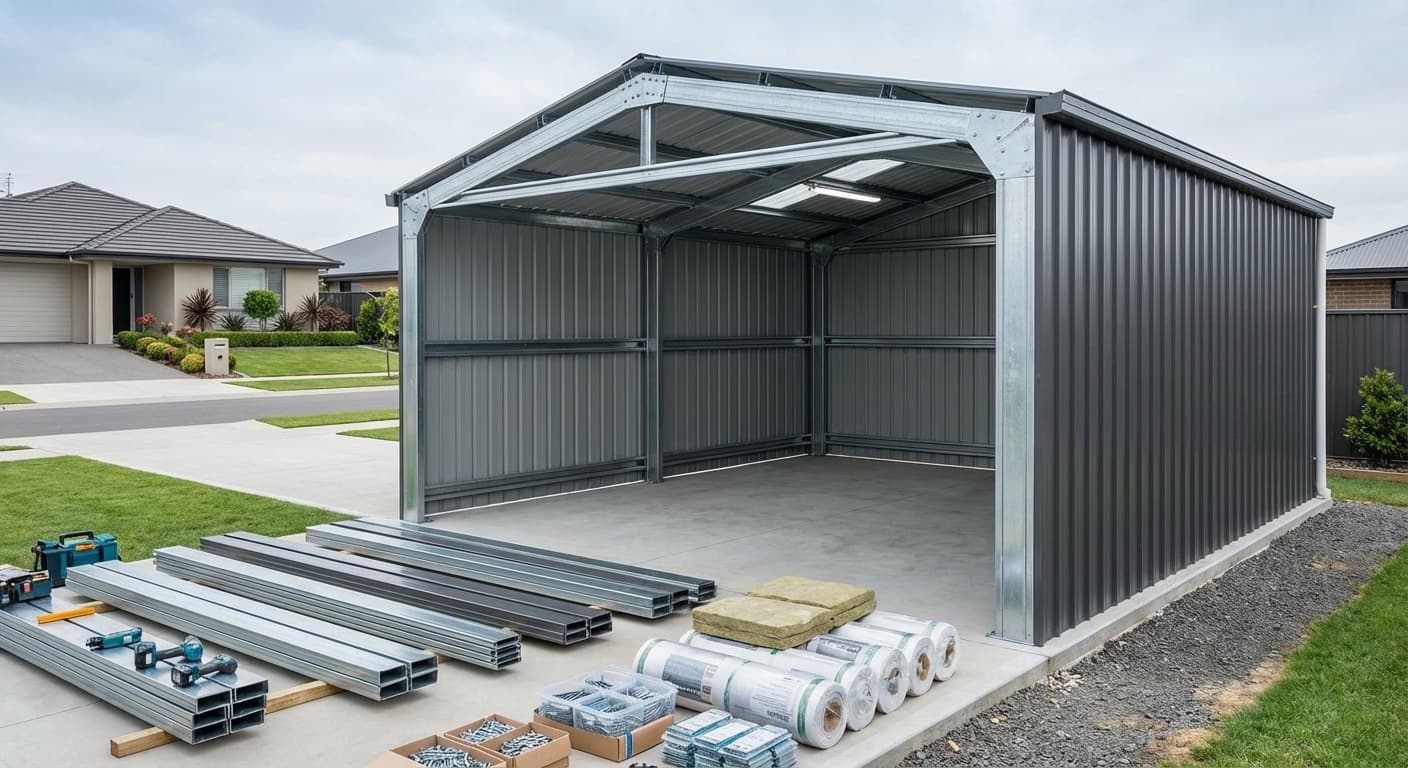

Steel garage kits are rapidly becoming the go-to choice for property owners who want a faster, cheaper, and tougher alternative to wood-frame construction, delivering a weather-tight shell in days, cutting total project cost by 20-30%, and lasting 50-100 years with little more than an annual rinse and bolt-check. This deep-dive comparison walks you through every decision point–standard vs. custom kits, I-beam vs. tubular frames, roof pitches that shrug off snow or 200-mph winds, 12-gauge steel that earns 20-year warranties, and turnkey prices that can run from $14k for a 30×40 kit to $100k+ installed–so you can match your building to your vehicles, workshop dreams, local codes and true budget before the first truck arrives. You'll learn why kit prices are only half the story (foundation, permits, delivery and crane can add 40-60%), when DIY makes sense (single-car in a weekend) and when pros pay for themselves (40×60 in a week, warrantied and inspection-ready), plus how coatings, gauge and proper site prep slash lifetime maintenance to roughly 1% of build cost per year. Whether you need basic car cover, a clear-span workspace for your lift and tools, or a future-proof warehouse that boosts resale value 20-30%, the article arms you with supplier Essentials, cost Estimates and climate-specific engineering rules so you buy once, build once and enjoy decades of virtually maintenance-free performance.
Why Choose Steel Garage Kits
Steel garage kits cost 20-30% less than traditional construction while going up in days instead of months, protecting your equipment and keeping projects on schedule.
Growing demand for steel garage kits
You're not alone in looking for better building solutions. The steel garage kit market is booming–projected to double from $12.98 billion in 2024 to $27.10 billion by 2033 [2]. Why? Because smart property owners like you have discovered what works: steel buildings that go up fast, cost less, and last longer.
Here's what's driving the shift. Housing costs keep climbing, but steel construction cuts your total project cost by 20-30% compared to stick-built [1]. You get a weather-tight shell in days, not months–meaning your equipment stays protected and your project stays on schedule [1]. In the Southeast particularly, where zoning is flexible and land is available, steel buildings make perfect sense [1].
The demand isn't just residential. E-commerce growth has businesses scrambling for warehouse space, with manufacturing facilities making up 34% of new steel construction [2]. Plus, steel checks the sustainability box–it's fully recyclable with minimal construction waste [3].
What really sells these structures? Versatility. You can combine garage space, workshop areas, and storage under one roof–all within budget [1].
Key benefits over traditional construction
Forget what you know about traditional construction headaches. Steel garage kits solve the problems that keep property owners up at night.
Start with durability. Your steel structure won't rot, warp, or become a termite buffet. While wooden buildings battle constant threats–pests, mold, mildew–steel just stands there, unaffected [4][5]. We're talking about buildings engineered to last (detailed lifespan expectations are covered in our Maintenance section).
The numbers make the decision easy:
- Steel construction: $5+ per square foot
- Wood construction: $7+ per square foot [4]
- Installation time: One day for prefab steel vs. weeks for stick-built [4]
- Fire resistance: Steel withstands 1,200 degreesF temperatures [5]
Your maintenance checklist shrinks to almost nothing–an annual inspection and spot-check for rust beats the endless cycle of pest control and weather protection that wood demands [4]. Factory-precision manufacturing means less waste on your site and fewer surprises during assembly [4].
Sure, wood has its charm. But when you need a structure that performs without the drama, steel delivers.
Compliance with 2025 building codes
Building codes keep getting tougher–and that's good news if you're choosing steel. The 2025 updates demand buildings that can take a beating, especially in storm-prone regions. Coastal areas now require structures rated for 200+ mph winds, up from previous standards [6].
Here's where steel shines. Standard steel construction already meets these 200+ mph requirements. Need more? Enhanced systems handle 250+ mph winds [6]. The continuous load path from roof to foundation that codes now require? That's exactly how welded steel connections work–seamless strength transfer throughout your structure [6].
In flood zones, the new rules call for elevated construction with flood-resistant materials. Steel checks every box: it won't absorb water, won't lose shape when wet, and maintains full strength even if submerged [6].
The permit maze varies by location:
- Florida: Statewide enforcement, engineer-stamped plans mandatory [7]
- Texas: County-by-county rules, but you'll need certification for insurance [8]
- Energy efficiency: New insulation and air-sealing requirements that steel easily accommodates [6]
Working with
Environmental and sustainability advantages
Environmental responsibility doesn't have to complicate your project. Steel delivers sustainability without the greenwashing.
Your steel garage is 100% recyclable–not just once, but indefinitely without losing strength [9]. Manufacturing with recycled steel cuts energy use by 75% compared to virgin materials [10]. That's a smaller carbon footprint before you even break ground.
On your jobsite, prefabricated components mean less waste and cleaner construction. Factory-cut pieces arrive ready to assemble–no scrap piles, no material guesswork [10].
Want to go further? Steel structures make it simple:
- Add energy-efficient insulation to slash heating and cooling costs
- Mount solar panels without structural concerns
- Install rainwater harvesting systems [9]
For LEED certification seekers, steel earns points across multiple categories–materials, efficiency, and indoor environmental quality [11]. Need to expand or modify later? Steel frames adapt without demolition, keeping future changes simple and sustainable [10].
The bottom line: you get a building that performs today and preserves options for tomorrow.
Understanding Steel Garage Kit Types & Designs
Choose between standard kits for fast assembly or custom designs that accommodate tomorrow's expansion while protecting your long-term investment.
Standard vs. custom steel garage kits
When you're ready to build, you'll choose between standard and custom steel garage kits. Standard kits get you up and running fast–fixed dimensions, proven designs, lower costs. You'll have your single-car garage assembled in 1-2 days with basic components that work right out of the box [12].
Custom kits put you in control. You size the building to fit your RV. You pick the roof style that handles your local snow load. You place doors and windows exactly where you need them [13]. Yes, customization adds 10-25% to your budget and pushes delivery out 2-4 weeks. But you get the insulation that keeps your workspace comfortable year-round. You get the ventilation that protects your classic car. You get the layout that turns storage into a functioning workshop [14].
The smart money looks ahead. Standard kits solve today's problem. Custom designs accommodate tomorrow's boat, tomorrow's business expansion, tomorrow's hobby that needs more space. Many custom steel buildings accept additions without starting over–protecting your investment [14].
Frame systems: red iron, tubular, I‑beam, C‑channel
Your frame system determines what your building can handle–and for how long. Here's what each option delivers:
I-beam (red iron) frames mean business. These hot-rolled steel giants carry massive loads without breaking a sweat. You want a 60-foot clear span for your equipment? Red iron delivers. Yes, you'll pay more upfront. But you'll never worry about structural integrity when that storm rolls through [15].
Tubular frames get smaller jobs done fast. Square or rectangular galvanized tubing in 12- or 14-gauge thickness works perfectly for your two-car garage or backyard workshop. Quick to install, minimal maintenance required, decades of reliable service–exactly what residential projects need [15].
C-channel frames hit the sweet spot.
Roof options: gable, vaulted, low‑slope, insulated panels
Your roof does more than keep rain out–it determines how your building performs and what it costs to operate.
Gable roofs remain the go-to choice. Two slopes meeting at a ridge give you maximum interior space, natural ventilation, and a look that fits any neighborhood. You'll pay slightly more for the extra framing, but you'll appreciate the flexibility when you need to add that vehicle lift. Pitch options from nearly flat to steep 6:12 handle everything from desert heat to mountain snow [18][19].
Single-slope roofs save money without sacrificing function. One clean slope sheds water efficiently, installs fast, and creates full height on one wall–perfect for backing in your RV or mounting solar panels. When you need simple and reliable, single-slope delivers [18].
Vaulted and monitor roofs add dramatic height and natural light. The raised center section transforms a basic garage into an impressive workspace. Yes, you'll invest more. But those windows flooding your shop with daylight? Worth every penny [19].
Insulated metal panels change the game for year-round comfort. Metal skins sandwich foam cores that slash heating and cooling costs. The premium price pays you back through energy savings while delivering the weathertight seal your classic car collection deserves [19].
Pick your pitch wisely: Low slopes (1:12 to 2:12) minimize interior volume for efficient climate control. Steeper pitches (4:12+) handle heavy snow loads and create the traditional garage look. Your location and intended use make the decision clear [19].
Sizing and layout for single, double, and workshop garages
Getting the size right the first time saves money and headaches. Here's what actually works:
Single-car garages need 12 ft wide by 20 ft deep minimum. That gives you room to park plus some wall storage. Can you squeeze into 10 ft by 18 ft? Sure–if you enjoy gymnastics every time you open your door. Smart money goes 18 ft wide for real storage capacity alongside your vehicle [20].
Two-car garages start at 20 ft by 20 ft, but you'll thank yourself for going wider. Those extra feet mean opening doors without dinging paint, walking between vehicles without shuffling sideways, and actually using your garage instead of parking in the driveway [20].
Workshop garages require honest planning. The popular 24 ft by 30 ft configuration works because it fits two vehicles plus a real work area. Add a separate walk door so you're not raising the overhead every time you grab a tool. Position windows where they'll light your workbench, not create glare [21][22].
Height matters more than most people realize. Standard 8-10 ft clearances handle cars and pickups. But that boat on a trailer? That lifted truck? Your future car lift? You need 11-14 ft minimum. Build tall once instead of wishing you had later [21].
The bottom line: Measure your largest vehicle, add 4-5 feet on all sides, then add your wish list. Professional engineering ensures your dream garage stands strong–no matter what you park inside [22].
—
Ready to move forward? Understanding these options puts you in control of your project. Whether you need basic vehicle storage or a complete workshop solution, the right combination of kit type, frame system, roof style, and dimensions turns your vision into reality–on time and within budget.
Feature Comparison of Leading Steel Garage Kit Brands
Complete steel garage kits include engineered plans, primary and secondary framing, pre-cut panels with 20-30 year warranties, and every bolt and connector you need.
Core components included in base kits
Your steel garage kit should include everything needed for the shell–no surprises, no scrambling for missing pieces. Quality kits include engineered building plans stamped for your specific location's wind, snow, and seismic requirements [23]. You get the complete structural system: primary framing (your main supports), secondary framing (purlins and girts), and every bolt, nut, and connector needed [23].
The metal panels arrive pre-cut and coated with factory-applied finishes that carry 20-30 year warranties [24]. Your kit includes self-drilling screws designed specifically for steel construction–no guessing on fastener specs [23]. Door and window openings come pre-framed into the structure, ready for the actual doors and windows you'll select separately [23][25].
Trim pieces for corners, eaves, and bases complete your weathertight shell. You also get the necessary sealants and closure strips [23]. What's not in the kit? Your foundation, site prep, erection equipment if you're doing it yourself, insulation, and interior finishes [23][24]. As covered in our cost breakdown section, knowing these exclusions helps you budget accurately from the start.
Customization options: doors, windows, accessories
Your garage works harder when it's configured for your specific needs. Roll-up doors maximize interior space by coiling overhead–perfect when every square foot counts [27]. Overhead sectional doors deliver better insulation for climate-controlled shops, and you can add automatic openers for daily convenience [27]. Walk-in doors keep foot traffic separate from vehicle access, with options for windows and heavy-duty locks [27].
Windows change everything. Fixed windows bring in natural light without compromising security. Sliding windows add ventilation without eating floor space. Skylights illuminate work areas from above–no more squinting under dim bulbs [27]. Each window option comes with tempered glass and energy-efficient tinting choices [27].
The best customization starts with understanding how you'll use the space.
Material thickness, coating, and warranty considerations
Steel gauge determines how long your garage stands strong. Remember: lower gauge numbers mean thicker steel. Standard 14-gauge framing handles most applications, but 12-gauge delivers 30% more steel mass–smart insurance for snow country or high-wind zones [29].
For panels, 29-gauge works fine for residential use. But 26-gauge commercial panels resist dents better and won't develop that wavy "oil-canning" look [29]. The real difference shows in yield strength–steel rated at 80,000 PSI shrugs off hail that would dent 40,000 PSI alternatives [30].
Coatings matter as much as thickness. Quality galvanization creates a sacrificial zinc layer that protects the underlying steel. Top manufacturers use triple-layer protection systems on framing components [29]. This isn't just about appearance–it's about structural longevity.
Read warranty terms carefully. Paint warranties (typically 40 years against peeling or cracking) sound impressive but mean little compared to rust-through structural coverage [29]. You want protection against actual deterioration, not just cosmetic issues.
The best warranties come from manufacturers who control their own production. They stake their reputation on every component rather than passing blame to suppliers [29]. As discussed in our maintenance section, proper warranties paired with basic upkeep deliver decades of reliable service.
Design flexibility and aesthetic finishes
Your steel garage doesn't have to look like a warehouse. Today's finishing options include shingles, stucco, metal panels, or CMU blocks–whatever matches your existing buildings [31]. Factory-applied paints come in dozens of colors with 30-40 year warranties against chipping, peeling, and fading [32].
Steel's real design advantage? Clear-span interiors. No support columns cluttering your floor plan. Park anywhere. Set up shop equipment without working around posts. Create layouts impossible with wood construction [31].
Smart owners personalize their spaces. Slat walls organize tools at eye level. LED lighting brightens work areas. Some add vinyl graphics or custom color schemes that reflect their business or hobby [31]. Your garage becomes a functional extension of your style, not just a metal box.
These finishing options solve the "industrial look" concern while keeping steel's structural benefits. You get the appearance you want with the durability you need–whether that's blending with your home's architecture or creating a standout commercial presence [31]. The frame system discussion in our earlier section shows how different steel types support these varied design approaches.
Cost Breakdown and Value Analysis
Budget 40-60% beyond the kit price for foundation, permits, delivery, and assembly to avoid stalled projects and cost surprises.
Price ranges by size (20×20, 30×40, 40×60)
Need more space? A 30×40 structure (1,200 sq ft) ranges from $14,000-$25,000 for the kit [33]. This size handles multiple vehicles plus workshop space. If you upgrade to commercial-grade framing (as detailed in our frame systems section), expect to pay around $24,000 [34]. Worth it if you're running equipment or need the extra strength.
For serious storage or business needs, 40×60 buildings (2,400 sq ft) start at $43,200 for the kit alone [34]. Add foundation, delivery, and installation? You're looking at $58,000-$103,000 total. Big investment, but you're getting 2,400 square feet of clear-span space that'll outlast anything else you could build.
Here's what drives your final price: Location matters–northeastern states pay 30-40% more than the Southeast due to stricter codes and transport costs [33]. Your roof choice makes a difference too (see our roof options breakdown), with vertical styles costing more but performing better in tough weather.
The number everyone forgets? Kit prices don't include everything. Budget another 40-60% for foundation, permits, delivery, and assembly [34]. We've seen too many projects stall because someone believed the kit price was the only price. When you're comparing quotes, make sure you're looking at complete project costs, not just the steel. That's how you avoid surprises and keep your project moving.
Factors influencing cost: gauge, roof style, accessories
Steel gauge significantly impacts both cost and durability of garage kits, with smaller numbers indicating thicker, stronger material. Standard options range from 29-gauge (residential standard) to heavier 26, 24, and 22-gauge options, with thicker materials commanding premium prices [14]. For framing, 14-gauge steel works well in mild climates, while areas with heavy snow or high winds require 12-gauge frames with 26/29-gauge certified panels–representing a substantial price increase but offering critical structural integrity [14].
Roof style creates another major price variable, with vertical roof systems costing 5-15% more than horizontal designs but providing superior drainage and snow shedding capacity [14]. This practical advantage makes vertical roofs worth the additional investment in regions with significant precipitation [14]. Beyond these structural considerations, customization options significantly impact final pricing.
Each garage door adds $600-1,200 depending on size and insulation, while windows and skylights typically cost $200-400 per opening but improve natural lighting and ventilation [14]. Interior accessory packages for organization and workflow–including steel workbenches, electrical packages, and climate control systems–can add $1,500-5,000 to base pricing but transform basic storage into functional workshop spaces [14]. The frame construction type represents perhaps the most consequential cost factor, with commercial-grade I-beam frames commanding substantially higher prices than tubular steel frames–explaining why seemingly identical-sized kits can have dramatically different price points [35].
Hidden expenses: foundation, permits, delivery, site prep
The advertised "kit price" for steel garages typically excludes substantial costs that can double or triple your budget. Foundation expenses vary dramatically based on your choice of base–a simple gravel pad (22'x32'x6") costs around $3,000 ($1,800 materials plus $1,200 excavation) while a 4" concrete slab for the same footprint runs approximately $8,500 [36]. While gravel saves 65% upfront, concrete delivers superior long-term performance and may be required by code in many jurisdictions [37].
Permit costs scale with location complexity–rural areas average $400 total ($150 zoning plus $250 building permits), suburban locations reach $1,400 ($450 zoning, $650 building, $300 setback variance), while urban permits can hit $2,800 due to stricter requirements [37]. Delivery charges hide numerous potential fees beyond basic shipping, including crane rental ($450+), access complications requiring special equipment, staging area challenges, and offloading costs that suppliers rarely mention upfront [36]. The delivery phase commonly triggers unexpected expenses when trucks can't navigate your property or when special equipment is needed for unloading [38].
Site preparation represents another major budget risk, with excavation, grading, drainage solutions, and soil problems frequently turning estimated $500 projects into $4,200 realities [36]. Five common inspection failures that trigger costly corrections include inadequate anchoring, improper foundation dimensions, insufficient setbacks from property lines, non-compliant electrical work, and missing structural bracing–each potentially adding $1,000+ in remediation costs [37].
Long‑term ROI: energy savings, durability, resale impact
Steel garage kits deliver substantial returns through measurable energy savings, minimal maintenance, and enhanced property value. Properly insulated metal structures reduce energy consumption by 10-20%, saving $2,000-$5,000 annually for commercial applications through superior thermal efficiency [39]. Maintenance costs remain predictably low at approximately 1% of initial construction cost annually, compared to 2-4% for traditional wood or concrete structures [39].
This translates to just $1,000-$4,500 in total maintenance expenses over a full decade for typical residential garage sizes, with most costs going to minor tune-ups like door hardware and fastener adjustments rather than structural repairs [40]. Durability creates significant long-term value, with steel structures lasting 30-50+ years with basic upkeep, eliminating the expensive replacement cycles common with traditional materials [40]. This extended lifespan translates directly to property valuation–steel garages typically increase resale value by 20-30% over a 20-year period beyond normal property appreciation [39].
Insurance providers often recognize steel's superior performance in fires and natural disasters, offering premium discounts that further enhance ownership economics [41]. For owners who need future flexibility, steel's adaptability supports layout modifications without complete reconstruction, preserving the initial investment while accommodating changing needs [41]. When calculating total lifecycle costs over 20 years, the financial advantage becomes stark: a steel structure costs approximately 48-68% less than traditional construction when accounting for all maintenance, energy, and operational expenses [39].
Installation Pathways: DIY vs. Professional
Proper site prep with correct drainage, compacted gravel base, and engineered foundation plans prevents costly failures and inspection rejections down the road.
Site preparation: grading, foundation types, permitting tips
Site prep makes or breaks your steel garage. Get it right, and you'll have a building that stands strong for decades. Cut corners here, and you'll face drainage issues, structural problems, and failed inspections.
Start with permits. Call your local building office before touching the site. They'll tell you exactly what setbacks, permits, and inspections you need [42]. This 15-minute call saves weeks of delays and thousands in fines.
Mark your building footprint with stakes and string. Add space for delivery trucks–steel building components need room to unload. Pick a spot that's slightly elevated with natural drainage away from the building [44]. Water is steel's enemy. Keep it away from day one.
Clear everything–vegetation, stumps, rocks, topsoil. Level and compact the ground with proper slope for drainage. Most steel garages need 8 inches of compacted gravel as a base, extending 2 feet beyond the building's footprint [43]. This isn't overkill. It's insurance against settling and water damage.
Your foundation choice depends on your site and budget. Four main options work for steel garages:
- Slab-on-grade: The gold standard. Concrete slab with footings below frost line. Even load distribution, maximum stability [43]
- Gravel pad: Budget option for smaller structures. Works on level sites but limits future finishing [44]
- Pier foundation: Vertical concrete columns for uneven terrain or poor soil [43]
- Screw pile: Fast installation, minimal site disturbance. Perfect for sensitive areas [43]
Getting permits means having engineered foundation plans with exact anchor bolt locations [43]. You need a licensed engineer familiar with local codes–no exceptions. Expect inspections after site prep, foundation pour, and final assembly [42].
Common inspection failures? Inadequate anchoring, wrong foundation dimensions, and setback violations [42]. For garages over 3,000 square feet or in strict-code areas, hire professionals. The extra cost beats redoing a failed foundation.
Step‑by‑step DIY installation overview and required tools
DIY installation saves money but demands time, tools, and patience. Here's what you're signing up for.
First rule: Read the manual completely before opening a single box [45]. Your kit is engineered for your exact location and specs. Skip steps or improvise, and you void warranties fast.
The basic sequence stays consistent:
- Mount base rails to foundation
- Assemble and raise wall frames
- Install roof frames and supports
- Add window and door frames
- Attach panels and trim
- Hang doors last [46]
Tools you'll need:
- Cordless drill or screw gun (2,500 RPM variable speed) [47]
- Socket set (3/8" to 3/4")
- Metal cutting tools (tin snips, circular saw with metal blade)
- Measuring and marking tools
- Lifting gear for raising frames
- Safety equipment–no exceptions
Components arrive precut with pre-punched holes. No welding, no drilling–just bolts and screws [45]. Pro tip: Don't fully tighten bolts until the entire frame is up. You need wiggle room for alignment.
For smaller garages, you and a few friends can muscle through assembly. Anything over 30×40 needs equipment rental–forklifts or cranes to safely position heavy components [47]. Damage a main beam during unloading, and you're looking at expensive delays.
Multi-day projects need overnight bracing. Wind doesn't care that you're only half done [45]. Secure every partially assembled section before leaving the site.
When to hire professional installers and what to expect
Some projects scream for professional installation. Buildings over 40×60 feet need cranes and specialized equipment–rentals that cost more than hiring pros [49]. Complex designs, commercial applications, or tight deadlines? Skip the DIY headache. Professional crews turn steel building kits into finished garages in 1-2 weeks. Here's what you get:
- Complete project management from delivery to final inspection
- All equipment and tools provided
- Code compliance handled
- Workmanship warranties beyond material coverage
- Zero stress about structural alignment [48][49]
Yes, professional installation adds 30-50% to your kit price [48]. But consider what's included: labor, equipment, permits, inspections, and warranty protection. Plus, you keep working while they build.
The real value shows up in the details. Pros know exactly how to handle your region's wind loads. They catch foundation issues before they become expensive problems. They get inspections passed the first time.
Working with companies like
Typical timelines and labor estimates for common steel garage kits
Reality check on installation timelines: DIY takes 3-5 times longer than professional crews [51].
Here's what actual projects require:
Single-car garage (20×20)
- Professional: 30-40 labor hours (2-3 days with crew)
- DIY: 90-200 hours (3-6 weekends)
Double-car garage (30×40)
- Professional: 60-80 labor hours (4-5 days with crew)
- DIY: 180-400 hours (2-3 months of weekends) [51]
DIY looks cheaper until you factor in reality. Tool rentals run $500-1,500. Your time's worth something–about $38.75/hour based on median income [51]. Add 10 weekends at 16 hours each, and you've invested $6,200 worth of time on a double garage.
Equipment needs compound the timeline. Projects requiring cranes or lifts add complexity that most DIYers underestimate [53]. One bent main beam from improper lifting sets you back weeks.
Professional installation delivers more than speed:
- Permit coordination handled
- Foundation done right first time
- Code compliance guaranteed
- Insurance and warranties intact [52]
That 30-50% premium for professional installation? It shrinks fast when you add up tool rentals, time investment, and potential mistakes [53].
Smart money says: DIY small, simple structures if you have skills and time. Hire pros for anything complex, large, or time-sensitive. The bigger question isn't can you do it yourself–it's should you.
Maintenance, Longevity, and Decision Guide
Steel buildings last 50-100+ years with proper maintenance, outlasting wood structures by decades and requiring only quarterly 15-minute inspections to catch issues early.
Expected lifespan and warranty coverage for steel garage kits
Your steel garage will outlast traditional structures by decades. Properly maintained steel buildings last 50-100+ years, while wood structures typically fail after 20-40 years [54]. That's generations of reliable service from a single investment.
Warranty coverage varies by material choice. As covered in our materials comparison section, thicker gauges mean longer protection–12-gauge frames typically carry 20-year warranties versus 10 years for standard 14-gauge [54]. Modern protective coatings now include 40-year paint warranties that guarantee your building won't crack, peel, or expose bare metal [54][56].
What warranties actually cover matters more than their length. Check whether coverage is prorated, what specific defects are included, and the manufacturer's track record for honoring claims [56]. Most warranties exclude natural disasters, improper maintenance, and unauthorized modifications–critical details often buried in fine print [56].
The smart move? Choose a supplier who stands behind their work. When you work with a single-source provider for design, supply, and erection, warranty questions get simple answers. One call, one company, one solution.
Maintenance best practices and climate considerations
Steel buildings earn their "maintenance-free" reputation, but smart care extends their life even further. Your quarterly walkthrough takes 15 minutes: look for rust spots, check door seals, clear debris from corners. Catch issues early and they stay small [57].
Your climate determines your focus:
- Coastal areas: Rinse salt spray monthly, apply marine-grade rust inhibitor annually [58]
- High humidity: Keep air moving with ventilation or dehumidifiers [57]
- Heavy snow: Choose 4:12 roof pitch or steeper, inspect connections before winter [58]
- Desert sun: UV-resistant coatings prevent paint breakdown [59]
Basic maintenance stays simple. Sand and prime any rust spots immediately. Keep gutters clear. Ensure water drains away from your foundation [57][58]. That's it–no repainting, no rot repair, no pest control.
The right initial design eliminates most maintenance worries. Proper roof pitch sheds snow automatically. Quality coatings resist your specific climate challenges. Professional installation ensures water can't collect where it shouldn't. Get these fundamentals right upfront, and your building practically maintains itself.
Post‑installation upgrades and warranty implications
Future modifications don't have to void your warranty–if you handle them right. Most warranties exclude third-party changes because even simple modifications can affect structural integrity [56]. Adding solar panels, cutting new door openings, or moving bracing changes how loads transfer through your building [61].
Common upgrade mistakes that void coverage:
- Moving X-bracing without engineering review
- Adding roof equipment beyond design loads
- Cutting openings where structural members connect
- Installing snow guards on "unobstructed" roof designs [61]
The solution is straightforward: work with your original supplier. They know your building's engineering, maintain your warranty records, and can properly document modifications [60]. Need a new overhead door? Want to add lean-to storage? Planning solar panels? One call to your original provider keeps everything above board.
This single-source approach protects your investment. You get engineered solutions that maintain structural integrity. Your warranty stays intact. And if questions arise years later, there's one complete record of your building's history [56]. Smart owners plan ahead–discuss potential future modifications during initial design to build in flexibility from day one.
Checklist for choosing the right kit and next steps
Your steel garage decision comes down to answering the right questions in the right order. Here's your roadmap:
Define Your Purpose □ Vehicle storage only, or workshop space too? □ Current needs versus 5-year plans □ Required clearance: vehicles + 4-5 feet minimum [63]
Choose Your Structure (see frame comparison section for details) □ Tubular frame: economical for basic storage □ C-channel: best value for most applications □ Red iron: when you need maximum strength [64]
Match Your Climate □ Snow loads determine roof pitch requirements □ Vertical roofs cost 15% more but shed snow/rain better □ Local wind ratings drive engineering specifications [63]
Navigate Local Requirements □ Call building department before ordering □ Confirm setbacks and height restrictions □ Budget for permits and inspections [64]
Calculate True Costs □ Kit price: typically 60% of total □ Foundation: gravel pad or concrete slab? □ Delivery and crane fees □ Professional installation versus DIY [63]
Next Steps
- Measure your site and verify access
- Get itemized quotes from 2-3 suppliers
- Compare warranties–structural coverage matters most
- Ask about future modification options [62]
Ready to move forward? The right partner makes complex decisions simple.
- Steel kits cut total build cost 20-30% vs wood and erect in days, not weeks.
- Kit price is only ~60% of final cost–add 40-60% for foundation, permits, delivery, assembly.
- 12-gauge frames & 26-gauge panels are required for snow/wind zones; 14/29-gauge suffices elsewhere.
- DIY saves 30-50% but takes 3-5x longer; pro crews finish a 30×40 in 4-5 days vs months of weekends.
- Steel garages last 50-100 years with <1% annual maintenance cost vs 2-4% for wood structures.
- Vertical roofs cost 5-15% more but shed snow/rain reliably; essential in wet or snowy regions.
- Any owner modifications must be pre-approved by the original supplier or the structural warranty is void.
- https://www.thetimesherald.com/press-release/story/11893/americans-turning-to-metal-buildings-for-affordable-living/
- https://www.grandviewresearch.com/industry-analysis/us-pre-engineered-metal-building-market-report
- https://www.bossbuildings.com/blog/steel-buildings-industry-statistics/?srsltid=AfmBOooUiqf1PP4J2CKQMf06mQl52IZapdtHRPRHNkUL-CFTNqCkXe-N
- https://alansfactoryoutlet.com/metal-garage-vs-wood-garage/?srsltid=AfmBOoq0TcYe2pAA2CEvOj3du9qMN7Y3sxkfgA0V_VqCn96PseJ2Rpje
- https://directmetalstructures.com/blog/say-goodbye-to-stick-built-metal-buildings-vs-wooden-buildings/?srsltid=AfmBOoqF5ihJ8FAYvHeAyqNsy_xuDFjuE8WDmmWhr-85tiI0a1jhj9M4
- https://floridasteelhomes.com/florida-building-codes/
- https://www.probuiltsteel.com/blog/permits-and-foundation-requirements-for-metal-buildings-in-florida/?srsltid=AfmBOopd1XdS5YDgzfOTsEtHiVkvaJR7pROJx4D_mpxUMCI0gkvtav8a
- https://garagebuildings.com/navigating-building-codes-permits-for-steel-structures-state-by-state-guide
- https://www.metalbuildingoutfitters.com/eco-friendly-metal-garage-designs-a-how-to-guide/
- https://steelcommandercorp.com/sustainable-steel-construction-strategies-for-reducing-environmental-impact/
- https://www.metalconstruction.org/index.php/online-education/environmental-benefits-of-metal
- https://futurebuildings.com/blog/traditional-garages-vs-prefab-steel-garages-pros-and-cons.html
- https://www.youryardsuperstore.com/blogscape/metal-garage-kits-vs-pre-built-metal-garages
- https://www.nationwidesteelstructures.com/post/metal-garage-kits-guide
- https://americanmetalgarages.com/red-iron-vs-pole-barn-vs-tubular-frame-cost-lifespan-best-uses/
- https://norsteelbuildings.com/us/steel-building-systems/cee-channel-vs-tube-steel-buildings-choosing-the-right-structure/
- https://metalprobuildings.com/how-to-choose-between-i-beam-cold-form-and-tube-frame-steel-structures/
- https://kitbuildings.com/en-us/blogs/project-portfolio/mono-pitch-steel-buildings-vs-gable-roof-designs-which-offers-more-value
- https://www.buildingsguide.com/design/metal-building-roofs/?srsltid=AfmBOorOxf2G_KcY4lejS2GOCtf3X9nSgYdOtII8P_FQPNlxc6NF18xO
- https://www.vikingsteelstructures.com/blog/standard-garage-size-dimension-diagrams?srsltid=AfmBOooJzzwSZseP0iuql8bLyy0NQzMygCsYX5-oNhmTNzBKwdcVTk1J
- https://www.muellerinc.com/products/steel-buildings/garage-24-x-30-x-11
- https://www.buildingsguide.com/floor-plans/garage-plans/?srsltid=AfmBOorCcCnf_EOO1xUo911FEDr_TM7khR8u8R6Qbv0yCZlaB4pMSpVc
- https://www.uspatriotsteel.com/blog/whats-included-in-a-steel-building-kit/
- https://www.buildingsguide.com/metal-building-kits/?srsltid=AfmBOoohs6RJEQm2mz8CtkH9FwQaLe6ccdwtFB4e_yDCgaZR-taS6Jjs
- https://www.kysteel.com/garage-kits
- https://gensteel.com/steel-building-kits/garages/
- https://lionbuildings.com/top-7-door-and-window-options-for-steel-buildings/5/
- https://steelbuildingkit.com/top-10-metal-garage-kit-companies-in-depth-reviews-scores-and-buyer-guide/
- https://topsteelshed.com/steel-structure-buyers-guide-gauges-coatings-and-warranties/
- https://info.fbibuildings.com/blog/pole-barn-steel-comparison
- https://armstrongsteel.com/blog/top-design-trends-for-garage-building-kits-in-2024
- https://www.buildingsguide.com/metal-building-kits/?srsltid=AfmBOoprEVjIRh6300EG3PCt807Qc4lTi4thP5sNib_KXWiUDwio0zZq
- https://www.vikingsteelstructures.com/enclosed-metal-garage-prices?srsltid=AfmBOoraIay3ZhKgODFqEK7W1lz1f_6UR9hA6wr0Cj8jrDqZ19imxwNi
- https://www.buildingsguide.com/metal-building-prices/?srsltid=AfmBOoo-iZDa93bqRdkJ14juaK6hV8HCTSb7RzKx9v1GictvIl69p4V5
- https://www.buildingsguide.com/metal-building-prices/?srsltid=AfmBOooncZ4niPdqIgfzqKKXJ9yOA44g4qvap1ROFB3-T9BPIGKqxsFu
- https://www.americanmetalbuildings.com/blog/hidden-costs-that-blow-up-metal-building-budgets-and-how-to-catch-them-early/?srsltid=AfmBOopdwix-R5k_cSRXmxHTZW5B1lBCbZWwlfulOpxgVuhFar3jliDd
- https://metalportablebuildings.com/before-you-buy-a-portable-metal-building-read-this-hidden-cost-breakdown/
- https://metalprobuildings.com/steel-metal-buildings-what-you-need-to-know-before-signing-a-contract/
- https://www.summitsteelbuildings.com/20-year-cost-comparison
- https://www.aametalbuildings.com/blog/maintenance-resale-value-10-year-cost-of-ownership-for-metal-garages?srsltid=AfmBOoobH-V4llbaA0VcEmZyZ6rh8xrMgZPn9Twi-g_uQbZjXCgHdHSc
- https://peb.steelprogroup.com/steel-structure/building/are-metal-cheaper-than-wood/
- https://www.buildingsguide.com/build/metal-garage-construction/?srsltid=AfmBOooo5A9xlF34rynwsuMNg31jiKeAIWIANXTxE083lCuBklp34zo0
- https://norsteelbuildings.com/steel-building-foundations/an-introduction-to-building-foundations/
- https://www.aametalbuildings.com/blog/metal-building-site-prep-do-it-right-before-you-build?srsltid=AfmBOoqXwae_iye0L8qS3il-hE76MHvSdnLOqFs5YED2eRXrHHEgpPoG&srsltid=AfmBOoq97BDwPQr29lcSOQn5GZKwZ1rKWqkkNWqt2YvwLK0mgsv_Xjc5
- https://futurebuildings.com/blog/8-tips-for-installing-a-diy-steel-building-kit.html
- https://www.absoluterv.com/steel-garage-kits/installation/
- https://garagebuildings.com/recommended-tools-to-build-a-metal-building-without-a-hitch
- https://prometalbuildings.com/steel-building-kits-vs-fully-installed-metal-buildings/?srsltid=AfmBOopKwC2ggeYLun5ehgR4te8M7K-SeG_C3JbZMIpiQm83K-0-6nSb
- https://adcometals.com/should-i-erect-my-own-metal-building-building-or-leave-it-to-the-pros/
- https://torosteelbuildings.com/blog/diy-steel-building-kits-vs-turnkey/
- https://keensbuildings.com/diy-vs-professional-carport-installation-cost-comparison/?srsltid=AfmBOorLce-NJbJGd2ZQQK1pWp5PKcvMFDER7M7-ibOW1lG-zdl5EnXJ
- https://trinitysteelstructures.com/blog/metal-building-kits-diy-vs-professional-installation?srsltid=AfmBOoq5oJOgqia9F5i-2FpEai5j9IrIBmAouj4n3xk1iYU2rrAKT9xD
- https://prometalbuildings.com/steel-building-kits-vs-fully-installed-metal-buildings/?srsltid=AfmBOorkapf_UPj3fWptV_lewac4GvWdIJTVrPIAf4hAd_nc5McH0jkF
- https://metalbuildingsnorthamerica.com/how-long-do-steel-garage-buildings-last/
- https://www.eaglecarports.com/blog/how-long-do-metal-garages-last
- https://garagebuildings.com/steel-building-warranties-explained-whats-really-covered-in-2025-2026
- https://futurebuildings.com/blog/tips-to-stop-rust-on-metal-garage.html
- https://www.worldwidesteelbuildings.com/blog/how-to-prevent-rust-on-metal-buildings/
- https://www.metalbuildingoutfitters.com/maximizing-durability-with-steel-garages-11-tips/
- https://vmg.vikingmetalgarages.com/blog/what-you-should-know-about-metal-building-warranty
- https://www.linkedin.com/pulse/use-caution-when-modifying-existing-metal-buildings-justin-tedesco
- https://www.worldwidesteelbuildings.com/blog/pre-construction-checklist-for-metal-buildings/
- https://iconsteelbuildings.com/metal-garage-building-kits/
- https://goldtierstructures.com/blogs/news/how-to-choose-a-metal-building-a-step-by-step-guide-nbsp?srsltid=AfmBOoolBXIGz0ueNfAdqIUB75gXAUNCDqWEhts4NtM9J8EsW23H8kt9