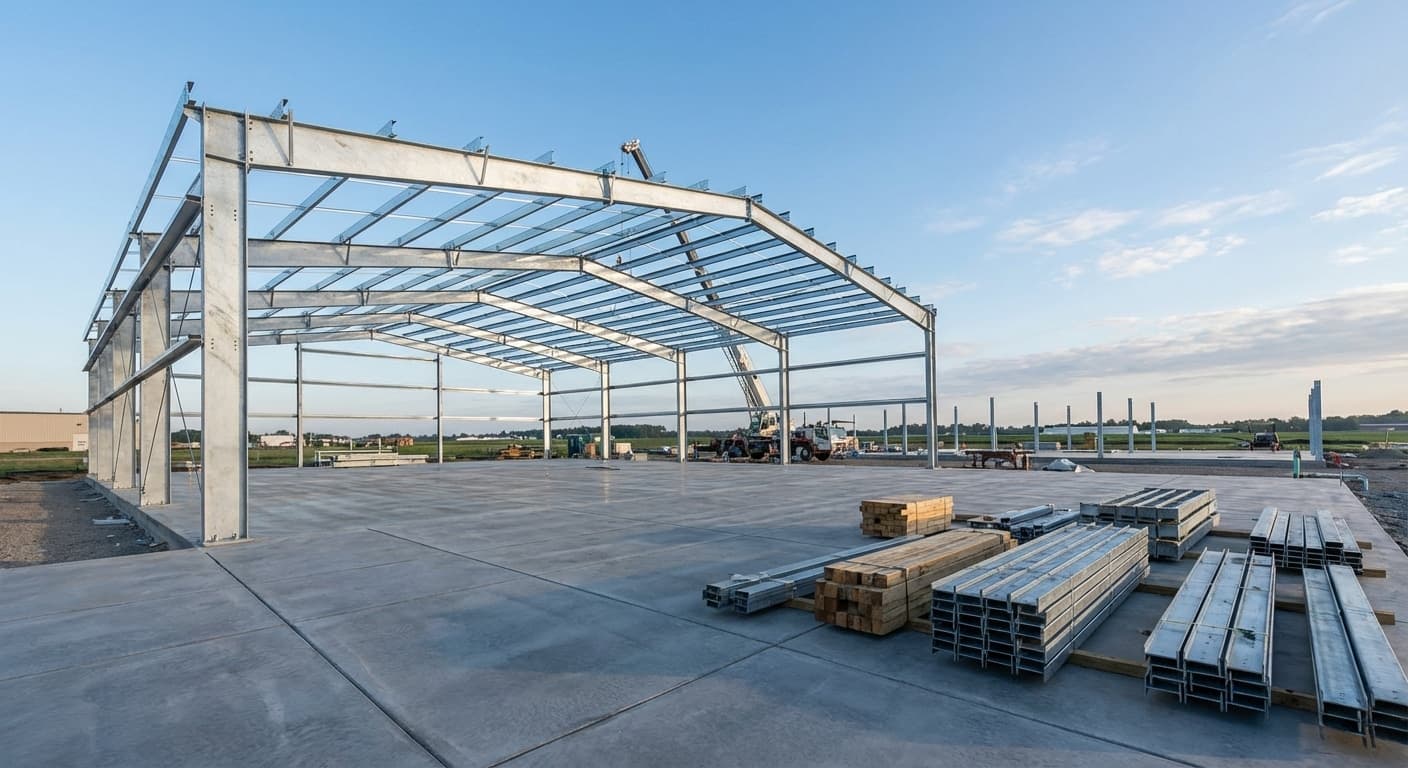

We help you understand that a 30×40 steel building costs $15-$22 per square foot for materials, climbing to $24-$43 fully installed when you factor in the slab, delivery, and professional erection. Getting the details right upfront–gauge specifications, roof style, regional engineering requirements, and exact measurements–protects your budget and prevents costly surprises down the road.
Understanding the Base Cost per Square Foot
Your fully installed 30×40 steel building shell costs $29,000 to $52,000, with the concrete slab alone consuming 25-35% of that budget.
Breaking Down the Kit Price
Your 30×40 steel building kit in 2026 runs between $18,000 and $26,000–roughly $15 to $22 per square foot for materials alone. [1] That price gets you the three structural layers: primary framing (columns and rafters), secondary framing (purlins and girts), and the roof and wall panels. [1] What you won't find in that quote: the slab, erection, or any interior finishing. That's where your per-square-foot number climbs.
Not all kits deliver equal value. As covered in detail in the Materials section below, frame quality drives both price and permit approval. Once you factor in delivery, concrete, and professional installation, you're looking at $24 to $43 per square foot fully installed. Total project investment: $29,000-$52,000 for an enclosed shell before any interior work. [2][3]
Foundation and Site Preparation Expenses
The concrete slab catches more buyers off guard than any other line item. Your standard 6-inch reinforced floor–the minimum you'll want for equipment and vehicles–runs between $8,500 and $13,500 based on your location and crew availability. [1] That's for a straightforward pour. Need grading?
Compacted fill? Thickened edges for column loads? Your costs climb from there.
Door aprons require their own budget line–they need extra material and finishing that basic slab quotes skip. [4] Figure $6 to $12 per square foot for the slab alone. That's 25-35% of your total project before steel even arrives. [4]
Labor and Installation Fees
Erection labor swings more than any other cost component–you need local bids to pin it down. A professional crew of three to four assembles your 1,200-square-foot building in three to five days. Their rates?
Entirely market-dependent. [1] You might save $6,000 to $12,000 going DIY–but know the trade-offs. [1] Steel erection demands specialized rigging knowledge, proper lifting equipment, and enough hands to position heavy framing safely. Two people and a rental forklift won't cut it. Your self-performed work still faces inspection.
Any code-related rework? That's your time and money. The smart middle ground: hire professionals like
Factors That Influence the 30×40 Steel Building Cost per Sq Ft
Steel gauge thickness and frame material choice–I-beam versus tubular–create the largest cost and quality gap between competing quotes.
Material Grades and Steel Gauge Choices
Here's what catches most buyers off guard: steel gauge numbers run backward. A 12-gauge frame is thicker and stronger than 14-gauge–and you'll feel that difference in both the price tag and how your building handles loads over time. [6] When you're comparing quotes, demand specifics. What gauge are the columns and rafters? What about the wall panels?
Budget suppliers love to advertise one low price while using thinner panels that dent easier and insulate worse. Without those details broken out, you're not comparing apples to apples. [6] The frame material choice is where you'll see the biggest cost–and quality–gap. Commercial I-beam frames built from North American steel do one thing tubular frames can't: pass building department scrutiny without drama. [5] Yes, tubular costs less upfront. But when your permit gets rejected because the engineering doesn't meet code, that savings evaporates fast.
If two quotes are thousands apart, you're probably looking at this exact difference. One question settles it: "Is this I-beam or tubular?" For any permitted structure, that answer determines whether the kit's actually usable or just cheap.
Roof Styles, Eave Height, and Door Configurations
Your roof choice drives more than just the quote–it determines how your building handles weather for the next 30 years. Regular roofs cost least but leave horizontal seams fighting gravity every time it rains. A-frame roofs pitch sharper, giving you better center clearance without jacking up the walls. But vertical panels? They run perpendicular to the roofline, shedding water, snow, and debris like they're supposed to. [7] Yes, vertical costs more. It's also the only configuration that keeps you leak-free through decades of weather cycles. [8] Eave height is where buyer's remorse lives. That 10-12 ft standard covers your pickup with a rack and leaves room for basic storage. [7] Going taller adds steel cost–but less than you think. The real price of too-short eaves hits when you can't fit a lift, can't install proper racking, can't work on equipment standing up. Every foot of clearance you skip now is a limitation you'll work around forever. Most regrets we hear? Not about square footage. About headroom. [9]
Door placement in a 30×40 needs strategy, not guesswork. Every opening steals wall space you'll want later. One 14-foot overhead door often beats two 8-footers–you get vehicle access plus continuous wall for storage and workbenches. Map your workflow first: Where does the compressor go? Tool storage? That second man door? Smart buyers solve the puzzle on paper. The ones who don't end up with doors and equipment fighting for the same wall. [9] At National Steel Buildings, we help you think through these layouts before steel gets cut–because moving a door after delivery costs more than getting it right the first time.
Regional Market Conditions and Shipping
Your zip code determines your steel building price more than any catalog or website can show. It's not about regional steel pricing–it's about what Mother Nature and your building department demand. Florida? Your kit needs hurricane-rated connections. Colorado? That roof better handle 90 pounds of snow per square foot. California coast? Add seismic bracing you'll never see but can't build without. [10] [11] As covered in the base cost breakdown, this engineering premium–10-15% in snow country alone–gets baked into your kit before the first piece of steel is cut. [1] But here's what most suppliers won't tell you upfront: these regional requirements also stretch your timeline. Standard delivery runs 6-10 weeks, but custom-engineered snow or seismic loads can push that out further. [1]
Then there's freight–the cost everyone forgets until the truck shows up. Distance from the fabrication plant matters, but so does local trucking availability. Rural sites often pay premium delivery rates not because they're far, but because carriers charge more for final-mile logistics. When you're comparing quotes, delivered price to your actual address is the only number that counts. Everything else is wishful thinking.
Optimizing Your Budget Without Compromising Quality
Lock your kit price before finalizing the loan, since steel prices fluctuate and cost increases during processing become your responsibility.
Selecting Standard Options for Cost Efficiency
Leveraging Single-Source Solutions with ProTradesSingle-source delivery changes everything. Instead of juggling four different contractors who all blame each other when something goes wrong, you get one number to call. [13] Missing component? They handle it. Framing question? Same team. No finger-pointing, no runaround.
This approach cuts your construction time from months to weeks. [14] Pre-engineered components arrive ready to assemble. Your crew isn't waiting on parts or clarifications. The schedule stays tight because one team controls every variable.
National Steel Buildings operates this way through our
Financing and Payment Strategies
Traditional mortgage lenders waste your time. The FHA won't touch kit buildings. [16] Most banks don't understand pre-engineered steel. Save yourself the runaround and start with lenders who actually finance these projects.
Your three real options:
- Home improvement loans: For projects under $50,000. Terms up to 12 years, APRs from 4-20%. [16]
- HELOCs: Draw funds as you build. Good if you have home equity to tap.
- Construction loans: Released in stages as you hit milestones. Best for larger projects.
Farm or rural build? Start with farm credit institutions–they finance metal buildings daily. [16] USDA programs work too. Commercial project? SBA-backed loans handle warehouses and larger structures but require full business documentation. [17]
Want fast approval? Show up prepared. Detailed plans. Itemized costs. Contractor credentials. Proof of income. [17] Complete applications move in weeks. Incomplete ones drag for months.
Pro tip: Lock your kit price before finalizing the loan. Steel prices move. If costs jump while your loan processes, you're stuck covering the difference. [16]
Transparent Communication and Next Steps
Get itemized quotes that break down materials, delivery, engineering, and accessories separately so you can compare apples to apples and avoid hidden costs later.
How to Get an Accurate Quote
Your accurate quote starts with providing three key details: exact location (county, not just state), building dimensions measured out-to-out of the steel framing, and specific use purpose. [18] That county detail matters–snow loads vary dramatically even between neighboring counties, and your local codes drive the engineering requirements that affect your final price. [18]
Most quote mistakes happen at the measurement stage. Steel buildings measure from the outside of the frame, not interior walls. Your eave height? That's measured at the framing point, not your finished ceiling. [18] Get those numbers wrong, and you'll be re-quoting later.
Here's what separates a real quote from a sales pitch: itemized line items. A complete quote breaks down materials, delivery, engineering, and accessories separately. [19] That "30×40 building – $22,000" number with no detail? Walk away. You need to see what's included and–just as important–what isn't.
Quick math for comparing quotes: Add $3-$6 per square foot for installation labor if it's not included. Insulation runs another $3-$7 per square foot. [19] One supplier includes it, another doesn't–now you know why their prices look different.
Red flags to avoid: high-pressure "today only" tactics, vague language like "additional charges may apply," and suppliers who won't provide written itemization. [18][19]
What to Expect During the Design and Engineering Phase
The design phase starts with one critical question: exactly how will you use this building? "Storage and maybe a workshop" isn't specific enough. You need operational details–what equipment moves through the space, which walls need to stay clear, whether you'll expand operations later. [20] Those answers drive every structural decision that follows.
Here's what most buyers don't realize about dimensions: width costs more than length. Every extra foot of width means extending all your rafters across the full span. Adding length? You're just adding frames to the end–much cheaper per square foot. [21] Your roof pitch choice affects both price and performance. Standard 1:12 pitch keeps costs down. A steeper 4:12 gable gives you more headroom at the ridge and sheds snow better. [21] Pick based on your needs, not assumptions.
Door and window placement happens now, not later. As covered in our door configuration section, positioning these openings requires mapping your wall usage first. [20] Your county's zoning rules–setbacks, height limits, foundation requirements–need checking before drawings get finalized. Miss this step, and you'll be redrawing layouts and losing weeks. [20]
Standard catalog dimensions save you money–up to 15% on fabrication costs, as discussed in our cost optimization section. [21] Custom sizes trigger engineering revisions that add time and cost without improving performance. When 1,480+ buildings have taught us anything, it's this: standard dimensions work for 90% of applications, and the 10% that need custom sizing know exactly why.
Ongoing Support and Service Excellence
Your building's warranty hinges on one thing most buyers overlook: documented maintenance. Primary framing coverage runs 10-20 years. Secondary components like roofing get 1-5 years. [22] But skip your annual inspection log? Your legitimate claim just became procedural rejection. [23]
The maintenance that protects your investment takes minutes, not hours. Check fasteners annually. Inspect sealants around openings. These simple tasks prevent 90% of water infiltration before it reaches your framing. [23] Buildings with regular upkeep need half the emergency repairs over ten years. Every maintenance dollar saves you $5-$10 in future repairs. [22][23]
When issues arise–and over decades, something always does–remote technical support resolves most problems within days. Misaligned panels, sealant questions, climate control adjustments–a phone call beats a site visit. [22] Our ProTrades team stays accessible after your building goes up because construction relationships don't end at final inspection.
Before you sign any purchase agreement, get three things in writing: the warranty document, required maintenance schedule, and technical support availability. A reachable support team makes the difference between a quick fix and a costly delay. [23] You're not just buying steel–you're investing in decades of use. Make sure your supplier plans to be there for all of them.
- Concrete slab costs represent 25-35% of total project expense at $6-$12 per square foot, making it the most underestimated line item in budgeting.
- Commercial I-beam frames pass building code requirements without rejection, while cheaper tubular frames often fail permit approval despite lower upfront costs.
- Regional factors including snow loads, hurricane ratings, and seismic requirements add 10-15% engineering premiums and extend delivery timelines beyond standard 6-10 weeks.
- Steel gauge numbers run backward; 12-gauge is thicker and stronger than 14-gauge, so detailed specifications must be verified when comparing supplier quotes.
- Eave height decisions create lasting regrets when too short; adding one foot of clearance costs less than working around permanent headroom limitations.
- Annual maintenance including fastener checks and sealant inspections prevents 90% of water infiltration and reduces emergency repairs by 50% over ten years.
- https://www.steelcobuildings.com/how-much-does-a-30×40-steel-building-cost-in-2026/
- https://www.engineeredmetalbuildings.com/blog/30×40-metal-building-prices/?srsltid=AfmBOorxolKjJ8F9k6BwHk0smDMsy02Wt1eoJIudAlh9BFsQtLURjBWn
- https://www.buildingsguide.com/metal-building-prices/?srsltid=AfmBOoojUim7wc2KnbnhGcDBCI1LKdo9VUqqAFjRsNedI-ST4Bn4IVRH
- https://www.engineeredmetalbuildings.com/blog/30×40-metal-building-prices/?srsltid=AfmBOoo2oyG_ywYBVVBctQ-GxkEeS-KpwSgg4lAPAe-RspbCk-00hHeq
- https://www.buildingsguide.com/metal-building-prices/?srsltid=AfmBOoo9NK5SePSpUQ1jo6oMOaIw4H6A9gh6EZGS90tGzdT-WiBebTQ3
- https://www.probuiltsteel.com/blog/30×40-metal-building-cost/?srsltid=AfmBOoo1g6nyBA2Zrcb3sFoHZV9sz0PY79HObEesF8lD01T3uzdqFXPb
- https://www.engineeredmetalbuildings.com/blog/30×40-metal-building-prices/?srsltid=AfmBOoq5dWUjNgCuJwakNVVMnFB5ox6IpbNjtK7wXs0fY10wKY5hzmG_
- https://www.coast-to-coastcarports.com/how-much-does-a-30×40-metal-building-cost?srsltid=AfmBOoru8cz0C3e7wOQBzQTmAqWVo9hGPRDYfEETNByHutIRIJy_4hyV
- https://www.americanmetalbuildings.com/blog/30×40-vs-40×50-metal-building-expert-comparison-and-what-actually-works-in-2025-2026/?srsltid=AfmBOoonaLLVsbnU85mj6PJNd7yTT5Om4OYuGGO4zBn0LsobJP3qZuPz
- https://www.probuiltsteel.com/blog/30×40-metal-building-cost/?srsltid=AfmBOoo6TIr5kQUrSQ3KYXQYOg-xmPhvNPKXpdJdS3jO74zhZ6fF1PDf
- https://www.engineeredmetalbuildings.com/blog/30×40-metal-building-prices/?srsltid=AfmBOorXoRLr_6KDsgvJMkJm6dgjcWImIyG5X2lVm1wdbkkEQzFAPSz7
- https://www.probuiltsteel.com/blog/30×40-metal-building-cost/?srsltid=AfmBOor73pRxb6ngBojGIAodEGMm9kDLNeif2Q1qcF5XwbGniNQY25cm
- https://norsteelbuildings.com/advantages-of-steel-series/advantages-single-source-responsibility/
- https://marbuildingsolutions.com/understanding-cost-savings-of-pre-engineered-metal-buildings/
- https://www.wolgast.com/blog/top-benefits-of-ssr-construction
- https://www.buildingsguide.com/build/metal-building-financing/?srsltid=AfmBOooIcs2rWoXmXic5kEdFjpdSyJPSZKxZHvh7J6kBo-OCQJrLKQCA
- https://idadevelops.com/can-you-finance-metal-building-construction/
- https://www.rhinobldg.com/blog/how-to-get-a-metal-building-quote
- https://roimetalbuildings.com/how-to-vet-a-metal-building-quote/
- https://bullbuildings.com/what-to-expect-when-building-a-30-x-40-metal-building/
- https://bulldogsteelstructures.com/blog/the-ultimate-guide-to-building-a-30×40-metal-structure-costs-design-and-more/
- https://www.prefabsteelpro.com/what-after-sales-services-come-with-prefab-warehouses-for-sale
- https://steelcommandercorp.com/warranty-maintenance-upkeep-how-ongoing-care-impacts-lifetime-cost/