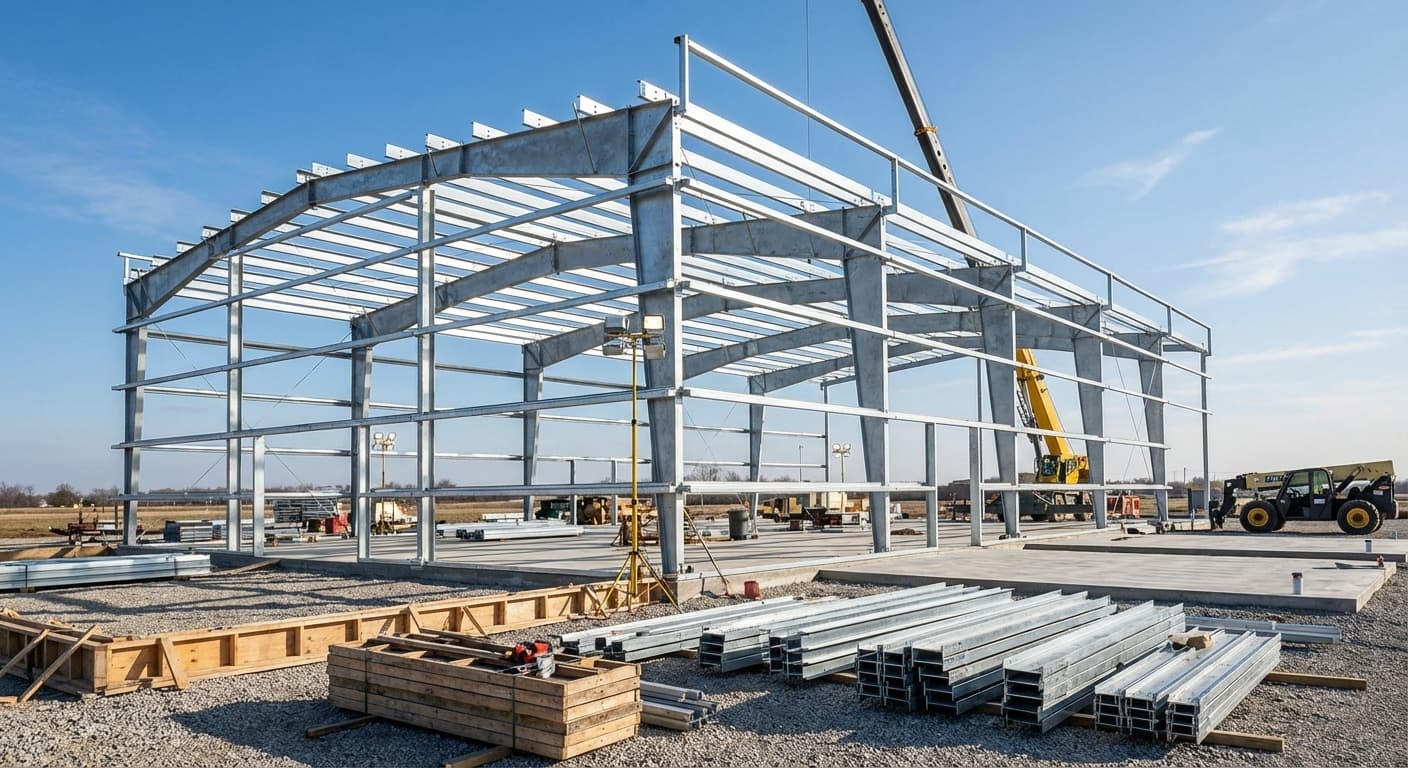

If you're budgeting a 30×40 steel building, brace for a true turnkey range of $28,000-$46,000–nearly double the advertised kit price–because foundation, labor, doors, insulation, and permits are never in the starter quote and can balloon fast once snow loads, wind codes, or seismic rules in your ZIP code demand heavier steel and more engineering. The article unpacks every driver behind that spread, from hot-rolled coil at double 2018 prices and new 25% tariffs to regional cost deltas that swing a slab $5-$8 per square foot and coastal wind-load upgrades that quietly add thousands in framing and fasteners. It shows why locking in steel early with an engineering deposit beats waiting for a dip, how I-beam frames outperform cheaper tube steel for real load capacity, and why single-source ProTrades packages erase the hidden overruns that plague DIY contractor juggling. Readers learn to insulate for 30-50% energy savings, layer federal Section 179 or bonus depreciation on top of state rebates, and sequence tax claims so state rebates don't claw back federal credits–turning a $30k building into a year-one write-off even when financed. Ultimately, the piece equips buyers to demand line-item quotes that capture their exact site conditions, upgrade wish list, and local codes so the building that shows up is the one they actually budgeted for.
Market Overview of the 30×40 Steel Building Price
A complete 30×40 steel building installed costs $28,000 to $46,000 nationally, but locking in your price now protects you from the steady 4-8% climbs happening this year.
National price range and what's included
A 30×40 steel building kit–which includes the primary I-beam frame, secondary framing (purlins and girts), roof and wall panels, and all hardware–runs $15,000 to $25,000 nationally. [1] That covers 1,200 sq. ft. of clear-span space, but not a functional, ready-to-use structure. Concrete foundation, labor, doors, insulation, and permits are always quoted separately, and skipping them in your budget is where you'll get caught off guard. Add those in, and your total turnkey cost rises to $28,000-$46,000+, or $24 to $43 per square foot installed. [2]
The wide spread isn't inconsistency between suppliers–it reflects how dramatically specs, site conditions, and regional codes move your final number. A basic self-build in the Midwest sits at the low end. A fully finished structure in coastal California, where seismic and wind requirements demand more steel and tighter engineering, pushes toward the top. [3] That's why getting a complete quote up front–one that captures your specific location and intended use–prevents budget surprises down the line.
Recent trends and market shifts
Steel building prices have stabilized since the pandemic-era spikes, but "stabilized" doesn't mean cheap or back to pre-2020 levels. Hot-rolled coil steel now trades around $950-$1,050 per ton–roughly double what mills charged in 2018–and producers are deliberately keeping supply tight to avoid another crash like 2022. [4] The result for you: prices are moving sideways with small seasonal bumps, not dramatic swings. Standard 30×40 kits installed have climbed 4-8% since January alone. [4]
Waiting for prices to fall is a documented losing strategy. One Arizona buyer watched his quote jump from $27,400 to $31,200 in 90 days while freight costs rose and crews booked out. [4] The lesson? Lock in your price when you're ready to build, not when you hope the market might be cheaper.
Two structural forces are keeping upward pressure on prices beyond raw material costs. First, a 25% global steel tariff announced in early 2025 added a new layer of cost across all metal building categories, pushing material prices higher than any previous year. [5] Second, 72% of U.S. steel production now runs through electric arc furnaces rather than basic oxygen furnaces–a shift toward greener, more corrosion-resistant steel that carries a modest premium at purchase but reduces your long-term maintenance costs. [6]
Together, these forces mean the market baseline has reset permanently upward. If you're planning around 2020-2021 pricing, you'll consistently undershoot your actual costs.
How weekly market monitoring keeps prices competitive
Steel prices don't move on monthly schedules–they shift with freight rates, mill output decisions, and trade policy announcements that can land any day of the week. Smart contractors track these movements weekly rather than quarterly to gain a real advantage. They shorten bid validity windows when volatility spikes. They introduce escalation clauses before material costs outrun their estimates. They lock in steel purchases earlier before prices move against them. [7]
This isn't overcaution–approximately 70% of a typical project's total expenses are now increasing faster than bid prices, leaving firms with little margin to absorb a surprise. [7] That's why working with a
Core Cost Components Shaping the 30×40 Steel Building Price
Your 30×40 foundation alone costs $7,200-$14,400 for a basic slab, but site conditions, reinforcement, and drainage requirements often double that investment.
Base kit pricing per square foot
As discussed in the market overview, steel building kits start at $15-$20 per square foot–but that's where the simple math ends. [9] You're buying more than a price per foot; you're choosing between frame types that fundamentally change what your building can do. Commercial-grade I-beam frames cost 20-30% more than tubular alternatives because they deliver real load capacity and decades of service life. [9] That's not marketing–it's structural engineering you can measure.
When you move from kit pricing to installed cost, the numbers jump to $25-$30 per square foot, landing your 1,200-square-foot structure at $30,000-$36,000 for a basic build. [10] But here's what catches buyers: every upgrade changes the equation independently. Need a 12×14 roll-up door instead of a walk door? That's $2,500-$4,000. Adding windows for natural light? Each one runs $300-$800 installed. Snow load requirements jumping from 20 to 50 psf? Your frame weight–and cost–increases proportionally. [3] The gap between a base quote and your finished building often doubles once you add the features that make it functional for your specific use.
Concrete slab and site preparation costs
Your foundation drives more budget variability than any other component. That 4-inch slab for basic storage? Budget $6-$12 per square foot, or $7,200-$14,400 for your 30×40 footprint–and that's before addressing what your site actually needs. [11]
Here's what moves the number:
- Site grading and fill dirt–not included in any slab quote
- Rebar reinforcement at $1.40-$1.85 per foot for slabs over 4 inches [12]
- Apron pads for door openings–required for smooth equipment access
- Thickened edges for frost protection in northern climates
- Drainage systems to prevent water pooling against your foundation
Planning heavy equipment storage or installing lifts? You need 5- or 6-inch reinforced concrete, not the standard 4-inch pour. [13] That's more concrete, more steel, more labor–the numbers add up fast.
Location hits hard too: central states average $5.35 per square foot for slab work, while California and New York push $8.50 per square foot. [12] Same concrete, different market. Smart buyers get their slab quote simultaneously with their building quote. Waiting means discovering a $10,000 surprise after you've already committed to the kit.
Labor, erection, and optional upgrades
Professional erection runs $7-$12 per square foot nationally–that's $8,400-$14,400 for your 30×40 building, separate from everything else. [14] A seasoned crew raises your shell in 3 to 5 days, but speed doesn't equal savings. [15] You're paying for expertise, equipment, and the confidence that your building meets code on the first inspection.
DIY assembly saves that labor cost–potentially $6,000-$12,000 as noted earlier–but demands real commitment. [6] You need 3 to 4 capable people, equipment rental costs, and enough code knowledge to avoid costly rework. Most DIY builders compromise: hire pros for the foundation and main frame, then tackle interior finishing themselves. It's a practical split that balances risk and reward.
Your upgrade decisions reshape the final number more than the base structure:
- Insulation: The smartest money you'll spend. With heating/cooling consuming 50-70% of building energy use, quality spray foam cuts those costs 30-50%. [6]
- Doors: Basic roll-up versus insulated? The price gap matters if you're climate-controlling the space. [6]
- Windows and skylights: Natural light transforms a metal box into a workspace–budget $300-$800 per opening installed
- Electrical and HVAC rough-in: Never included in kit quotes but essential for anything beyond storage
Working with a
Regional Factors Influencing the 30×40 Steel Building Price
Coastal steel buildings require engineered upgrades for higher wind speeds and corrosion resistance, while permitting complexity and state compliance add measurable costs that inland projects avoid entirely.
Coastal vs. inland price differentials
The price gap between coastal and inland 30×40 steel buildings comes down to engineering requirements that change with your zip code.
Coastal sites in hurricane-prone regions must be engineered to ASCE 7 wind speeds of 140-160+ mph, compared to 115-120 mph for inland locations within the same state–and that difference cascades through every structural element, from heavier primary frames and additional bracing to stronger anchor bolts and wind-borne debris protection requirements for exterior openings. [17] A direct pricing comparison illustrates the gap: the same 60×100 steel building costs $26,800 in Dallas (115 mph wind, Exposure B) versus $27,200 in San Francisco (110 mph wind, Exposure C, seismic D)–while coastal Florida, with 141 mph wind loads and Exposure C classification, pushes the number higher still. [18] Salt air introduces a second cost layer that purely inland buyers don't face: corrosive marine environments degrade standard steel coatings faster, making higher-performance PVDF paint systems or upgraded corrosion-resistant specifications a practical necessity rather than an elective upgrade. [17] Permitting widens the gap further–coastal projects typically require layered agency reviews, environmental documentation, and compliance steps around flood elevation and coastal setback lines that inland projects bypass entirely, extending schedules and increasing soft costs in ways that never show up in a kit quote. [16] In designated coastal windstorm zones like the Texas Gulf Coast, additional state-level compliance and documentation requirements apply on top of standard code reviews–a regulatory layer with no inland equivalent that adds both time and cost to an otherwise standard 30×40 build. [17]
Climate code impacts on material selection
Climate codes don't just dictate structural steel weight–they drive specific component choices that change what a 30×40 kit actually contains. ASCE 7-22's updated Components & Cladding (C&C) provisions apply pressure calculations zone by zone across the roof and walls, not as a single building-wide load. This means corners, edges, and localized roof zones can demand heavier attachment hardware, upgraded secondary members, and reinforced framing even when the primary frame footprint stays the same. [17] For tornado-prone regions, ASCE 7-22 introduces additional design checks for Risk Category III and IV buildings–schools, essential facilities, certain public structures–that can drive real structural implications beyond what standard wind design requires. [17] In practical terms, two 30×40 buildings with identical square footage but different zip codes can carry materially different steel tonnage before a single upgrade is added.Insulation selection is where energy codes convert climate data directly into a material spec.
The International Energy Conservation Code (IECC) sets minimum R-values and U-factors by climate zone and assembly type, which means a building in a cold northern climate must meet a higher roof and wall insulation threshold than the same structure built in a mild temperate zone. [17] Standard vapor-retarder-faced fiberglass blankets–the default in basic kits–are designed for condensation control, not thermal performance. Systems that physically separate insulation layers to prevent compression deliver measurably better installed R-values and matter most in hot-humid or cold climates where IECC minimums are stricter and HVAC loads are higher. [17] Specifying insulation that merely meets code on paper but underperforms in installation means paying for HVAC capacity to compensate–a cost that compounds over the building's life.Snow and moisture loads translate into secondary steel decisions that don't show up in a basic kit quote. In regions where ground snow load jumps from 20 psf to 50 psf, the required changes aren't cosmetic: purlin spacing tightens, purlin gauge increases, bridging requirements grow, and deflection control on the primary frame becomes more stringent. [17] In humid or coastal environments, steel's vulnerability to corrosion from moisture exposure makes protective coatings a functional requirement, not an optional finish.
Galvanizing or powder coating creates a moisture barrier that slows oxidation, while high-performance PVDF paint systems are standard practice where salt air or persistent humidity would degrade standard coatings within a few years. [19] Proper ventilation systems–sized for local humidity conditions–reduce airborne moisture inside the building envelope and prevent the condensation cycles that accelerate corrosion from within. [20]
State-by-state financing incentives
Federal incentives provide the most consistent leverage regardless of where your 30×40 build lands. For commercial builds, Section 179 lets businesses deduct the full cost of qualifying property–including certain metal building systems–in the year it's placed into service, up to $1,160,000 in 2024. Bonus depreciation runs parallel: introduced under the Tax Cuts and Jobs Act, it allowed 100% first-year write-off but is phasing down, sitting at 60% in 2024 before dropping further in subsequent years.
For longer-horizon planning, MACRS depreciation spreads the commercial structure's cost over 39 years with accelerated recovery in early years–meaningful for businesses that can't absorb the full cost in year one. [21] Metal buildings that incorporate qualifying energy-efficient features–high-performance insulation, reflective coatings, or solar–may also qualify under Section 45L, which provides a $2,000-per-unit credit for properties meeting specific energy efficiency criteria. [21] Through December 31, 2025, the federal Energy Efficient Home Improvement Credit adds another layer for residential applications: 30% of qualified expenses up to $3,200 annually, covering insulation, heat pumps, and certain envelope improvements on a primary residence. [22] That credit has no lifetime dollar limit, so buyers improving a residential 30×40 structure can claim the maximum each year improvements are made through 2025–but the credit is nonrefundable, meaning you can't recover more than you owe in taxes for that year. [22]State-level programs add a layer on top that varies significantly by location. Arkansas, for example, pairs the federal stack with local economic development incentives designed to encourage commercial investment–tax credits, financing assistance, and programs administered through the Arkansas Economic Development Commission. [21] Most states run comparable programs through their economic development or energy offices, but the structure differs: some offer direct rebates, others provide financing at reduced rates, and a few apply property tax abatements to newly constructed commercial structures.
The practical step is checking your state's energy office and economic development agency before finalizing your project scope–not after–since some incentive programs require pre-approval or documentation of qualifying specs before construction begins. For insulation and energy system upgrades specifically, the IRS notes that state incentives labeled as "rebates" may need to be subtracted from your federal qualified expenses if they meet the definition of a purchase-price adjustment, which means the sequencing of state and federal claims matters for maximizing the combined benefit. [22]
Strategic Approaches to Manage Your 30×40 Steel Building Investment
One accountable contractor eliminates scheduling conflicts and cost overruns that plague multi-bid projects on your 30×40 steel building.
Single‑source solution benefits with ProTradesManaging separate contractors creates more than scheduling headaches–it creates cost overruns. When your slab pours late or steel arrives early, each subcontractor bills for their time regardless. That's money out of your pocket for someone else's delay.
A single-source provider changes the math. One contract covers everything: material procurement, site prep, foundation, steel erection, and mechanical rough-ins. One schedule. One accountable party. [23] This approach delivers real savings–bundling all trades lets your provider negotiate better pricing across materials and control costs more precisely than you could managing multiple bids. [24]
Communication gets simpler too. Instead of playing phone tag between your kit supplier, concrete crew, and erection team, you have one contact tracking your entire project. [23] For a 30×40 build, where permits, codes, and inspections can each cause delays, that single point of contact keeps your project moving.
National Steel Buildings takes this approach through our ProTrades erection division. We handle your
Financing options and tax advantages
Here's what most buyers miss: financing your 30×40 build doesn't block your year-one tax deduction. Section 179 lets you write off the entire cost of qualifying property when it goes into service–whether you paid cash or financed. [25]
For 2026, you can deduct up to $2,560,000 with a phase-out starting at $4,090,000. Your $30,000-$46,000 steel building fits easily within these limits. [25]
Bonus depreciation adds another layer. Currently at 60% for 2024, it's phasing down from the original 100% write-off. [26] The bottom line: you can finance your building to preserve cash flow while still capturing most tax benefits immediately. Without these deductions, you'd recover costs over 39 years through standard depreciation. [21]
Energy-efficient features boost your savings further. High-performance insulation, reflective coatings, or solar additions may qualify for Section 45L's $2,000-per-unit credit. [21]
One critical step: sequence your claims correctly. Some state rebates must be subtracted from federal qualified expenses before calculating deductions. Run both state and federal incentives through your tax advisor before finalizing your project–not after.
Clear communication steps for accurate estimates
Accurate estimates start with what you bring to the table. Before contacting suppliers, know:
- Your exact dimensions
- Your intended use
- Any site constraints
Why? Suppliers engineer buildings to your specific address. Snow loads, wind loads, seismic factors, and local codes all vary by location. Two identical 30×40 buildings in different zip codes are fundamentally different structural products. [28]
Go direct to manufacturers, not brokers. Brokers mark up quotes from multiple manufacturers–you don't control who builds your structure or what warranty you get. [28]
When quotes arrive, don't jump to price comparisons. Check what's actually included:
- Frame type (I-beam vs. tubular)
- Paint system and warranty length
- Domestic vs. foreign steel
- Galvanized secondary framing
That lower price might be a different product entirely. [28]
List every planned upgrade before requesting quotes–doors, windows, insulation, electrical rough-in. Get everyone pricing the same finished building, not a bare shell. [27]
Ready to move forward? An engineering payment with a reputable manufacturer freezes your steel price for up to 90 days. That protection matters when material costs can jump thousands in a single quarter. [28]
- Kit-only price $15-25k; turnkey with concrete, labor, doors, insulation runs $28-46k+.
- Hot-rolled coil steel at ~$1,000/ton is double 2018 levels and unlikely to fall.
- 2025's 25% global steel tariff and greener EAF steel keep permanent upward pressure.
- Wind/seismic codes can raise steel tonnage 20-30% for coastal vs inland same-size buildings.
- Foundation variability is huge: $6-12/ft² for 4″ slab, more for thicker, reinforced, or graded sites.
- Section 179 lets businesses deduct full building cost year-one–even if financed–up to $2.56M limit.
- Lock steel price with engineering deposit; 90-day freeze shields against quarterly cost spikes.
- https://www.probuiltsteel.com/blog/30×40-metal-building-cost/?srsltid=AfmBOorcEvcCmT8zYFEPim4kfZ0Pcaz8NbMLnsx66N9_kfqbyKIVhdE8
- https://www.buildingsguide.com/metal-building-prices/?srsltid=AfmBOooJ2L2ArkS045UI3Rq_O7zFrmDBzUQ1dn8cclXJkUtTHchsoIOD
- https://artsprimesteelstructures.com/30×40-metal-building-cost/
- https://www.aametalbuildings.com/blog/2025-metal-building-price-trends-are-steel-building-costs-going-up-or-down-this-year?srsltid=AfmBOorpAcMH8S67kepT-3HGMR1x13riX0wZbOlK9In0sslSsJPVnkk1
- https://directmetalstructures.com/blog/the-impact-of-steel-price-fluctuations-on-metal-building-projects-in-2025/?srsltid=AfmBOopgy1N1CGLmCJ4otWbwcNg3XNU8lFH96CFcQgfOgnRBRcGkMTyZ
- https://www.steelcobuildings.com/how-much-does-a-30×40-steel-building-cost-in-2026/
- https://news.constructconnect.com/metal-price-volatility-squeezes-projects-amid-data-center-boom
- https://eoxs.com/new_blog/the-complete-guide-to-managing-fluctuating-steel-prices-in-2024/
- https://www.buildingsguide.com/metal-building-prices/?srsltid=AfmBOorDjf1ijWhGFmfk73O7XhSSCEUfZYEfnrlmai6F9PoIVXe3n3Px
- https://titansteelstructures.com/facts/how-much-does-a-30×40-metal-building-cost/
- https://www.engineeredmetalbuildings.com/blog/30×40-metal-building-prices/?srsltid=AfmBOorpvK64DklQ2A6L1VulPpLuzSR6HrIKGzKmSEWGFWvH3oRQKTBC
- https://www.homeadvisor.com/cost/outdoor-living/concrete-slab/
- https://www.probuiltsteel.com/blog/30×40-metal-building-cost/?srsltid=AfmBOopVk6nxf17iQG_t6gf1DPIAP7tJpN_BAThWBQBq-T1vT9LaCvlr
- https://www.metalbuildingoutlet.com/how-much-does-a-30×40-steel-building-cost/
- https://www.probuiltsteel.com/blog/30×40-metal-building-cost/?srsltid=AfmBOooJNjKY7E34jXam2iftBqXU_zY6X3JxcKJL87vT1EO3JNXcKHal
- https://seasidemarineconstruction.com/insights/coastal-construction-vs-inland-building-key-differences-to-consider/
- https://www.tylerbuilding.com/post/2026-metal-building-cost-variables
- https://www.rhinobldg.com/blog/comparing-pre-engineered-steel-building-costs
- https://cmsmaterialsolutions.com/blogs/news/how-climate-and-location-affect-material-choices-in-construction
- https://lionbuildings.com/what-are-the-design-considerations-for-steel-buildings-in-all-climates/2/
- https://www.paramountmetalsystems.com/tax-advantages-of-metal-building-systems-save-money-while-adding-value
- https://www.irs.gov/credits-deductions/energy-efficient-home-improvement-credit
- https://www.summitsteelbuildings.com/the-general-contractor-role-in-steel-building-projects
- https://www.elkayinteriorsystems.com/blog/the-benefits-of-a-single-source-general-contractor
- https://www.section179.org/
- https://oakmontfinance.com/understanding-section-179-for-2024-maximizing-your-tax-benefits-for-business-investments/
- https://www.buildingsguide.com/metal-building-prices/?srsltid=AfmBOorRLbKNacL0d1WbPrcQAq0x4MWi0Jb9LD1XX5St7KCrGQR90pQm
- https://armstrongsteel.com/blog/steel-building-quotes-prices-estimates