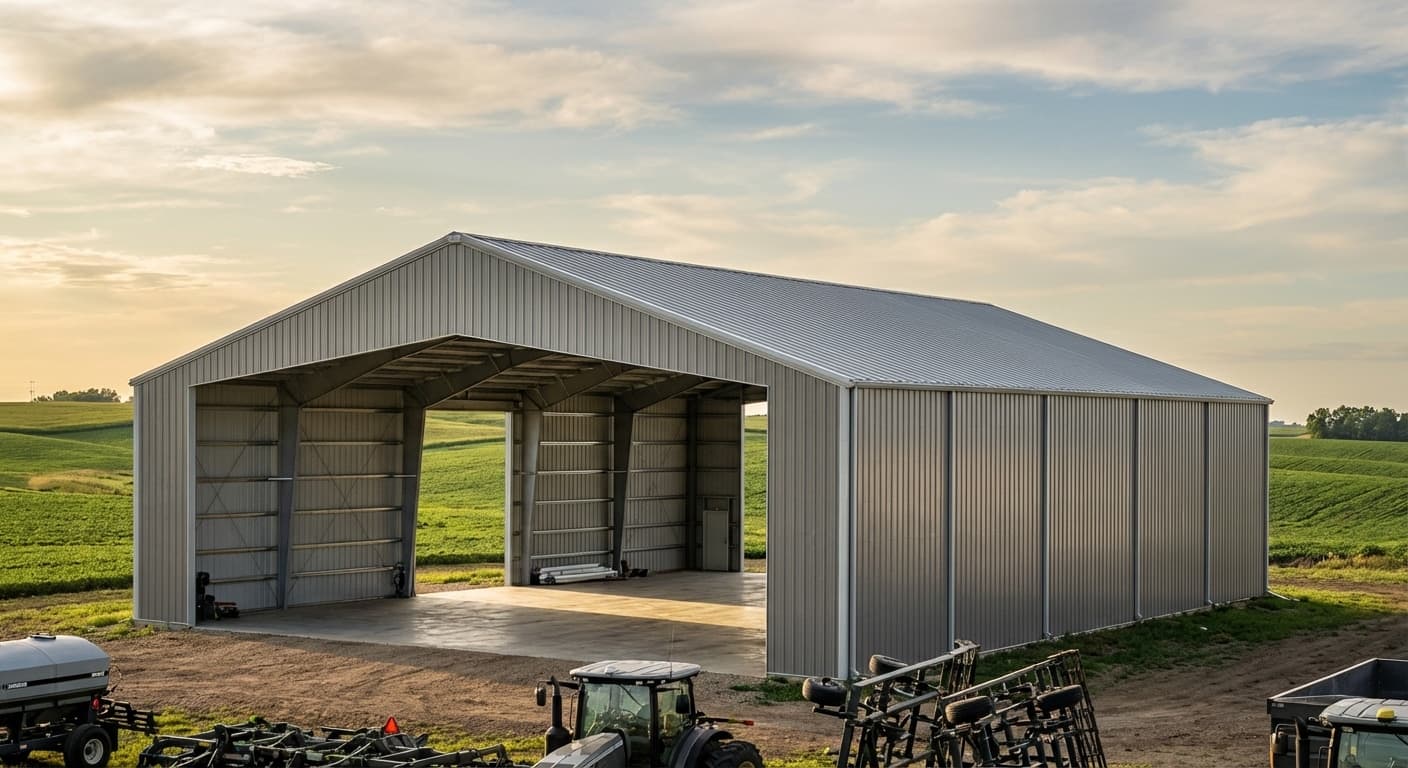

This definitive guide shows farmers how to stop losing money to inefficient buildings by designing, constructing, and maintaining steel agricultural structures that slash maintenance costs, boost productivity, and protect profits for decades. Readers learn to match building type to exact operational needs–whether livestock, crop storage, or equipment housing–while leveraging steel's 50-year lifespan, fire resistance, and 90% recyclability to outlast and outperform wood. The article walks through every critical decision: site testing for soil and drainage, navigating location-specific permits, selecting hybrid steel frames that cut upfront costs 37%, and engineering ventilation, waste, and climate systems that keep animals healthy and grain spoilage near zero. It delivers actionable maintenance schedules, season-by-season Essentials, moisture-control tactics, and affordable sensor networks that catch problems early, plus real-world ROI data–like a Midwest dairy recovering its investment in seven years and saving $10,000 annually–so farmers can future-proof their operations, meet sustainability targets, and turn barns into profit centers instead of money pits.
Foundations for Successful Agricultural Buildings
Set SMART objectives for your building before breaking ground to prevent expensive mid-construction changes and keep your project on budget.
Understanding the agricultural buildings design and maintenance guide
Your agricultural building plan drives farm success. Start with a property map showing where buildings fit your operation–location, size, expense, and function all matter [1]. You'll need the basics: barns for animals, greenhouses for plants, sheds for equipment, pack houses for market prep [1].
Don't rush to build new. Check existing structures first. Renovating saves money and keeps farm character intact. Your buildings should match your farm values–land stewardship, economic goals, and quality of life [1].
Here's the reality: infrastructure eats your first few years. Plan carefully. Build what you need, not what you want. Design for today's production with room for tomorrow's growth [1]. That's how you create buildings that work as hard as you do.
Defining project goals and functional requirements
Know exactly what your building needs to do before breaking ground. Crop storage? Livestock housing? Dairy operations? Each demands different features [3].
Skip vague goals. Set SMART objectives–"process 25% more harvest within three years," not "increase efficiency" [3]. Write down:
- What you're building (greenhouse, storage, barn)
- Clear boundaries to prevent scope creep
- Specific requirements for your operation [3]
Livestock buildings need ventilation specs, waste systems, and welfare features. Crop storage requires climate control and pest protection [3]. Define success with numbers–production targets, quality benchmarks, certifications [3].
Clear goals prevent expensive mid-construction changes. Everyone knows what success looks like. You stay on budget.
Site assessment: climate, soil, and topography
Test your site before you build. It saves money and headaches.
Soil matters: Sandy or heavy clay means extra foundation work. Loam soils support buildings better [4]. Test for pH, fertility, and contaminants–especially if bio-solids were used [4].
Slope and drainage: Skip steep slopes for buildings–they cause erosion and equipment hazards [4]. Flat spots work best but need proper drainage. No water pooling around foundations.
Smart orientation: Face your longest walls north to cut summer heat gain and capture winter warmth [5]. Check prevailing winds. Good orientation reduces damage and improves ventilation.
Water concerns: Know your water table depth. Shallow tables compromise foundations. Avoid flood zones entirely [4].
Site surveys reveal flooding risks, erosion patterns, and wildlife issues before they cost you [2]. Smart planning upfront means your
Navigating permits, zoning, and code compliance
Agricultural permits aren't like residential ones. Rules change by location–what flies in one county fails in the next [6].
Federal oversight: USDA covers food production buildings. EPA watches environmental impact [6].
Local rules dominate: Most permitting happens at state and county levels [6]. Some states exempt farm structures but require setback compliance [7]. Others exempt buildings on 5+ acre agricultural parcels but still enforce building codes [8].
Get documentation ready:
- Property surveys
- Structural drawings
- Environmental assessments
- Compliance proof [6]
Smart moves: Meet planning officials early. Catch issues before they delay you [6]. Complex projects? Get permit experts who know the system [6].
Timeline: 6-12 weeks typical, but budget for delays [6]. Never start without approvals–fines and demolition orders hurt more than waiting [6].
Working with an experienced steel building supplier simplifies this process. We know local codes and help you navigate requirements efficiently.
Selecting Materials and Structural Systems
Hybrid steel-and-wood buildings deliver 40+ years of performance while cutting maintenance costs and saving 37% compared to traditional wood construction.
Comparing steel, wood, and hybrid options for durability
Your building material choice determines maintenance headaches for decades to come. Steel gives you 50+ years of service with minimal upkeep–no termite treatments, no rot repairs, no weather-related surprises [9]. It shrugs off extreme temperatures, high winds, and won't burn when sparks fly [9].
Wood needs constant attention. You'll seal it, treat it, repaint it, and still watch for termites, rot, and weather damage [9]. The maintenance never stops.
Hybrid buildings split the difference smartly. Steel handles the heavy lifting–your main frame and roof trusses–while wood fills in where flexibility matters [10]. You get steel's strength where you need it most, especially in the roof system that takes your weather punishment [11]. Steel trusses won't sag, won't harbor insects, and go up faster than traditional wood framing [11].
Yes, steel costs more upfront than all-wood construction [9]. But hybrid designs cut that premium significantly–you'll save about 37% compared to traditional wood buildings while still getting 40+ years of warranty-backed performance [11]. Factor in the reduced maintenance, insurance savings, and peace of mind–the math works in your favor.
Engineered steel framing and cold‑formed solutions
Cold-formed steel changes the game for agricultural buildings. Shaped at room temperature instead of blast-furnace heat, these components arrive stronger yet lighter than traditional steel [12]. Your crew bolts together C-channels and Z-sections without welding equipment or specialized skills [14]. Here's what that means for your project: You need 30% less concrete for foundations because the structure weighs less [14]. Components show up pre-cut and labeled–no measuring, no cutting, no waste. Your building goes up fast, even during harvest season when time matters most [13].
The real payoff comes in performance. Your
Insulation, roofing, and energy‑efficient envelopes
Your building envelope is your profit protector–it keeps conditioned air in and weather out. Get it wrong, and you'll pay for it every month in energy bills and repair costs. Start with insulation R-value–the higher the number, the better it blocks heat transfer [16]. For agricultural use, polyisocyanurate (polyiso) delivers the best bang for your buck. It packs the highest R-value per inch, resists moisture from livestock and washing operations, and won't support fire [16]. Steel framing can create thermal bridges where heat escapes, so continuous insulation breaks that expensive connection [15].
Your roof takes the biggest beating and affects your bottom line most. White or reflective coatings cut cooling costs 15-30% in hot climates while doubling your roof membrane's life by blocking UV damage [17]. That's real money saved on both energy and replacement costs.
Don't let moisture become your enemy. Farm buildings generate humidity–from animals, crop processing, equipment washing–that will destroy insulation and rust steel if you let it [17]. Seal every gap: foundations, wall-roof joints, around doors and windows. The EPA says proper sealing alone cuts heating and cooling costs up to 20% [17].
Consider getting a professional envelope assessment. Thermal cameras and blower door tests show exactly where you're losing money through air leaks and poor insulation [17]. Fix the worst problems first for maximum payback.
Sustainable and eco‑friendly material considerations
Steel buildings check all your sustainability boxes while padding your wallet. Over 90% of steel gets recycled–more than any other building material–and 40% of new steel comes from recycled sources [18][19]. Your building can be completely recycled decades from now without losing any strength or value [19]. But sustainability pays off long before recycling. Steel's strength lets you pack in thick insulation without bulky walls, slashing energy costs year-round [19]. The structure easily carries solar panels that might overload other buildings [19]. Add rainwater collection, position for natural light, and design for cross-ventilation–you've got a building that practically runs itself [20].
Your construction site stays cleaner too. Components arrive cut to size, so you're not dealing with scrap piles or disposal costs [18]. Once up, steel resists everything that shortens building life–mold, termites, moisture damage–meaning fewer replacements and less environmental impact over time [19].
The financial benefits make sustainability affordable:
- Lower utility bills from better insulation and renewable energy [20]
- Reduced maintenance costs throughout the building's life [20]
- Potential tax credits, grants, and incentives for green building [20]
- Higher property values from sustainable features [20]
You're building for the next generation while protecting today's profits. That's smart farming.
Designing for Specific Farm Operations
Smart ventilation design removes moisture and harmful gases while maintaining comfort, protecting both your animals' health and your building's structural integrity.
Livestock housing: ventilation, waste management, and welfare
Your livestock deserve housing that works as hard as you do. Smart ventilation design keeps your animals healthy and productive by removing moisture, ammonia, and harmful gases without creating stressful drafts [21]. You'll get the best results from natural ventilation through strategically placed openings, ridge vents, and eave gaps that maintain fresh air circulation [21]. Cross-ventilation with openings on opposite sides creates airflow patterns that efficiently remove stale air, while height differences between inlets and outlets generate a natural chimney effect [21]. Adjustable panels or curtains let you modify airflow based on weather conditions, maintaining comfortable environments year-round [21]. Skip proper ventilation and you'll face respiratory issues in your animals plus accelerated building deterioration [23].
Animal waste attacks your building through a nasty combination of high moisture, hydrogen sulfide, and ammonia gases [23]. Wood frames take the worst hit–moisture gets trapped and degrades rafters and trusses [23]. You've got several foundation protection options: high-density polyethylene post protectors that block direct contact between posts and waste, or pre-cast concrete columns with steel brackets that lift wooden components above ground level [23]. Your flooring choice drives your waste management strategy. Solid floors (concrete or dirt) can hold manure for months in composted bedding systems, while slatted flooring needs at least six months of manure storage capacity below [23]. Beyond protecting your structure, proper waste containment keeps nitrogen and phosphorus out of groundwater and water bodies [23].
The "Five Freedoms" framework keeps your design focused on what matters: ready access to fresh water and proper diet; appropriate shelter with comfortable resting areas; prevention of pain, injury or disease; sufficient space for normal behavior; and freedom from fear and distress [22]. These translate into real requirements–6-8 square meters per adult cow, comfortable resting areas, rounded corners, and non-slip flooring [21]. Modern "cow comfort" facilities reduce stress, cut disease rates, and support natural behaviors [22]. Strategic building placement lets you monitor animals quickly and respond fast during extreme weather or health emergencies [21]. Get ventilation, waste management, and animal welfare right from the start–you'll see healthier animals, better productivity, and reduced environmental impact while meeting sustainability goals like the dairy sector's carbon neutrality targets [23].
Equipment and machinery bays: clear spans and workflow
Clear-span structures transform equipment storage from a daily hassle into smooth operations. By eliminating internal columns, you get uninterrupted floor space for moving large machinery freely. Strong steel frames, trusses, or pre-stressed concrete beams support the roof through external walls only–creating spans from 20 to over 300 meters without obstacles [26]. Your tractors, combines, and implements move without interference while you maximize every square foot of storage. Your building layout determines whether you waste time or save it [24]. Start by mapping your current space usage–find those underutilized corners and traffic jams before reorganizing [24]. Set up distinct zones for storage, maintenance, and cleaning with enough space between areas to prevent workflow bottlenecks [25]. Go vertical with smaller tools and parts to free floor space for big equipment–your facility instantly feels larger and works better [24].
Get your aisle widths right by measuring your largest equipment and adding maneuvering room. Size main pathways for machinery, but secondary aisles can be narrower for foot traffic [24]. Add external staging areas with gravel pads or concrete aprons for preliminary cleaning and maintenance before equipment rolls inside [25].
Organization saves time and prevents accidents. Group related items–all planting equipment here, harvesting tools there [24]. Position power outlets throughout maintenance zones where you need them. Include wash bays with proper drainage for safe equipment cleaning [25]. Design for seasonal flexibility–your equipment storage can double as workshop space during off-seasons without new construction [24].
Crop, feed, and grain storage: climate control and pest protection
Your crops, feed, and grain need storage that protects quality and prevents loss. Start with climate control–consistent internal conditions prevent the moisture fluctuations that ruin harvests. Position buildings to minimize weather exposure, with longest walls facing north to reduce summer heat while capturing winter warmth [27]. Install ventilation that removes excess moisture and regulates temperature without damaging drafts.
Pest protection requires smart planning. Lock pesticide storage areas and limit access to trained personnel only [28]. Mark these areas clearly with warning signs and post inventory lists outside for emergency responders [28]. Keep pesticides in original containers with labels protected by transparent tape. Stack dry formulations above liquids to prevent leak contamination [28]. Track everything–purchase dates, quantities, usage–to spot problems fast [28].
Build in protection from day one. Sealed concrete or epoxy-coated floors prevent moisture absorption and simplify spill cleanup [28]. Add 2-4 inch curbs around storage areas to contain spills before they spread [28]. Keep temperatures between 40 degreesF and 90 degreesF–extreme temps degrade both crops and protective chemicals [28]. Your integrated pest management plan should cover regular inspections, sanitation procedures, and targeted pesticide use only when needed. Steel buildings excel at maintaining these precise storage conditions while resisting pests and moisture damage.
Multi‑purpose barns and future‑proof modular layouts
Multi-purpose barns save space, cut costs, and streamline your daily operations by combining functions in one smart structure [29]. Future-proof your investment with versatile layouts that adapt as your farm grows. Open-concept designs give you unobstructed spaces you can reconfigure with temporary partitions or modular stalls whenever needs change [29]. Zone your interior for maximum efficiency–designate areas for livestock, storage, and work while keeping everything adaptable with movable elements [30]. Wide alleyways and large doors let machinery flow through easily. Place utilities strategically so every area can serve multiple purposes [29].
Modular components transform your space with the seasons. Flexible stall dividers, movable workbenches, and adaptable storage systems let you switch from equipment storage to processing areas–even retail space during harvest [30]. Steel structures deliver the clear spans and durability you need for truly multi-functional spaces, plus superior fire resistance [31].
Think beyond today's needs. Install plumbing and electrical infrastructure during initial construction–you'll thank yourself when adding living quarters or specialized workshops later [31]. Position buildings for optimal ventilation and natural light to cut energy costs [29]. Build in technology infrastructure now for future smart farming systems, monitoring equipment, and automated climate controls [30]. Your multi-purpose barn becomes an investment that grows with your operation.
Proactive Maintenance and Seasonal Care
A documented maintenance schedule–tracking component details, seasonal tasks, and repair history–prevents costly downtime during your critical harvest operations.
Building a maintenance schedule and documentation system
You can't afford downtime during harvest season. That's why smart farmers build maintenance schedules that catch problems before they shut you down. Start with a simple inventory–list every major component in your buildings, from roof panels to ventilation fans [32]. For each item, jot down model numbers, installation dates, and warranty details. You'll thank yourself when ordering replacement parts at 7 AM [32].
Sort your building components into priority levels. Critical systems that could stop operations get checked first. Less urgent items can wait for scheduled maintenance windows [33]. Your daily walk-through might include quick visual checks and listening for unusual sounds. Weekly tasks could cover belt inspections and safety equipment [32]. Monthly maintenance digs deeper–electrical systems, hydraulic components, anything that needs a closer look [32].
Seasonal maintenance keeps you ahead of weather challenges. Each season brings specific tasks that protect your investment (we'll detail these in the next section) [32]. Annual inspections catch the deeper issues your regular checks might miss [32].
Track everything. Whether you use maintenance software (CMMS) or simple spreadsheets, document what you find and what you fix [33]. Digital systems send automatic reminders and spot patterns you might miss. They'll tell you when that bearing starts failing every 18 months like clockwork [33]. Record dates, parts used, and any changes you notice–this history becomes invaluable when troubleshooting [32].
This systematic approach saves you money three ways: fewer emergency repairs, longer building life, and zero surprises during critical operations [32]. With steel buildings' naturally low maintenance requirements, a good schedule keeps your costs minimal and your operations running.
Spring, summer, fall, and winter inspection checklists
Spring, summer, fall, and winter inspection checklistsSpring – Time to check what winter left behind:
- Walk your roof. Look for loose panels or damaged fasteners [34]
- Clear gutters before spring rains cause problems [34]
- Check building bases for moisture damage or settling [36]
- Replace worn weatherstripping on doors and windows [34][36]
- Service ventilation systems for the warmer months ahead [34][36]
Summer – Beat the heat and unwanted guests:
- Inspect insulation, especially in livestock areas where temperature matters [36]
- Hunt for wasp nests, termites, and rodent entry points [35][36]
- Pressure wash exteriors (low pressure only) to protect coatings [36]
- Test cooling systems before you really need them [36]
Fall – Your last chance before winter:
- Winterize plumbing–insulate pipes or drain non-essential lines [36]
- Clear roof debris and tighten any loose panels [36]
- Seal every gap you find. Mice look for winter homes too [36]
- Check foundations before freeze-thaw cycles start [36]
Winter – Stay ahead of the weather:
- Monitor snow loads. Remove buildup before it becomes a problem [36]
- Check for air leaks on the coldest days–they're easier to find [36]
- In livestock buildings, balance ventilation with draft prevention [35]
- Keep doors operational and paths clear for safety [36]
Controlling moisture, condensation, and corrosion in steel structures
That dripping you see on cold mornings? It's condensation forming when warm, humid air hits cold steel surfaces [37]. In agricultural buildings–especially with livestock, equipment washing, or grain drying–this moisture becomes your enemy. It causes rust, breeds mold, and damages stored products [37][38]. Your first defense is ventilation. As covered in our livestock housing section, proper airflow removes moisture before it becomes a problem. Install vents on opposite walls for cross-flow. Add ridge and soffit vents. Put exhaust fans where humidity builds up [38].
Insulation forms your second line of defense. It keeps surface temperatures consistent, stopping that warm-to-cold contact that creates condensation [38]. Quality vapor barriers go under roof panels, in walls, and beneath concrete floors–they block moisture migration before it starts [37][38].
Smart building design fights moisture too:
- Roof overhangs protect walls from rain [38]
- Proper gutters and downspouts direct water away [38]
- Adequate roof pitch prevents pooling [38]
For livestock buildings, the added investment in composite walls (steel exterior, insulation, vapor barrier, interior sheathing) pays off through better moisture control, despite the higher upfront cost [39].
Stay on top of maintenance basics:
- Check and replace damaged seals
- Keep gutters clear
- Ensure vents work properly
- Fix leaks immediately
- Monitor humidity levels
With quality steel construction and these moisture control strategies, you'll protect your investment and avoid costly moisture damage [37][38].
Leveraging smart monitoring and predictive maintenance tools
You can't be everywhere at once. But smart sensors can. Today's monitoring systems watch your buildings 24/7, catching problems while they're still cheap to fix [40].
Here's what modern sensors do for you:
- Temperature monitoring in livestock areas sends alerts when conditions drift outside safe ranges [41]
- Vibration sensors catch bearing failures before equipment breaks [41]
- Humidity tracking prevents condensation damage we discussed earlier [40]
- Environmental monitoring protects both buildings and stored products [40]
When something goes wrong, you get a text or email immediately–not next Tuesday when you do your rounds [40]. Connect these sensors to maintenance software (CMMS), and you'll spot patterns humans miss. That fan that fails every 18 months? The system will schedule replacement at month 17 [41].
Setting up is simpler than you think:
- Place sensors at critical points (doors, equipment, problem areas)
- Most systems connect via cellular or long-range wireless [40]
- Battery life often exceeds 10 years [40]
- Setup takes about 15 minutes per sensor [40]
- Check everything from your phone or computer [40]
The payoff? You fix things before they break, schedule maintenance when it's convenient, and sleep better knowing you'll get an alert if something needs attention [41]. With monitoring costs dropping yearly, even smaller operations can afford this peace of mind.
Combined with durable steel structures, smart monitoring gives you buildings that practically maintain themselves–exactly what busy farmers need.
Repair, Renovation, and Emerging Innovations
Regular inspections catch problems when they're small and cheap to fix, while quality repairs usually cost far less than replacement.
Assessing damage: repair vs. replacement decision framework
When your agricultural building shows damage, you need a clear framework to decide: repair or replace? For steel structures, corrosion that reduces material thickness directly affects how much weight the building can safely carry [42].
Start by checking where the damage is and what it affects. Damage to main support beams needs immediate attention. Problems in decorative trim can wait [42]. Location matters–damage at connection points or column bases creates more risk than surface issues in low-stress areas [42].
Look at these key factors:
- How much load-carrying capacity remains
- How fast the damage is spreading
- Whether surrounding components are sound
- What your original building specs require [42]
Quick deterioration means you need to act now. Slow, gradual wear gives you time to plan and budget [42]. Use the right inspection tools–visual checks catch obvious problems, but ultrasonic testing finds hidden issues. For critical structures, bring in a structural engineer who knows local building codes and can calculate actual load requirements [42].
Here's the bottom line: quality repairs usually cost far less than replacement and keep your operation running. Regular inspections catch problems when they're small and cheap to fix [42].
Common repair techniques for metal and hybrid buildings
Metal buildings give you three repair options based on what's wrong: spot fixes for small issues, restoration for moderate damage, or replacement when sections can't be saved [44].
Common repairs you can handle:
- Roof leaks – Find the source and seal it properly
- Surface rust – Remove it, treat the metal, apply protective coating
- Panel damage – Straighten bent edges, patch small holes, replace badly damaged sections [44]
Keep problems from starting with simple maintenance:
- Clean gutters regularly
- Tighten loose fasteners
- Check seams for gaps
- Clear debris from drains [43]
The beauty of pre-engineered metal buildings? Components are standardized. When you need to replace a damaged panel or section, it's straightforward–no custom fabrication delays [44].
Integrating smart sensors, modular upgrades, and renewable energy
Smart sensors turn your building into an active partner in farm management. Temperature and humidity sensors protect stored crops and livestock. Soil sensors track moisture and nutrients. Air quality monitors keep ventilation optimal. All this data flows to your phone or computer in real-time [45][46]. Smart placement makes the difference:
- Multiple soil sensors at different depths
- Environmental sensors in key building zones
- Entry point monitors for security
- Equipment sensors for predictive maintenance [46]
Today's Getting power to remote sensors used to be a dealbreaker. Not anymore. Modern sensors run for years on a single battery using efficient communication protocols [47]:
- LoRaWAN – Transmits data several kilometers, perfect for large properties
- Zigbee – Ideal for greenhouses and buildings with many nearby sensors
- Solar-powered options – Set and forget for truly remote locations [47]
Smart systems combine power sources–a small solar panel with battery backup keeps sensors running through any weather. They even adjust their reporting frequency based on power levels, ensuring critical alerts always get through [45].
Choose technology that fits your farm:
- Match communication range to your property size
- Place sensors where they deliver actionable data
- Start with critical monitoring points
- Expand as you see value [46]
The goal isn't maximum data–it's the right data at the right time to make better decisions.
Case studies of successful upgrades and cost‑benefit analysis
Real farms see real returns when they upgrade to steel. A Midwest dairy saved 37% by converting their wood barn to a hybrid steel-frame structure instead of complete replacement. With a 40+ year warranty on the metal skin, they'll save money for decades [48].
The numbers tell the story:
- Initial investment recovered in 7 years through eliminated termite damage and lower insurance
- Annual maintenance: 1-3% of building cost versus much higher for wood [49]
- 10,000 sq ft facility saves $5,000-$10,000 yearly in maintenance alone
A grain storage operation upgraded to steel and cut cooling costs 15-30% with reflective roof coatings. The clear-span design gave them 20% more usable space–no interior columns blocking equipment movement. Better airflow reduced spoilage by 15% [48].
Smart upgrades pay multiple ways:
- Lower utility bills
- Reduced maintenance
- More efficient operations
- Potential environmental certifications
- Protection from future regulation costs [50]
One livestock facility's steel upgrade improved animal health metrics while meeting environmental regulations–protecting against compliance issues down the road [48]. When you factor in all benefits, steel buildings deliver returns that keep growing year after year.
- Renovate existing farm buildings first to save money and preserve farm character.
- Set SMART building goals like 'process 25% more harvest within three years'.
- Test soil, slope, drainage, and water table before construction to avoid costly surprises.
- Use hybrid steel-wood designs to cut upfront costs 37% while gaining 40+ year durability.
- Install continuous insulation and vapor barriers to stop condensation and energy loss.
- Design livestock housing around the Five Freedoms to cut disease and boost productivity.
- Schedule seasonal maintenance to prevent emergency shutdowns during harvest.
- https://extension.oregonstate.edu/catalog/cms-100641-introduction-whole-farm-systems-design
- https://agrisysintl.com/key-considerations-when-planning-an-agricultural-construction-project/
- https://agriculture.institute/project-management-in-agribusiness/steps-in-project-planning-process/
- https://njaes.rutgers.edu/fs1342/
- https://www.cfisherconstruction.com/6-things-to-consider-before-constructing-agricultural-steel-buildings/
- https://www.steelcobuildings.com/building-permit-for-agricultural-building/
- https://agriculture.vermont.gov/farm-structures-and-how-theyre-regulated
- https://www.permitsonoma.com/divisions/engineeringandconstruction/building/agriculturalbuildingpermitexemption
- https://ccr-mag.com/steel-vs-wood-whats-best-for-farm-buildings/
- https://www.worldwidesteelbuildings.com/blog/hybrid-steel-and-wood-building/
- https://troyerpostbuildings.com/blog/hybrid-pole-barn/?srsltid=AfmBOoqgjfpwGkD9GUD9_eN0pEE3XBgmnodbP923-ul7xQNYOHGD0Hqs
- https://www.storagebuildingcompany.com/resources/2024/9/12/advantages-and-applications-of-cold-formed-steel-beams-in-self-storage-construction
- https://iron-giants.com/the-advantages-of-cold-formed-steel-buildings-vs-hot-rolled-steel/
- https://www.buildingsguide.com/build/cold-formed-steel-buildings/?srsltid=AfmBOoqIQTLwHzV1mHXifD9DK2z_wilVF7YKtUraEesjBrxpxfy0-GW8
- https://www.certainteed.com/inspiration/how-tos/creating-energy-efficient-building-envelopes
- https://www.rmax.com/blog/energy-efficient-building-envelope
- https://thermacote.com/7-essential-tips-to-improve-your-building-envelope-for-maximum-energy-efficiency/
- https://vodsteelbuildings.com/blog/sustainable-steel-buildings-eco-friendly-structures-for-a-better-tomorrow/
- https://www.fedsteel.com/insights/why-steel-structures-are-environmentally-friendly/
- https://www.springfieldsteelbuildings.com/blog/the-role-of-agricultural-buildings-in-sustainable-farming/?srsltid=AfmBOoqMDgc2BFYU7kETCHJF_xyfO_X-Ydon0qsX53Jx1QsaQCfBH1sd
- https://agriculture.institute/organic-production-system/optimal-housing-organic-livestock/
- https://extension.psu.edu/animal-welfare-objectives-for-dairy-facility-design/
- https://ruralbuildermagazine.com/building-for-animal-waste-management/
- https://www.lesterbuildings.com/blogs/tips-for-maximizing-agricultural-storage-building-space/
- https://builtmorbuildings.com/blog/complete-guide-to-workshop-design-planning-your-agricultural-workspace/?utm_source=openai
- https://peb.steelprogroup.com/peb-structure/industrial-1/clear-span/
- https://www.umass.edu/agriculture-food-environment/greenhouse-floriculture/greenhouse-best-management-practices-bmp-manual/pesticide-storage-handling
- https://extension.psu.edu/pesticide-storage-and-security/
- https://www.lesterbuildings.com/blogs/how-to-design-a-multi-use-barn-for-your-farm/
- https://mbmisteelbuildings.com/blog/multi-purpose-agricultural-steel-building/
- https://www.betterfarm.org/blog/2024/1/17/designing-a-multi-purpose-barn-balancing-form-and-function
- https://eworkorders.com/cmms-industry-articles-eworkorders/farm-equipment-checklist/
- https://limble.com/learn/industry-maintenance/farm-equipment/
- https://www.leecompany.com/resources/seasonal-facility-maintenance-checklist-for-year-round-care/
- https://tristatebarnbuilders.com/blog/horse-barn-maintenance-checklist/
- https://dtconstruction.com/seasonal-maintenance-checklist-for-pole-barns/
- https://www.worldwidesteelbuildings.com/blog/preventing-metal-building-condensation/
- https://armstrongsteel.com/blog/7-proven-methods-to-prevent-condensation-in-steel-buildings
- https://extension.illinois.edu/blogs/ag-engineering-update/2019-05-20-condensation-prevention-metal-walled-livestock-buildings
- https://www.monnit.com/applications/agriculture-livestock-monitoring/?srsltid=AfmBOorWtAxiiC1IaBbk4LckjJQ0n056SnE_fFRvobOZiaOwpKBxPtKv
- https://upkeep.com/learning/sensors-for-predictive-maintenance/
- https://www.highperformancecoatings.org/resources/should-i-repair-or-replace-steel-members
- https://marbuildingsolutions.com/metal-building-maintenance-care-guide/
- https://vmg.vikingmetalgarages.com/blog/an-easy-checklist-for-metal-building-maintenance-and-repair-work
- https://www.digi.com/blog/post/iot-in-agriculture
- https://pmc.ncbi.nlm.nih.gov/articles/PMC12116683/
- https://www.fieldbee.com/blog/the-role-of-energy-efficient-communication-in-farm-sensor-networks
- https://pacesetterconstruction.com/2023/10/02/agricultural-steel-buildings-advantages-and-cost/
- https://www.steelcobuildings.com/steel-agricultural-buildings-prices/
- https://designandbuildwithmetal.com/featured-content/2025/09/11/steel-agricultural-buildings-exploring-the-many-benefits