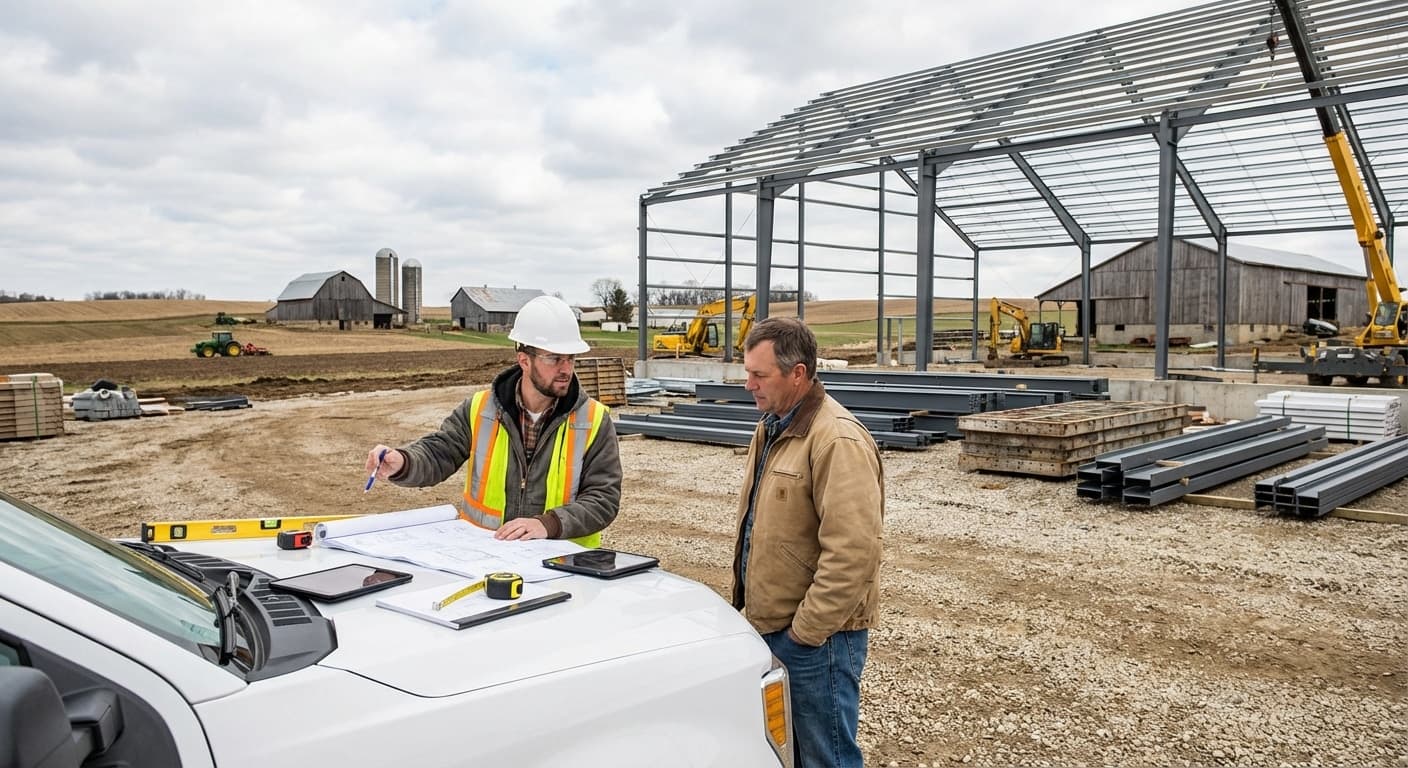

Before you sign with an agricultural building contractor, this Essentials-packed guide shows you how to lock in a partner who will protect every dollar and every day of your build: start by defining the real functional needs of your dairy, grain or equipment facility–then future-proof it 20% bigger to avoid six-figure rebuilds; insist on a true single-source firm that controls design, permits, steel procurement and all trades so one phone call ends finger-pointing and keeps crews on schedule; verify current state licensing, iron-clad insurance COIs that name you as additional insured, documented QA/QC plans and open-door third-party inspections so quality is engineered in, not inspected in later; demand transparent line-item pricing, national-steel buying power, realistic 20- to 30-year total-cost comparisons and warranty maps that spell out exactly what voids coverage; negotiate a balanced contract with milestone-driven payments, written change-order approval and tiered dispute resolution tied to your harvest and calving windows; and lock in post-construction victory with scheduled inspections, defect-tracking software and a named warranty manager so loose fasteners get fixed for pennies instead of rusted panels for thousands. Follow these steps and you will move from "low bid" roulette to a controlled, on-time, on-budget project backed by a contractor who stays accountable long after the last bolt is tightened.
Define Your Project Scope with a Full-Service Agricultural Building Contractor
Plan your agricultural building around specific operational needs first, then build 20% larger to accommodate the equipment and expansion you'll need within five years.
Define the exact building size, function, and future expansion plans
Start with function, not footprint. Your dairy barn needs milking stations and ventilation that actually works. Your grain storage needs temperature and humidity controls that protect your harvest. Get these requirements on paper first–square footage comes second. [1] Bring in professionals who know your specific farming operation before anyone draws a single line. Fix it on paper now, not with steel and concrete later. [1]
Here's what undersizing really costs you: that combine you're buying in three years won't fit through the door. That expansion you're planning means tearing out walls instead of just adding on. [2] Build 20% bigger than today's needs tell you to build. For livestock facilities, leave room for calving areas, an office, maybe a sales space. Think five years out, not five months. [2] The extra steel you buy today costs pennies compared to the structural rebuild you'll face tomorrow. Future-proofing isn't an expense–it's the best investment you'll make before the foundation gets poured. [2]
Match your agricultural needs to the contractor's full-service capabilities
Your livestock barn isn't just a big shed with doors. Neither is your grain facility or processing plant. Each one demands specific know-how that general contractors often lack. Dairy operations need milking parlor layouts and airflow that keeps cows healthy. Grain storage needs moisture control that saves your harvest. Machinery storage needs clear-span designs that fit your biggest equipment–combines, balers, whatever rolls on your farm. [1]
Don't let them show you their "agricultural portfolio." Make them show you dairy barns if you run dairy, grain facilities if you store grain, equipment buildings if you need
Confirm single-source solutions covering design, engineering, permitting, and construction
Single-source means one number to call, one team to manage, one company accountable for everything from design to final bolt. [5] No finger-pointing between your architect and builder when something doesn't fit. No waiting while your engineer and permit consultant sort out who dropped the ball. When problems pop up–and they will–they're solved inside one organization, not negotiated between three. [5]
This setup saves you money too. One contractor buying all the trades gets better pricing than you coordinating five different vendors. One schedule manager keeps crews moving without dead days between phases. [6] Ask for specifics: What do you handle directly? What gets subcontracted? How do you keep subs accountable? The contractor who runs permits and engineering through their own team beats the one who's waiting on outside consultants every time. Speed matters when you're racing weather or market windows. [6]
Validate Credentials and Quality Standards of Your Full-Service Agricultural Building Contractor
Verify your contractor's current state license, request a Certificate of Insurance showing general liability and workers' compensation coverage, and confirm additional insured endorsements before work begins.
Check licenses, insurance, and industry certifications for full-service agricultural building contractors
Before you evaluate a contractor's portfolio or pricing, confirm that their licensing is current and appropriate for your state.
Certified building contractors must pass state certification exams and demonstrate at least four years of experience or an equivalent combination of college and field work–and their financial stability gets verified through credit checks during the licensing process. [8] This matters because licensing boards impose these requirements to screen out contractors who lack both the technical knowledge and the financial backing to complete large-scale projects–exactly the kind of failure risk that becomes your problem mid-construction on an agricultural facility.Insurance verification goes beyond asking whether a contractor is covered.
Request a current Certificate of Insurance (COI) before work begins, since over 85% of general contractors and project owners require valid COIs as a baseline condition. [9] A complete COI should show general liability coverage, workers' compensation for all employees, and commercial auto coverage if their crews use vehicles on your property. [9] State licensing boards also require contractors to carry public liability, property damage, and workers' compensation insurance as a condition of holding an active license. [7] The two most common COI problems to watch for are inadequate coverage limits and missing additional insured endorsements–both of which can leave you exposed if a claim arises from work on your property. [9] Ask the contractor to name you as an additional insured on their policy, not just list you on the certificate, since only additional insured status gives you direct coverage rights if something goes wrong. [9] Also confirm that their policies won't expire before your project completes–many project owners require coverage extending 30 to 60 days beyond the final build date. [9]
Review quality assurance processes, third‑party inspections, and past project performance
Quality assurance (QA) and quality control (QC) serve different functions, and understanding the difference helps you ask better questions during contractor evaluation. QA is proactive–it establishes the processes and systems designed to prevent defects before work begins. QC is reactive–it catches defects through inspections and testing after work is done. [10] This distinction matters because a contractor who relies solely on reactive QC is managing problems after they've already cost you money.
The Egan Report found that 30% of all construction work involves rework, and poor quality can cause a 300% loss in crew productivity–with the Cost of Quality reaching 5-6% of a project's total budget when issues aren't caught early. [10] Ask any contractor you're considering to show you their written quality management plan, not just describe their inspection process. A plan that specifies how defects are prevented–through material verification, standardized procedures, and pre-work approvals–tells you more than a list of past projects.Third-party inspections fill a gap that internal QC cannot: they provide an independent, objective assessment with no stake in the project outcome. External inspectors evaluate based on facts and industry standards rather than relationships, which is exactly why their findings carry more weight in disputes. [11] They also bring specialized knowledge of sector-specific standards that internal teams may lack, and their post-inspection reports document both strengths and non-conformances with recommended corrective actions. [11] When vetting a contractor, ask directly whether they accommodate third-party inspections at structural milestones–foundation pour, framing, roofing, and systems installation.
A contractor who resists independent scrutiny is telling you something important about their confidence in their own work.Past project performance is the most concrete evidence of how a contractor will manage quality on your build. Ask for QC audit records and third-party inspection reports from comparable agricultural projects, not just client references who've been handpicked to speak positively. [11] What you're looking for specifically is how they handled non-conformances: whether corrective actions were documented, resolved within a defined timeframe, and verified through follow-up. A contractor with a clean record of third-party inspection results and documented corrective action histories demonstrates the process discipline that protects your investment across a multi-year build.
Evaluate communication plans, reporting frequency, and problem‑resolution procedures
Before committing to a contractor, ask them to produce a written communication plan–not describe one verbally. A plan worth trusting identifies every stakeholder involved in your project, lists the channels used for each type of information (site meetings, emails, project management platforms, daily logs), assigns named individuals responsible for communicating each type of update, and sets a fixed schedule for reporting events. [12] Without this structure, information gaps develop between trades and project phases, and you end up managing coordination work that the contractor should own. The plan should also specify how the team confirms that messages have been received and understood–verbal confirmation in site meetings, signatures on change orders, or responses logged in a central platform–since communication isn't complete until both parties have understood each other. [12]Reporting frequency is where contractor accountability becomes visible.
Ask specifically which reports you'll receive and at what intervals. Job cost reports show whether spending aligns with estimates; work-in-progress (WIP) reports tell you if the project is on budget and whether billing is tracking correctly against completion; and estimates-vs-actuals comparisons flag cost overruns before they compound. [13] A contractor who can't answer these questions with specifics–or who offers only informal verbal updates–is telling you their financial transparency ends at the contract signature. Construction management software that centralizes these reports in a single platform also gives you a verifiable record if a dispute arises later. [13]Problem-resolution procedures deserve the same scrutiny as pricing.
Most construction disputes trace back to vague contract language, payment delays, or miscommunication–and without a documented escalation process, minor disagreements turn into project-halting claims. [14] Before signing, confirm the contract includes a tiered dispute-resolution clause: informal negotiation first, followed by mediation if needed, and arbitration as a final step before litigation. [14] Mediation is particularly useful because it's voluntary and confidential, preserving the working relationship while giving both parties a neutral third party to facilitate resolution–and any agreement reached through mediation tends to hold because both sides helped craft it. [14] A contractor who can walk you through this process clearly, with specific examples of how they've resolved past disputes, demonstrates the process discipline that protects your project when something inevitably goes wrong.
Analyze Financial Transparency and Value from a Full-Service Agricultural Building Contractor
Demand a line-item breakdown from your contractor so you can identify hidden costs and accurately compare bids across competing quotes.
Request a detailed, itemized cost breakdown for steel structures from 30×40 barns to mega dairies
You'll see steel building quotes ranging from basic kits to full turnkey projects. Kit prices start at $24,000 for a 30×40 and reach $75,000 for a 50×100–that's $15-$20 per square foot for materials alone. Turnkey pricing runs $24-$43 per square foot, covering the kit, concrete slab, delivery, and construction. [15]
For dairy facilities, expect costs to swing 20% above or below average. [16] A competitive-looking quote might miss critical factors that surface later. What inflates your final bill isn't the steel–it's everything else:
- Roof pitch (steeper = more material)
- Frame gauge (12-gauge beats 14-gauge but costs more)
- Panel grade (26-gauge vs. 29-gauge)
- Insulation ($1.50-$3 per sq ft extra)
- Foundation type
- Enclosed vs. roof-only
Demand a line-item breakdown showing every variable separately–permits, delivery, local certifications, everything. [17] Bundled quotes hide where you can save money and make honest bid comparisons impossible. A contractor leveraging national buying power on agricultural steel buildings passes those savings directly to your bottom line.
Compare pricing structures, financing options, and lifecycle cost savings
Your pricing structure choice–kit, turnkey, or custom–sets how accurately you'll predict total costs. Pre-engineered steel buildings save you 20-30% over custom designs. [18] That matters when site prep, foundation, and systems already stretch your budget.
Look beyond upfront pricing. Steel needs just 1-3% of building value yearly for maintenance. Wood? You're looking at weatherproofing, pest control, roof repairs, and repainting that never stops. [18] Steel shrugs off moisture, pests, and fire–dropping your insurance premiums and eliminating surprise repair bills. [19]
For financing, you've got options:
- Agricultural loans (short, intermediate, or long-term)
- Lines of credit for seasonal cash flow
- Co-op financing programs
Match the structure to your operation's rhythm. [19]
The real financial picture spans 20-30 years. Calculate what you'll spend on operations, insurance, and maintenance–not just the signing price. Steel's minimal upkeep and energy efficiency from proper insulation beat wood's lower sticker price every time. [20] National buying power makes that long-term value even stronger.
Understand warranties, maintenance programs, and long‑term service commitments
You're not getting one warranty–you're getting a stack of them. Structural warranties run about 20 years. Panel and paint warranties now hit 30-40 years thanks to better UV coatings and corrosion protection. [21]
Each warranty covers specific failures:
- Rust-through: Only when corrosion punches completely through steel
- Paint: Fading and chalking
- Workmanship: Manufacturer's crew only–third-party installers void it
Get each warranty document separately. [22] Make your contractor map exactly what each one covers. Bundled warranty language hides gaps that surface when you need coverage most.What voids your warranty matters more than what it covers. Skip documented maintenance–miss an inspection, ignore a loose fastener, let sealants deteriorate–and watch your claim get denied years later. [21] Cut into panels, add unapproved features, hire outside repair crews? You just voided workmanship coverage. [22]
Get a written maintenance schedule tied directly to warranty requirements. Not general suggestions–specific requirements. That document saves your claim if disputes arise. Construction warranty frameworks call this pre-construction alignment essential. [23] Smart contractors provide it without you asking.Steel maintenance runs 1-3% of building value yearly. Every maintenance dollar saves you $5-10 in avoided repairs and longer building life. [21]
One loose fastener becomes water damage becomes wall rust. Catch it early? Pennies to fix. Miss it? Thousands in panel replacement. [21]
Ask about post-construction support structure:
- Scheduled inspection programs?
- Warranty claim documentation?
- Defect tracking through resolution?
You want a contractor with formal warranty management–recording defects, setting timelines, verifying fixes. [23] The discipline they show after handover matches what they deliver during construction. That's the difference between a vendor and a partner who protects your investment.
Finalize Agreements and Ongoing Support with Your Full-Service Agricultural Building Contractor
Push back on standard contract language–most terms are negotiable, and five critical elements deserve your focused attention before signing.
Negotiate contract terms that reflect service excellence and clear expectations
Most contractors present their standard contract language as non-negotiable. It rarely is. Simply pushing back opens most terms for discussion. [25]
Five critical terms require your attention on any agricultural build:
- A scope of work naming every deliverable, material, and service the contractor owns
- Contract time with specific milestone dates, not just a completion date
- Payment schedule tied to verified progress, not calendar intervals
- Written modification process requiring approval before changed work proceeds
- Dispute resolution that escalates from negotiation to mediation before arbitration [24]
The change order clause deserves extra scrutiny. Scope changes are routine on agricultural projects. Without written approval requirements before modified work proceeds, verbal agreements become disputes once billing starts. [25]
Risk allocation matters more than most farmers realize. When contractors absorb all risk without compensation, they protect margins through constant change orders. That slows your project. Name this dynamic during negotiation–ask what happens to their pace when risk falls entirely on them. This conversation produces more balanced terms than trading redlined documents. [26]
On pricing, start negotiations with room to move down. Once you accept a number, you can't recover ground. [25] If site conditions or permit timing prevent a formal contract before work starts, draft a one-page Memorandum of Understanding. It takes an hour to create and provides written protection while the full agreement is finalized. [25]
Set realistic milestones, delivery schedules, and contingency plans
Start timeline negotiations by asking your contractor to identify the critical path–the longest sequence of dependent tasks that sets your earliest completion date. Any delay on that path pushes back handover, no matter how efficiently other work proceeds. [27]
Agricultural projects face unique scheduling constraints. Planting and harvest seasons pause work. Peak farm activity conflicts with site access. Your contractor must map milestone dates against your operational calendar, not just their construction sequence. The schedule should reflect when your farm can accommodate disruption–not when the contractor prefers to work. [1]
Look-ahead schedules give you the clearest view of project health. Updated weekly and covering the next two to six weeks, they show which tasks are resourced and ready. You'll spot delays before they compound. Ask contractors to share these schedules as part of regular reporting. Watch for resource gaps–missing framing crews, delayed steel deliveries. A contractor who can't produce a look-ahead schedule manages reactively. You'll pay for that. [27]
Demand a written contingency plan, not verbal promises. The document should name specific scenarios, assign responsible parties, and define exact response actions. [28] Agricultural construction faces predictable disruptions:
- Weather delays for foundation pours
- Supply chain disruptions for steel delivery
- Key subcontractors becoming unavailable
Your contractor's written plan should address these scenarios with named contacts, response timelines, and escalation paths. A conversation won't hold when problems surface at week fourteen of a twenty-week build. On an agricultural facility, delays that bleed into calving or harvest affect your entire operation, not just construction. [28]
Establish post‑construction support, warranty service, and continuous problem‑solving
Post-construction support determines whether your investment holds strong or quietly erodes. After handover, your contractor's focus shifts to warranty management, defect resolution, maintenance planning, and troubleshooting early operational issues. [29] Problems caught and fixed early cost far less than defects discovered through failure. That's why proactive post-construction services cut ownership costs over time. [29]
Warranty management for agricultural facilities involves multiple moving parts. You're dealing with guarantees from the contractor, subcontractors, and material manufacturers–each with different coverage windows, triggers, and exclusions. [23] What makes a warranty program work is systematic defect tracking. Every issue needs:
- Clear description and photos
- Responsible contractor identified
- Proposed fix documented
- Resolution timeline defined [30]
Ask contractors about their defect tracking system before signing. A single-source contractor who captures issues at handover and follows them to verified closure protects your investment better than one who relies on verbal confirmations. [23]
Continuous problem-solving requires structure, not good intentions. Look for contractors who schedule regular post-occupancy inspections instead of waiting for your call. [23] On agricultural facilities, ventilation defects or drainage problems can harm livestock or spoil crops within days. The difference between proactive check-ins and reactive responses shows up in operational losses, not just repair bills. [29]
Before signing, make contractors specify:
- Post-construction inspection schedule
- Named warranty claim handler on their team
- Documentation from past projects showing how defects were tracked and resolved [30]
These details reveal whether they'll stand behind their work when it matters most.
Ready to Build with Confidence?
I don't see the actual section content provided in your message–only the heading "Ready to Build with Confidence?" appears. Could you share the full section content so I can generate an accurate, derived callout sentence?
- Start with function, not footprint; size for 5-year needs plus 20% buffer.
- Verify current state license, COI, and QA/QC plan before hiring.
- Demand line-item quotes to expose hidden cost drivers like insulation or gauge.
- Name you as additional insured and require 30-60 day post-completion coverage.
- Fix scope, milestones, change-order rules, and dispute tiers in writing.
- Use weekly look-ahead schedules tied to your planting/harvest windows.
- Require written warranty and defect-tracking with scheduled post-handover inspections.
- https://agrisysintl.com/key-considerations-when-planning-an-agricultural-construction-project/
- https://www.farmprogress.com/farm-business/consider-these-tips-when-planning-a-farm-building-project
- https://extension.missouri.edu/publications/g1005
- https://www.cfisherconstruction.com/what-you-need-to-know-about-agricultural-commercial-construction/
- https://www.wolgast.com/blog/top-benefits-of-ssr-construction
- https://www.elkayinteriorsystems.com/blog/the-benefits-of-a-single-source-general-contractor
- https://www.myfloridalicense.com/CheckListDetail.asp?SID=&xactCode=1047&clientCode=0603&XACT_DEFN_ID=18429
- https://www.myfloridalicense.com/CheckListDetail.asp?SID=&xactCode=1042&clientCode=0602&XACT_DEFN_ID=18293
- https://contractorschoiceagency.com/blog/certificate-of-insurance-requirements-for-contractors
- https://goaudits.com/blog/construction-quality-control-assurance/
- https://tetrainspection.com/3rd-party-inspection/
- https://www.procore.com/library/construction-communication
- https://www.deltek.com/en/construction/construction-reporting
- https://www.abchawaii.org/conflict-resolution-in-construction/
- https://www.buildingsguide.com/metal-building-prices/?srsltid=AfmBOorwiSmqSpx8Kqu43-GRwOtvpa9jMYC4vlCx2862eP0RvZLEZWy_
- https://lactanet.ca/en/dairy-barn-construction-costs-and-impacts/
- https://www.carportsadvisor.com/metal-farm-building-prices?srsltid=AfmBOoo3fJEvvacwzGX-jU5g5OzI5CaV7v_IAbotCNtPcJRRvmr_6fvu
- https://www.steelcobuildings.com/steel-agricultural-buildings-prices/
- https://californiaallsteel.com/steel-agricultural-buildings-prices-benefits-more/
- https://armstrongsteel.com/blog/cost-effective-metal-buildings-smart-choice-for-farmers
- https://steelcommandercorp.com/warranty-maintenance-upkeep-how-ongoing-care-impacts-lifetime-cost/
- https://garagebuildings.com/steel-building-warranties-explained-whats-really-covered-in-2025-2026
- https://blog.constructiononline.com/the-ultimate-guide-to-construction-warranty-management
- https://learn.aiacontracts.com/articles/5-key-terms-that-should-be-in-every-construction-contract/
- https://www.levelset.com/blog/construction-contract-negotiation/
- https://themakergroup.com/construction-contract-negotiation-strategies/
- https://www.procore.com/library/construction-scheduling
- https://www.horizonfc.com/about/newsroom/farm-contingency-plan-basics
- https://darbyconstructionservices.com/post-construction-support-ensuring-building-performance-and-client-satisfaction/
- https://safetyculture.com/library/construction/warranty-defects