
Prefabricated steel riding arena kits deliver a fire-resistant, clear-span building that slashes construction time by a third and lifetime maintenance to near zero, all for an average $150,000 that can slide from $30,000 for a modest 60 x 120 ft cover to $3.5 million for a 200 x 400 ft commercial showpiece, with every $25-$35 per square foot of materials matched by similar labor costs and site work that can add 10-20% more. Readers learn exactly how factory-cut I-beam frames, pre-painted panels, and labeled bolts create an expandable, column-free arena that meets local snow, wind, and seismic codes while qualifying for insurance discounts and 40-year structural warranties; how size, coatings, doors, insulation, and regional steel markets move prices; and why choosing standard 80 x 200 ft dimensions, locking in quotes early, and scheduling winter builds can trim 15-30% off custom construction, letting owners ride sooner, board more horses, and recoup up to 70% of the investment at resale–all critical budgeting intel for anyone turning equestrian dreams into profitable, low-maintenance reality.
Understanding Prefabricated Steel Riding Arena Kits
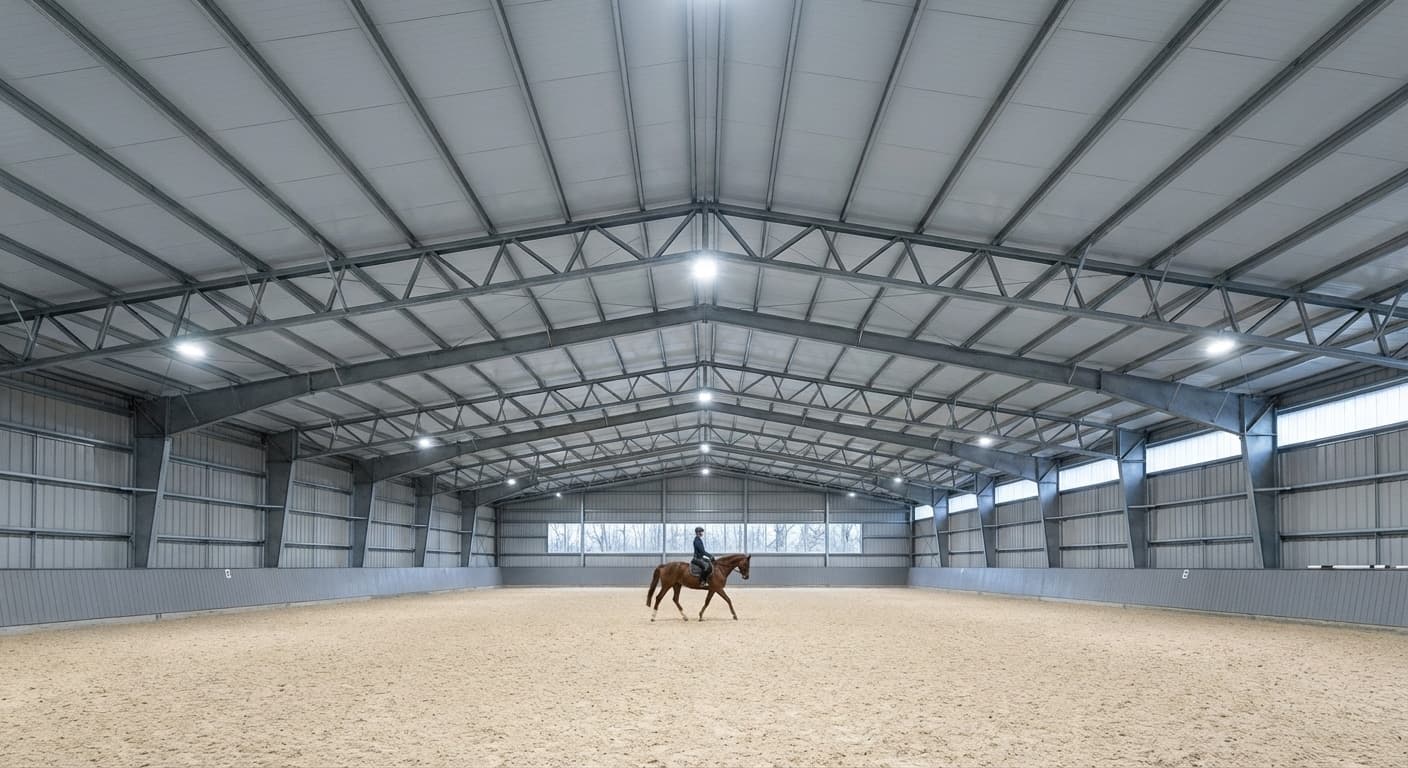
Bolt-together steel kits arrive complete with precision-cut components, engineered drawings, and clear-span design that eliminates posts from your riding space.
What they are and how they work
You're looking at bolt-together steel structures built for horses and riders. Your kit arrives complete–I-beam frames, secondary supports, fasteners, pre-painted panels. Everything precision-cut at the factory [1]. No guesswork, no field modifications.
You pick your style: fully enclosed for year-round comfort or open-sided for natural ventilation. Both give you column-free space for safe riding–we'll cover exact dimensions in later sections [1].
Here's what matters: You're operational in weeks, not months. Most owners bring in professional installers, though DIY is possible with the detailed plans included [1]. Every component meets your local codes for wind, snow, and seismic loads. The modular design means you can expand later by removing an end wall and adding bays–simple as that [1].
Core components included in every kit
Your kit includes everything structural. Start with the backbone: rigid I-beam frames that create the clear-span design. No posts in your riding space [4].
Secondary components connect it all–roof purlins, wall girts, the works [4]. Your panels come pre-painted in your color choice. Every bolt, screw, and connector arrives sorted and labeled for the exact spot it goes [4].
You also get stamped engineer drawings that satisfy your building department [4]. Many kits feature portal frames and rigid end-walls that skip the diagonal bracing–meaning more usable space for you and your horses [4].
Key advantages over traditional construction
Steel beats wood where it counts. No rot. No termites. No warping. Your arena handles whatever weather throws at it with minimal upkeep [5].
Yes, you'll invest more upfront. But you'll save that back through lower maintenance and insurance discounts–we'll detail the exact savings in our cost comparison section [5] [6].
Speed? Cut your build time by 33%. These buildings go together like giant erector sets [6]. The real game-changer is the clear-span capability–detailed dimensions covered in our sizing section–that gives you unobstructed riding space wood can't match [7].
Fire safety matters when you're storing hay. Steel doesn't burn [5]. It's also fully recyclable and, with proper insulation, keeps your energy costs down [7]. For equestrian
Why the cost of prefabricated steel riding arena kits matters
Cost knowledge drives smart decisions. You're looking at $150,000 on average, though prices run from $30,000 to over half a million depending on what you need [8]. That's serious money–and it affects everything from your loan application to your lesson pricing.
Here's the payoff: Steel lasts 40 years with virtually no maintenance [9]. No annual treatments. No rot repairs. No pest control contracts. Insurance companies know this too–they'll cut your premiums for fire-resistant, weather-tough steel construction [9].
With prefab kits, you control costs through standardized pricing and faster build times [8]. You know your numbers upfront. You plan your financing. You set your boarding rates accordingly. The sections ahead break down every cost factor so you can budget accurately and build profitably.
Factors Influencing the Cost of Prefabricated Steel Riding Arena Kits
Steel arenas expand easily by removing end walls and adding bays, letting your facility grow with your business without rebuilding from scratch.
Size, span, and square‑footage considerations
Your arena size determines your cost–and your capabilities. Bigger arenas cost more upfront but deliver better value per square foot [10].
The minimum you'll want: 60 feet wide by 120 feet long with 16-foot clearance [11]. That's enough space for safe training. Commercial facilities? You're looking at 100×200 feet or larger to handle events and multiple riders [12].
Here's what makes steel special: clear-span design up to 200 feet wide with zero interior columns [10]. Your horses get uninterrupted space for patterns, jumping courses, and safe movement. Wood can't touch that.
The numbers: An 80'x200' arena (16,000 square feet) runs $400,000-$560,000 for materials alone. Add $25-$35 per square foot for labor [11]. Smart buyers choose standard sizes–80×100, 100×200, 200×400–because manufacturers optimize these dimensions for cost efficiency [10].
Plan for growth. Steel arenas expand easily. Remove the end wall, pour new footings, add another bay. Your building grows with your business [10].
Steel grade, coatings, and finish options
Your steel choices today determine your maintenance costs tomorrow.
The foundation: commercial-grade steel I-beams that handle your local snow and wind loads while keeping that clear-span design column-free [10]. These frames already come with your kit–as discussed in "Core components included in every kit."
Your finish options affect both price and performance. Standard kits include pre-painted metal panels in multiple colors [10]. Want something fancier? Decorative paneling looks great but adds to your budget [13].
For humid environments, invest in galvanized or zinc-aluminum coated steel. Yes, you'll pay 15-25% more upfront. You'll save that back in reduced maintenance [13].
Smart protection: Add kickboards 4-8 feet up your walls. Horses kick. These boards take the hit instead of your walls. Cost: $15-$25 per linear foot [13].
Look for 20+ year structural warranties. Manufacturers backing their steel that long use superior materials and coatings. The higher price pays for itself through decades of service [10].
Site preparation, foundation, and utility requirements
Site prep can make or break your budget–it's 10-20% of your total cost.
Plan on $10,000-$50,000 for grading, drainage, and soil stabilization [12]. Your steel needs a level, well-drained base. Skip this step and you'll pay for it later.
Foundation requirements:
- Concrete piers or continuous foundation based on your soil
- $5-$15 per square foot added to your budget
- Larger arenas need engineered foundations for heavier loads [14]
Utilities add up fast:
- Electrical: 200-400 amp service minimum for proper lighting
- Plumbing: $3,000-$15,000 for restrooms and wash bays
- HVAC: $8,000-$40,000 for year-round comfort [14]
Your location matters. Snow country? You need stronger foundations for roof loads [13]. Your local codes might require stormwater management and erosion control [12]. Remote property? Budget extra for delivery and equipment access [13].
Don't forget permits: several weeks to months of waiting, $1,000-$10,000 in fees [14]. Start this process early.
Custom features such as doors, windows, insulation, and accessories
Custom features transform a basic arena into a professional facility. Budget 15-25% of your total project for these upgrades [16].
Doors determine daily functionality:
- Standard sliding doors: economical choice
- Hydraulic doors: save space, seal better, cost more
- Equipment door (12-16 feet): $1,000-$8,000
- Personnel doors (3-4 feet): included in most kits [12]
Windows pay for themselves. $200-$500 per opening, but natural light cuts your electric bills and keeps riders happy [12].
Insulation is non-negotiable for year-round use. It stops condensation that damages steel and keeps temperatures comfortable [15]. Your
Pricing by Arena Size and Configuration
A 16,000-square-foot arena with column-free spans costs $800,000-$1.2 million total, returning 50-70% of your investment at property sale.
Small private arenas (up to 150 ft²) – typical price range
Your small private arena starts at 60 by 120 feet–that's 7,200 square feet of training space ready for daily use [14].
You'll invest between $40 and $125 per square foot for quality
Mid‑size arenas (150‑300 ft²) – cost per square foot
You're looking at 15,000-30,000 square feet for a serious commercial operation. Materials run $25-$35 per square foot, with labor matching that cost [11]. Take an 80×200 arena–16,000 square feet of prime training space. Materials alone: $400,000-$560,000. Total project with everything included: $800,000-$1.2 million [11].
Here's what that investment buys you: column-free spans up to 200 feet wide. No posts. No obstacles. Just clear riding space for multiple horses working simultaneously [15]. Your larger arena demands better ventilation–critical for air quality when horses and riders push hard [15].
The numbers work in your favor long-term. Steel buildings hold value, returning 50-70% at property sale [17]. Bigger arenas cost less per square foot–economy of scale working for you [17]. Planning year-round operation? Add $5-$7 per square foot for quality insulation [15].
Watch those quotes carefully. Many leave out the essentials covered in our site preparation section [17]. Get the complete picture before you commit.
Large commercial/event arenas (300‑600 ft²+) – budgeting tips
Big arenas mean big numbers. Your 300-600+ square foot commercial facility runs $25-$35 per square foot for materials, same again for labor [11]. Total investment: $1.5-3.5 million for the complete package. Strategic thinking keeps that number manageable.
Put your money where it matters. The clear-span design costs more upfront but delivers the open sightlines and movement patterns events demand [18]. No columns blocking views. No posts limiting course design. Build for expansion from day one–steel lets you remove end walls and add bays when business grows [19].
Foundation work takes 10-20% of your budget. Site prep alone runs $50,000-150,000 at this scale. Smart operators phase the project. Get your structure up and generating revenue, then add the premium features [11].
Location drives costs through permits and site requirements–know your local codes [11]. Demand complete engineering packages with stamped drawings for your specific wind, snow, and seismic loads [18]. Stick to standard dimensions when possible–custom sizes add unnecessary expense [19].
Lock in steel prices early or budget 5-10% contingency. Markets move. Your project shouldn't wait [11].
2025‑2026 cost‑per‑square‑foot benchmarks for prefabricated kits
Current pricing follows clear patterns you can plan around. Open-sided covered arenas: $18-$30 per square foot. Fully enclosed structures: $40-$65 per square foot for materials and standard features [21].
Real numbers for real projects: A basic 60×80 covered arena starts at $28,800. A premium 100×200 enclosed facility exceeds $240,000 [21]. That popular 80×200 configuration? Materials run $25-$35 per square foot–$400,000-$560,000 total. Add matching labor costs [11].
Your location matters. Northern states pay 15-25% more for snow-load engineering. Southeast? You might save 5-10% off national averages [21]. Time your build right–November through February brings 10-15% discounts from hungry contractors and stable steel prices [21].
Watch those advertised prices. Most leave out 40-80% of your actual costs–the site work, foundations, electrical, doors, and footing materials detailed earlier [21]. Global steel markets drive pricing, along with your location and design complexity [20].
Protect your budget. Lock in steel prices during quoting–5-10% market swings hurt when you're buying by the ton [20]. Phase your construction if needed. Get riding sooner, upgrade later [21].
Comparing Prefab Kits to Fully Custom Steel Arenas
Save 15-30% by choosing a prefab steel arena kit, get riding 33% sooner, and recover your investment through lower maintenance and insurance costs over the building's lifetime.
Up‑front investment comparison
You'll save 15-30% choosing a prefabricated steel arena kit over custom construction–that's real money back in your pocket [22]. Yes, the average arena runs about $150,000, but your actual cost lands anywhere from $30,000 to half a million based on what you need [22]. Here's why prefab saves you money: standardized manufacturing cuts production costs, faster assembly reduces labor hours, and simplified designs eliminate complex engineering fees [22].
Custom builds hit your budget harder–specialized crews, longer timelines, and those "unique features" can tack on $50,000-$100,000 for commercial facilities [15]. Your material choices matter too. Basic steel frames with metal roofing keep costs down, while custom brick walls and engineered lighting systems push prices up fast [12].
Bottom line: prefab gets you riding sooner for less money.
Lifecycle maintenance and operating cost savings
Your steel arena pays for itself through lower operating costs–it's that simple. Forget the rot, pests, and warping that eat up wood arena budgets. Steel needs just basic inspections and occasional touch-up paint over its 30-40 year lifespan [5]. Your insurance company knows steel doesn't burn, so expect lower premiums–especially important when you're storing hay and bedding [5].
Add proper insulation and you'll cut heating and cooling bills year-round. Your arena becomes a sealed envelope that holds heat in winter and keeps it out in summer [13]. Steel's naturally anti-fungal properties mean no mold or mildew issues that threaten horse health [23]. Add it up: reduced maintenance, lower insurance, energy savings, and no replacement costs.
Those savings often cover your entire initial investment over the building's lifetime [5]. That's smart business, not just smart building.
Lead time, installation speed, and labor cost differences
You'll be riding 33% sooner with a prefab kit–that's months, not seasons, from order to first ride. Your kit arrives in weeks, pre-cut and ready to bolt together, while custom builds drag on as fabricators create each specialized piece [24]. Labor costs tell the same story: $5-$10 per square foot for prefab assembly versus premium rates for custom construction crews [25]. Why?
Your prefab components fit together like a giant erector set–no on-site cutting, drilling, or head-scratching over custom connections [24]. Standard connections mean standard labor rates and predictable timelines. For commercial facilities, faster construction means faster revenue. For private owners, it means less disruption to your property and routine [24].
When you need your arena operational fast, prefab delivers. It's why companies like
When a fully custom design is justified
Sometimes you need custom–let's be honest about when that makes sense. Your property sits on a steep slope or odd-shaped lot? Custom might be your only option. Running a high-profile competition venue where architectural wow-factor drives ticket sales? Custom delivers that unique look [26]. Planning a complex expansion in phases over several years? Custom design accommodates that master plan better than modular kits [5].
But here's the reality: most riding needs fit perfectly in prefab dimensions. Standard sizes handle dressage, jumping, barrel racing, and general training just fine. Unless you're building for Olympic-level competitions or dealing with impossible site constraints, prefab delivers everything you need at better value [26]. Even high-end facilities find that prefab structures accept premium finishes, advanced lighting, and climate control systems without going full custom. Ask yourself: do you need a one-of-a-kind architectural statement, or do you need a solid, functional arena that gets you riding sooner for less money? For 90% of owners, that answer points straight to prefab.
- Prefab steel arena kits cost $30k-$500k, averaging $150k for standard builds.
- 80×200 arenas run $400k-$560k materials plus equal labor, totaling $800k-$1.2M.
- Clear-span steel up to 200 ft wide gives unobstructed riding space wood can't match.
- Prefab cuts 15-30% vs custom builds and slashes construction time by 33%.
- Steel arenas last 40 years with minimal upkeep and earn insurance discounts.
- https://www.buildingsguide.com/metal-building-kits/riding-arenas/?srsltid=AfmBOopvaNAoKbQuP1GmwxPZeqySvSZkLYYIeOCtL_BvYvpSAOuQjCxN
- https://gensteel.com/recommended-use/riding-arena/
- https://titansteelstructures.com/100-x-200-steel-indoor-and-outdoor-riding-arena/
- https://www.alliedbuildings.com/equestrian-buildings/
- https://www.uspatriotsteel.com/blog/steel-vs-wood-riding-arenas/
- https://www.rhinobldg.com/blog/why-ranchers-love-steel-barns-and-riding-arenas
- https://www.metalbuildingoutlet.com/equestrian-buildings/
- https://www.vikingsteelstructures.com/blog/comparing-metal-riding-arena-prices-prefab-vs-custom-built-structures?srsltid=AfmBOop045xUraeEB0rx1Yo97nMQCHRFqr9nb7ZXvMLgKjhQoqplMQGl
- https://mavericksteelbuildings.com/11-benefits-of-buying-prefab-steel-building/
- https://gensteel.com/steel-building-kits/riding-arenas/100×200-riding-arena/
- https://titansteelstructures.com/ag-and-farm-buildings/steel-riding-arena-prices-cost-estimates-and-considerations/
- https://www.uspatriotsteel.com/blog/how-much-does-it-cost-to-build-an-indoor-riding-arena/
- https://reichconstructionllc.com/cost-of-pre-engineered-steel-indoor-horse-riding-arena/
- https://www.angi.com/articles/indoor-riding-arena-cost.htm
- https://www.alliedbuildings.com/indoor-horse-riding-arena-cost/
- https://www.vikingsteelstructures.com/blog/comparing-metal-riding-arena-prices-prefab-vs-custom-built-structures?srsltid=AfmBOormq5m-uygeDh-1cJ5SM2Xo4DTFXY1VgPw6lw77JE0HvuENXgQ8
- https://homeguide.com/costs/indoor-riding-arena-cost
- https://trusteelbuildings.com/steel-buildings/warehouse/300×600/
- https://www.buildingsguide.com/metal-building-kits/riding-arenas/?srsltid=AfmBOooGloIr5L_yk6PbxSRjS5r1E9Y6DrctytQjx1UCsKEZUiWH350i
- https://americansteelinc.com/blog/steel-building-costs-prices-guide/
- https://www.metal-buildings.org/metal-riding-arena/
- https://www.vikingsteelstructures.com/blog/comparing-metal-riding-arena-prices-prefab-vs-custom-built-structures?srsltid=AfmBOoofpa55_oLMQd_vLoLf9t5c8iz8LFhVUGSBT_7-9e1GnEOhFI1P
- https://www.vikingsteelstructures.com/blog/comparing-metal-riding-arena-prices-prefab-vs-custom-built-structures?srsltid=AfmBOor-kDeRU3IvSO1JIiKGfWhVoIb202GAhUc-94MeQVp484lRgAD9
- https://www.vikingsteelstructures.com/blog/comparing-metal-riding-arena-prices-prefab-vs-custom-built-structures?srsltid=AfmBOopmH8hSapQmPQ7kwiRxY6D8rkmC1zlpzglJIuVUWzi-Mw9DGlKy
- https://steelerectionaz.com/a-cost-comparison-between-erection-only-and-custom-build-steel-building-projects/
- https://www.vikingsteelstructures.com/blog/plan-a-perfect-equestrian-arena-with-prefab-metal-building?srsltid=AfmBOopLQVjjpPpPn10rhzLZGrbo6u-qxj9KBaHi4txhd9g8Uoh8ys3o