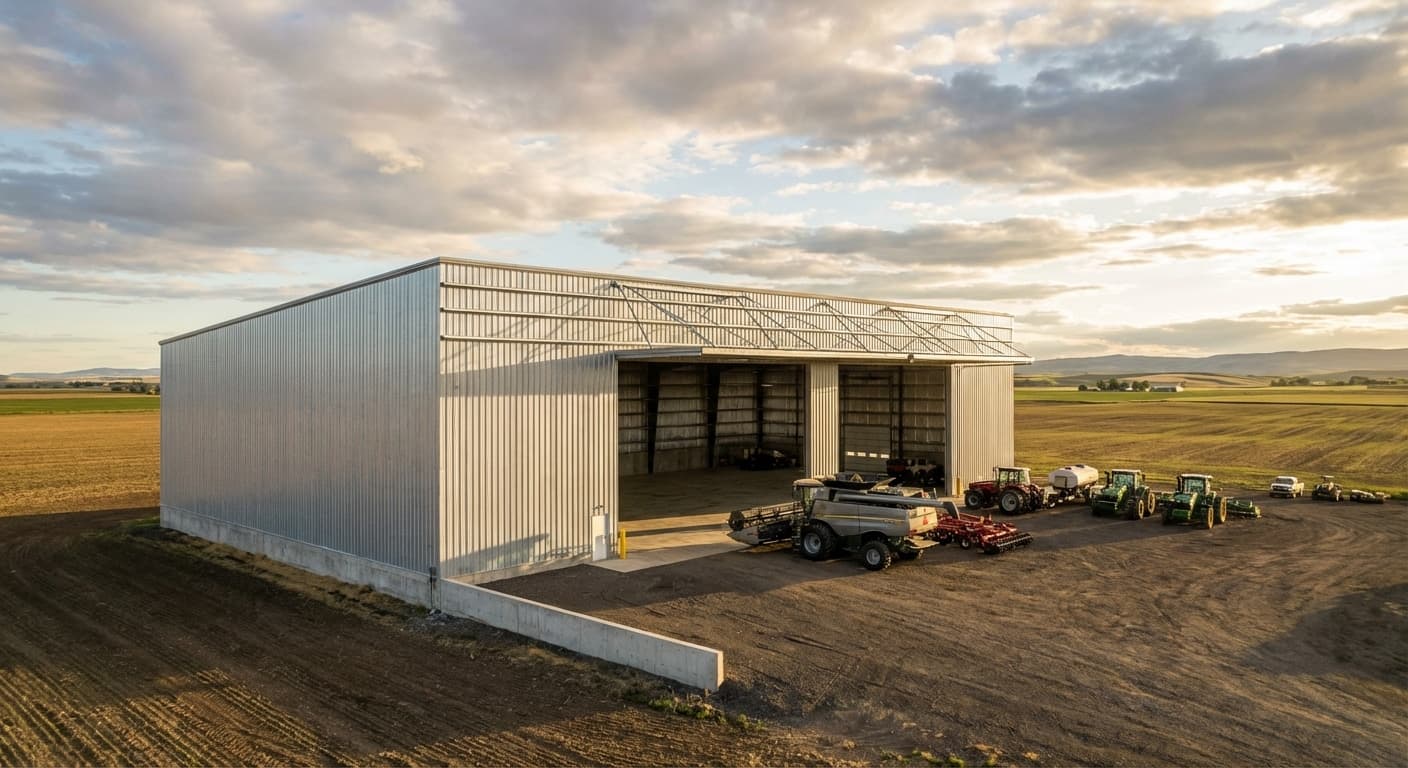

Steel agricultural buildings are rapidly replacing traditional barns because they deliver a rare triple win: they slash lifetime costs, shrug off extreme weather, and adapt as your operation changes. Readers will discover how pre-engineered steel cuts upfront construction spending by up to 30 % compared with wood or concrete, then keeps saving every year through near-zero maintenance, 15-30 % lower insurance premiums, and energy-smart upgrades like solar-ready roofs and automated ventilation. The article shows why galvanized steel outlasts wood by decades, resists fire, pests, and corrosion, and meets local wind, snow, and seismic codes without constant repairs, while clear-span interiors up to 300 ft wide let farmers reconfigure space for equipment, livestock, or storage in weeks, not months. Real-world examples and financing strategies– from ag-specific loans to green-building tax credits–demonstrate how producers can turn a steel structure into a cash-flow-positive asset that shortens construction timelines, boosts biosecurity, and supports sustainable farming with recycled materials and rainwater-harvesting roofs.
Why Steel is Transforming Modern Agriculture
Steel buildings eliminate the constant maintenance that drains your budget while protecting your operation against storms that traditional structures can't withstand.
Rising demand for resilient farm structures
Weather patterns keep getting worse. You know it, your neighbors know it–one bad storm can wreck a traditional barn and put you months behind schedule. That's why farms everywhere are switching to steel [1]. You need buildings that stand up to whatever nature throws at you, hold your equipment without constant repairs, and adapt as your operation grows [1].
Climate unpredictability hits agricultural operations hard. Traditional structures fail when you need them most [2]. Yes, steel costs more upfront–but you'll save that back in reduced maintenance and longer building life. When margins are tight, you need infrastructure that pays for itself [3]. Today's farming demands flexibility. Your building should handle equipment storage today and livestock tomorrow without major reconstruction [3].
Shift from traditional barns to engineered steel solutions
Your grandfather's wooden barn served its purpose. But farming isn't what it used to be–it's a business, and your buildings need to work as hard as you do [5]. Wood demands constant attention: repainting, pest treatments, rot repair. Those costs add up fast, draining money you need elsewhere [6].
Steel solves problems wood can't touch. It won't burn, rot, or feed termites. It stands up to storms that flatten traditional structures [4]. This isn't just about durability–it's about protecting your investment and cutting long-term costs [6].
Pre-engineered steel adapts to your needs. Store equipment this year, house livestock next year–no reconstruction required [4]. As your operation changes, your building changes with you. That flexibility keeps your infrastructure investment working, not sitting idle.
Key benefits of steel agricultural buildings driving adoption
Here's what makes steel the smart choice.
Clear spans up to 300 feet–no posts blocking your combine's path [7].
No rafters for birds to nest in, less mess to clean [7].
Alignment with sustainable farming goals
Want to farm sustainably? Steel helps. Unlike wood that depletes forests, steel contains up to 89% recycled content–and recycles again when you're done [9]. That's circular economics working for you.
Metal roofs collect rainwater efficiently. Set up gutters and tanks, and you've got irrigation water ready when you need it [10]. Construction disturbs less soil than traditional building methods. Your land stays productive [10].
Properly insulated steel buildings cut heating and cooling costs while keeping livestock comfortable [10]. Mount solar panels directly on steel roofing–generate your own power [9]. When extreme weather hits, you keep operating while others rebuild [10].
Steel buildings check every box: resource efficiency, adaptability, climate resilience. They're infrastructure that works with your sustainable farming goals, not against them.
Unmatched Durability and Longevity
Your steel building handles 150+ mph winds, heavy snow loads, earthquakes, and floods without the pest damage and constant repairs that plague traditional barns.
Weather and climate resistance across regions
Your steel building faces different challenges depending on where you farm. That's why every structure gets engineered for your specific region.
In hurricane country? Your building handles 150+ mph winds with reinforced connections and aerodynamic roof designs that prevent uplift [11]. Tornado alley? Continuous load paths keep everything connected when lateral forces hit, while wind-rated doors and secure fasteners prevent collapse [12].
Heavy snow loads crush traditional barns, but your steel building carries the weight. Calculated load capacities and proper roof slopes shed snow before it becomes a problem [12]. In wildfire zones, steel won't ignite or spread flames–it often exceeds local fire codes without trying [12].
Flood-prone areas need elevated foundations and materials that won't rot after water exposure. Desert operations benefit from reflective coatings that beat UV damage and extreme heat without warping [12]. Even earthquake zones work–steel bends without breaking, with lateral bracing that distributes forces throughout the frame [12].
Every design accounts for your local stressors: wind uplift, snow loads, seismic activity, thermal expansion. You get a building that meets or exceeds local codes while standing up to whatever nature throws at it [12].
Pest, fire, and corrosion protection
As covered in our opening section, steel naturally defeats the three enemies of farm buildings: pests, fire, and corrosion.
Termites, carpenter ants, rodents–they can't penetrate steel framing. No more pest control bills. No more contaminated grain [9]. Birds and bats that nest in wooden rafters? Not in your smooth steel structure [13].
Fire resistance comes standard. Steel won't ignite, won't spread flames, won't collapse in minutes like wood. Your equipment, livestock, and harvest stay protected–and you get extra time for emergency response [14].
Galvanized coatings handle decades of exposure to chemicals, animal waste, and moisture without breaking down [13]. You skip the constant repairs that drain farm budgets and redirect that money where it belongs–growing your operation [14].
Extended lifespan with warranty insights
Your steel building lasts 40-70 years–double what you'd get from wood [15]. No rot. No warping. No cracks from moisture and temperature swings [16].
The key? Choose suppliers who back their claims with real warranties. Look for coverage on structural integrity, panel finishes, and corrosion resistance. That's how you know they trust their materials [15].
Low‑maintenance design for farm efficiency
Stop wasting time on building maintenance. Steel eliminates the constant upkeep cycle that steals hours from your farming operation.
No repainting. No pest treatments. No structural repairs. Just occasional cleaning and quick inspections [14]. As detailed in our cost analysis section, this saves you $3,000-$5,000 annually compared to traditional structures.
Galvanized finishes shrug off decades of moisture, chemicals, and animal waste [17]. Those labor hours you used to spend on repairs? Now they're making you money in the field [17].
For livestock operations, smooth steel surfaces speed cleaning and improve biosecurity–no porous wood harboring bacteria [14]. Heavy equipment storage? Steel won't sag under the load like wood does [18].
Your workflow stays uninterrupted. No emptying buildings for repairs. No relocating equipment. No gradual decline in performance as the building ages [14]. Steel maintains optimal conditions year after year without extra energy costs [18].
Cost Efficiency and Long‑Term ROI
A 10,000-square-foot steel agricultural building costs $120,000-$250,000 compared to $350,000-$700,000 for wood or concrete alternatives.
Initial cost comparison with wood and concrete
Your steel agricultural building investment typically runs $20-$45 per square foot complete–materials and labor included. Compare that to wood framing at $35 per square foot for the frame alone (before you add siding or finishing) or concrete pushing $50 per square foot [20].
Let's put that in real terms: Your 10,000-square-foot facility costs $120,000-$250,000 in steel. The same building in wood? $350,000-$500,000. Concrete? $500,000-$700,000 [20].
Why such dramatic savings? Steel's strength means you need less material. Pre-engineered components arrive ready to assemble–no on-site cutting, measuring, or waste. Your crew works faster, your building goes up sooner, and you're operational while others are still framing [20].
Yes, you'll need experienced steel erectors, but the shortened timeline more than compensates. A project that takes months in wood or concrete wraps up in weeks with steel [21].
Your final price depends on several factors:
- Building dimensions and height
- Site preparation needs
- Insulation requirements
- Foundation complexity
- Local permit fees [21]
Steel may cost more per pound than lumber, but you use far less of it. Faster installation, minimal waste, and immediate operational readiness–that's where your savings multiply [19].
Reduced lifecycle expenses and maintenance savings
Here's where steel buildings really prove their worth–in your pocket, year after year. Traditional farm structures eat up $4,000-$6,000 annually in repairs, repainting, and pest control. Your steel building? Just $1,000-$2,000 for basic inspections and occasional cleaning [22].
Over 40+ years (double the lifespan of wood structures), those savings compound dramatically. Add your insurance savings–15-30% lower premiums thanks to steel's fire resistance and storm-survival strength–and the numbers get even better [22].
Steel's smooth surfaces mean no pest problems, no expensive extermination contracts. Cleaning for livestock facilities becomes simpler and faster. Your properly insulated steel building holds temperatures better, cutting heating and cooling costs throughout the year [23].
Weather damage? While your neighbors patch roofs and replace siding after storms, your steel building stands strong, saving you emergency repair costs and operational downtime [22].
Take a typical $200,000
Financing options, tax incentives, and insurance benefits
Smart financing turns your steel building from major expense to manageable investment. Traditional bank loans work well, with programs like the Agricultural Loans Act providing up to $500,000 for farm building construction [24].
Need to preserve cash flow? Consider:
- Lease arrangements through banks and credit unions
- PACE programs offering 20-year repayment through property taxes
- Manufacturer financing with lower down payments and faster approvals [24]
Your steel building qualifies as a capital improvement, boosting property value and providing tax advantages when you sell. Install energy-efficient features and tap into additional credits–the Residential Energy Efficient Property Credit covers 30% of solar, wind, and renewable technology investments [25].
Insurance savings start immediately. Your premiums run 15-30% lower than traditional structures because insurers know steel means:
- Superior fire resistance
- Structural integrity in extreme weather
- Lower replacement risk [19]
Those insurance savings compound annually. Combined with available tax incentives and smart financing options, your steel building becomes a financial tool that works as hard as you do.
Total cost of ownership analysis for agribusiness
Let's talk total cost–the only number that matters to your bottom line. Over 30 years, steel agricultural buildings cost 15-20% less than traditional construction [22].
Initial Investment: $19-28 per square foot for steel versus $25-35 for wood frame [22]
Annual Operating Costs:
- Traditional structures: $4,000-$6,000 (repairs, painting, pest control)
- Steel buildings: $1,000-$2,000 (basic inspections, occasional cleaning) [26]
Long-term Multipliers:
- Lifespan: 40-70 years for steel versus 20-30 for wood [22]
- Insurance: 15-30% lower premiums throughout ownership [26]
- Energy costs: Reduced through superior insulation and temperature control
- Expansion: Modular additions without rebuilding [22]
Your steel building grows with your operation. Need more space? Add on without compromising structural integrity or starting over. Weather events that sideline traditional structures barely interrupt your workflow.
For a typical agricultural building, cumulative savings exceed $150,000 over its lifetime [26]. Factor in tax incentives for energy-efficient components, and your return on investment accelerates even further.
This isn't just smart building–it's smart business. Your steel structure becomes an asset that strengthens your operation year after year.
Speedy Construction and Operational Advantage
Get your steel building assembled in six weeks instead of three months, keeping your operation on schedule when you need it most.
Pre‑engineered kits and rapid on‑site assembly
Your new steel building arrives as a complete kit–every beam, panel, and bolt manufactured to fit perfectly. No guesswork, no field cutting, no delays. These pre-engineered systems go up 30-40% faster than stick-built structures, turning a three-month project into six weeks [27]. That matters when you need equipment storage before harvest or livestock shelter before winter [29].
The components arrive pre-cut, pre-drilled, and labeled according to clear assembly drawings. You skip the measuring, cutting, and fabrication that eat up time on traditional builds [27]. Many farmers handle assembly themselves–it's that straightforward–cutting labor costs while getting exactly the building they need [29].
Best of all, your pre-engineered kit includes complete structural plans that already meet local codes and load requirements [27]. No waiting for architect revisions. No surprise engineering costs. Just fast, efficient assembly that gets you back to farming [28].
Minimized labor and downtime for planting cycles
You can't afford months of construction during planting season. That's why steel buildings make sense–they go up fast when you need them most. Your building arrives ready to assemble, cutting construction time dramatically compared to traditional methods [30].
Think weeks instead of months. Equipment storage before harvest? Done. New livestock housing before cold weather hits? No problem. You stay on schedule while your operation keeps running [30].
The benefits continue after construction. Steel buildings don't sag, shift, or need constant adjustments like wood structures. Once they're up, they perform consistently year after year [30]. That means your crew spends time on farming, not fixing buildings.
For operations running on tight margins, this efficiency adds up. Less downtime during construction. Minimal maintenance after. Faster return on your building investment. More time and money for what actually grows your business [4].
Flexible foundation solutions and site preparation tips
The right foundation keeps your building solid for decades–and steel buildings give you options. For stable soils in warmer regions, a monolithic slab combines footer and floor in one pour at $4-$8 per square foot [31]. Got expansive clay or slopes? Pier and beam foundations put concrete supports under each column, solving soil problems while creating utility space [32]. In frost zones, stem walls provide the best of both worlds–perimeter strength with slab convenience [32].
Smart prep work saves money later. First, test your soil ($500-$1,500) to know what you're building on. It beats discovering problems after concrete's poured [32]. Clear all vegetation and organic matter–anything that rots causes settlement [33]. Excavate 6-8 inches for your base, then compact gravel to 95% density. No shortcuts here–proper compaction prevents cracks [32].
For enclosed
Integrated smart systems for ventilation and lighting
Today's steel buildings work smarter, not harder. Install programmable ventilation that adjusts to temperature, humidity, and air quality automatically. Your fans run only when needed, cutting electricity costs while keeping livestock healthy and grain properly stored [34].
Add motion-sensing LED lights that turn on where you need them, dim when natural light's available. Combined with smart controls, you can slash energy use by up to 83% [34]. These aren't complicated systems–sensors feed data to control panels that make real-time adjustments, maintaining ideal conditions without constant manual tweaking [35].
The technology pays for itself by preventing problems. AI-powered monitoring spots equipment issues before they become failures. No more discovering broken fans during a heat wave [36]. The system learns your operation's patterns, adjusting automatically as seasons change and needs shift [36].
For livestock operations, smart ventilation responds to actual conditions–more animals, higher temperature, increased airflow. Better environment, healthier animals, improved productivity [35]. Steel buildings make installation simple with pre-wired panels and modular sensors that mount directly to the framework. Add them during construction or retrofit later–your choice [34].
Design Flexibility, Sustainability, and Real‑World Success
Clear-span steel buildings eliminate interior columns, giving you 100% usable floor area that adapts as your farming operations grow and change.
Clear‑span interiors and modular expansion
Steel agricultural buildings offer unobstructed interior space through clear-span design, eliminating the need for interior columns or support posts. This creates 100% usable floor area that maximizes operational efficiency [37]. Farmers gain complete freedom to configure interior spaces according to changing needs–from equipment storage to livestock housing–without structural limitations [37]. The absence of internal supports transforms agricultural workflows by allowing unrestricted movement of large machinery, improving loading/unloading efficiency, and enabling optimal space utilization for hay and grain storage [38].
Clear-span structures accommodate widths from 20 to 300 feet, providing sufficient space for even the largest agricultural equipment while maintaining structural integrity [39]. This design flexibility extends to vertical space as well–buildings can feature cathedral ceilings for ventilation or incorporate mezzanine levels for additional storage without compromising structural integrity [37]. For growing operations, steel buildings offer straightforward expansion through modular design. Farmers can add sections to existing structures when operational needs change, avoiding the complete rebuilds required with traditional barns [39].
When selecting clear-span buildings, farmers should consider height and width requirements based on current and anticipated equipment sizes, local climate conditions that might affect design, and potential future expansion needs [38]. This adaptability transforms agricultural infrastructure from fixed assets into flexible systems that evolve with farming operations.
Energy‑efficient insulation and renewable integration
Steel agricultural buildings offer exceptional energy performance through advanced insulation systems and renewable energy integration. Insulated metal panels provide superior thermal regulation, combining a core layer of polyurethane or mineral wool between metal sheets to minimize thermal bridging common in traditional construction [40]. These panels not only reduce heating and cooling demands but also enhance structural integrity while simplifying installation [41].
For optimal efficiency, building owners should select appropriate R-values based on regional climate conditions and building usage, with higher values necessary for extreme temperature regions [41]. Beyond insulation, steel structures excel as platforms for renewable energy, with metal roofs providing ideal mounting surfaces for solar panels [42]. This integration allows farmers to generate on-site power while reducing external energy dependence–a critical step toward achieving net-zero energy operations [42].
High-performance HVAC systems further enhance efficiency through smart thermostats that automatically adjust temperatures based on occupancy patterns and geothermal heating options that utilize stable ground temperatures [40]. The combination of proper insulation and renewable energy systems can reduce operational costs significantly, with buildings achieving return on investment within 5-10 years through energy savings [42].
Environmental certifications and green incentives
Steel agricultural buildings qualify for substantial environmental incentives that reduce construction costs while supporting sustainability. The 2022 Inflation Reduction Act expanded Green Building Tax Incentives through programs like the 179D Energy-Efficient Commercial Building Tax Deduction, allowing owners to claim benefits for energy-saving technologies implemented in agricultural facilities [43]. For qualifying structures, the 45L Tax Credit provides up to $5,000 per unit, making green construction financially attractive beyond operational savings [43].
LEED Certification offers another pathway to incentives by validating environmental performance against global standards for sustainable design [44]. Many states offer additional benefits, with tax credits ranging from $1 to $5 per square foot for buildings achieving LEED Gold or Platinum certification [45]. Agricultural operations can also access specialized funding like Green Building Revolving Funds that provide grants and loans for environmentally responsible construction [45].
When planning steel facilities, consulting the Database of State Incentives for Renewables & Efficiency (DSIRE) helps identify all available regional incentives that apply to your specific project [45]. These combined incentives can transform sustainability investments from cost centers into financial advantages that complement the inherent environmental benefits of steel construction.
Case studies showcasing benefits of steel agricultural buildings
A North Yorkshire agricultural project demonstrates the economic and environmental advantages of steel buildings through innovative material sourcing. The operation constructed 30x15x6m structures using 17 tonnes of reclaimed steel per building, generating 34 tonnes (76 kgCO2e/m2) of embodied carbon savings compared to traditional steel frames [46]. The project sourced reclaimed steel from demolished buildings and surplus material, with all elements validated through independent testing and proper certification. This approach delivered finished fabricated items at costs 20% lower than new steel equivalents without extending project timelines [46].
In practical farming applications, steel buildings have proven particularly valuable for livestock operations requiring open training spaces. A horse training facility utilized steel's structural strength to create column-free interiors, enabling year-round training sessions regardless of weather conditions [47]. This design flexibility eliminated the need for internal support columns that would otherwise restrict movement and limit operational efficiency [47]. Multi-purpose implementations showcase steel's adaptability across diverse agricultural needs.
Farmers have successfully designed structures with modular elements and movable internal partitions that transform from equipment storage during off-seasons to retail spaces during harvest periods [48]. These versatile buildings incorporate wide entryways for machinery access alongside climate control systems that maintain optimal conditions for both products and livestock [48]. Smart technology integration represents the next evolution in agricultural steel building design, with structures now incorporating IoT devices for real-time monitoring of environmental conditions and AI-driven systems that optimize resource management through data analytics [48].
- Steel buildings cost 15-20% less over 30 years and save $150,000+ in lifetime expenses versus wood.
- Pre-engineered steel kits cut construction time 30-40%, going from months to weeks with minimal labor.
- Clear-span widths up to 300 ft maximize usable space and allow future reconfiguration without reconstruction.
- Galvanized steel lasts 40-70 years, eliminating pest, fire, and rot risks while cutting annual upkeep to $1-2k.
- Insurance premiums drop 15-30% thanks to steel's fire resistance and storm survival, saving money every year.
- Steel roofs mount solar panels easily and contain up to 89% recycled content, supporting circular economics.
- Regional engineering ensures steel structures withstand local hazards: 150 mph winds, heavy snow, earthquakes, floods.
- https://www.ibeehivesteelstructures.com/blog/why-steel-is-the-future-of-agricultural-construction/
- https://mirinbuildingsystems.com/importance-of-steel-building-engineering-in-agriculture/
- https://www.simpsonsteel.com/2025/08/12/why-farmers-are-switching-to-steel-agricultural-buildings/
- https://northernsteelbuilding.com/agricultural-steel-structures-advantages/
- https://www.raecobuilders.com/blog/2024/3/6/from-hay-barns-to-high-tech-how-steel-buildings-are-revolutionizing-agriculture
- https://www.hswilliams.com/uncategorized/top-benefits-of-agriculture-metal-buildings-why-farmers-are-choosing-steel-structures-for-modern-farming
- https://www.rhinobldg.com/blog/13-reasons-farmers-and-ranchers-choose-steel-systems
- https://nocobuildings.com/blog/the-benefits-of-steel-farm-buildings-over-traditional-materials
- https://renegadesteelbuildings.com/why-steel-is-the-best-material-for-your-agricultural-building/
- https://bulldogsteelstructures.com/blog/how-do-metal-barns-support-sustainable-farming-practices/
- https://armstrongsteel.com/blog/how-weather-and-soil-conditions-affect-the-installation-of-metal-buildings
- https://lionbuildings.com/can-metal-buildings-withstand-extreme-weather-what-you-need-to-know/5/
- https://www.newmartbuildersinc.com/blog/benefits-of-steel-farm-buildings/
- https://www.universalsteel.com/why-agricultural-steel-frame-buildings-are-the-best-choice-for-modern-farms/
- https://atlanticsteelstructures.com/blog/maintenance-longevity-of-steel-buildings/
- https://torosteelbuildings.com/blog/steel-farm-buildings-vs-wooden-buildings-combating-mold-fungus/
- https://designandbuildwithmetal.com/featured-content/2025/09/11/steel-agricultural-buildings-exploring-the-many-benefits
- https://armstrongsteel.com/blog/key-benefits-of-adding-a-steel-building-to-your-farm
- https://www.steelcobuildings.com/steel-agricultural-buildings-prices/
- https://www.summitsteelbuildings.com/20-year-cost-comparison
- https://pacesetterconstruction.com/2023/10/02/agricultural-steel-buildings-advantages-and-cost/
- https://ruthvengreenhouse.com/agricultural-buildings/
- https://bulldogsteelstructures.com/blog/exploring-the-cost-efficiency-of-metal-buildings-vs-traditional-construction/
- https://metalprobuildings.com/financing-options-for-steel-agriculture-buildings/
- https://armstrongsteel.com/blog/what-are-the-tax-benefits-of-steel-buildings
- https://www.vikingsteelstructures.com/blog/the-cost-efficiency-of-metal-farm-buildings-a-smart-investment-for-farmers?srsltid=AfmBOorT9MTXCeHeE1_EFrSs9ZD4lKNAIf_E4g1O9C5NphQu0PxcYyCt
- https://imagebuildingsystems.com/pre-engineered-agricultural-buildings/
- https://globalsteelbuildings.ca/pre-engineered-steel-buildings-for-farm-construction
- https://www.rhinobldg.com/blog/agricultural-building-trends-part-2
- https://xtdsteel.com/blogs/steel-framed-agricultural-buildings/
- https://iconsteelbuildings.com/steel-building-foundation-requirements/
- https://mbmisteelbuildings.com/blog/steel-building-foundation/
- https://www.worldwidesteelbuildings.com/blog/how-to-pour-a-concrete-slab-foundation-for-metal-building/
- https://www.morningagclips.com/energy-efficient-farm-buildings-how-smart-technology-can-reduce-operational-costs/
- https://www.matrix-ndi.com/resources/energy-efficiency-in-smart-building-automation-systems/
- https://cimetrics.com/ai-in-building-automation/
- https://norsteelbuildings.com/advantages-of-steel-series/advantages-of-steel-buildings-advantages-clear-span-design/
- https://www.vikingbarns.com/blog/why-clear-span-buildings-are-a-fantastic-choice-for-hay-storage
- https://www.carportcentral.com/blog/benefits-of-having-a-clear-span-metal-building?srsltid=AfmBOoopN_Loh9JmRcL4LCDR3S-zSnRgxxj36AFOfURc0nHoq-29cDBV
- https://www.metalbuildingoutfitters.com/5-best-energy-efficient-custom-metal-buildings-options/
- https://mbmisteelbuildings.com/blog/steel-building-insulation/
- https://ecosteel.com/ecosteelprefab/achieving-net-zero-energy-goals-with-commercial-metal-buildings/
- https://www.kbkg.com/179d/green-building-tax-incentives-and-how-the-inflation-reduction-act-expanded-them
- https://www.cxperks.com/blog-posts/going-green-the-financial-perks-of-leed-certification
- https://www.greenlivingllc.com/tax-credit-incentives/
- https://asbp.org.uk/case-studies/steel-reuse-agricultural-buildings
- https://coastalsteelstructures.com/how-agricultural-steel-buildings-contribute-to-sustainability/
- https://mbmisteelbuildings.com/blog/multi-purpose-agricultural-steel-building/