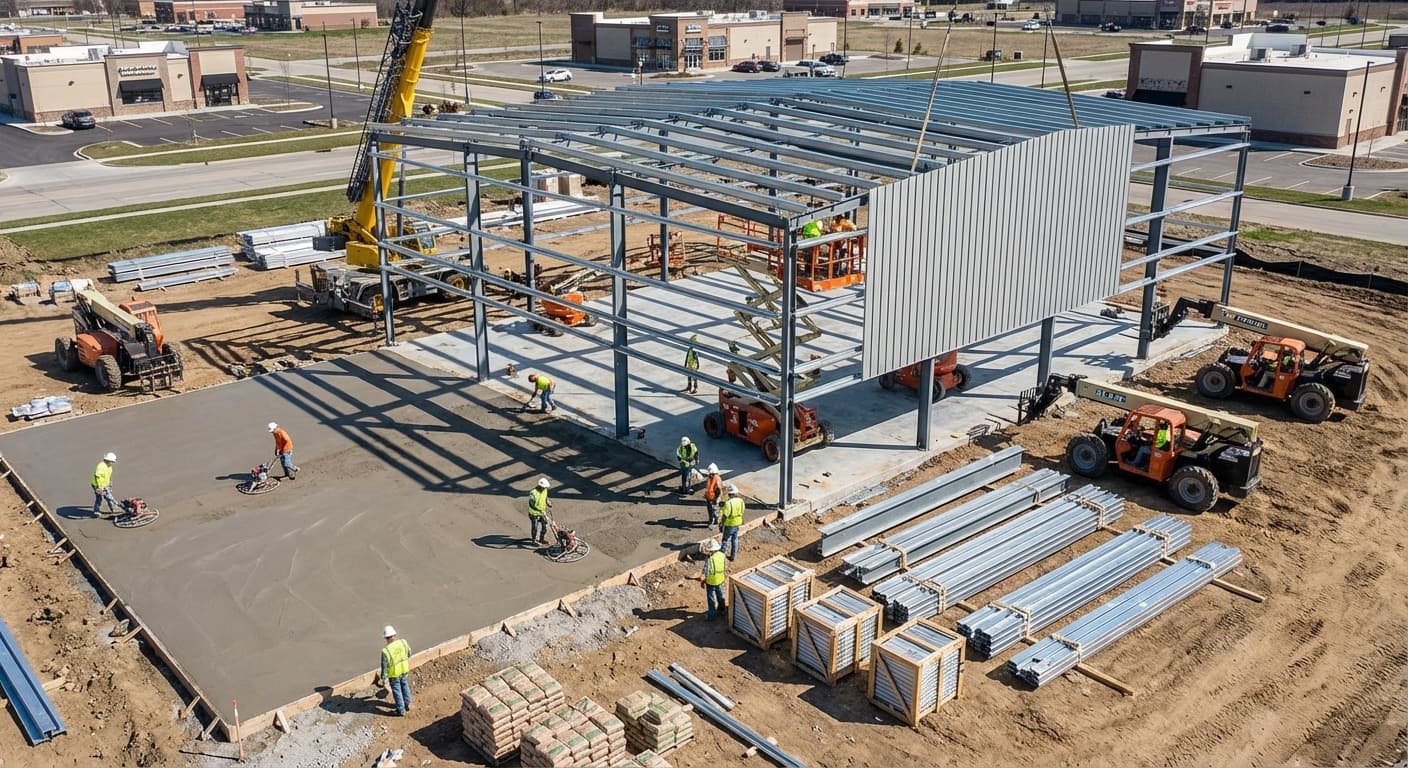

Before you celebrate a $18-000-to-$26,000 quote for a 30×40 metal-building kit, understand that the price covers only the bare steel shell–primary frame, panels and maybe a basic door–while every necessity that makes the space usable arrives as a separate, often underestimated, expense. Site preparation (grading, soil tests, utilities, engineered foundation) and the concrete slab alone can add $15,000-$40,000; erecting the shell, renting cranes and lifts, permits, insulation, doors, windows, electrical and interior finishes routinely push the true turnkey cost to $60,000-$80,000 or more–roughly double the kit figure. Regional labor swings, missing components like seals or rodent barriers, price-escalating steel-market volatility and the coordination risk of juggling multiple vendors can each tack on thousands, so readers learn to demand itemized lists, lock quotes quickly and budget a 5-15% contingency. The article details these hidden cost centers, compares financing options and shows how steel's low 1% annual maintenance and superior energy efficiency offset higher upfront spending versus wood or concrete, arming buyers with a realistic roadmap that prevents sticker shock and safeguards both budget and timeline.
Understanding the Base Kit Cost
Your 30×40 metal building kit costs $18,000 to $26,000, but plan for another 15-20% on doors, windows, and finishing before construction begins.
What the quoted 30×40 metal building kit price covers
Your 30×40 metal building kit quote–typically $18,000 to $26,000–covers the essentials: primary framing (columns and rafters), secondary framing (purlins and girts), and your roof and wall panels. [1] Some packages include basic roll-up doors and windows, others don't–it depends on your supplier and what tier you select. [2] Here's what catches buyers: quality gaps between suppliers. Some skip critical components like roof seals, siding closures, and rodent blocking.
Get the itemized list. Check it twice.
Those missing pieces cost you later. [2] Remember, that kit price is just your starting point. Add your concrete slab, site work, insulation, electrical, and labor–now you're looking at $30,000 to $40,000 or more for a finished building. [3] That's reality, not sticker shock, when you know what's coming.
Hidden material costs beyond the shell
You need more than a shell to work in your building. Those extras hit your budget fast. Shipping your kit to site?
That's extra. Equipment rental for installation? Extra.
Engineering stamps and certifications? Extra again. [5] Most buyers end up spending another 15-20% of their kit price on doors, windows, and skylights once they see what "basic" really means. [4] Permits alone run $550 to $2,000–higher if you're in seismic or high-wind zones that need special engineering. [4] For insulation specifics and interior finishing costs, see our Customization section below. Bottom line: these necessary additions push your actual investment well beyond the kit quote before anyone picks up a wrench.
How regional steel pricing impacts the base price
Your kit price depends on when and where you buy.
Steel market swings alone can shift
Foundation and Site Preparation Expenses
Your concrete slab and site prep costs vary dramatically based on soil quality, drainage needs, and local codes–typically $10,000 to $21,000 for a 30×40 footprint.
Concrete slab pricing and options
Your concrete slab represents the second-biggest investment after the kit itself, but you control exactly what you spend. A standard 4-inch slab works perfectly for workshops and garages at $4 to $8 per square foot–that's $4,800 to $9,600 for your 30×40 footprint. [8] Planning to park heavy equipment?
You'll need a 5- or 6-inch reinforced slab, which adds to the cost but prevents cracking under load. [9] Want the full garage treatment with aprons, thickened edges, and sealed surface? Budget $6 to $12 per square foot for that professional finish. [10] Here's a timing tip: if you're considering in-floor radiant heating, decide now–it goes in during the pour or not at all. [8] One more budget item: foundation and anchor bolt plans.
Your kit supplier provides the building, but you'll need a local structural engineer to design the foundation that meets your county's specific codes. [9]
Site grading, drainage, and permitting fees
Site grading hits your budget right after you lock in your kit price. At $5-$10 per square foot nationally, grading your 1,200-square-foot footprint runs $6,000-$12,000–and that's before drainage. [11] Rocky soil or mature trees?
Add $1,000-$6,000 per acre for clearing. Low spots?
Fill dirt runs $8-$15 per cubic yard plus labor. [11] Water issues demand their own solution: basic re-sloping to fix drainage averages $1,900, but buried drainage lines cost significantly more. [11] Don't forget permits–your grading permit alone ranges from $100 to several thousand dollars, completely separate from your building permit. [11] Your specific site determines the final number: soil quality, slope, and accessibility all factor in, which explains why identical 30×40 projects on different lots produce wildly different prep bills. [12]
Additional groundwork that isn't in the kit quote
Several critical groundwork items hide outside your kit quote–items you can't skip without violating code or risking your foundation. First, you need a licensed surveyor to document exactly where your building sits relative to property lines and existing structures. [13] Next comes soil testing: a geotechnical engineer must verify your ground can support the load, check for problem soils like expansive clays, and specify the exact bearing capacity your foundation contractor needs. [13] No power on site?
Running utilities costs $10,000-$30,000 depending on distance from public lines. Even temporary construction power runs $1,700-$4,500. [13] These aren't optional extras–they're code requirements that protect your investment.
You'll also need a civil engineer to create the master site plan that pulls everything together, separate from the structural engineer who designs your foundation. [14] Working with
Erection, Labor, and Installation Considerations
Erection labor for a 30×40 metal building typically runs $6,000 to $12,000 and completes in 3 to 5 days, though regional markets can swing costs by as much as 60%.
Typical erection labor rates and what they include
Erection labor for a 30×40 metal building runs $5 to $10 per square foot, putting the labor cost for a 1,200-square-foot shell somewhere between $6,000 and $12,000 depending on your region and crew. [15] That rate covers raising the primary steel frame, setting purlins and girts, and fastening the roof and wall panels–essentially everything needed to close the shell.
A professional crew typically completes this scope in 3 to 5 days once the slab has fully cured and the site is ready. [16] What that rate doesn't cover matters just as much: interior build-out work like framing and drywall is billed separately at $8 to $18 per square foot, and mechanical rough-ins for electrical and plumbing each add another $2 to $6 per square foot on top. [4] Regional labor markets swing erection costs by as much as 60%, so a crew in coastal California will bill meaningfully more than one in the Midwest for an identical scope of work–making it worth collecting at least two or three local erection quotes before assuming the national average applies to your site. [4]
Equipment rentals and safety measures
Equipment rental is a line item that erection quotes often understate or omit entirely.
Raising a 30×40 steel shell requires at minimum a crane, a telehandler or forklift, and either a boom lift or scissor lift–and none of these come with the kit. [17] Crane selection comes down to the heaviest component you need to lift and how far out the arm needs to reach; getting this wrong means either a safety risk or paying to mobilize a second crane. [18] A 10,000-12,000 lb forklift with a telescoping boom is the practical minimum for moving steel components around the site efficiently, while lift height determines what class of boom or scissor lift your crew needs. [18] Beyond the hardware itself, bare crane rentals don't include an operator–you either supply one or pay the rental company's rate, and certified operators are non-negotiable under OSHA's crane safety requirements. [19] Transport and mobilization fees are separate from the daily rental rate, and larger cranes may require road permits just to reach your site. [19] Every ironworker operating a lift must hold current certification on that specific equipment class, and OSHA documentation for each crane must be on-site and reviewed by project management before any lifts begin. [18] Skipping or underbudgeting any of these items doesn't just affect cost–it creates liability exposure and can shut a project down mid-erection.
Why a single-source solution streamlines costs
Managing separate contracts for the kit supplier, erection crew, concrete contractor, and equipment rental company multiplies the coordination risk on every front–schedule conflicts, finger-pointing over damaged components, and gaps between what each vendor claims is someone else's scope.
A single-source supplier eliminates that friction by making one entity responsible for the entire building envelope: structural framing, panels, doors, and accessories all arrive together, bundled and labeled from one point of origin. [20] When something is missing or arrives damaged, there's one call to make instead of three.
Bundling all components into a single order also typically reduces pricing compared to sourcing each element separately, and a unified delivery schedule cuts the coordination overhead that staggers timelines when multiple vendors each manage their own logistics. [21] Consistency matters beyond logistics, too–components manufactured together share the same finish batch, which means the roof panels and wall cladding age uniformly over time rather than diverging in color or coating performance as separate-source materials often do. [21] For buyers already managing site prep, permitting, and labor contracts, reducing the supplier count by even one meaningful vendor simplifies both the budget and the build.
Customization, Finishes, and Ongoing Costs
Budget an extra 15-20% beyond your kit price for doors, windows, insulation, and electrical–the upgrades that transform steel panels into usable space.
Doors, windows, insulation, and finish upgrades
Your base kit delivers a weather-tight shell. That's it. Making that shell work for your business takes doors, windows, insulation, and interior finishes–each priced separately from the kit. [22] You need natural light in a workshop.
Proper clearances in a garage. Code-compliant insulation in any conditioned space. Plus electrical to power it all. [22] These aren't luxuries–they're what turn steel panels into usable square footage.
The difference between a $24,000 kit and a $43-per-square-foot turnkey building? Mostly these functional upgrades. [23] Kit-only pricing tells maybe 60% of the story. As discussed in the base kit section, most buyers add 15-20% in accessories alone, before counting labor or electrical.
Long‑term maintenance savings with quality steel
Steel costs more upfront. Then it starts paying you back. Your annual maintenance runs just 1% of initial cost–$1,500 to $2,500 for a 10,000-square-foot building. [24] No rot. No warping. No termites. No freeze-thaw cracks. Wood and concrete? They'll cost you 2-4% annually–$7,000 to $20,000 for the same footprint. [24] One termite hit alone can run $30,000. [24]
Your energy bills drop too. Insulated metal panels seal tighter than wood or brick construction–fewer seams, fewer joints, better thermal envelope. Annual savings: $2,000 to $5,000 for steel versus $1,000 to $2,500 for traditional builds. [24]
Need to expand later? Steel modifications cost less. The frame accepts changes without major structural gymnastics–unlike wood, where touching one load path affects everything. [25]
Twenty-year totals tell the real story: A 10,000-square-foot steel facility runs about $350,000 all-in. Wood or concrete? $670,000 to $1.1 million when maintenance, energy, and remodeling compound. [24] Your 30×40 follows the same pattern. Quality steel means higher finish costs today, lower operating costs forever.
Steel prices shift weekly. Your quote today might jump next month–same building, higher cost. [26] Lock your price the moment you finalize your design. That's your first budget protection. [26]
Can't pay cash? You've got options:
- Traditional bank loans: competitive rates, longer terms for strong credit
- SBA construction loans: lower down payments, government backing
- Equipment financing or lease-to-own: faster approvals, preserve working capital [27]
Most lenders want 10-30% down. More down means lower payments, less interest, better approval odds. [27]
Budget smart: Add 5-15% contingency to your total. Site prep varies. Permits surprise. Utility connections cost more than expected. Under-financing creates expensive mid-project scrambles. Build your budget buffer upfront–it's cheaper than solving problems later. [27]
- Kit price ($18-26k) excludes slab, labor, permits, doors, insulation, utilities–real total $30-40k+
- Concrete slab alone adds $4.8-9.6k; thicker reinforced or finished slabs push $6-12/sq ft
- Erection labor runs $5-10/sq ft ($6-12k), but crane, operator, equipment rental are extra and mandatory
- Site prep (grading, soil test, survey, utilities) can match or exceed kit cost before construction starts
- Steel's 1% annual maintenance beats wood/concrete at 2-4%, saving thousands over building life
- Lock steel price at order; market volatility can raise costs before delivery
- Add 5-15% contingency to total budget–permits, utility taps and site surprises routinely overrun
- https://www.steelcobuildings.com/how-much-does-a-30×40-steel-building-cost-in-2026/
- https://www.reddit.com/r/metalbuildings/comments/1mer6n7/real_cost_breakdown_of_a_30x40_metal_garage_with/
- https://americanmetalgarages.com/30×40-metal-garage-cost-breakdown-what-you-get-and-how-it-works/
- https://www.cascadingfallsinc.com/what-do-prefab-metal-building-cost-to-construct
- https://www.summitsteelbuildings.com/the-hidden-costs-of-metal-building-kits
- https://www.steelcobuildings.com/metal-building-cost-a-comprehensive-guide-to-budgeting-and-planning/
- https://metalprobuildings.com/building-steels-cost-guide-average-prices-cost-per-square-foot/
- https://www.engineeredmetalbuildings.com/blog/30×40-metal-building-prices/?srsltid=AfmBOorwH2MOm2JAclTswqTTlEyt_BwYo7yDprisiHKls2GmRKWvbhyy
- https://www.probuiltsteel.com/blog/30×40-metal-building-cost/?srsltid=AfmBOoryFdm_5xar2mnjpEswTiSSXRvjPP_sENeJaL6PKLXBzlkWjc-b
- https://www.buildingsguide.com/build/30×40-building-construction/?srsltid=AfmBOool3VMsw1L_J66Kqk40YXWSDzTcit3rY6IytxcwVtK3_kelOB_T
- https://mavericksteelbuildings.com/land-grading-cost-for-steel-buildings/
- https://pricebuildings.com/steel-buildings/cost/30×40-metal-building-cost/
- https://www.buildingsguide.com/build/metal-building-site-prep/?srsltid=AfmBOorA_7A83vt_5G5jYd33tmJlGnaQYSuzvzGbE-vPs0CMZzo5RKjg
- https://coastalsteelstructures.com/the-true-cost-of-a-metal-building-kit/
- https://www.buildingsguide.com/standard-sizes/30×40-metal-building/?srsltid=AfmBOoqy-ToXZsVXl9_t-_JMmBzxELcXXQFERbKy6cFt5gP9YA95ZKb9
- https://www.probuiltsteel.com/blog/30×40-metal-building-cost/?srsltid=AfmBOopHl7YXCT_GUYvuKPFt_aRPaX_BHlv62TIDcFsU-XrYFcFv0_hd
- https://www.ferrobuildings.com/2019/04/equipment-needed-erect-steel-building/
- https://steelestimatingsolutions.com/steel-erection-best-practices-for-cranes-and-equipment/
- https://www.bigge.com/news-media/crane-industry-insights/crane-rental-costs-what-to-expect-key-pricing-factors/
- https://norsteelbuildings.com/advantages-of-steel-series/advantages-single-source-responsibility/
- https://fairview-na.com/single-source-supply/
- https://www.probuiltsteel.com/blog/30×40-metal-building-cost/?srsltid=AfmBOorrvgKuSJXt5UBTDy4DvK8AVX1a1-onLZG2jXGnONY0IvSSzzTj
- https://www.buildingsguide.com/metal-building-prices/?srsltid=AfmBOorXE7mNnX4K3dlHt6aQ8_Z9oc-Qku4b5fU-h26sAUReFmjizSi-
- https://www.summitsteelbuildings.com/20-year-cost-comparison
- https://bargainmetalbuildings.com/metal-building-vs-wood-frame-cost-short-long-term-considerations/
- https://www.vikingmetalgarages.com/blog/metal-building-price-changes-in-2026
- https://www.nationwidesteelstructures.com/post/commercial-metal-building-financing-options